

Kuwait Long-Term Residency 2026: Investor & Property Visa Costs, Rules and Resolution 2249
Last updated: June 2026
Kuwait's long-term residency for investors and property owners in 2026 is a narrow, regulated pathway, not a lifestyle visa anyone can buy off a shelf. The framework now rests on Resolution No. 2249 of 2025, which rewrote the executive regulations of Kuwait's Law on the Residence of Foreigners and, building on Amiri Decree No. 114 of 2024, opened longer residence terms for defined groups. Two layers were added in 2026: the higher fee schedule that took effect with the new regulations on 23 December 2025, and Cabinet Resolution No. 651 of 2026, announced on 14 June 2026, which operationalized the 15-year investor pathway.
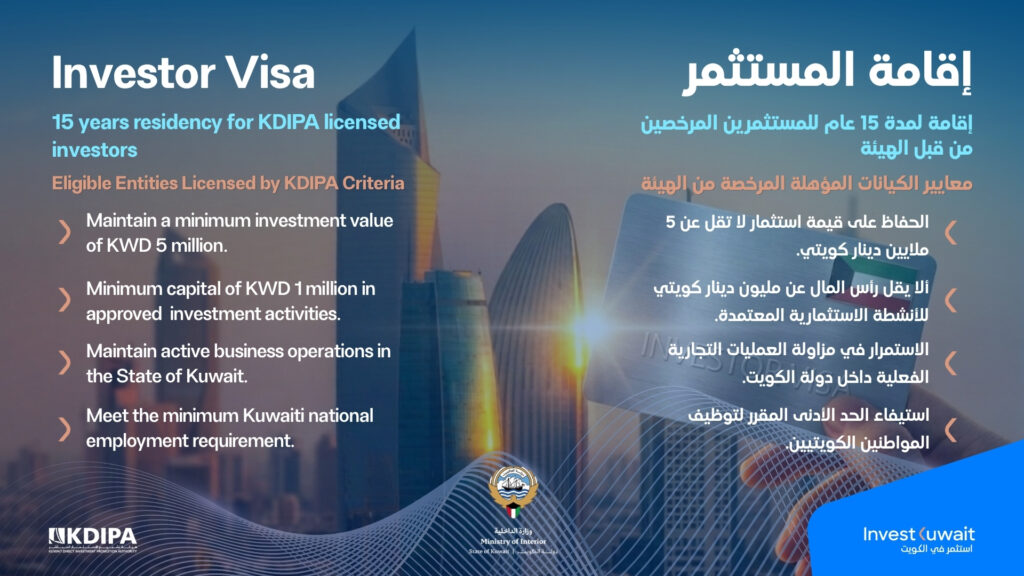
In one paragraph: licensed foreign investors under Law No. 116 of 2013 can be granted up to 15 years of residence, certain foreign property owners and children of Kuwaiti women up to 10 years, and KDIPA, the investment authority, decides qualifying investor files within five working days. The headline thresholds are an investment value of at least 5 million KWD (around $16.2 million) or capital of at least 1 million KWD held inside Kuwait. The benefit is real, but it follows eligibility; it is not a product you simply purchase.
This guide explains exactly what Resolution 2249 changed, the verified 2026 fee table that competitors do not publish in full, the mandatory-insurance rule that now caps your residence term, the six-month absence penalties enforced from February 2026, and how Kuwait compares with the UAE and Qatar before you commit capital.
Source: KDIPA
Residency rules are regulated and change through ministerial decisions, circulars, and portal practice. Treat this as orientation, not legal advice. Before you buy property, move capital, or restructure a company, confirm the current requirement with Kuwait's Ministry of Interior, KDIPA, and a licensed adviser.
What Resolution 2249 Changed
Resolution 2249/2025 updated Kuwait's residence framework by expanding longer validity periods for specific categories of foreign residents. The core change is not "everyone gets ten years"; it is that defined groups can move beyond the ordinary, shorter residence cycle once they meet investment or legal conditions. Ordinary residence still depends on sponsorship, work, or family. The long-term tiers target investors and property owners Kuwait wants to attract and stabilize.
The decision was issued by the First Deputy Prime Minister and Minister of Interior in November 2025, with the executive regulations and the new fee schedule taking practical effect on 23 December 2025. It sits on top of Amiri Decree No. 114 of 2024, and in June 2026 Cabinet Resolution No. 651 added the operating detail for the 15-year investor route under Article 13 of that decree. Independent monitors such as UNCTAD and global mobility teams at the major advisory firms describe the same structure: up to 15 years for qualifying licensed investors, up to 10 years for selected property owners and groups, while standard permits stay capped at shorter terms.
The guardrails remain. A property owner should not assume any apartment purchase creates a ten-year permit, and an investor should not assume passive capital outside the foreign-investment framework qualifies for fifteen years. The final decision stays tied to the competent authority and the regulations in force when you apply.
Kuwait's Routes and the Verified 2026 Numbers
The table below separates the main routes against the verified thresholds now confirmed by official and advisory sources.
| Route or category | Duration | Main basis | Key 2026 requirement | Main caveat |
|---|---|---|---|---|
| Foreign investor under Law 116/2013 | Up to 15 years | Licensed foreign investment | Investment value 5M KWD or capital 1M KWD inside Kuwait; KDIPA decides in 5 working days | Needs real operating premises and a Kuwaitisation quota |
| Foreign property owner | Up to 10 years | Property ownership in Kuwait | Valid, dispute-free title and compliance record | Not automatic on any purchase |
| Children of Kuwaiti women | Up to 10 years | Defined legal category | Eligibility confirmation | Category rules apply |
| Ordinary expatriate residence | Commonly up to 5 years | Work, family, sponsorship | Standard documentation | Not upgraded automatically |
| Any residence with insurance | Capped at insurance validity | Compliance condition | Valid MOH/private coverage | Insurance term limits the permit |
| Stays abroad over 6 months | Auto-cancellation | Absence rule from 1 Feb 2026 | Continuous presence or prior permission | Overstay fines and possible entry ban |
Is Kuwait Offering a Golden Visa?
Kuwait's framework should not be marketed as a broad golden visa. It is better described as targeted long-term residence for selected investors, property owners, and approved categories. In many markets "golden visa" is used loosely for any residence-by-investment program, but readers comparing Kuwait with the UAE, Portugal, or Greece can easily misunderstand the product. Kuwait offers longer residence validity for defined legal categories, not a retail investor visa with a published menu, a portal, and a fixed property threshold for everyone.
The UAE's real-estate route, by contrast, is openly packaged around property value, title conditions, and family sponsorship. If you are weighing Kuwait against the Dubai property route, treat them as different legal products, not two versions of the same offer. Kuwait can still be valuable for a serious investor: fifteen years of residence reduces administrative friction for a company owner or regional executive with a long operating plan, and a ten-year property-linked permit helps a family with a legitimate property position. But the investment case comes first, and the residence benefit follows the legal eligibility.
How the 15-Year Investor Residency Works in 2026
The fifteen-year route is the centerpiece for corporate investors, and 2026 finally pinned down its numbers. It is tied to investors licensed under Law No. 116 of 2013, Kuwait's foreign direct-investment framework, and Cabinet Resolution 651/2026 set the operating mechanics under Article 13 of Amiri Decree 114/2024.
The verified qualifying thresholds are an investment value of at least 5 million KWD, roughly $16.2 million, or capital of at least 1 million KWD, with proof that the capital is actually deposited inside Kuwait. Authorities also expect real operating premises and compliance with a minimum Kuwaitisation quota for staff. Critically for serious investors, KDIPA decides a qualifying file within five working days, which is fast by regional standards.
A practical investor file should answer five questions before residency is even discussed. What entity is investing? Is the investment licensed under the right foreign-capital law? Who actually needs residence: the owner, a manager, specialist staff, or family? Does the applicant hold valid health insurance and a clean compliance record? And is the business plan durable enough to justify a long-term presence? Separate "up to 15 years" from "guaranteed 15 years," too; the phrase is a ceiling, not a promise on every file.
If you are comparing models, Saudi Arabia may be clearer for product selection because its Premium Residency separates real-estate owners, business investors, and entrepreneurs, while Qatar presents executive and founder routes through Invest Qatar. You can line Kuwait up against our guide to Qatar permanent residency for investors and Oman's golden residency for investors.
The 10-Year Property Owner Route
The ten-year property route sounds straightforward, which is exactly why it needs the most careful due diligence. Kuwait is not advertising an open property-for-residence product. Foreign property owners and children of Kuwaiti women may be eligible for permits of up to ten years, but the details decide everything: the type of property, the ownership documentation, whether the title is free of disputes or encumbrances, the nationality restrictions that apply, and whether the property is held directly or through a structure.
The correct sequence is eligibility first, property second, residence third. Start with a lawyer or regulated adviser who can confirm whether your nationality and ownership structure can even hold the property, then confirm the residence category, likely term, insurance requirement, absence rules, and renewal conditions. Only after that should you model the return. Buying first and asking residency questions later is the most expensive mistake in this space.
This is where a consultation pays for itself. If you are comparing premium residency, golden-visa, and property-linked routes across the Gulf, Truescho consultants can help you assess eligibility before you pay fees or sign anything. For a property-threshold comparison, see our breakdown of Qatar's 10-year golden residency for 200k property.
The Real Cost: Kuwait's Full 2026 Fee Table
This is the matrix competitors mention but never publish in full. With the new regulations, the headline mandatory health-insurance fee doubled to 100 KWD a year, around $325, and the rest of the schedule rose alongside it.
| Item | 2026 fee (KWD) | Approx. USD |
|---|---|---|
| Mandatory health insurance (per person/year) | 100 | ~$325 |
| Iqama renewal, standard | 20 | ~$65 |
| Iqama renewal, investor or property owner | 50 | ~$163 |
| Self-sponsored residence (Article 24) | 500 | ~$1,625 |
| Dependent, spouse or child | 20 | ~$65 |
| Dependent of investor or owner | 40 | ~$130 |
| Parents | 300 | ~$975 |
| Outside-Kuwait permission (per month) | 5 | ~$16 |
| Visit visa (per month) | 10 | ~$33 |
A serious cost model goes beyond this table to include legal review, property due diligence, company licensing, translations and attestations, banking costs, and annual compliance support. The headline duration is generous, but the cost to obtain and maintain the permit is what determines whether the move actually works.
Insurance Now Gates Your Residency
The new framework ties residence directly to coverage: no iqama is issued, renewed, or transferred without valid health insurance, and the residence term cannot exceed the insurance validity period. For an investor, that means even a fifteen-year ceiling is operationally limited by the insurance you submit and the authority accepts. Budget for compliant, continuous coverage from day one, and align the policy term with the residence term you want.
Because this single rule can shorten a long permit, read it together with our dedicated guide to health insurance for expats in Kuwait 2026 and the companion piece on health insurance for Kuwait residents before you finalize any application.
The Six-Month Absence Rule and the Penalty Timeline
For globally mobile investors, the absence rule now matters as much as the headline duration, and in 2026 it became hard law. Staying outside Kuwait for more than six consecutive months triggers automatic cancellation of the residence, enforced from 1 February 2026. Overstaying carries fines starting at 2 KWD per day and can lead to a multi-year entry ban. An "outside-Kuwait permission" exists at 5 KWD per month for residents who need to be away legitimately, and it should be arranged in advance rather than discovered after the fact.
The practical takeaway is not "you can stay away indefinitely," but "settle the absence question before choosing Kuwait as your base." A family that wants a genuine Gulf home base may be comfortable with regular presence. A private investor who splits the year between London, Singapore, and Dubai needs written clarity, and a plan for the outside-Kuwait permission, before relying on the permit. The rule also affects dependants: confirm whether each person's status is linked to the principal and what happens to the family if the principal's permit lapses. Our guide to the Kuwait exit permit and residency covers the travel-permission mechanics in detail.
Maya in London: Why a Property Purchase Was Not Enough
Maya, a British-Lebanese finance executive based in London, started looking at Kuwait after her employer opened a regional project office. With family ties in the Gulf, she considered buying a small apartment as a long-term base, and her first spreadsheet treated Kuwait like a simple property-residence route: purchase price, annual costs, schools, and travel days.
The flaw was that she had never confirmed whether her planned property structure would qualify, whether the new six-month absence rule would clash with her constant travel, or whether an employment assignment through her company would be cleaner. After legal review she changed the sequence. Her employer handled her work status first, while she postponed the purchase until a Kuwaiti lawyer confirmed the ownership and residence implications and modeled the insurance and absence costs. That saved her from treating a real-estate decision as an immigration decision. In Kuwait, property supports a residence case only when the legal category, the insurance, and authority practice all line up.
Kuwait Compared with Nearby Gulf Options
Kuwait appeals most to investors who already have a business reason to be there. It is not automatically the most packaged residency product in the region.
| Destination | Strongest investor route | Typical attraction | Main limitation | Best-fit profile |
|---|---|---|---|---|
| Kuwait | Long-term residence for licensed investors and property owners | Up to 15 years (5M KWD investment or 1M KWD capital); up to 10 years for some owners | New framework; insurance and absence rules bind tightly | Investor already operating or planning serious Kuwait exposure |
| Qatar | Executive, entrepreneur, and property routes | Clear separation of founder and property paths | "Golden residency" is shorthand, not one product | Senior executive, founder, or property buyer eyeing Doha |
| Saudi Arabia | Premium Residency products | Multiple published categories | Cost and eligibility vary sharply | Investor, entrepreneur, or real-estate owner |
| United Arab Emirates | Golden Visa and property routes | Mature, widely understood pathways | Property price and renewal vary by emirate | Buyer wanting a packaged property-residence path |
| Europe | Portugal or Greece | Schengen access, long-term settlement | Higher due diligence, changing rules | Family seeking EU mobility |
Before treating residence duration as the whole decision, weigh Gulf salary, tax, schooling, and travel rhythm. Our guide to accountant and finance salaries across the Gulf is a useful reality check on the compensation side of the move, and the GCC unified visa guide helps if you plan to move across several Gulf states.
Common Mistakes Before You Apply
- Buying property first and asking residency questions later.
- Assuming "up to 15 years" means a guaranteed fifteen-year permit.
- Ignoring that insurance validity caps the residence term.
- Underestimating the six-month absence rule and its fines.
- Treating passive capital as a qualifying licensed investment.
- Modeling government fees only, and forgetting legal, attestation, and compliance costs.
- Relying on a broker's verbal promise instead of written, source-backed confirmation.
Read Also
- Kuwait Expat Health Insurance: Fees & Rules
- Health Insurance for Expats in Oman
- Compare Visa-Approved Travel Insurance Prices
Frequently Asked Questions
How much investment is needed for Kuwait long-term residency?
For the 15-year investor route under Law 116/2013, the verified 2026 thresholds are an investment value of at least 5 million KWD or capital of at least 1 million KWD held inside Kuwait, plus real operating premises and a Kuwaitisation quota. KDIPA decides a qualifying file within five working days.
Does buying property in Kuwait give you residency?
Not automatically. Certain foreign property owners may qualify for up to ten years, but eligibility depends on the property type, dispute-free title, nationality restrictions, and current Ministry of Interior practice. Confirm the category, insurance, and absence implications with a licensed adviser before you buy.
Is Kuwait's investor residency a golden visa?
Not in the retail sense. Kuwait offers targeted long-term residence for licensed investors, qualifying property owners, and defined groups, not a published menu with fixed thresholds for everyone. Calling it a broad golden visa can mislead applicants who compare it with the UAE or European programs.
What happens if you stay outside Kuwait for 6 months?
From 1 February 2026, more than six consecutive months abroad triggers automatic cancellation of the residence. Overstaying carries fines starting at 2 KWD per day and a possible multi-year entry ban. Arrange the 5 KWD-per-month outside-Kuwait permission in advance if you must be away.
How much is iqama renewal in Kuwait in 2026?
Standard iqama renewal is 20 KWD, while investors and property owners pay 50 KWD, and self-sponsored Article 24 residence is 500 KWD. Mandatory health insurance is a separate 100 KWD per person per year, and dependants range from 20 KWD up to 300 KWD for parents.
What is Kuwait Resolution 2249 of 2025?
It is the ministerial resolution that updated the executive regulations of Kuwait's foreigners-residence law, in force from 23 December 2025 and built on Amiri Decree 114/2024. It created the longer residence tiers and the new fee schedule, later operationalized for investors by Cabinet Resolution 651/2026.
Can investor residency be renewed indefinitely in Kuwait?
The investor route offers up to fifteen years and is renewable provided the investment, insurance, presence, and compliance conditions remain satisfied at each renewal. There is no automatic permanence; the permit depends on the underlying facts staying compliant with the rules in force at renewal.
What are Kuwait residency fees for dependents in 2026?
A spouse or child costs 20 KWD, a dependant of an investor or property owner costs 40 KWD, and parents cost 300 KWD, each on top of the mandatory 100 KWD annual health insurance per person. Visit visas run 10 KWD per month.
Conclusion
Kuwait's 2026 long-term residency is a meaningful, well-defined opportunity for the right profile, not a shortcut for anyone. The strongest reading is targeted stability for qualifying investors and property owners: up to fifteen years for licensed investors meeting the 5M KWD investment or 1M KWD capital threshold, and up to ten years for certain property owners and children of Kuwaiti women, all gated by mandatory insurance and the hard six-month absence rule.
If Kuwait is part of a real business, property, or family plan, the numbers can work. If you are simply shopping for the easiest residency product, compare it carefully against Qatar, Saudi Arabia, and the UAE before committing capital. Truescho consultants can help you compare routes and prepare the exact questions to put to a licensed local adviser.