
On July 16, 2026, Chinese AI startup Moonshot AI unveiled Kimi K3, the world's largest open-source AI model at 2.8 trillion parameters. The company followed up by releasing the full model weights on Hugging Face on July 27, where it reached #1 trending within just 30 minutes of publication. This model represents a watershed moment in the open-weight AI race, surpassing DeepSeek V4 Pro by 75% in parameter count.
What Is Kimi K3 and Why Does It Matter?
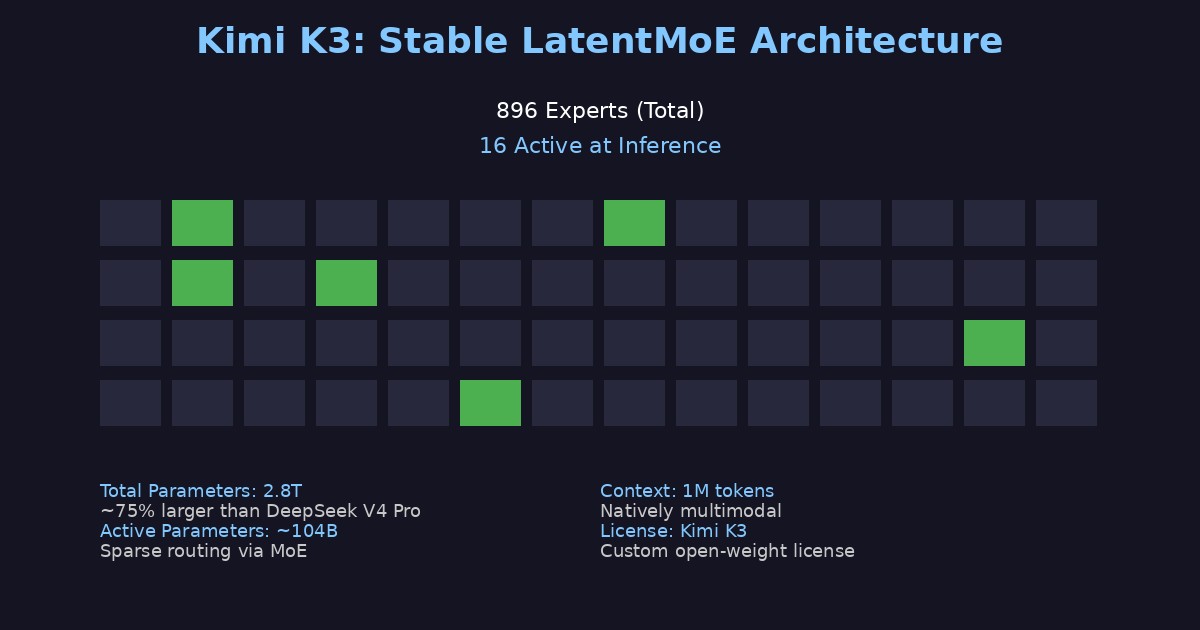
Kimi K3 is an open-weight model built by Moonshot AI, a Chinese AI startup based in Beijing. The model uses a Stable LatentMoE (Mixture-of-Experts) architecture that activates 16 experts out of 896 during each inference call, meaning approximately 104 billion active parameters out of the 2.8 trillion total.
What makes Kimi K3 significant is not just its massive size, but that it is the first open model to reach the level of proprietary models like GPT-5 and Claude Opus on independent benchmarks. Reuters described it as a model that is "closing in on US rivals," and VentureBeat called it "the largest open-source model ever."
Context: Why This Model Matters Strategically
The open-source model race accelerated dramatically in 2026. Before Kimi K3, DeepSeek V4 Pro (1.6 trillion parameters) was the largest available open model. Kimi K3 nearly doubles that figure and proves that Chinese companies can build models at the scale of closed American models and release them to the world.
The timing is also significant: the announcement came one day before the WAIC 2026 (World AI Conference) in Shanghai and generated massive media coverage. Then the weight release on July 27 sparked debate in the United States about whether Chinese open-weight models should be banned.
The China-US AI Arms Race
The AI race between China and the United States is no longer just a commercial competition — it has become a matter of national security and technological sovereignty. Chinese open models like Kimi K3, DeepSeek V4, and Qwen 3.8-Max pose a strategic challenge to American dominance in this field:
- United States: Controls closed models (GPT-5, Claude, Gemini) and imposes export restrictions on advanced Nvidia chips
- China: Builds open models at scale (to run on available infrastructure despite restrictions) and releases them to the world
Kimi K3 was trained on approximately 20,000 Nvidia chips — a remarkable number given US export restrictions. This proves that China has found ways to access the computational power needed to build world-scale models.
Technical Specifications in Detail
| Feature | Value |
|---|---|
| Total Parameters | 2.8 trillion |
| Active Parameters | ~104 billion |
| Architecture | Stable LatentMoE (Mixture-of-Experts) |
| Number of Experts | 896 (16 active per query) |
| Context Window | 1,000,000 tokens |
| Modalities | Text + Image (natively multimodal) |
| License | Kimi K3 License (custom) |
| Announcement Date | July 16, 2026 |
| Weight Release Date | July 27, 2026 |
| Training | ~20,000 Nvidia chips |
Stable LatentMoE Architecture
The core technical innovation in Kimi K3 is the Stable LatentMoE architecture. In traditional MoE architectures, the router selects experts based on the task, but this can lead to training instability at large scales. LatentMoE solves this problem by using a latent representation to make routing decisions, improving stability and allowing the model to scale larger.
The result: a model with 896 experts with more stable and efficient routing, where only 16 experts activate per query. This balance between scale and efficiency is what makes Kimi K3 practically deployable despite its enormous size.
Why 896 Experts and Not Fewer?
The more experts in an MoE architecture, the greater the model's ability to specialize. However, increasing experts also increases training difficulty and memory requirements. Stable LatentMoE allows increasing the expert count to 896 (compared to 128-256 in previous models) without losing stability. Each expert evolves to specialize in a specific type of task, improving overall quality.
Benchmark Results
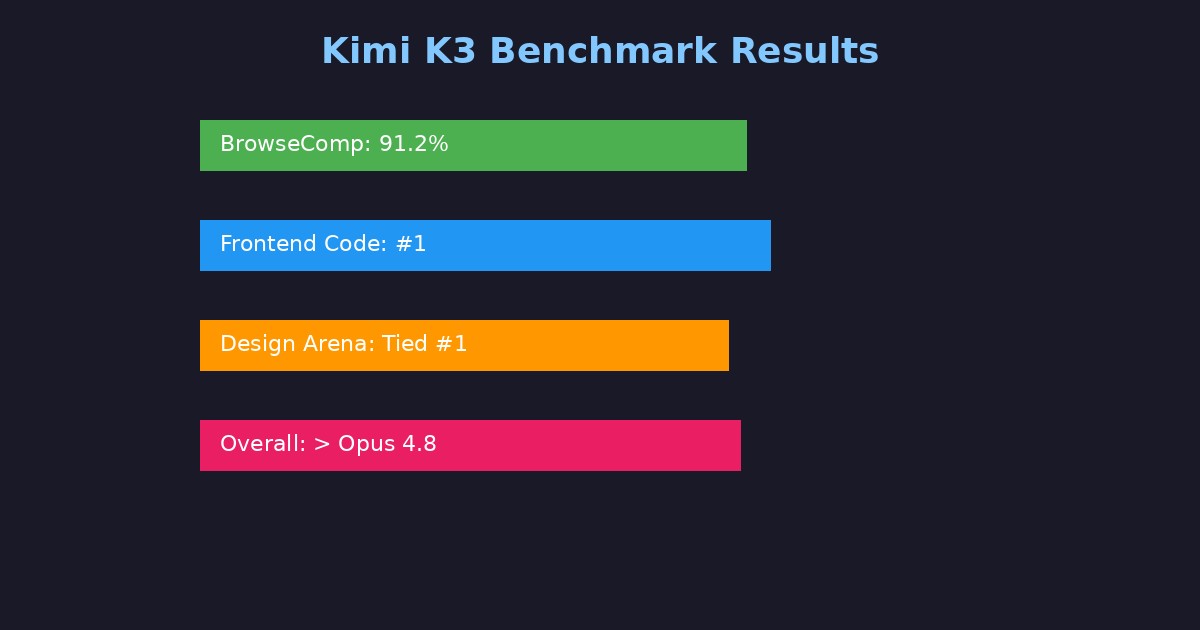
Kimi K3 achieved remarkable results on independent benchmarks:
- BrowseComp: 91.2% — the best published agentic score ever in independent measurement
- Frontend Code Arena: 1st place, beating Claude (Fable 5 / Opus class)
- Design Arena: Tied for 1st with Gemini 3 and Opus 4.5
- Independent assessment (Artificial Analysis): "overall better than Opus 4.8" while being fully open-weight
These results mean Kimi K3 is not just a large model, but an effective one that outperforms top closed models on specific tasks (coding, agentic browsing, design).
What Is BrowseComp and Why Is 91.2% Amazing?
BrowseComp is a benchmark that measures a model's agentic browsing capability: searching for information on the internet, navigating between pages, extracting answers, and making decisions. A score of 91.2% is the highest ever published — better than any other model, open or closed.
This means Kimi K3 excels at tasks requiring independent research and gathering information from multiple sources. Practical applications: intelligent research assistants, market intelligence agents, news monitoring systems.
Important Note on Security Testing
Despite strong results, an independent analysis using Semgrep noted that while security benchmarks look competitive on paper, real-world testing revealed precision gaps and weaker performance on large codebases. This is an important caveat: numbers alone are not sufficient, and practical testing is essential before adoption.
Availability and Access
Hugging Face
The full weights are available on huggingface.co/moonshotai/Kimi-K3 in 96 weight shards. The model reached #1 trending within 30 minutes of release — an indicator of massive community interest. The research paper is also available on huggingface.co/papers.
Moonshot API
Before the weight release, Kimi K3 was available via API from Moonshot AI. Demand was so high that the company had to temporarily pause new subscriptions due to GPU capacity strain. This raises questions about long-term service stability.
Licensing
Kimi K3 uses a custom license (Kimi K3 License) — not Apache 2.0 or MIT. This means there are specific restrictions on commercial use and derivative development. The license should be reviewed carefully before enterprise adoption.
MXFP4 Quantization
The model supports MXFP4 quantization to reduce the memory footprint by up to 75%, making it more practical to deploy on less expensive hardware. This is very important because the full model size makes it out of reach for most organizations.
How to Use It from Around the World
1. Via Hugging Face (for researchers and large organizations)
The full weights can be downloaded from Hugging Face and run on private infrastructure. This requires:
- Approximately 8-16 H100-class GPUs (or equivalent)
- Complex software setup using inference engines like vLLM or TGI
- Deep technical knowledge of MoE architecture and model deployment
2. Via Moonshot API (for developers)
Moonshot AI provides an API for accessing Kimi K3. Pricing was not publicly available at the time of writing, but the company typically offers competitive pricing compared to American models.
3. Via Kimi.com (for general users)
The model can be tried via the free Kimi platform at kimi.com. This is an easy way to evaluate model quality before committing to commercial use.
4. Via Intermediary Platforms
Companies like Together AI may provide hosted access to Kimi K3, making it easier for developers to use without needing private infrastructure.
What Does This Mean for Developers?
For the Open-Source Community
Kimi K3 proves that open models at the trillion-parameter scale are possible and available. This opens the door for the open-source community to build advanced AI applications without relying on American companies.
For Startups
Startups worldwide can now access a GPT-5/Claude Opus-level model through:
- Using Moonshot's API (if available in your region)
- Running the model locally (if infrastructure is available)
- Using intermediary platforms like Together AI or Anyscale
For Researchers and Academics
Releasing 2.8 trillion parameter weights to the public provides an unprecedented opportunity for academic research:
- Studying the Stable LatentMoE architecture and how it works
- Building fine-tuned models for specific applications
- Publishing papers that contribute to understanding large models
- Developing improvements to MoE routing techniques
For Regional AI Industries
Countries investing in AI (such as Saudi Arabia through the Lorea project and the UAE through G42) can leverage open models to build domestic capabilities. The model is open and can be run on local infrastructure, supporting digital sovereignty and reducing dependence on foreign companies.
Quick Comparison with Competitors
| Criterion | Kimi K3 (Moonshot) | Qwen 3.8-Max (Alibaba) | DeepSeek V4 Pro | GPT-5 (OpenAI) | Claude Opus |
|---|---|---|---|---|---|
| Parameters | 2.8 trillion | 2.4 trillion | 1.6 trillion | Not disclosed | Not disclosed |
| Open Source | Yes (Kimi K3 License) | Coming soon | Yes (Apache 2.0) | No | No |
| BrowseComp | 91.2% (#1) | N/A | N/A | N/A | N/A |
| Frontend Code | #1 | #4 | N/A | N/A | ~#2 |
| Context | 1 million | 1 million | Not disclosed | 2 million | Not disclosed |
| License | Kimi K3 (custom) | TBD | Apache 2.0 | Closed | Closed |
Kimi K3's main advantages are its record-breaking scale, BrowseComp results (91.2%), and 1st place in Frontend Code Arena. These are stunning results for an open model.
Challenges and Limitations
- Resource Requirements: Running 2.8 trillion parameters requires massive infrastructure. Even with MXFP4 quantization, you need hundreds of GB of GPU memory.
- Custom License: Kimi K3 License is not Apache 2.0. There may be restrictions on commercial use or derivative development. Review the license before adoption.
- Geopolitical Considerations: The model is from a Chinese company, and some institutions may face regulatory restrictions. In the United States, the weight release sparked debate about banning Chinese open-weight models.
- Arabic Language Quality: Kimi K3 has not been extensively tested on Arabic. Chinese models typically focus on Chinese and English and may be weaker in Arabic.
- Accuracy on Security Tasks: Semgrep analysis showed gaps in practical performance despite strong benchmark numbers. Critical coding tasks need extensive practical testing.
- Stability: Moonshot AI temporarily paused new subscriptions due to GPU strain, raising questions about long-term service stability.
Frequently Asked Questions
Is Kimi K3 free?
The weights are available for free on Hugging Face for download. Using Moonshot AI's API may be paid. The custom license defines terms for commercial use.
Can I run Kimi K3 locally?
Yes, but it requires massive infrastructure. With MXFP4 quantization, you need approximately 8-16 H100-class GPUs. This is not accessible to individuals, but large organizations can run it.
How does Kimi K3 compare to GPT-5?
On specific tasks (coding, agentic browsing), Kimi K3 outperforms or matches GPT-5. However, GPT-5 may excel in creative tasks and complex reasoning. The biggest difference: Kimi K3 is open and GPT-5 is closed.
What is Stable LatentMoE and why is it different?
Stable LatentMoE is an architecture that improves training stability in large MoE models. It uses a latent representation to make expert routing decisions instead of direct routing. This allows building larger models (896 experts) without instability.
What is MXFP4 and why does it matter?
MXFP4 is a type of quantization that reduces number precision from 16-bit to 4-bit, reducing the memory footprint by up to 75%. This makes the giant model more practically deployable on accessible hardware.
Does Kimi K3 support Arabic?
The model is multimodal and theoretically supports multiple languages, but it has not been extensively tested on Arabic. Chinese models are typically stronger in Chinese and English. Extensive testing is recommended before relying on it for production applications.
How much does it cost to run?
Running the model locally costs hundreds of thousands of dollars in hardware. Via API, pricing has not been announced yet. Initial estimates suggest costs will be lower than competing American models but higher than DeepSeek.
Was Moonshot AI affected by US chip export restrictions?
Despite restrictions, Moonshot managed to train Kimi K3 on approximately 20,000 Nvidia chips. This proves that China found ways to access the computational power needed, though the exact details of chip sourcing are not publicly known.
Conclusion
Kimi K3 represents a defining moment in the history of open-source AI. For the first time, an open-source model with 2.8 trillion parameters outperforms top closed models on specific benchmarks. The BrowseComp result (91.2%) and 1st place in Frontend Code Arena prove that the gap between open and closed models is narrowing rapidly.
For developers and users worldwide, Kimi K3 offers a new and exciting option: a world-class model, open-source, and runnable on suitable infrastructure. The challenges (resource requirements, custom license, Arabic quality) are real and need addressing, but the opportunity is greater than the challenges. The near future will see more large open models, and competition will continue pushing quality up and prices down.