

Italy Golden Visa 2026: Investment Tracks, Requirements and Real Costs
The Italy golden visa — officially the Investor Visa for Italy — is Western Europe's lowest entry ticket for investors who want a Schengen base without moving full-time. The floor is €250,000, the screening committee must decide within 30 days, and there is no minimum-stay requirement. What almost every guide underplays is the full cost stack behind the headline number.
Quick answer: the program offers four tracks — €2,000,000 in Italian government bonds, €500,000 into an Italian company, €250,000 into an innovative startup, or a €1,000,000 philanthropic donation. There is no real estate option. Official filing fees are just €30.46 plus €50, and the whole permit journey is measured in weeks, not years.
Here is the comparison serious applicants ask for first, taken directly from the official Investor Visa for Italy portal.
| Track | Minimum investment | What the money buys | Capital at risk? |
|---|---|---|---|
| Italian government bonds | €2,000,000 | Debt securities issued by the Italian state | Low — capital is lent to the state |
| Italian company (S.p.A. or S.r.l.) | €500,000 | Equity in an existing incorporated Italian company | Yes — business performance |
| Innovative startup (Law 221/2012) | €250,000 | Equity in a qualifying innovative startup registered in Italy | Yes — highest risk, lowest entry |
| Philanthropic donation | €1,000,000 | A gift to an Italian charity or public-interest entity | Full — no return of capital |

Source: Investor Visa for Italy
Track 1: €2,000,000 in Italian government bonds
The bond track is the conservative choice: you purchase at least €2,000,000 of Italian government securities and hold them for the life of your permit. Your capital is lent to the Italian state rather than to a private company, so risk is lower — but so is return, and the money stays locked.
This route suits investors whose priority is preserving wealth while securing EU mobility, not generating yield. Italian government bonds pay modest interest, and the real "return" is the residence permit itself. You are effectively parking seven figures for five or more years: a two-year permit, then renewals in three-year blocks, all conditional on keeping the investment in place.
The compliance story is the simplest of the four tracks. A bank purchase receipt from a major institution answers most source-of-funds questions cleanly. The trade-off is opportunity cost — €2,000,000 committed to low-yield debt is capital that cannot work elsewhere while you hold the status.
Track 2: €500,000 into an Italian company
The company track requires a €500,000 equity investment into an Italian joint-stock company (S.p.A.) or limited liability company (S.r.l.). It suits buyers who want operational exposure — a stake in an operating business, a supply-chain partner, or a company vehicle you control and run yourself. Returns follow the business, so diligence replaces the bond track's safety.
You can be passive or active. Some applicants take minority stakes in established firms; others structure the investment around their own expansion into Europe, using the Italian company as an EU operating base and the visa as the personal residence wrapper. The strategy is common among founders who have sold a first business and are building a second one with European customers.
The risks are real. You are buying equity, and equity can lose value. Because renewal every three years depends on maintaining the investment, a distressed company mid-way through your permit term creates a legal problem, not just a financial one. Professional due diligence before wiring funds is not optional here.
Track 3: the €250,000 innovative startup route
The startup track is the cheapest door to EU residence: €250,000 buys equity in an innovative startup registered in Italy under Law 221/2012. The qualifying company must be no more than 60 months old, keep its registered office or main place of business in Italy, generate less than €5 million in annual revenue from its second year, and distribute no dividends.
This is the route behind the phrase "Europe's golden visas from €250,000" that circulated widely in July 2026, when moneywise reported that eight European countries now run investor programs at that entry level. It is also the correct answer to a common 2026 confusion: US outlet KQ2 confirmed the same month that the Italy program starts at €250,000 and that buying a home does not qualify — the minimum is not €500,000, and it is not a property scheme.
Treat it as venture capital, because it is. Startup equity can go to zero, and if the company fails, your renewal is in danger since the investment must be maintained. The applicants who do well here pick durable ventures — deep tech, industrial innovation, energy transition — and treat the residence benefit as compensation for taking commercial risk with a quarter of a million euros.
Track 4: the €1,000,000 philanthropic donation
The donation track converts €1,000,000 into a gift to an Italian charitable or public-interest entity. You receive no financial return — the capital is spent, not invested — and in exchange the compliance picture is the cleanest of all four routes: there is no asset to manage, no valuation to defend, and no business performance to monitor.
Very few applicants take this path, and that is precisely its appeal for a certain profile. Legacy planners, philanthropists who already fund causes in Europe, and investors who want the fastest possible source-of-funds narrative tend to prefer it. The single critical task is verifying that the receiving entity qualifies under the program rules before any transfer, because a donation to a non-qualifying organization buys nothing but a tax receipt.
For a family whose wealth already exceeds any practical need for yield, trading €1,000,000 for a two-year permit, three-year renewals, and a five-year path to EU long-term residence can be a rational allocation rather than charity overhead.
Which Italy golden visa track is right for you?
Match the track to your money, not the other way round. Wealth preservers choose bonds, operators choose the €500,000 company route, risk-tolerant capital chooses startups, and legacy planners donate. The wrong pairing — startup risk carried with a bond-holder's mentality — is the most common and most expensive mistake applicants make.
Take Daniel — an illustrative composite of real applicant profiles, not a documented case — a 47-year-old software company founder from Austin who sold a minority stake in his business in 2025. He arrived assuming the golden visa meant buying a villa in Tuscany; it does not, because there is no real estate track. His first choice, the €250,000 startup route, looked efficient until a consultant review flagged that his proceeds included crypto gains that would need heavier source-of-funds documentation under 2026 scrutiny. He landed on the €500,000 company track, taking a stake in a Bologna industrial-software firm he could monitor — more capital, but a compliance story he could defend.
Comparison shoppers should frame it against the alternatives. Portugal's program no longer accepts real estate and its fund route is generally quoted around €500,000 by advisory platforms; Greece has tightened its prime-area property thresholds in stages, a shift we break down in our Greece golden visa 2026 threshold guide. Italy's differentiators are the €250,000 floor and the 30-day committee clock — no other major EU program commits to a decision that fast. If your comparison set includes the Gulf, our Gulf golden visa comparison for 2026 covers how investment residency there stacks up.
Before you move six or seven figures, an hour of professional review pays for itself — you can book a vetted investment-migration consultant through Truescho's consultant marketplace and pressure-test the track choice against your actual documentation.
The official timeline: 30 days, 8 days, 3 months
The process is faster than most EU programs: the Investor Visa Committee must decide within 30 days of a complete application. After the Nulla Osta clearance you have 6 months to apply for the visa, 8 days from entry to file at the Questura, and 3 months from entry to execute the investment.
| Stage | Official deadline | What happens |
|---|---|---|
| Portal filing | Day 0 | Open an account on the IV4I portal, upload passport, proof of financial resources and criminal record certificate, sign digitally, submit |
| Compliance pre-check | 30 days to respond | If the committee requests extra documents, your application stays pending while you supply them |
| Committee decision | Within 30 days of submission | The Investor Visa Committee rules; a Nulla Osta clearance is issued for download |
| Visa application | Within 6 months of the Nulla Osta | Apply at the Italian embassy or consulate covering your place of residence |
| Visa validity | 2 years | The visa is valid for two years, and you must enter Italy within two years of issue |
| Questura filing | Within 8 days of entry | Apply for the two-year investor residence permit at the local Questura |
| Investment execution | Within 3 months of entry | Transfer the capital into your chosen track — a condition of the permit |
| Renewal | Every 3 years | Apply at least 60 days before expiry, with the investment maintained and a new Nulla Osta |
| EU long-term residence | After 5 years | Continuous qualifying investment opens eligibility, with 183 days per year in Italy and A2 Italian required |
Two details in that table decide real-world outcomes. First, the 30-day committee clock only starts on a complete file — weak source-of-funds evidence converts a 30-day process into a pre-check loop. Second, the 3-month execution deadline after entry is hard: applicants who arrive before their capital is ready to move sometimes have to restart.
The 5-year horizon matters for planners. After five years of continuous qualifying investment, you can apply for the EU long-term residence permit (permesso UE di lungo periodo), which detaches your status from the investment itself — but it requires genuine presence of at least 183 days per year and A2-level Italian, so it rewards those who actually live in the country rather than visit.
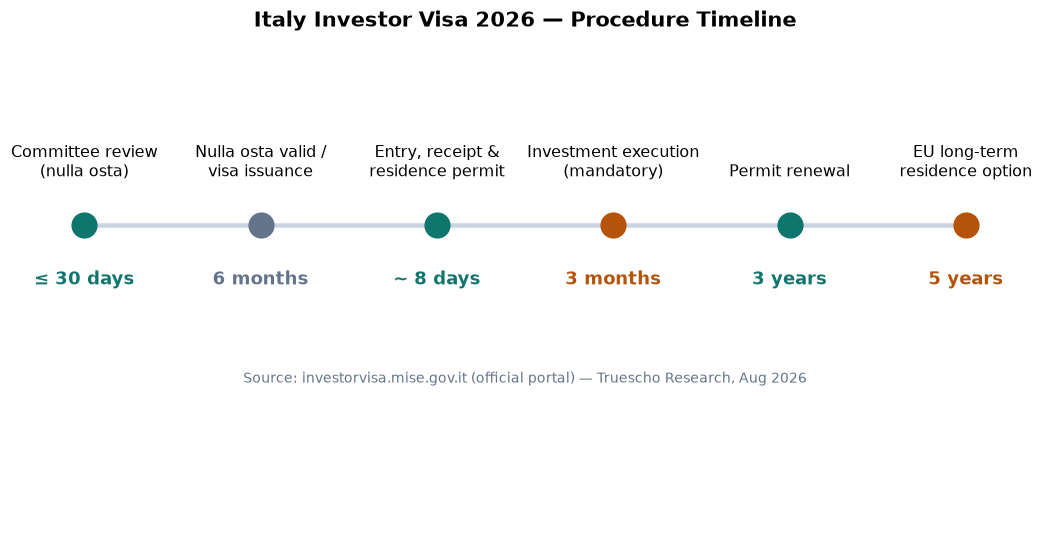
Infographic: Truescho Research from the official portal — August 2026
Hidden costs and taxes: the real bill behind the minimum
Budget beyond the track minimum. Official fees are €30.46 for printing the electronic residence permit plus a €50.00 issuance contribution, paid through a postal payment slip. On top of that you must demonstrate around €8,500 in independent financial resources, and advisory packages quoted in the market run near €11,250.
| Cost item | Amount | Status |
|---|---|---|
| Track investment | €250,000 – €2,000,000 | Official minimum, maintained for permit life |
| Electronic residence permit fee | €30.46 | Official fee |
| Permit issuance contribution | €50.00 | Official fee |
| Proof of financial resources | ≈ €8,500 held, not spent | Official requirement |
| Legal and advisory packages | around €11,250 | Market estimate from advisory platforms |
| Translation and legalization of documents | typically a few thousand euros | Market estimate |
Those official fees are the detail competitors never publish — and they answer a question people actually search: why the Italy golden visa can look "half price" next to programs like Greece's. The investment is the investment everywhere; the administrative burden here is €80.46 in state fees, which is trivial by the standards of golden visa jurisdictions.
Taxes are the cost that genuinely bites, but only if you relocate for real. New residents can opt into Italy's flat-tax regime for foreign income — the official policy guidance set it at €100,000 per year plus €25,000 per family member for up to 15 years under Article 24-bis of the tax code, while some advisory platforms now quote updated 2026 figures of €300,000 plus €50,000. We untangle the current numbers, and who should elect the regime at all, in our dedicated guide to Italy's new-resident flat tax. Americans note the extra layer: US citizens remain taxable by the IRS regardless of residence, so model the foreign earned income exclusion before assuming a flat tax solves everything.
Source of funds is the last hidden cost in time and nerves. With European regulators pushing harder on security and transparency through 2025 and 2026, applicants whose wealth came from crypto trading, private placements or fast-growing emerging-market businesses should prepare acquisition records early — advisory firms field this question constantly, and weak files are the main reason 30-day decisions slip.
What has actually changed in 2026
The four minimums have not changed. What has changed is scrutiny: European regulators now press harder on security, transparency and the origin of funds, and applications from citizens of Russia and Belarus remain suspended — imposed in July 2023 and extended to holders of dual citizenship with those countries in March 2024.
The Florentine, writing in late July 2026, captured the mood well: the program's financial architecture has not moved since 2017, but the regulatory environment around it has grown markedly more cautious. In practice that means longer document checklists, more questions about how wealth was built, and no appetite for gray-area structures.
The demand side is moving the other way. A July 2026 moneywise survey reported that 61 percent of wealthy Americans want to leave the United States, and that eight European countries now offer golden visas starting at €250,000. For that audience, Italy's specific advantages in 2026 are the absence of any minimum-stay requirement — unlike southern Europe's D7-style programs or Greece's residence expectations — and the 30-day committee commitment.
Frequently asked questions
Straight answers to the questions international applicants actually type into Google.
What are the Italy golden visa requirements in 2026?
You need a valid passport, a documented investment plan in one of the four tracks, a certificate showing no pending criminal proceedings, and proof of roughly €8,500 in financial resources beyond the investment. Applications are filed online on the official IV4I portal with a digital signature, and citizens of Russia and Belarus remain excluded.
How much does the Italy golden visa cost in total?
Count the investment (€250,000 to €2,000,000), the official fees of €30.46 plus €50, about €8,500 in demonstrated resources, document translation and legalization, and advisory packages that the market prices around €11,250. Add the flat tax only if you actually relocate and elect the new-resident regime.
What is the Italy golden visa processing time?
The committee must decide within 30 days of a complete application, and incomplete files pause that clock. After the Nulla Osta you have 6 months to apply for the visa, 8 days after entry to file for the permit, and 3 months to execute the investment. Realistic end-to-end time is two to three months.
Is there an Italy golden visa real estate option?
No. July 2026 reporting confirmed again that the program starts at €250,000 and that buying a home does not qualify. The only tracks are government bonds, an Italian company, an innovative startup, or a philanthropic donation. You may buy property in Italy separately, but it grants no visa benefit.
Italy, Portugal or Greece: which golden visa is better in 2026?
Advisory platforms quote Portugal's fund route near €500,000 with real estate abolished, while Greece keeps raising the bar for its prime-area property tracks. Italy wins on entry price (€250,000), the 30-day committee decision, and zero minimum stay. Choose Portugal for fund familiarity, Greece only if property is the point.
Does the Italy golden visa lead to citizenship?
Not directly — Italy has no citizenship-by-investment program. The realistic path is a two-year permit, three-year renewals, then EU long-term residence after five years, which requires 183 days of presence per year and A2 Italian. A passport eventually requires ordinary naturalization after genuine long-term residence.
What are the Italy golden visa tax benefits?
New residents can elect a flat tax on foreign income — historically €100,000 a year plus €25,000 per family member for up to 15 years, with some platforms quoting higher 2026 figures. It replaces ordinary progressive taxation on foreign income and is elective, so non-resident permit holders owe nothing. US citizens still file with the IRS.
Is the Italy golden visa worth it in 2026?
Yes, if you want fast, low-commitment EU residence with no day-count obligation and a five-year path to long-term status. No, if you expect citizenship by writing a cheque, a property play, or a tax shelter without moving. The structure is unchanged in 2026; only the scrutiny has grown.
Our verdict
For 2026 the Italy golden visa remains the best value in European investor residence: a €250,000 floor, a 30-day committee clock, no minimum stay, and a clean five-year route to EU long-term residence. It is not a citizenship shortcut and not a property purchase — judge it as residence infrastructure, and it holds up well.
Choose the bond track if you cannot tolerate risk, the startup track if a quarter million in venture equity is acceptable, and the €500,000 company route if you want control and substance. Then do the boring work early: source-of-funds documentation, translated records, and a realistic tax projection before you file. The applicants who fail here rarely pick the wrong track — they arrive at the committee with the wrong file.
If you want a professional to pressure-test your track choice and paperwork before you commit capital, start with a vetted investment-migration consultant and run your profile through a visa checker to confirm eligibility before any money moves.
Sources
- Investor Visa for Italy — Official Portal — The Italian government portal where applications are filed, listing the four investment tracks and current program rules.
- Investor Visa for Italy — Policy Guidance (PDF) — The Investor Visa Committee's official policy document covering procedures, deadlines, the €8,500 resources requirement and the €30.46 + €50 fees.
- Ministry of Enterprises and Made in Italy (MIMIT) — The ministry operating the Investor Visa Committee and publishing program notices, including the Russia and Belarus suspension.
- Mazzeschi Legal Counsels — Italy Investor Visa in 2 Minutes — An independent Italian immigration law firm's short video explainer of the process; included as a secondary reference, not an official source.