
Last updated: September 2026
You have seen the number everywhere: $2,000. Seller forums, short videos and a string of recycled blog posts insist that the 1099-K threshold for 2026 dropped to two thousand dollars. It did not. That figure does not appear in any current IRS document, and a filing plan built around it is a reliable way to misreport your income.
Quick answer: For tax year 2026, a payment app or online marketplace is required to send you Form 1099-K only when payments for goods or services exceed $20,000 across more than 200 transactions — both conditions together. Platforms may voluntarily send one below that line, and payment card processors face no threshold at all.
This is not an interpretation. It is the literal text of three separate IRS sources: the "Understanding your Form 1099-K" page updated on September 18, 2026, the Instructions for Form 1099-K revised in December 2026, and IRS news release IR-2025-107 issued on October 23, 2025. This article traces how the 1099-K threshold for 2026 got tangled in rumors, what the law actually says, and exactly what to do if a form lands in your inbox anyway.
Where the $2,000 rumor came from
The confusion has a real legislative history, which is why it survives. In 2021, the American Rescue Plan Act (ARPA) scheduled a collapse of the reporting threshold to $600 starting with 2022 payments. The IRS delayed that change more than once — most recently through Notice 2023-74 — while sellers braced for a flood of small forms.
Then, on July 4, 2025, the One Big Beautiful Bill Act (P.L. 119-21) did the opposite of what the rumors predicted. As the IRS explained in IR-2025-107, the law "retroactively reinstated" the pre-ARPA rule, so third party settlement organizations are not required to file Forms 1099-K unless the gross amount of reportable payments to a payee exceeds $20,000 and the number of transactions exceeds 200.
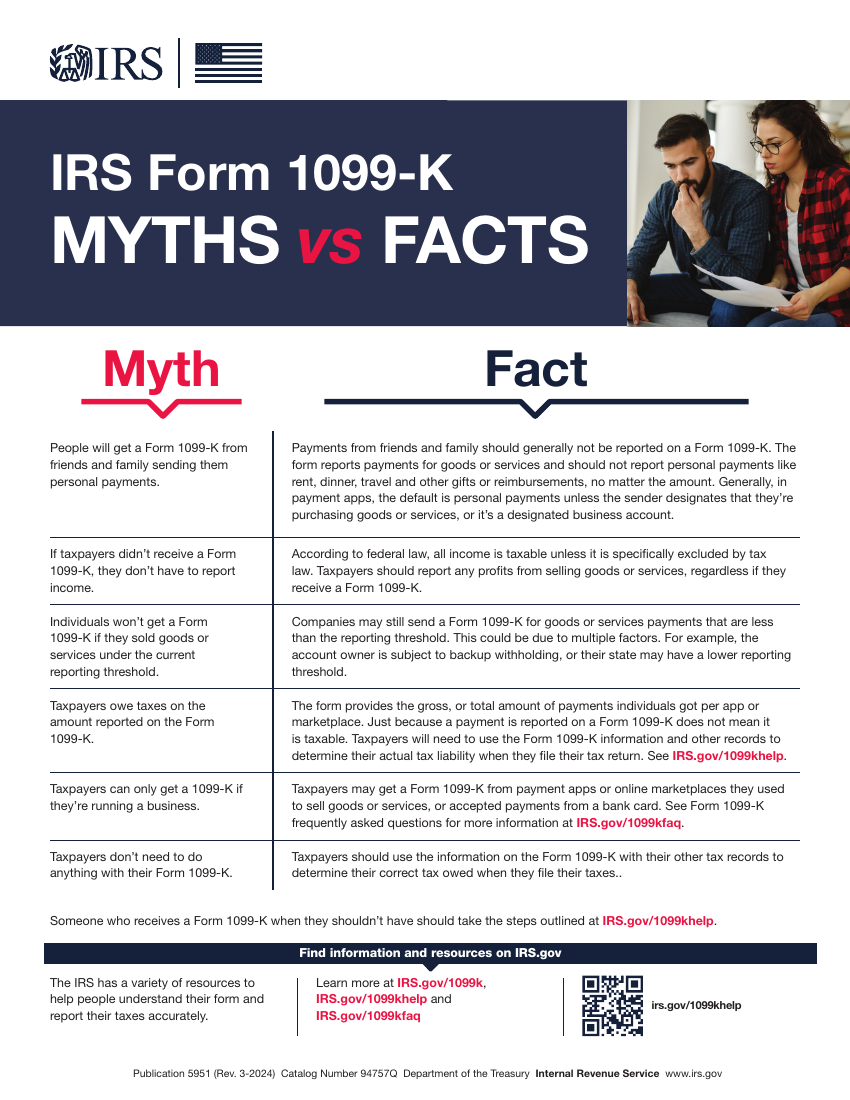
Somewhere between an early draft proposal and a repost, figures like $2,000 detached from reality and started circulating as "the new rule." If a source quotes that number as the 2026 threshold, it is describing something that was either cancelled or never enacted. The IRS publishes its own myths-versus-facts sheet, and it matches the law, not the rumor mill:
Source: IRS
Who must send the form — and when nobody has to
Read the IRS sentence closely, because one word does all the heavy lifting: "and." The current guidance says a payment app or online marketplace is required to send you the form if the payments you received for goods or services total over $20,000 in more than 200 transactions. Both tests must be met in the same year.
Suppose you passed only one of them — say, $25,000 across 90 sales, or $9,000 across 400 sales. In either case the platform is not federally required to file. That is a very different reality from the "$2,000 rule" being passed around.
Then comes the sentence sellers tend to miss: "However, they may send you a Form 1099-K with lower amounts and/or transactions." Voluntary reporting is legal and common, so receiving a small form is never proof that the law changed again.
Payment cards live outside this debate entirely. In the IRS's own words, you will get a form from your payment card processor "no matter how many payments you got or how much they were for." Credit, debit and gift-card settlement carries no minimum threshold at all.
One more principle from the same page: gifts, shared-cost reimbursements and other personal payments are not income and should not be counted. Flag them as non-business inside the app when friends send you money for the group gift or the dinner split.
The federal threshold chain, 2023 to 2027
The fastest way to kill the rumor is to see the whole timeline in one place. Every row below traces back to a named IRS source, so you can verify each line yourself.
| Tax year | Federal TPSO threshold | What actually happened | Source |
|---|---|---|---|
| Through 2023 | $20,000 + more than 200 transactions | The original 6050W rule; the ARPA cut to $600 was delayed by Notice 2023-74 | IRS reporting rule in force at the time |
| 2024 | $5,000 | An IRS administrative phase-in, applied for the 2025 filing season | IRS phase-in relief |
| 2025 | Planned $2,500 — cancelled | The One Big Beautiful Bill Act (July 4, 2025) repealed the planned cut and retroactively restored $20,000/200 | IR-2025-107 (October 23, 2025) |
| 2026 | $20,000 + more than 200 transactions | The rule in force for forms that arrive in early 2027 | Instructions for Form 1099-K, Rev. December 2026; IRS page updated September 18, 2026 |
| 2027 | No announced change | The IRS has published no $1,000 threshold for 2027 in any current document | IRS pages verified September 19, 2026 |
Two rows deserve emphasis. The 2025 row is where the chaos was born: a $2,500 threshold had been announced in December 2024, then Congress erased it mid-year and pulled the law backwards. The 2027 row is where the next rumor is already forming — treat any "$1,000 rule" claim as unverified until you can read it on irs.gov.
Platform by platform: when the form actually arrives
Sellers do not deal with abstract categories; they deal with apps and marketplaces. Here is how the rule maps onto the places money actually lands, based on how the IRS describes third party settlement organizations.
| Where you get paid | Required to send Form 1099-K? | The rule that applies |
|---|---|---|
| Online marketplaces — eBay, Etsy, Depop, StockX, ticket-resale sites | Only above $20,000 across more than 200 transactions | TPSO rule |
| Payment apps — PayPal, Venmo and similar, for goods and services | Only above $20,000 across more than 200 transactions; voluntary filing below the line is allowed | TPSO rule |
| Friends-and-family or personal payments inside apps | Not supposed to be reported at all | Personal payments are excluded from gross reportable transactions |
| Payment card processors — credit, debit and gift-card settlement | Yes, at any amount and any volume | Card settlement has no minimum threshold |
The calendar matters as much as the math. Platforms must furnish your copy of the form by January 31, so early February is when the questions start piling up.
Remember the deeper rule that no threshold change can alter: all taxable income must be reported on your return whether or not a form ever arrives. Sellers who budget around marketplace economics usually pair this with a full accounting of selling costs — our breakdown of Amazon seller fees and complete costs in 2026 is written for exactly that exercise.
What the 2026 form itself looks like — two brand-new boxes
Before 2026, most sellers could ignore the form's fine print. This year the form changed, and almost nobody has covered it. The Instructions for Form 1099-K revised in December 2026 add Box 1c, reserved for cash tips, which is mandatory reporting under Section 70201 of P.L. 119-21.
Alongside it sits Box 1d, which carries the Treasury-issued tip-industry code. If you run tips through a payment platform — a food truck, a salon chair, a touring act — these two boxes are where that money now surfaces, and where the IRS will look for it.
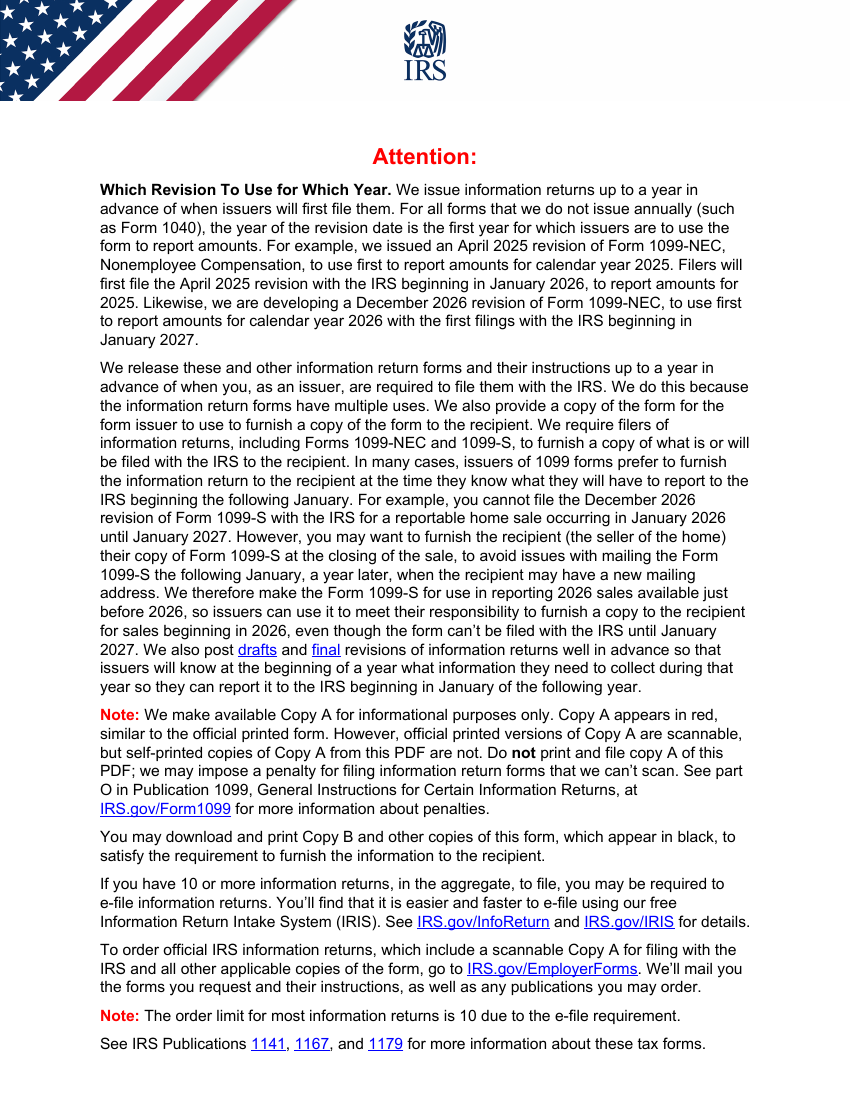
For everyone else, the layout stays familiar: gross reportable payment transactions in Box 1, filer information on the top left, and your taxpayer identification details checked against the payer's records. Knowing the anatomy helps you spot an error in seconds:
Source: IRS — About Form 1099-K
Marcus sells vinyl on eBay from Berlin — here's his 2026 filing
Marcus is a US citizen who has lived in Berlin for six years, pressing and reselling records on eBay while PayPal handles the money. This year his goods-and-services payments crossed $20,000 across more than 200 transactions, so a 1099-K arrived in his email in February.
Three line items on that form needed three different treatments. His actual record sales are business income, reported on Schedule C like any other year, because a form neither creates nor cancels taxability.
His roommate, however, had sent him $11,000 of rent through a payment app, and the app miscategorized it as a commercial payment. That is the IRS's own textbook example of a form received in error, and the fix is mechanical — described in full in the next section.
He also offloaded a vintage synthesizer he had bought for $1,000 and sold for $700. That is a personal item sold at a loss: no tax due, and no deductible loss either. He simply keeps records showing the original cost.
Living abroad changed nothing about his obligations. As the IRS states plainly, US citizens and resident aliens abroad follow the same filing and estimated-payment rules as everyone else, on worldwide income — Publication 54 is the reference guide. Non-resident sellers on US marketplaces face a different conversation entirely, and our guide to the US ITIN tax number for non-residents walks through that lane, just as our piece on VAT and marketplace obligations for non-residents covers the other side of the pond. And if a platform's payment policies are the reason you are reorganizing, the alternatives to PayPal for freelancers are worth a look.
Cross-border paperwork like Marcus's — two tax systems, one marketplace account — is exactly the kind of filing-season planning the Truescho consultancy team does with sellers before the forms arrive, not after.
The form arrived and it is wrong: the IRS two-line fix
The IRS is blunt about the first step: do not call them. The IRS cannot correct a form filed by someone else, so phone calls to the agency go nowhere.
Instead, look at the top-left corner of the form and contact the filer directly. Ask for a corrected Form 1099-K that removes the personal payments that were misreported. Most large platforms have a dispute process for exactly this.
If the filer refuses or the correction arrives after you file, the IRS prescribes a zero-out method on your return. Report the erroneous amount on Schedule 1 (Form 1040), Part I, line 8z, with a plain-language description — the IRS's literal example reads "Form 1099-K received in error, $11,000," the roommate-rent scenario. Then subtract the identical amount on Part II, line 24z. The two entries cancel, your taxable income stays correct, and the paper trail satisfies automated matching. The full walkthrough, straight from the source, sits on the IRS page What to do if you receive a Form 1099-K.
Selling personal items: when a 1099-K creates no tax
Plenty of forms go out to people who cleaned out a garage rather than ran a business. The IRS splits these casual sales into two outcomes, and only one of them costs you money.
Sell a personal item at a gain — say, a first-edition print you bought cheap and sold high — and the gain is taxable, reported through Form 8949. The form itself is not the tax; the profit is.
Sell at a loss and the outcome surprises people: no tax is due, and the loss is not deductible either. The IRS's own example is a refrigerator bought for $1,000 and sold for $700. The $300 loss disappears for tax purposes, but documentation of the original purchase price is what proves you owe nothing.
Backup withholding: the 24% trap when a TIN does not match
There is a penalty for ignoring payer paperwork, and it arrives before any audit. When the name and taxpayer identification number on your account fail the payer's matching, or you ignore a W-9 request, the payer may have to withhold federal income tax from your payments and send it to the IRS.
The federal backup withholding rate is 24%, applied to the gross payments — a real cash-flow hit for a busy seller. The IRS's general instructions for information returns, including Publication 1099 guidance on TIN matching and backup withholding, describe when payers must start and stop. The proposed regulations extending these mechanics to payment platforms under the One Big Beautiful Bill Act were still working through the system in 2026, so treat any platform's withholding email as urgent.
Your state may report far below the federal line
Everything above is the federal picture. Several states — among them California, Illinois, Massachusetts, Maryland, Virginia and Washington — impose lower thresholds, or none at all, through their own reporting laws.
A seller in one of those states can receive a state-mandated form for a few hundred dollars of sales while staying far under the federal line. The practical instruction from the IRS's own pages is simple: state rules vary, and no single national table governs them. Before assuming the $20,000/200 rule is the last word, check your own state revenue department's current guidance.
Questions sellers actually ask about the 2026 threshold
What is the 1099-K threshold for tax year 2026?
For 2026, a payment app or online marketplace must send Form 1099-K only if your goods-and-services payments exceeded $20,000 across more than 200 transactions, with both tests met together. The One Big Beautiful Bill Act reinstated this pre-2021 rule retroactively, and the IRS confirmed it in IR-2025-107.
Is the 1099-K threshold $600, $2,000 or $20,000 in 2026?
It is $20,000 combined with more than 200 transactions. The $600 figure was the ARPA change that never took effect after repeated IRS delays, and Congress cancelled the lower thresholds in July 2025. No $2,000 threshold exists in any current IRS document.
Did the IRS change the 1099-K threshold again for 2026?
Yes, but in the opposite direction from the rumors. After the $5,000 phase-in for 2024 and the cancelled $2,500 plan for 2025, the law restored the original $20,000/200 rule retroactively. Both the December 2026 form instructions and the IRS page updated September 18, 2026 reflect it.
Does eBay, Etsy, PayPal or Venmo report my sales to the IRS?
These platforms are third party settlement organizations, so they must file once you pass $20,000 and 200 transactions, and they may file voluntarily below it. Payments marked as personal, such as gifts and reimbursements, are excluded. Card processors report every amount with no minimum.
What should I do if I receive a Form 1099-K in error?
Do not call the IRS, which cannot fix another company's filing. Contact the filer named on the top-left corner and request a corrected form. If that fails, enter the amount on Schedule 1, Part I, line 8z with a description, then subtract the same figure on Part II, line 24z.
Do I owe taxes if I sold personal items at a loss but got a 1099-K?
No. A personal item sold at a loss produces no taxable gain and no deductible loss. The IRS's example is a refrigerator bought for $1,000 and sold for $700. Keep proof of the original cost, adjust the reported figure accordingly, and use Form 8949 only when personal items sell at a gain.
Do US citizens living abroad receive Form 1099-K and pay taxes?
US citizens and resident aliens abroad follow the same filing and estimated-payment rules as residents, on worldwide income, as Publication 54 explains. A citizen selling from Berlin or Dubai receives the same forms from US platforms and reports on the same schedules.
Which states have a lower 1099-K threshold than the federal one?
Several states, including California, Illinois, Massachusetts, Maryland, Virginia and Washington, set lower thresholds or none at all under their own laws. That means a form can arrive for amounts far below the federal line. Check your state revenue department before assuming the federal rule settles the question.
The bottom line before you file
The 1099-K threshold for 2026 is $20,000 across more than 200 transactions — the rumors about $2,000, a surviving $600 rule or a $1,000 drop in 2027 have no basis in anything the IRS currently publishes, and every figure in this article links back to the page that says so. Report all your income with or without a form, fix erroneous forms through the filer or the 8z/24z method, and expect your copy by January 31. If the cross-border or paperwork side of that list feels heavy, the consultants at Truescho sit with sellers and plan exactly this kind of filing-season workload every week.
Sources
- IRS — Understanding your Form 1099-K (updated September 18, 2026): https://www.irs.gov/businesses/understanding-your-form-1099-k
- IRS — Instructions for Form 1099-K (Rev. December 2026): https://www.irs.gov/pub/irs-pdf/i1099k.pdf
- IRS — IR-2025-107, FAQs on the Form 1099-K threshold under the One Big Beautiful Bill Act (October 23, 2025): https://www.irs.gov/newsroom/irs-issues-faqs-on-form-1099-k-threshold-under-the-one-big-beautiful-bill-dollar-limit-reverts-to-20000
- IRS — Form 1099-K FAQs (updated September 18, 2026): https://www.irs.gov/newsroom/form-1099-k-faqs
- IRS — What to do if you receive a Form 1099-K: https://www.irs.gov/newsroom/form-1099-k-faqs-what-to-do-if-you-receive-a-form-1099-k
- IRS — About Form 1099-K: https://www.irs.gov/forms-pubs/about-form-1099-k
- IRS — Form 1099-K, official form document: https://www.irs.gov/pub/irs-pdf/f1099k.pdf