
7.3 Million Students Study Abroad: US Hosts 957,000, China Sends 1 Million — The New 2026 Map
Last updated: September 2026
The German Centre for Higher Education Research and Science Studies (DZHW) and the German Academic Exchange Service (DAAD) released "Wissenschaft weltoffen kompakt 2026", their annual reference report on global student mobility built on UNESCO and OECD statistics. Its headline finding: roughly 7.3 million students were enrolled outside their home countries in 2023 — up 3.5 million, or +92%, since 2010. This article unpacks the full dataset: who hosts, who sends, and what the numbers mean for anyone applying abroad this cycle.
What Counts as an "International Student" in This Data?
One methodological note first, because it changes how you read every ranking below. Where countries can supply precise records, the figures count students who were not resident in the host country before enrolling (so-called non-resident students). Where they cannot, the figures fall back to all foreign nationals studying there (non-citizen students). The report is explicit that some values are estimated and that missing data — notably incoming numbers for Mainland China and Singapore — make this the best available approximation rather than a complete census.
The practical consequence: some host countries are almost certainly more significant than their official line suggests, and year-over-year comparisons can shift when national statistics agencies improve their reporting.
Two Decades of Relentless Growth — Including Through COVID
The total has nearly quadrupled in a generation. In 1975, only about 800,000 students studied outside their home country. By 2005 the figure stood at 2.8 million, and by 2010 at 3.8 million. Then came the fastest decade on record:
| Year | International students worldwide |
|---|---|
| 1975 | 0.8 million |
| 2005 | 2.8 million |
| 2010 | 3.8 million |
| 2019 | 6.1 million |
| 2020 | 6.4 million |
| 2021 | 6.6 million |
| 2022 | 6.9 million |
| 2023 | 7.3 million |
The most striking line is 2020–2021. A global pandemic that closed borders and moved lectures online still did not shrink the total — growth slowed, then accelerated again through 2022 and 2023. Anyone waiting for international education to "collapse" after the next crisis is waiting for something the data has never shown.
By region, Western Europe hosts 30% of all internationally mobile students, Asia and the Pacific 19%, and North America 18%. Two-thirds of the entire global movement concentrates in just three regions.
The Hosting Table: Where the 7.3 Million Actually Study
| Rank | Host country | International students | Share of world total |
|---|---|---|---|
| 1 | United States | 956,923 | 13.1% |
| 2 | United Kingdom | 748,461 | 10.3% |
| 3 | Australia | 467,074 | 6.4% |
| 4 | Germany | 423,197 | 5.8% |
| 5 | Canada | 389,181 | 5.3% |
| 6 | Russia | 336,453 | 4.6% |
| 7 | Turkey | 301,634 | 4.1% |
| 8 | France | 276,217 | 3.8% |
| 9 | UAE | 237,034 | 3.3% |
| 10 | China | 208,380 | 2.9% |
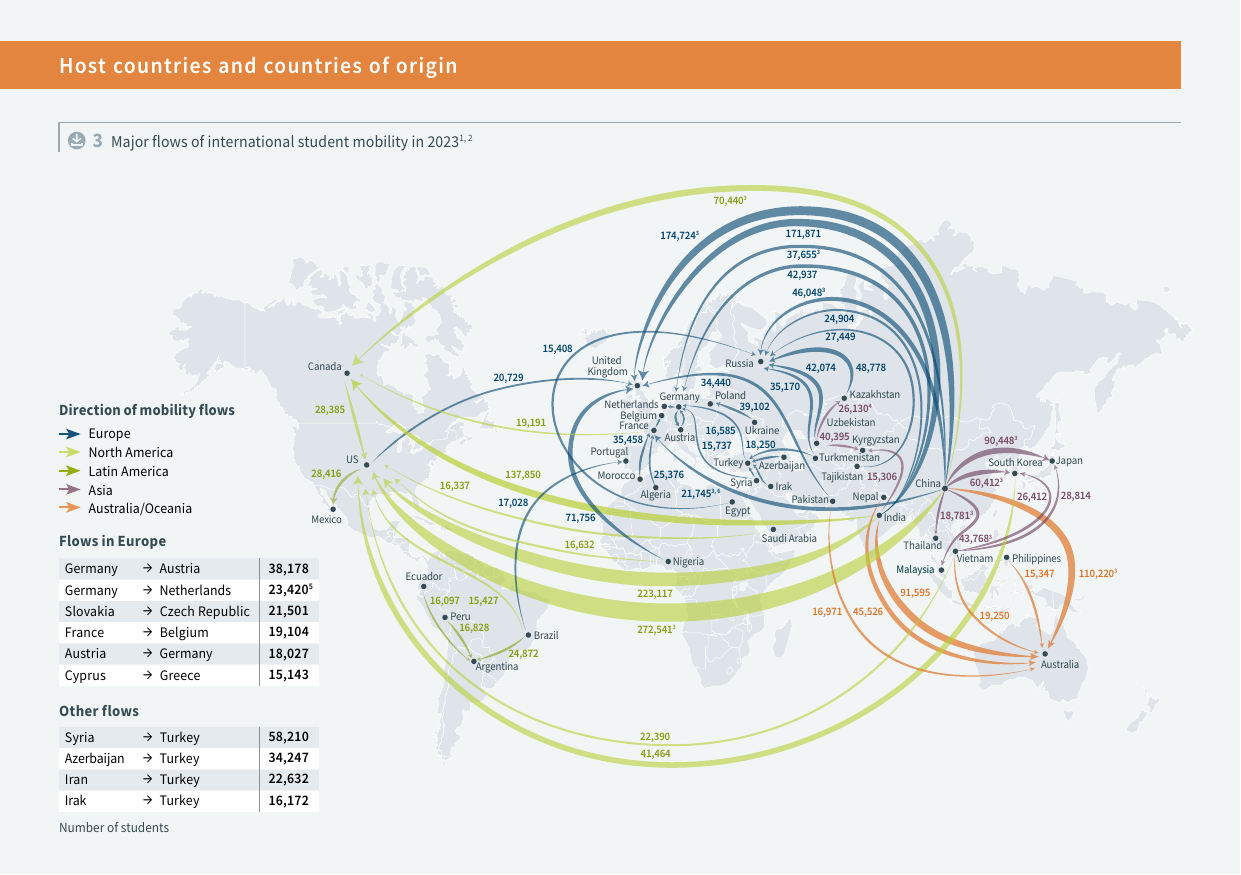
Source: Wissenschaft weltoffen kompakt 2026 report — DZHW & DAAD
The map above draws only flows of at least 15,000 students — and the biggest corridors all run from China and India to the United States and the United Kingdom.
Two readings stand out. First, the four major English-speaking destinations (US, UK, Australia, Canada) together absorb more than a third of the world's mobile students. Second, the table is no longer a Western monopoly: Turkey hosts more international students than France, and the UAE — a country of barely 10 million people — ranks ninth globally, ahead of China.
If you are shortlisting destinations, remember that a country's position in this table measures volume, not fit. Start from the actual programs and funding open to you on the Truescho opportunities page, then compare institutions.
The Sending Table: One in Four Mobile Students Comes From Just Two Countries
| Rank | Country of origin | Students abroad | Share of world total |
|---|---|---|---|
| 1 | China (incl. Hong Kong & Macao) | 1,029,550 | 14.1% |
| 2 | India | 834,361 | 11.4% |
| 3 | Nigeria | 146,305 | 2.0% |
| 4 | Germany | 129,070 | 1.8% |
| 5 | Vietnam | 128,240 | 1.8% |
| 6 | Uzbekistan | 120,564 | 1.7% |
| 7 | United States | 118,321 | 1.6% |
| 8 | France | 115,166 | 1.6% |
| 9 | Pakistan | 114,915 | 1.6% |
| 10 | Nepal | 108,282 | 1.5% |
The gap after the top two is the story. No third country reaches even 2.1% of the world total — China and India together account for roughly 25.5% of all international students, and everyone else is scattered in small shares across dozens of countries.
The more consequential signal for the decade ahead sits in the middle of the table: Nigeria, Vietnam, Uzbekistan, and Nepal now all out-send France and the United States. These are young, ambitious populations where a foreign degree has become a core career route. Uzbekistan alone sends 120,564 students abroad — one of the most telling numbers in the entire report for anyone watching where the next wave of applicants will come from.
Importer Nations vs Exporter Nations: The Mobility Balance
The report's sharpest analytical tool is the mobility balance — outgoing versus incoming students as a share of each country's total mobility:
| Country | Outgoing | Incoming |
|---|---|---|
| Australia | 3% | 97% |
| United Kingdom | 5% | 95% |
| UAE | 8% | 92% |
| United States | 11% | 89% |
| Canada | 12% | 88% |
| Russia | 16% | 84% |
| Turkey | 18% | 82% |
| Germany | 23% | 77% |
| France | 29% | 71% |
| China | 83% | 17% |
| Vietnam | 94% | 6% |
| India | 95% | 5% |
| Uzbekistan | 96% | 4% |
| Pakistan | 100% | 0% |
| Nepal | 100% | 0% |
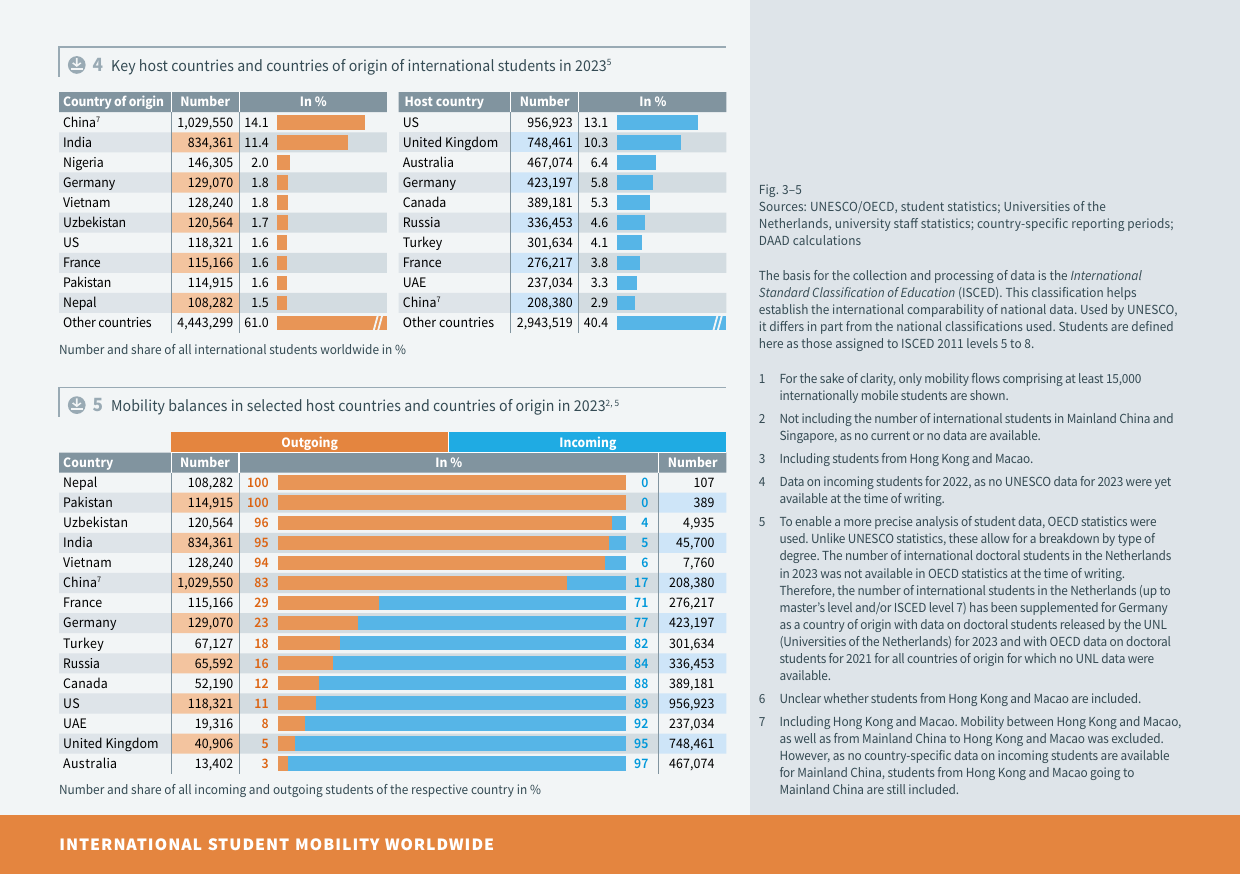
Source: Wissenschaft weltoffen kompakt 2026 report — DZHW & DAAD
Nepal and Pakistan sit at one extreme: virtually all of their mobility is outbound. Australia sits at the other: 97% of its mobility is incoming. For applicants, a high incoming ratio usually means a large international student community, support services designed for non-native speakers, and employers accustomed to hiring foreign graduates — alongside steeper competition for housing and part-time work.
Germany cuts a third profile: a genuine two-way hub that hosts 423,000 international students while sending 129,000 of its own abroad.
Germany: The Report's Home Turf, in Detail
Because the report is produced by German research institutions, its Germany chapter offers the deepest drill-down available anywhere — and it matters directly for applicants, as we cover in our Germany international students breakdown.
| Indicator | Value |
|---|---|
| International students, winter semester 2024/25 | 402,083 (+6% year-on-year) |
| Share of all students in Germany | 14% |
| Degree-seeking share | 94% |
| Top origin countries | India (58,833), China (38,989), Turkey (20,900) |
| Master's students | 46.7% |
| Bachelor's students | 34.5% |
| Doctoral students | 8.0% |
| Top subject group | Engineering (42.7%), Law/Economics/Social Sciences (25.3%) |
Nearly half of Germany's international students are in master's programs, and more than four in ten study engineering — which explains why English-taught engineering master's programs at German universities get more competitive every admission cycle. In the other direction, 137,700 German students study abroad, with Austria (40,666), the Netherlands (21,133), and Switzerland (12,599) as the top three destinations.
For applicants weighing a fully-funded European route, programs like Erasmus Mundus 2027 cover tuition, travel, and a living allowance across multiple European countries in a single scholarship.
Four Practical Takeaways From the 2026 Data
- 40.4% of international students study outside the top ten hosts. The majority of the world's mobile students are not in the US or UK. Russia, Turkey, and the UAE jointly host over 875,000 students — often with lower admission competition and lower living costs than the Anglosphere.
- The trend does not reverse. A +92% rise in 13 years means seats in strong programs tighten every cycle. A two-year delay means two more years of applicant growth competing for similar capacity.
- Read the balance before you apply. A 95–97% incoming ratio buys you infrastructure and community, but also competition. A balanced hub like Germany or France can offer a better ratio of support to competition.
- Funding changes the math more than ranking does. The difference between a fully-funded seat and a self-funded one is larger than any ranking gap. Filter for open scholarships first — then compare universities on the Truescho rankings.
Frequently Asked Questions
How many international students were there worldwide in 2023?
About 7.3 million students studied outside their home countries in 2023, according to UNESCO statistics documented in the Wissenschaft weltoffen kompakt 2026 report from DZHW and DAAD. That is an increase of 3.5 million students (+92%) compared with 2010 — the total has nearly doubled in thirteen years.
Which country hosts the most international students?
The United States leads with 956,923 international students in 2023, or 13.1% of the world total. The United Kingdom follows with 748,461 (10.3%), then Australia with 467,074 (6.4%), Germany fourth with 423,197 (5.8%), and Canada fifth with 389,181 (5.3%).
Which country sends the most students abroad?
China sends the most: about 1,029,550 Chinese students studied abroad in 2023 (14.1% of the world total, including Hong Kong and Macao). India ranks second with 834,361 students (11.4%). No third country exceeds 2.1% of the global total.
Are the China figures fully accurate?
Partially. Outbound numbers include Hong Kong and Macao, and the report excludes mobility between them and Mainland China. Separately, no current incoming data exist for Mainland China and Singapore, so the report itself cautions that some host countries' true weight is likely understated.
Where does Germany stand globally?
Germany is the world's fourth-largest host with 423,197 international students in 2023 (5.8%). Inside its universities, they number 402,083 in the 2024/25 winter semester — 14% of all students in Germany. The largest groups come from India (58,833), China (38,989), and Turkey (20,900), and 42.7% study engineering. Another 129,070 German students study abroad.
Sources
- Wissenschaft weltoffen kompakt 2026 — full English edition (PDF) — official report by DZHW and DAAD, June 2026
- UNESCO Institute for Statistics — Education — the international student database underpinning the report
- OECD — Education at a Glance — the second data source for mobility statistics
Start Your Application Journey With Data, Not Guesswork
The global map shifts every year, and funded deadlines open and close on fixed dates. Truescho brings together thousands of updated scholarships with university comparison tools and a free GPA calculator in one place.