
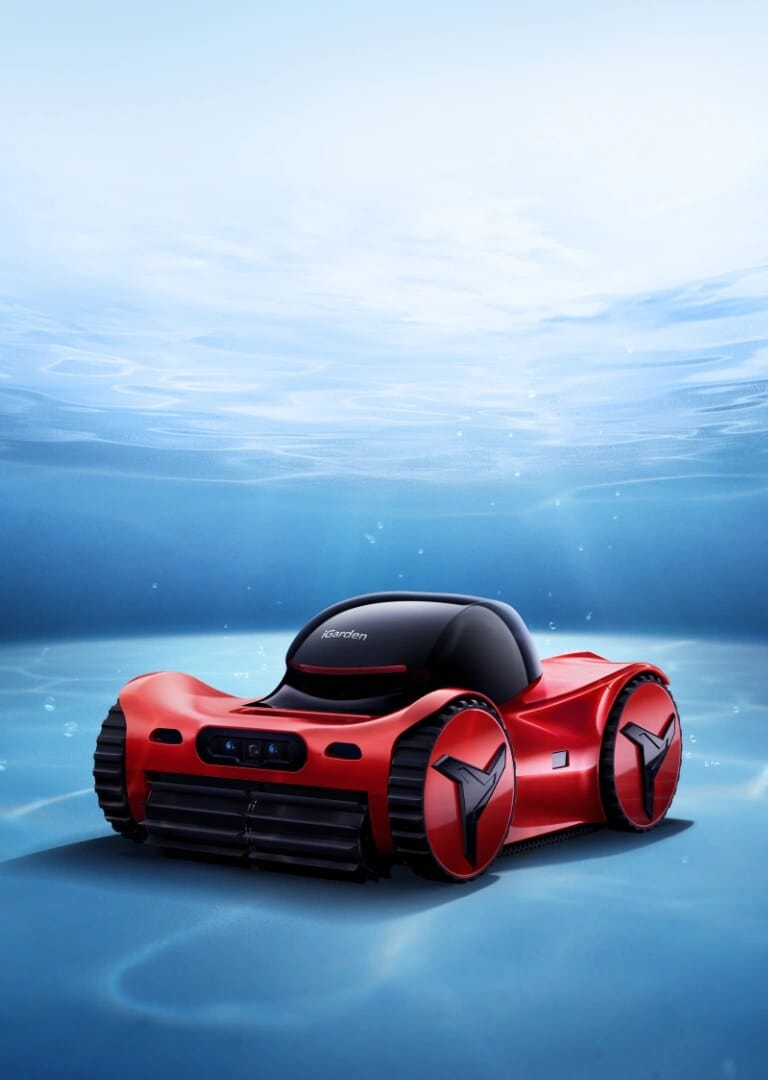
iGarden M1-AI vs K Pro 2026: Which Pool Robot Should You Choose?
If you are comparing iGarden M1-AI vs K Pro 2026, the useful answer is not that one robot wins every category. The M1-AI line makes more sense when fine filtration, complex pool shapes, steps, and smarter pathing matter most. The K Pro line is the stronger choice when battery life, larger pools, and a more established testing record matter more than catching the finest particles.
Updated May 16, 2026, this guide compares the models currently shown on the official US store pages, not older names that may still appear in search results. That distinction matters because the current M1-AI page lists M1-AI 55, 70, and 90 models, while some older references still mention different names.
💬 Disclosure: Some links in this article are affiliate links. We may earn a small commission when you complete a purchase at no extra cost to you. This helps us keep our content free, and it does not affect the integrity of our recommendations.
The short answer
Choose the M1-AI if your pool has stairs, curves, benches, unusual corners, or frequent fine debris such as dust and pollen. Choose the K Pro if your pool is larger, you want the longest possible run time between charges, or you prefer a product with a stronger independent review record today. For many buyers, the real decision is precision versus endurance.
That trade-off becomes clear when you compare the two top current models. The M1-AI 90 is listed at $1,399 with up to 9 hours of floor-only cleaning, dual-layer 150 micron plus 60 micron filtration, a 4.5 liter basket, and dual-vision navigation. The K Pro 150 is listed at $1,599 with up to 15 hours of floor-only cleaning, a 180 micron filter, a 4 liter basket, and much longer published runtime.
| What matters most | Better fit | Why |
|---|---|---|
| Fine debris capture | M1-AI | Dual-layer 150 micron plus 60 micron filtration |
| Longest floor-only runtime | K Pro | Up to 15 hours on K Pro 150 versus 9 hours on M1-AI 90 |
| Complex pool shapes | M1-AI | Dual-vision navigation and positioning for steps and curves |
| Larger pools and longer gaps between charges | K Pro | More battery headroom and scheduling features |
| Current independent testing record | K Pro | PCWorld has published a hands-on K Pro 150 review |
| Lowest current entry price | M1-AI | M1-AI 55 is listed below K Pro 100 |
What changed in the 2026 lineup?
The first thing to know before comparing iGarden M1-AI vs K Pro 2026 is that the M1-AI naming has moved quickly. The official store page currently shows M1-AI 55, M1-AI 70, and M1-AI 90. The global brand page still uses broader marketing language about the M1-AI family, while search snippets and older material may show earlier model names.
That does not make the product bad. It does mean a careful buyer should compare the exact model on the live store page before purchasing, rather than relying on a screenshot, an old launch article, or a headline that treats every M1-AI unit as if it had the same battery. The current store page shows floor-only runtime of 5.5 hours, 7 hours, and 9 hours across the three M1-AI models.
The K Pro line is easier to read today. The official page lists K Pro 100 and K Pro 150, with floor-only runtime of 10 hours and 15 hours. That simpler product story is one reason the K Pro feels easier to recommend for a buyer who values predictability over newer features.
Side-by-side comparison: M1-AI 90 versus K Pro 150
The fairest comparison is between the strongest current versions of each family, because many shoppers asking about iGarden M1-AI vs K Pro 2026 are deciding between the best M1-AI option and the longest-running K Pro. Both are premium cordless robotic pool cleaners, both clean floors, walls, and waterlines, and both carry a three-year warranty on major components under the official policy.
| Specification | M1-AI 90 | K Pro 150 |
|---|---|---|
| Current listed price | $1,399 | $1,599 |
| Floor-only runtime | Up to 9 hours | Up to 15 hours |
| Full-coverage runtime | Varies by mode | Up to 8.5 hours officially listed |
| Filtration | 150 micron plus 60 micron | 180 micron |
| Debris basket | 4.5 liters | 4 liters |
| Navigation emphasis | Dual cameras, 3D pathing | 3D pathing |
| Best pool type | Complex layouts and finer debris | Larger pools and longer unattended runs |
| Independent hands-on evidence | Still limited for current models | PCWorld tested K Pro 150 |
| Main caution | Newer line, less outside testing | Higher price, coarser standard filter |
The M1-AI 90 costs less on the current listing and gives you the finer standard filtration package. That is a meaningful advantage if your pool collects windblown dust, pollen, or small particles that a coarser basket may leave behind. It also has the larger basket on paper and a navigation story built around seeing more of the pool shape.
The K Pro 150 answers a different problem. It is not trying to win on fine filtration. It is trying to keep working for a very long time, and the available evidence supports that point better than it does for most cordless pool robots. PCWorld reported nearly 14 hours in floor-only mode during testing and strong debris removal over a three-hour run.
Navigation: why pool shape matters more than marketing
Navigation is the strongest argument for the M1-AI line. The official material positions it for pools with curves, stairs, benches, and more complicated layouts, using dual cameras and a 3D cleaning path. If your old cleaner repeatedly misses the same step pocket or spends too much time wandering around a freeform pool, that focus may be worth paying for.
The K Pro also uses a planned cleaning path, and it is not a crude machine. But its clearest advantage is endurance, not visual awareness. If your pool is a simple rectangle with a predictable floor, the practical gain from more advanced sensing may be smaller than the gain from several extra hours of runtime.
That distinction is easy to miss when product pages use broad words such as smart, precise, or intelligent. A better buyer question is simple: where does debris actually collect in your pool? If it gathers in corners, on steps, or around curved walls, M1-AI has the more relevant feature set. If it spreads across a long floor area, K Pro may solve the more expensive problem.
Filtration: the quiet difference that may matter every week
Filtration is where the M1-AI line separates itself most clearly. The official store page lists a dual-layer 150 micron plus 60 micron system. The K Pro page lists a 180 micron standard filter. Smaller micron numbers generally mean the cleaner is designed to trap smaller particles, although actual cleaning results still depend on flow, brush action, maintenance, and how full the basket becomes.
This difference matters in dusty climates, near flowering trees, or in pools that often look clean from a distance but develop a light film on the floor. A homeowner dealing mostly with leaves, larger grit, and routine surface debris may care less. A homeowner fighting fine particles after windy days may notice the filter difference more often than the difference between two app dashboards.
There is a practical caveat. Finer filters can demand more frequent cleaning because they collect smaller material sooner. That is not a flaw, but it changes the ownership routine. A cleaner that catches more dust is still asking you to empty and rinse the basket; it does not eliminate maintenance.
Battery life: where K Pro earns its price
Battery life is the strongest reason to choose K Pro. The K Pro 150 is officially listed for up to 15 hours in floor-only mode, and PCWorld's hands-on review reported almost 14 hours in that mode. The same review found about 10 hours when running floor, wall, and waterline cleaning, which is still substantial for a cordless unit.
The M1-AI 90 is officially listed for up to 9 hours of floor-only runtime. That may be plenty for many residential pools, especially if the cleaner is more efficient in a complicated layout. But it is not the same ownership proposition as a robot designed to stretch cleaning over longer gaps between charges.
If you travel often, maintain a large pool, or simply dislike charging devices frequently, K Pro's extra battery headroom is real. Just avoid turning any marketing claim into a promise that the pool can be ignored for weeks. Debris load, basket capacity, weather, and cleaning mode all change how long any robot remains useful between human check-ins.
Which one is easier to trust today?
The K Pro currently has the stronger outside evidence. PCWorld reviewed the K Pro 150 after hands-on use and reported both its strengths and its flaws: excellent battery life, solid cleaning, expensive pricing, less intuitive controls, pole-and-hook retrieval, and a charging-port design that can hold water under the rubber cover.
The current M1-AI page, by contrast, shows no customer reviews on the store page, and there is less long-form outside testing for the current sellable models. That does not mean the M1-AI performs poorly. It means the confidence level should be different. A buyer who wants a more established record today has a clearer case for K Pro.
The M1-AI is the more interesting design. The K Pro is the more documented purchase. Buyers often confuse those two ideas, especially with new consumer technology. Newer can be better for a specific need while still carrying more uncertainty.
Pros and cons of each line
The cleanest way to compare the two families is to state what each one does well and what it asks you to accept.
M1-AI strengths
- Finer standard filtration than K Pro
- Better fit for pools with stairs, curves, and less regular geometry
- Lower current starting price
- Larger listed basket capacity on the top current model
- Modern sensing features that may reduce repeated misses in difficult areas
M1-AI drawbacks
- Current product line is newer and has less outside testing
- Official naming and runtime information have changed across pages over time
- Shorter listed runtime than K Pro at the top end
- Store page currently shows no customer reviews
K Pro strengths
- Longer listed runtime, especially on K Pro 150
- Stronger independent review evidence today
- Practical scheduling for 24, 48, or 72 hour intervals
- Good fit for larger, simpler pools where battery matters most
- Clearer product family and published model differences
K Pro drawbacks
- Standard 180 micron filter is less fine than M1-AI's dual-layer setup
- Higher top-model price
- PCWorld found the app and onboard controls less intuitive than expected
- Retrieval still requires a pole and hook
- Long runtime does not remove the need to empty the basket
How to choose for your actual pool
Start with your pool, not the product names. A buyer with a 26 by 49 foot rectangle, mostly leaf debris, and frequent travel has a different problem from a buyer with a smaller freeform pool, several steps, and dust blowing in from nearby paving. Both may spend a similar amount of money, yet the best purchase is not the same.
Use this simple path:
- If fine dust is your main annoyance, lean M1-AI.
- If your pool has stairs, curves, benches, or tight transitions, lean M1-AI.
- If your pool is large and simple, lean K Pro.
- If long gaps between charges matter more than particle size, lean K Pro.
- If you want the more documented product right now, lean K Pro.
- If you are comfortable buying newer technology for a more tailored feature set, M1-AI becomes more attractive.
For a broader buying context before deciding, it also helps to read the standalone M1-AI review, the broader robotic pool cleaner guide, and the separate K Pro review. Those pages answer slightly different questions than this head-to-head comparison.
Who should not buy either one?
Neither model is the right answer for every pool owner. If your budget is tight, you may get better value from a simpler cleaner that handles floors only. If you dislike rinsing filters or lifting a wet machine from the water, no cordless cleaner will make pool care disappear. If your pool mostly needs leaf skimming rather than floor cleaning, a robotic floor cleaner may not address the main pain point.
You should also pause if you are choosing from the longest headline number alone. Runtime figures are mode-specific. Floor-only operation lasts longer than full cleaning that includes walls and the waterline. A buyer who does not need long unattended runs may be paying for battery capacity that sits unused.
Alternatives worth considering
The honest alternatives are not limited to another iGarden model. PCWorld has highlighted the Polaris Freedom Plus among strong cordless choices and the corded Polaris VRX iQ+ for buyers who care more about cleaning performance than cable-free convenience. Those alternatives may suit shoppers who want a longer independent track record outside the M1-AI family.
Within the same brand, a buyer who likes the M1-AI idea but wants lower spend can look at the M1-AI 55 or M1-AI 70. A buyer attracted to K Pro but unwilling to pay for the longest runtime can compare K Pro 100 with K Pro 150. The point is not to buy the top model automatically. It is to pay for the feature that solves your recurring problem.
Warranty and return details to check before checkout
Both M Series and K Series cleaners are listed under a three-year warranty for major components such as the motor, battery pack, electronics, charger, and main body on the official warranty page. Consumable materials such as baskets, tracks, brushes, and retrieval hooks are listed separately with six months of coverage. That split is common, but buyers should know it before assuming every part carries the same term.
The store pages also mention 30-day returns, yet return conditions can depend on where the product was bought, product condition, accessories, and regional consumer rules. Read the live policy before ordering, keep packaging until you are satisfied, and do not assume a store-banner phrase explains every exception.
If you decide that the M1-AI's finer cleaning fits your pool better, review the live official listing through iGarden before paying because model names, discounts, and availability can change. If long runtime matters more, compare the current K Pro options there with the same care.
Frequently asked questions
Is M1-AI better than K Pro?
M1-AI is better for fine filtration and difficult pool geometry, while K Pro is better for longer runtime and current outside evidence. The right answer depends on whether your weekly frustration is missed corners and fine dust or battery limits in a larger pool. Treat it as a fit question, not a universal ranking.
Which model is better for a large rectangular pool?
K Pro usually makes more sense for a large rectangular pool because its strongest advantage is runtime. The K Pro 150 is listed for up to 15 hours in floor-only mode, giving it more room to cover longer surfaces between charges. If the pool has unusually fine debris, compare filtration needs before deciding.
Which cleaner is better for stairs and curved pools?
M1-AI is the more logical choice for stairs, curves, and irregular layouts. Its official positioning centers on dual-vision navigation and complex pools, while K Pro emphasizes endurance. That does not guarantee perfect cleaning in every pool, but it gives M1-AI the more relevant toolset for complicated geometry.
Does the finer M1-AI filter mean less maintenance?
No. A finer filter can catch smaller particles, which may improve water appearance, but it can also fill sooner when the pool has lots of dust or pollen. Better capture does not remove the need to rinse the basket. It changes what gets collected and how often you may need to clean it.
Is the K Pro 150 really suitable for travel?
It is more travel-friendly than many cordless cleaners because it has long runtime and scheduling options, but it is not a substitute for all pool care. Heavy debris, a full basket, weather changes, and water chemistry still require attention. Think of it as reducing routine work, not replacing every check while you are away.
Why do M1-AI specifications look different across some pages?
The current official US store page and broader brand material do not always present the line in the same way, and older search snippets may preserve earlier names. For a purchase decision, use the live product page tied to the model you can actually buy and verify the runtime listed for that exact unit.
Are there better-known alternatives outside this brand?
Yes. Buyers who want more established third-party coverage can compare models such as Polaris Freedom Plus for cordless convenience or Polaris VRX iQ+ if a cord is acceptable. Those products solve somewhat different problems, so compare pool shape, filtration, service access, and your tolerance for cables before switching brands.
Related reading
- Best robotic pool cleaner 2026: is M1-AI worth it?
- Full M1-AI review for 2026
- K Pro review for large pools and long trips
- Swim Jet review: X Series or P Series?
Final verdict
For iGarden M1-AI vs K Pro 2026, the buyer with a complex pool and fine debris has a stronger reason to choose M1-AI, especially if the 9-hour ceiling of the top current model is already enough. The buyer with a large pool, longer gaps between charges, or a preference for stronger published evidence has the better case for K Pro.
The practical answer is narrower than the marketing answer: buy M1-AI for precision, buy K Pro for endurance, and verify the exact live listing before checkout. Start with the current iGarden product pages, then match the model to the mess your pool actually makes.
Sources
- Official M1-AI product page
- Official K Pro product page
- Official warranty policy
- PCWorld K Pro 150 review by Christopher Null
- PCWorld guide to robotic pool cleaners