
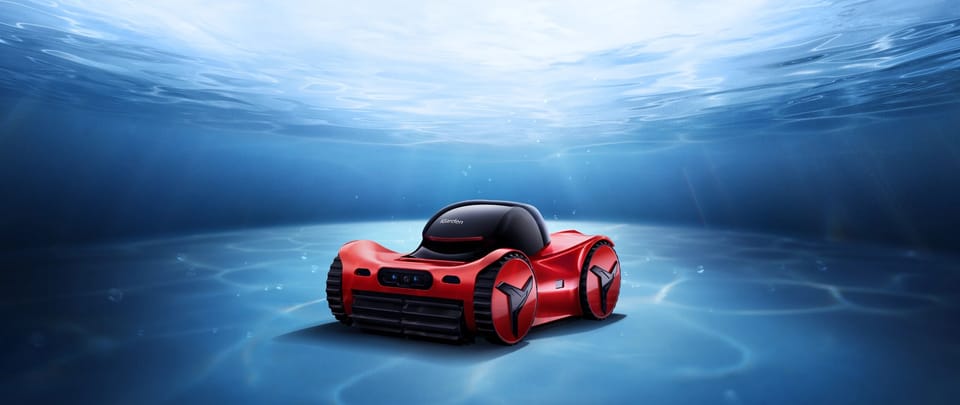
iGarden M1-AI Review 2026: Pros, Cons, and Who It Suits
Updated: May 2026
This iGarden M1-AI review 2026 is a buying guide, not a claim that we have completed months of hands-on ownership testing. The model is still new, and the exact versions currently sold through the official store are changing faster than many shoppers realize. What can be reviewed responsibly today is the purchase case: the current M1-AI 55, 70, and 90 options, their listed prices and runtimes, the technology they promise, the gaps in outside evidence, and the kind of pool owner they are most likely to suit.
💬 Disclosure: Some links in this article are affiliate links. We may earn a small commission when you complete a purchase at no extra cost to you. This helps us keep our content free, and it does not affect the integrity of our recommendations.
The short answer is that the iGarden M1-AI is appealing if you want a premium cordless cleaner for a pool with curves, steps, or recurring fine debris. It is less appealing if you want the most battle-tested product line, the longest cordless runtime, or a cleaner you can choose without reading model details carefully. In 2026, this is a promising product with a sensible use case, but not one that deserves blind praise.
What exactly is on sale now?
The most useful starting point for an iGarden M1-AI review 2026 is the store page that a buyer can actually order from today. That page currently shows three variants: M1-AI 55, M1-AI 70, and M1-AI 90. Their listed prices are $999, $1,199, and $1,399, with floor-only runtimes shown as 5.5, 7, and 9 hours respectively.
| Current store model | Listed price | Listed floor-only runtime | Sensible buyer profile |
|---|---|---|---|
| M1-AI 55 | $999 | 5.5 hours | Buyer who wants the M1 feature set at the lowest current entry price |
| M1-AI 70 | $1,199 | 7 hours | Buyer seeking a middle option without paying for the longest current runtime |
| M1-AI 90 | $1,399 | 9 hours | Buyer who wants the strongest currently listed store configuration |
That sounds simple until you compare other public materials. The broader brand page uses a higher family-level runtime claim, older launch coverage mentions different M1 names, and a WIRED review published in March discusses an M1-100 after a later correction to the model details. The safe conclusion is not that one page must be wrong in every context. It is that shoppers should anchor the decision to the exact purchasable model they select today.
This matters more than it may seem. Pool robots are expensive, and small changes in battery, filter, or bundle can change which version is a good value. If you want a quick broader comparison before choosing, read our guide to the best robotic pool cleaner 2026.
The feature set that makes it attractive
The M1-AI is built around a clear proposition: spend premium money for better perception and finer cleaning rather than for battery size alone. Official materials emphasize dual-camera vision, dual-force flow, dual-grip traction, dual-layer filtration, a 3D path, floor-to-waterline coverage, and suitability for complex pools.
The features with the strongest practical value are:
- Dual-camera vision. Better sensing should help the robot identify debris and obstacles instead of relying only on simple pathing.
- Dual-layer filtration. The listed 150 micron plus 60 micron arrangement is attractive if dust, pollen, or fine sand annoy you more than large leaves.
- Complex-pool positioning. The official cleaner comparison specifically points buyers with steps and curves toward the M1-AI line.
- Waterline return. A cleaner that comes back to a reachable edge is easier to live with than one that stops in the deepest inconvenient place.
- Cordless use. Removing a power cable reduces setup friction and deck clutter.
Those are not empty selling points. They answer real complaints owners have about weaker pool robots. The question is whether you need those strengths enough to justify paying a premium for a newer line.
What the published evidence says so far
The current evidence base is split into three layers. First, there are official materials from the manufacturer. Second, there is independent testing of adjacent or earlier-named M1 hardware. Third, there is still a visible gap in direct owner feedback for the exact current store lineup, because the store page shows no customer reviews at the time of writing.
The most useful outside evidence comes from Christopher Null's WIRED review of the M1-100. In that test, the robot reportedly cleaned about 95 percent of debris after two hours and completed the job after a third hour in his pool. He also reported that the 10-hour floor-only runtime claim for that tested unit held up, while full-coverage cleaning lasted about seven hours. His criticisms were concrete: the debris basket was awkward to clean, the unit needed pole retrieval, the control panel was confusing, and the app did little beyond basic setup.
That is encouraging because it shows the wider M1 design is not just a showroom concept. It is also a reminder to avoid sloppy conclusions. The model he tested is not named the same way as the 55, 70, and 90 options now highlighted in the store. A responsible iGarden M1-AI review 2026 should say, "this evidence is relevant," not "this evidence settles every current variant."
Pros that matter in normal pool ownership
The strongest case for the iGarden M1-AI appears when you picture weekly ownership rather than a glossy launch image.
1. It is aimed at difficult pool shapes
Owners of freeform pools often discover that a cleaner which performs well in a rectangle can become less convincing around curved walls, steps, and ledges. Official positioning for the M1-AI directly addresses that problem. If your pool has those features, the premium is easier to justify than it would be for a plain rectangle.
2. The filtration spec is genuinely interesting
Fine debris changes the feel of a pool even when large leaves are gone. The M1-AI's dual-layer setup is one of the clearest reasons to choose it over a simpler long-runtime model. It should be especially relevant in dusty climates, after landscaping work, or where pollen and tiny particles are a recurring nuisance.
3. It keeps the cordless experience
Cordless cleaners are popular for a reason. There is no cable to coil, route, or store, and the cleaner can be dropped in with less ceremony. That convenience matters because the best cleaner is often the one you are willing to use often.
4. Warranty coverage is respectable
The official policy lists three years for M Series main components, including the motor, battery pack, electronic control systems, charger, and main body. That is a meaningful support signal for a premium product, even though consumables are covered for only six months.
5. It gives buyers a clear reason to move above basic models
Premium products need a reason to exist. Here, the reason is not just styling. It is the combination of sensing, filtration, and complex-pool focus. If those are your actual pain points, the M1-AI is easier to defend than a generic premium cleaner with only a larger battery.
Cons that should change some buying decisions
No honest iGarden M1-AI review 2026 should hide the weaknesses. Some are ordinary premium-product compromises. Others are launch-year caution flags.
1. The public product story is still settling
The store page, global page, launch coverage, and outside review do not use one perfectly stable model story. That does not make the cleaner unusable, but it adds friction for a buyer trying to compare exact value. You need to read more carefully than you would for a mature line with settled naming.
2. There is little direct review volume on the current store variants
The official store page currently says "No reviews." New products always begin somewhere, but review scarcity matters when the purchase price is four figures. It means official claims carry more weight than owner patterns for now.
3. It is not automatically the best long-runtime option
If your main goal is to leave a cordless cleaner working for the longest possible stretch, the K Pro line has the clearer present case. The current store page lists up to 15 hours floor-only runtime for K Pro 150, and PCWorld has published detailed testing on that model. Our M1-AI vs K Pro guide goes deeper into that tradeoff.
4. Wider M1 testing still found usability annoyances
WIRED's M1-100 review praised cleaning results and battery longevity, but it did not describe a frictionless product. Basket cleanup, pole retrieval, a confusing control panel, and a limited app all appeared in the review. Even if current retail variants differ in details, those observations should keep expectations grounded.
5. The premium is wasted in an easy pool
If your pool is small, rectangular, and mostly collects leaves, you may not need vision-led precision and finer filtration enough to justify the spend. Premium hardware is not a virtue if your pool does not ask for it.
Who this cleaner suits best
The M1-AI makes the most sense for buyers who can say "yes" to several of these statements:
- My pool has steps, curves, or areas that simpler cleaners often miss.
- Fine debris bothers me as much as leaves.
- I want cordless convenience but do not want to drop to a basic cleaner.
- I am comfortable checking exact model details before purchase.
- I value better navigation more than the single longest runtime number.
- I am willing to buy a newer product if the feature fit is strong.
A buyer with that profile is not chasing novelty for novelty's sake. They are paying for the part of the product that could solve a real weekly annoyance.
Who should not buy it
The M1-AI is not for:
- Buyers who want the lowest-cost useful pool robot.
- Buyers who need the longest current cordless runtime above all else.
- Buyers who only trust products with a large body of current-model customer reviews.
- Owners of very simple pools where the advanced navigation adds little practical value.
- Anyone unwilling to verify the exact model name, live price, runtime, return terms, and warranty before paying.
If your pool is large and your priority is leaving the robot to run longer between charges, the dedicated K Pro review is more relevant. If you are upgrading a backyard for training rather than cleaning, the Swim Jet review covers a different product category entirely.
How it compares with K Pro in real shopping terms
The M1-AI and K Pro lines are not duplicates. They are two different answers to two different owner problems.
| Question | M1-AI answer | K Pro answer |
|---|---|---|
| Which line is better for complex geometry? | M1-AI is the stronger fit on paper | K Pro is less specifically positioned for that use |
| Which line has finer standard filtration? | M1-AI | K Pro standard filter is coarser |
| Which line has the longer current listed runtime? | M1-AI 90 tops the current store lineup at 9 hours floor-only | K Pro 150 lists up to 15 hours floor-only |
| Which line has stronger current outside testing? | Some relevant M1-family testing exists, but naming is less settled | K Pro 150 has a detailed PCWorld review |
| Which line suits a buyer who hates ambiguity? | Less ideal today | Easier to evaluate today |
For many shoppers, that table answers the question faster than a page of marketing copy. Choose M1-AI when the pool itself is the challenge. Choose K Pro when duration and currently clearer evidence matter more.
Warranty and return caveats buyers should read
The official M Series warranty is useful, but buyers should understand its boundaries. Main components receive three years of coverage, while consumables receive six months. A filter basket, wheel, brush, or retrieval hook does not carry the same term as the motor or battery system.
The official direct-store return policy is also more specific than a simple "30-day returns" badge. Eligible direct-store returns are generally available within 30 calendar days from the day after receipt. Change-of-mind returns require like-new condition with original packaging, accessories, gifts, and manuals intact and unused. For non-defect returns, the buyer is responsible for return shipping, and original shipping fees may not be refundable.
That means a buyer should do the careful thinking before dropping an expensive robot into a pool. Measure the pool, identify the debris problem, compare the exact model, and read the live terms. Returning a large wet machine is not like sending back a phone case.
The smarter way to decide before checkout
Use this checklist before buying the iGarden M1-AI:
- Describe your pool in one sentence. "Large rectangle with leaf fall" and "freeform pool with steps and fine dust" should not lead to the same purchase.
- Name your most annoying debris. Leaves, sand, pollen, and algae film place different demands on a cleaner.
- Choose your evidence threshold. Are you comfortable with a newer line, or do you need years of feedback?
- Pick the exact current model. Do not buy from a memory of an older article or search snippet.
- Compare one true alternative. Use the best robotic pool cleaner 2026 guide if you need the broader market view.
- Read the live warranty and return terms. A premium purchase deserves five extra minutes of paperwork.
This method reduces the chance of buying the right cleaner for someone else's pool.
Is the price justified?
The price is justified only when the feature fit is justified. At $999 to $1,399 on the current store page, M1-AI variants sit firmly in premium territory. If dual vision, finer filtration, and complex-pool navigation solve problems you actually have, that premium can be rational. If you mainly need routine floor cleaning in a simple pool, the same premium is much harder to defend.
The better question is not "Is it expensive?" It clearly is. The better question is "What manual work or repeated disappointment does it remove from my routine?" A buyer who currently re-vacuums fine dust after every automated clean may value the M1-AI differently from a buyer whose old cleaner already handles a simple rectangle well.
If the M1-AI's strengths line up with your pool, review the current configuration directly through iGarden and compare the exact variant before ordering. Launch-year pricing and bundles can move quickly.
Frequently asked questions
Is this a hands-on iGarden M1-AI review 2026?
No. This is a purchase analysis based on current official specifications, warranty and return terms, and named independent testing of related M1 hardware. Because the current store variants are still new and the store page shows no reviews, it would be misleading to present this as months of personal ownership testing.
Which current M1-AI model should most buyers choose?
The M1-AI 70 is the middle option on paper, but the best choice depends on pool size, cleaning frequency, and whether you need the longest available runtime in the current lineup. Buyers with smaller or easier pools may prefer the 55, while shoppers wanting the strongest current store configuration should inspect the 90.
Why is there confusion around M1-AI runtime?
Different public materials refer to the wider M1 family in different ways. The current store page lists 5.5, 7, and 9 hours for the current 55, 70, and 90 variants, while broader brand material uses a higher family-level claim. For purchase decisions, use the exact live model page tied to the product you are buying.
Does the M1-AI have customer reviews yet?
At the time of writing, the official store page for the current M1-AI series displays "No reviews." That can change quickly, but it means buyers currently rely more on official specifications and outside testing of related M1 hardware than on a mature body of owner feedback for these exact variants.
Is the M1-AI good for fine sand and dust?
It appears promising because the stated dual-layer filtration is finer than many standard pool-robot filters. Still, actual results depend on water conditions, debris load, cleaning mode, and maintenance. If fine particles are your main issue, this is one of the strongest reasons to investigate the M1-AI rather than choosing purely by runtime.
Is it better than K Pro?
Not across every use case. M1-AI looks better suited to complex pool shapes and finer filtration. K Pro is easier to defend for long runtime and has stronger current outside testing on the exact K Pro 150 model. Choose according to the problem your pool creates, not according to which product has the more dramatic spec.
What are the biggest disadvantages?
The biggest disadvantages are premium price, limited current-store review volume, less settled public naming, and usability concerns seen in wider M1-family testing such as basket cleaning, retrieval, and controls. None of those erase the product's strengths, but they do mean buyers should make a deliberate choice rather than an impulsive one.
What should I read after this review?
Read the broader best robotic pool cleaner 2026 guide if you want market context, then compare the two main lines in M1-AI vs K Pro. If long-runtime cleaning is your priority, continue to the K Pro review.
Final verdict
This iGarden M1-AI review 2026 lands on a careful recommendation. The iGarden M1-AI looks like a smart choice for owners whose pools are difficult enough to reward better perception and finer filtration. It is not the easiest blanket recommendation for every buyer because current product naming, direct review volume, and model-specific evidence are still catching up with the hardware launch.
Buy it when your pool needs what it uniquely offers. Skip it when your priorities are maximum proven runtime, lowest price, or the reassurance of a long current-model review history.
Sources
- Official M1-AI store page — current models, prices, runtime labels, and live review count.
- Official cleaner comparison page — product positioning and complex-pool recommendation.
- Official warranty policy — coverage periods for M Series main components and consumables.
- Official refund policy — current return conditions and deductions.
- WIRED M1-100 review — named independent testing of the wider M1 family.