
IELTS Score Requirements: University Examples by Country and Degree
IELTS score requirements are set by the university, programme and admission route, rather than by a single rule for each country. You need to check the overall score, every component minimum, the accepted test version and the deadline for providing evidence. Scholarship and visa requirements may introduce separate checks.
The table below covers eight countries using named university examples for undergraduate, master's and doctoral study. It is a snapshot checked on 27 October 2026, not a list of national minimum scores. Some entries deliberately have no IELTS number: a particular route may assess English differently or reject IELTS altogether. Those differences can matter more than choosing between 6.0 and 6.5.
Use this guide to build a shortlist, then open the official page for your exact course and intake. A score that meets a university's general baseline can still fall short of a department's requirement, and an accepted overall band can conceal an unacceptable Writing or Speaking score.
How to read a university's English requirement
Start with the course page and follow its link to the applicable language policy. Record the degree, programme, campus, mode of study and admission route. These details help you avoid applying an undergraduate rule to graduate study or using a distance-learning policy for an on-campus programme.
Read “6.5 overall, no component below 6.0” as five conditions: one overall threshold and four separate component thresholds. If the page gives only an overall score, do not invent component rules. Check the department's guidance or request clarification when a missing detail affects your decision.
Also distinguish a requirement from an example of acceptable evidence. A university may accept several tests, assess an applicant's previous education or offer a waiver process. That does not mean every alternative applies automatically to every course. Save the relevant official page and the date you checked it, especially if your application spans several months.
| Detail to record | Why it changes your decision |
|---|---|
| Exact programme and degree | General institutional baselines may have exceptions. |
| Overall and four component scores | A strong total may not compensate for one weak skill. |
| Accepted test and delivery version | Academic, Online and One Skill Retake policies can differ. |
| Evidence deadline and age limit | A result may be acceptable at application but too old later. |
| Score delivery method | Uploading a PDF may not complete official verification. |
| Waiver or conditional route | An alternative needs explicit approval and supporting evidence. |
IELTS requirements in eight countries: named examples
Each stage cell identifies the institution or route concerned. Where a general page does not specify a component floor, the table does not assume one. The links lead to official institutional guidance, which should be checked again before booking a test or accepting an offer.
| Country | Undergraduate example | Master's example | Doctoral example |
|---|---|---|---|
| United Kingdom | University of Oxford: 7.5 overall, at least 7.0 in each component. Oxford undergraduate guidance | Oxford graduate courses: standard level 7.0 overall/6.5 each, or higher level 7.5/7.0 each. The course specifies the level. Graduate guidance | Oxford DPhil: the same graduate standard/higher framework; check the DPhil course's designated level. DPhil language framework |
| Canada | University of British Columbia: 6.5 overall, at least 6.0 in each component. UBC undergraduate requirements | UBC Master of Applied Science (MASc) in Mechanical Engineering: 6.5 overall, 6.0 each. UBC programme minimums | UBC PhD in Mechanical Engineering: 6.5 overall, 6.0 each. This is a named programme, not every UBC doctorate. PhD programme minimums |
| Australia | University of Sydney: university standard 6.5 overall, 6.0 each; some courses require more. Sydney language requirements | Sydney postgraduate coursework: standard 6.5 overall, 6.0 each, subject to course exceptions. Coursework guidance | Sydney postgraduate research: standard 6.5 overall, 6.0 each, with faculty exceptions. Research guidance |
| United States | Arizona State University: general undergraduate minimum 6.0 overall; some programmes have higher requirements. ASU undergraduate guidance | ASU graduate admission: baseline 6.5 overall; the academic unit may require more. Graduate guidance | ASU doctoral applicants: the graduate baseline is 6.5 overall, subject to academic-unit requirements. Graduate admission policy |
| Germany | Technical University of Munich, BSc Aerospace: English is assessed through the aptitude assessment; no English certificate is required for this application route. TUM language evidence | TUM English-taught master's programmes: IELTS Academic 6.5 is an accepted proof where a certificate is required; alternatives depend on programme regulations. Master's evidence rules | TUM doctoral admission: no formal language certificate or minimum IELTS requirement; very good spoken and written English is expected. Doctoral requirements |
| Turkey | Middle East Technical University, Ankara: IELTS taken on or after 24 December 2022 is not accepted. English proof is not mandatory at undergraduate application, but accepted evidence or the METU exam is needed to bypass preparation. METU undergraduate guidance | METU Graduate School of Natural and Applied Sciences: recent IELTS is not accepted; consult accepted exams and programme conditions. Graduate requirements | METU, the same graduate school: the IELTS exclusion also applies to doctoral admission under this policy. Doctoral application guidance |
| Saudi Arabia | King Fahd University of Petroleum and Minerals, primary admission track: IELTS 4.5 is an accepted English alternative. Other admission tracks differ. KFUPM tracks | KFUPM MSc, thesis or project routes: 6.0 overall. International graduate admission | KFUPM PhD, including the stated direct-entry route: 6.5 overall. Doctoral admission guidance |
| United Arab Emirates | Khalifa University undergraduate admission: 6.0 overall. Undergraduate admission FAQs | Khalifa University master's full admission: 6.5 overall. Current graduate catalogue | Khalifa University regular/direct PhD full admission: 6.5 overall. Doctoral full-admission criteria |
The table should not be reduced to “Germany requires 6.5” or “Turkey accepts IELTS.” The TUM and METU examples show why that approach fails. Likewise, KFUPM's 4.5 undergraduate entry is a condition for a particular admission track, not a statement that 4.5 is sufficient for every Saudi university, every scholarship or the academic demands of a degree.
The degree label alone is also insufficient. A master's programme can have a different requirement from another master's at the same institution. Use the programme name as part of your saved evidence, and check any teaching assistantship or professional registration requirements separately if they apply to your plans.
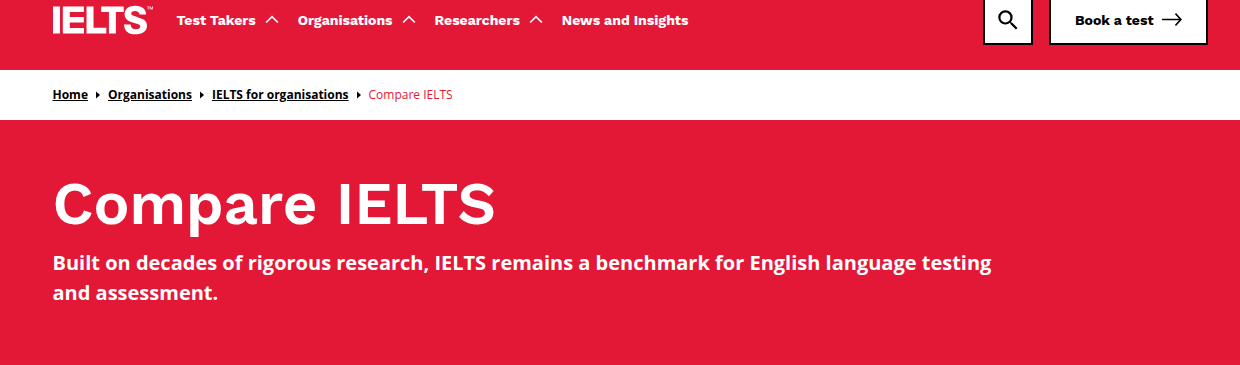
Source: screenshot of the official IELTS comparison resource. Test comparisons help interpretation; institutions decide which results they accept.
Why meeting the overall score may still be insufficient
Consider this constructed example for a programme requiring 6.5 overall and at least 6.0 in every component:
| Listening | Reading | Writing | Speaking | Overall | Requirement met? |
|---|---|---|---|---|---|
| 7.0 | 7.0 | 5.5 | 6.5 | 6.5 | No: Writing is below 6.0. |
The applicant's average reaches the overall threshold, but the Writing condition remains unmet. An extra half-band in Reading does not remove that problem. Planning only around an overall target can therefore waste preparation time.
Create a gap table using your most credible current evidence. If you have an official result, record the four components. If you have only practice results, label them as practice and avoid treating an unassessed essay or a short exercise as an official band. Our original four-skill IELTS exercises with answers help identify error patterns, but do not produce a certified score.
When Writing or Speaking is the uncertainty, Truescho's IELTS preparation service offers a mock package with feedback on both Writing tasks and a Speaking mock. Its estimated band and feedback can guide practice; they are not an official IELTS result or an admission guarantee.
Your preparation target should address the weakest required component while maintaining the others. For example, an applicant who already meets Listening and Reading thresholds may need more detailed review of essay organization and argument development, not simply more vocabulary lists. Make the next study activity answer a specific question about the gap.
Academic, General Training, Online, UKVI and One Skill Retake
A familiar test name does not establish acceptance of every version. Before paying, copy the institution's wording about IELTS Academic, any delivery restrictions and whether a combined result after One Skill Retake is accepted. Do not assume that a convenient booking option meets the course's evidence rules.
The verified examples show different policies. Oxford graduate admission does not accept IELTS Online or One Skill Retake. UBC undergraduate guidance excludes General Training, Indicator and One Skill Retake. Sydney excludes IELTS Online but assesses One Skill Retake with the original Academic result, with validity linked to the original test date. TUM accepts One Skill Retake with the new complete Test Report Form. These details come from the institution pages linked in the table; none is a universal IELTS rule.
If you are considering an at-home option, our IELTS Online acceptance guide provides a checklist of questions to investigate. The decisive answer still belongs to the institution receiving the score. Keep written confirmation when the website is unclear, and include the exact test product in your question rather than asking only whether it accepts “IELTS.”
One Skill Retake can be relevant when one component is below the threshold, but first check availability, eligibility, recipient acceptance and the deadline. If one university accepts it and another does not, your shortlist may require a different plan. Do that comparison before deciding that a partial retake solves the whole application problem.
University admission, scholarship selection and visa proof
Treat these as three separate evidence checks. A university can require a test even when a scholarship does not impose its own English score. A scholarship can also set conditions beyond a university's basic entry standard. Meeting either set does not automatically complete immigration requirements.
For example, Chevening removed its own English-language requirement in 2020, while applicants still need to satisfy their chosen universities and obtain the required unconditional offer. “The scholarship has no IELTS requirement” therefore does not mean “I can ignore the university's English evidence.”
For the UK Student visa, government guidance on knowledge of English distinguishes CEFR B2 for degree-level study or above from B1 below degree level. At degree level or above, an eligible higher education provider can assess English itself. Other evidence routes and exemptions can apply. It is inaccurate to say that every UK degree applicant must take IELTS for UKVI.
Check the sponsor's instructions, your admission conditions and the official visa guidance together. Ask the institution which evidence it will use for your particular route. Do not turn a general CEFR statement into an invented universal IELTS overall score.

Source: screenshot of the UK government's Student visa English-language table. It describes CEFR levels, not a universal university IELTS threshold.
Comparing IELTS with the current TOEFL and Duolingo scales
Since 21 January 2026, TOEFL iBT uses a 1–6 scale in half-point steps. ETS provides a comparable overall 0–120 score during a two-year transition. Check which scale appears on your report and how the receiving institution expresses its requirement; do not silently read a new 4.5 as though it belonged to the old scale. See ETS's score-scale update.
The following comparisons come from provider guidance. They are useful reference points, not interchangeable certificates or a formula that grants admission.
| IELTS band | TOEFL iBT 1–6: ETS comparison | Duolingo English Test: provider comparison |
|---|---|---|
| 6.0 | 4.0 | 105–115 |
| 6.5 | 4.5 | 120–125 |
| 7.0 | 5.0 | 130–135 |
| 7.5 | 5.5 | 140–145 |
Sources: ETS's published comparison and the Duolingo English Test scoring guide for teachers. The columns are separate provider comparisons with IELTS; do not use them to create an additional TOEFL-to-DET conversion.
Acceptance can change independently of the score scale. At the verification date, Oxford's language guidance states that TOEFL tests taken from 21 January 2026 are not accepted. Check for a policy update before booking. A score comparison cannot override an institution's decision about the test itself.
If several tests are accepted by every programme on your shortlist, compare preparation fit, available dates, score reporting and practical constraints. Our IELTS, TOEFL and Duolingo comparison guide can help organize those choices; use each university's current page for its actual minimum.
Does an English-medium degree qualify you for a waiver?
An English-medium degree or a medium-of-instruction letter may support a waiver request, but it does not guarantee approval. Policies can depend on the institution, country, length and recency of study, prior test evidence and the precise programme. “My degree was taught in English” is the beginning of an evidence check, not the end.
KFUPM's international admission guidance identifies waiver categories including its own graduates and graduates from specified English-speaking countries. Do not expand that into an automatic exemption for every English-medium degree worldwide. Khalifa University's catalogue also makes waiver eligibility dependent on specified evidence and review, rather than an unrestricted promise based on a generic letter.
Use a short, factual request. Identify your intended programme, awarding institution, qualification dates and language of instruction. Attach or offer the evidence the university requests. Ask whether you qualify for the stated waiver and whether additional proof is needed. Avoid sending a long argument that assumes the outcome in advance.
Keep a backup plan until the waiver is confirmed. If testing deadlines are approaching, find out whether you can submit an application while evidence is pending and when the final condition must be met. Those rules are programme-specific; do not infer them from another university's flexibility.
Build an application plan around the actual gap
Make one row per programme in a spreadsheet. Include the source link, accepted test, overall and component thresholds, evidence deadline, validity rule, waiver status and any unresolved question. Use “not stated” for missing information, not a guessed value. When an admissions office replies, save the response alongside the row.
Next, identify the overlap across your shortlist. If every programme accepts the same test and delivery version, preparation can focus on one route. If a target programme excludes your preferred test, decide whether to change the test plan or the shortlist before you spend money.
Compare your current evidence with each row. Separate three situations: you meet the stated conditions; a specific component is below the minimum; or your evidence is not an accepted form. These call for different actions. More practice will not make an unaccepted test certificate acceptable, and a waiver request will not necessarily repair an inadequate score.
When a score is below target, ask about published alternatives such as an approved language pathway or conditional offer. Confirm the conditions, additional cost and progression rules in writing. Do not treat a pathway as an automatic route to the degree simply because a marketing page mentions it.
For preparation, use a realistic timetable based on the gap and application deadline. The one-month IELTS and TOEFL study plan offers a structure you can adapt. A calendar is a planning tool, not a promise that every learner can gain a particular band within that period.
Finally, leave time for score delivery, any required retake and administrative verification. Record the latest acceptable test date rather than assuming the application deadline is also the test deadline. Recheck the official policy before booking and again before submitting your evidence.
Frequently asked questions
Is IELTS 6.5 enough for a master's degree?
It meets the overall requirement for some programmes, including named examples in this guide. Others require a higher overall score or specific component floors. Check the exact programme and test version. A general statement about master's study in a country is not sufficient evidence.
Can a high overall score compensate for a low Writing score?
Not when the programme specifies a Writing minimum that you have not met. Treat each component condition separately. If the policy offers a retake or alternative route, check the terms; do not assume admissions staff will disregard the stated floor because your other scores are higher.
Does a department's requirement override the university baseline?
Follow the requirement applicable to your programme. A central graduate page often gives a baseline while departments specify higher standards. If two official pages conflict, ask for clarification and keep the response. Do not choose the lower number simply because it is easier to meet.
Can I replace IELTS with Duolingo using a conversion table?
Only if the recipient accepts Duolingo for your programme and you meet its stated DET conditions. A comparison table does not grant that permission. The same applies to TOEFL and other tests: acceptance and required scores must come from the receiving institution.
Does a medium-of-instruction letter guarantee an exemption?
No. It may be one document in a waiver application. Check the eligible institutions, qualifications, dates and other evidence in the university's policy, then obtain confirmation. Keep an alternative testing plan until the waiver has been approved.
Can I apply before my English score arrives?
Some routes allow pending evidence or conditional offers, while others require the score at application. Check both the application deadline and the deadline for satisfying conditions. If the website is unclear, ask the programme rather than relying on another applicant's experience.
Will One Skill Retake be accepted everywhere?
No. The institutional examples above include both acceptance and refusal. Check the specific programme, required report and validity rules before booking. A successful component retake does not solve the problem if the receiving institution excludes that result format.
Turn the requirement into your next study task
Once your shortlist and component targets are clear, choose practice that addresses the measured gap. For structured individual work, Truescho's IELTS preparation course includes lessons, corrected writing and mock practice. Confirm the current package and your starting level; the course supports preparation without guaranteeing a score or admission outcome.