
humain-m3: Saudi Arabia's Arabic-First Frontier Model, Explained
Last updated: October 2026
On September 3, 2026, at the LEAP conference in Riyadh, Saudi Arabia's HUMAIN unveiled humain-m3, a model it calls the first frontier-grade Arabic language model — posting a 89.37% average across seven dedicated Arabic benchmarks and, in the company's own evaluation, edging out GPT-5.6 Sol by two full points. The model is available now as a free-request research preview on the HUMAIN Node platform, though every number published so far is the company's self-evaluation rather than an independent measurement.
The headline score is only part of the story. What separates this launch from the dozens of model announcements that cross the wire every month are three facts: the model was purpose-built for Arabic with more than a trillion tokens of native Arabic content, it comes from a Saudi company backed by the kingdom's Public Investment Fund, and there is a formal commitment to release open weights within weeks. This guide breaks the model down piece by piece — what it is, who built it, how you can try it today, and whether it deserves a place in your toolkit alongside the models you already use.
The benchmark table everyone is quoting
The figures HUMAIN published at launch cover seven established Arabic-language benchmarks, equally weighted. Here is the full breakdown as reported in the company's evaluation of the preview checkpoint:
| Benchmark | humain-m3 score | What it actually measures |
|---|---|---|
| AlGhafa | 86.45% | Core Arabic language understanding |
| ArabicMMLU | 90.70% | Knowledge grounded in authentic Arabic content |
| Translated MMLU | 93.20% | General knowledge translated into Arabic |
| Arabic EXAMS | 67.67% | Academic examinations in Arabic |
| MadinahQA | 95.44% | Arabic grammar and style mastery |
| AraTrust | 97.53% | Truthfulness and answer reliability |
| ALRAGE | 94.63% | Retrieval-augmented answering quality |
The practical read of this table: the model is strongest in the language itself and in source-grounded answering, while its weakest result is formal academic examinations at 67.67% — a visible gap if you plan to use it for academic editing or complex exam-style reasoning.
For comparison, HUMAIN's announcement placed competitors on the same test suite under its own harness: GPT-5.6 Sol at 87.30%, Claude Opus 5 at 87.34%, and the MiniMax M3 reference point the model was built on at 80.34%. In other words, the gap to the closest international rivals sits near two percentage points on average, and the intensive Arabic post-training added roughly nine points over the original base model. HUMAIN also reports the model leading five of the seven individual benchmarks under its evaluation.
Who is behind humain-m3: HUMAIN, MiniMax, and the sovereign fund
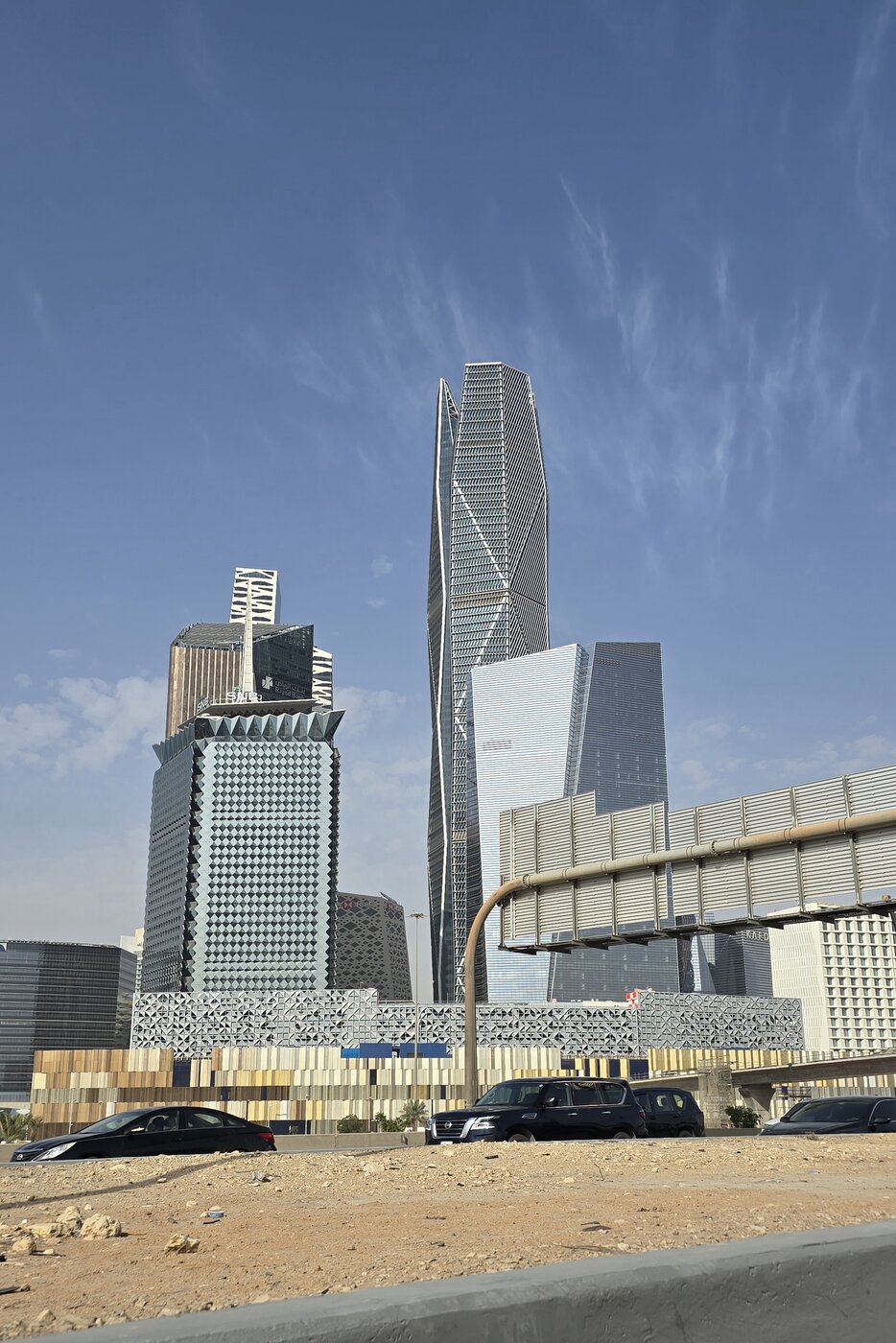
Source: Wikimedia Commons — Public Investment Fund Tower

HUMAIN is a Saudi AI company launched under the umbrella of the kingdom's Public Investment Fund (PIF), and it is led by the well-known technology executive Tareq Amin. The model itself came out of an unconventional partnership: Saudi design and commissioning on one side, technical execution by China's MiniMax on the other — one of the fastest-rising AI labs in Asia. humain-m3 is built on the MiniMax-M3 lineage and totals 428 billion parameters in a mixture-of-experts architecture that activates only 23 billion parameters per token — an approach that combines a very large knowledge capacity with efficient inference economics.
In the launch statement, Tareq Amin, CEO of HUMAIN, put the mission directly: Arabic is spoken by hundreds of millions of people, yet it remains heavily underrepresented at the frontier of AI, and with humain-m3 the company is investing in changing that. The bet, in plain terms: first-generation frontier labs treat Arabic as an afterthought, while this model is built with Arabic as its foundation rather than an accessory.
This is not HUMAIN's first move in this direction. The company previously partnered with France's Mistral on joint Arabic models — a collaboration we covered in detail in our analysis of the Mistral–HUMAIN partnership — and it maintains the academic ALLAM Arabic model family. What is new this time is the stated ambition: competing for the top of the leaderboard directly, not merely having regional representation on the map.
What actually makes it "Arabic-first": the technical story in plain English
Three engineering decisions distinguish this model from a foreign product with a translated interface. First, pre-training ran on more than a trillion tokens of native Arabic content — text originally written in Arabic rather than machine-translated material — and this shows up in the strong results on authentic-knowledge benchmarks like ArabicMMLU. Second, the post-training phase was executed in Arabic and added roughly nine points on average over the reference model, which is a large margin by the standards of this field. Third, the model is natively multimodal from the first step of training: it processes text, images, and video together, including long-video understanding and native computer-screen operation.
On top of that, humain-m3 is designed for long-horizon agentic workflows in both Arabic and English: tool use, computer control, and three switchable thinking modes — always-on thinking, adaptive thinking, or thinking fully disabled for faster responses. This flexibility matters in practice because the same model can run "heavy" for a complex analysis task or "light" for a quick conversation, which explains the two access tiers on the platform.
How to try humain-m3 today: a practical walkthrough
Access is open to anyone with an account on the HUMAIN Node platform, and the basic trial requires zero code. Here are the steps as documented by the platform:
- Go to node.humain.com and create a free account.
- Request humain-m3 access from your account dashboard (requests are approved quickly during the preview phase).
- For a quick test: use the no-code interactive playground and ask questions in formal Arabic or a regional dialect — the preview is partly designed to probe the model across dialects.
- For development: use the OpenAI-compatible API endpoint — any code written against the OpenAI SDK works by changing only the base URL and the key.
- Note the two service tiers: the "limited preview" tier runs behind a Saudi safety guardrail with thinking and streaming disabled and higher latency, while the "research preview" tier gives you the full checkpoint with thinking, streaming, and lower latency.
humain-m3 is the first model opened to preview users on the platform, but HUMAIN Node itself hosts more than a hundred global and open models behind a single API, a single key, and a single invoice, with global, in-Kingdom, or sovereign hosting options — the last of these aimed squarely at Gulf and government institutions that require data to stay inside the kingdom's borders.
For readers who use AI tools daily across study and work, note that Truescho's opportunity listings include AI training programs and fellowships for people going deeper into this field, while the Truescho shop covers discounted global subscriptions for anyone who needs GPT or Gemini running alongside this new Arabic experiment.
Quick comparison: humain-m3 versus the tools people actually use
How does the new model stack up against what's already in your toolkit? The table below summarizes the picture honestly, with the reminder that humain-m3's numbers are the company's own evaluation:
| Model | Arabic strength | Open weights | Access from the Gulf | Best suited for |
|---|---|---|---|---|
| humain-m3 | Highest in published evaluations (89.37%) | Promised in October | Native, with in-Kingdom hosting | Arabic content and sovereign institutions |
| GPT-5.6 Sol (OpenAI) | Strong (87.30% per HUMAIN's eval) | No | Via global endpoints | Broadest general use |
| Gemini 4 Argon (Google) | Good and improving | No | Via global endpoints | Google ecosystem and multimodal work |
| Qwen 3.8-Max (Alibaba) | Very good on translated content | Yes | Via global endpoints | Developers and lower budgets |
| ALLAM (earlier Saudi family) | Moderate | Partially | Limited | Academic research |
Two caveats on this table. First, the column is not final: independent, neutral measurements of humain-m3 have not been published yet, and differences under two percentage points between major models tend to flip from one test to the next. Second, the real value of the Saudi model is not a marginal claimed lead over GPT — it is the combination of three properties that no other model offers together: authentic Arabic training, open weights promised imminently, and a sovereign in-Kingdom hosting option. For a deeper look at the current frontier race, see our coverage of the Gemini 4 Argon launch, our review of Qwen 3.8-Max from Alibaba, and our guide to Arabic text-to-speech with Gemini TTS.
What this means for you in practice
For professionals and organizations worldwide — and especially anyone building for the Arabic-speaking market — four practical implications stand out. First, if you produce Arabic content, work in media, law, or localization, you now have a first frontier model trained on a trillion Arabic tokens one free sign-up away; test it on a sample of your real workload before drawing conclusions, because benchmark performance does not always transfer to your specific use case. Second, if you are a government or semi-government institution in Saudi Arabia, the sovereign hosting option removes the biggest obstacle to adopting frontier models, which until recently required dealing exclusively with foreign providers. Third, if you are a developer anywhere from Lagos to Jakarta, OpenAI API compatibility means the integration cost is minutes, not days — and the upcoming community-licensed weights could give you a strong Arabic model you run on your own hardware. Fourth, if you are a researcher, the research preview itself is a window into how Arabic models are being evaluated — and the 67.67% academic-exams score says the field is still wide open for improvement.
Honest limits you should know before judging
Professional honesty requires the other side of the picture. Every published result is a self-evaluation by HUMAIN of a preview checkpoint — not an independent audit — and the historical track record of labs grading their own homework is well known. The model is in research preview: its behavior and capabilities may change before general availability, no pricing has been announced, and access requires a manually approved request. The "limited preview" tier runs behind a Saudi safety guardrail compared to the full checkpoint, so your first experiment may not represent the model's best output. Finally, even taking the numbers at face value, a two-point lead over GPT-5.6 Sol is not a reason for wholesale replacement — the genuine value lies in the Arabic specialization, the sovereignty option, and the promised openness, not in a benchmark horse race. For more open-weight alternatives, see our DeepSeek V4 guide, which remains the cheapest option for heavy use.
The bigger picture: LEAP, $15 billion, and the October race
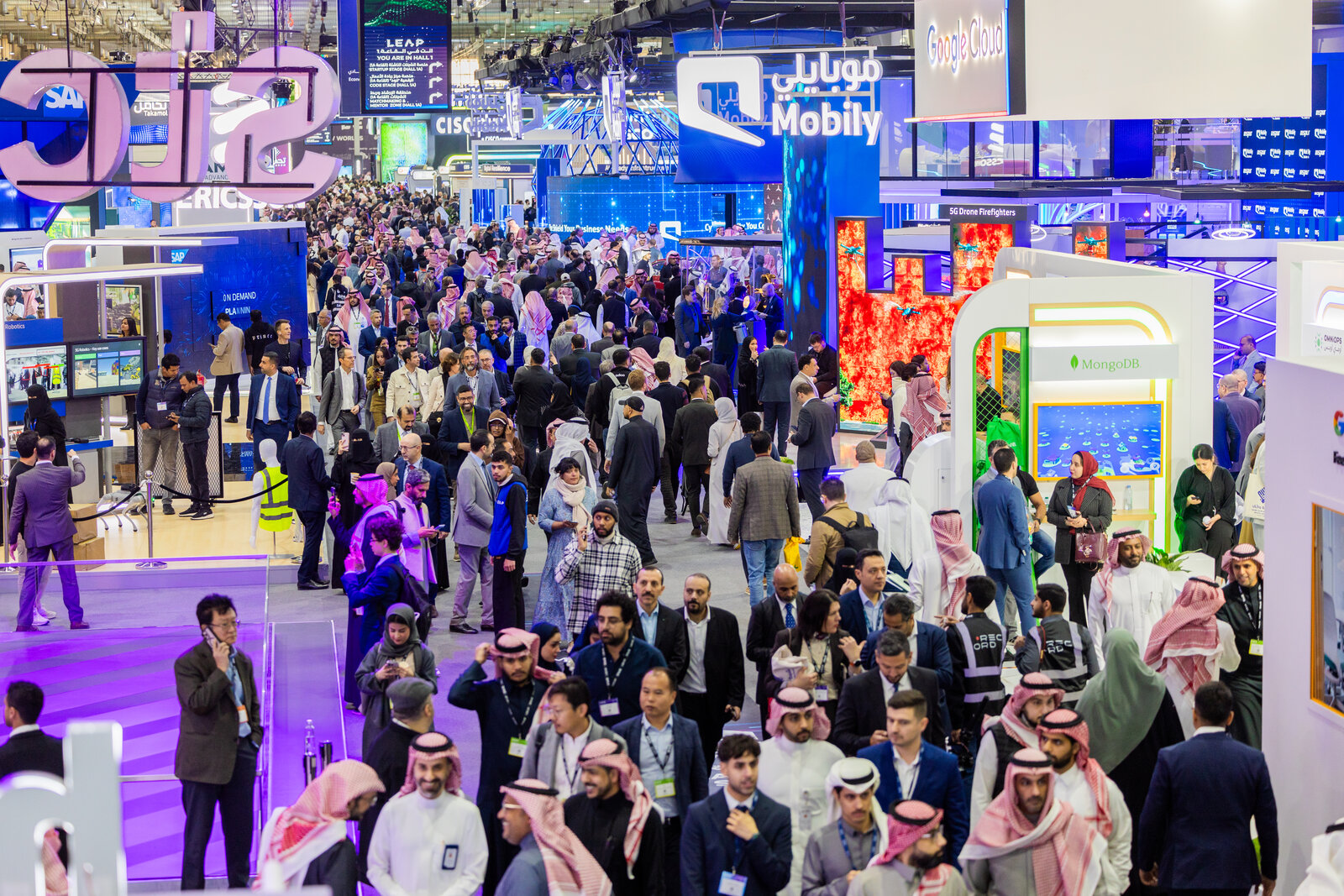
Source: Wikimedia Commons — LEAP Global tech event

The announcement did not happen in isolation. The 2026 edition of LEAP closed with roughly $15 billion in deals and investments according to multiple press reports, with HUMAIN at the center of projects spanning hyperscale data centers to model partnerships. In the same weeks, global outlets including Bloomberg reported on wider Saudi AI investment plans and dedicated AI venture funds.
The date that matters most for the open-source community is the next one: HUMAIN committed in its announcement to releasing humain-m3's open weights under the MiniMax Community license once safety and alignment training is complete, targeting "next month" — October 2026 by the announcement's timing. If the promise holds, it becomes the first open-weight Arabic frontier model you can download and run locally, ahead of every closed American frontier model and in direct competition with the open Chinese wave from Qwen and DeepSeek.
Frequently asked questions about humain-m3
What is the humain-m3 model?
It is an Arabic-first frontier language model announced by Saudi company HUMAIN on September 3, 2026, at the LEAP conference in Riyadh, developed for HUMAIN by China's MiniMax. It has 428 billion total parameters in a mixture-of-experts design activating 23 billion per token, was pre-trained on over a trillion tokens of native Arabic content, and is available as a research preview via the HUMAIN Node platform.
Is humain-m3 free to use?
During the research preview phase, yes: create an account at node.humain.com and request access. No commercial pricing has been announced; the company is collecting feedback before general availability, and pricing is expected to be revealed at the official launch.
Is humain-m3 better than GPT at Arabic?
By HUMAIN's own evaluation, yes on Arabic test suites: 89.37% average versus 87.30% for GPT-5.6 Sol. But the gap is only two points, the evaluation was run by the model's own maker rather than an independent party, and neutral measurements have not yet been published — so the honest answer is "ahead in company-run Arabic tests, final verdict pending."
Can developers outside the Middle East access it?
Yes. The platform exposes an OpenAI-compatible API endpoint, so any existing OpenAI SDK integration works with a changed base URL and key. The no-code playground is also open to any registered user, and enterprise customers can choose global, in-Kingdom, or sovereign hosting.
When will the open weights be released?
HUMAIN has targeted "the next month" from its September announcement — meaning October 2026 — under the MiniMax Community license, after safety and alignment training is completed. If the timeline holds, it will be the first open-weight Arabic frontier model available for local deployment.
How does humain-m3 differ from Saudi Arabia's earlier ALLAM models?
ALLAM is an earlier, smaller, research-oriented family of Arabic models, while humain-m3 is a 428-billion-parameter frontier model aimed at global competitiveness and production use — and it is the first model HUMAIN has opened to public preview on its own platform.
Where the Arabic AI landscape goes next
Over the coming weeks, three checkpoints will tell the real story: whether HUMAIN meets its October target for open weights, whether independent evaluations confirm or correct the company's numbers, and how OpenAI and Google respond on Arabic quality in their next updates. What is already certain is that the equation of "Arabic as a second-class citizen in AI" broke this month for the first time — and by an actor that holds the capital, the decision-making power, and the market simultaneously. Anyone whose work touches Arabic content now has a professional obligation to test the model personally and build an opinion on evidence rather than headlines. For continuous coverage of the model releases that matter, follow Truescho's opportunity feed and start with our free tools for students and researchers.
Sources
- HUMAIN's official humain-m3 announcement — the developer's primary statement
- HUMAIN Node platform — preview access and the interactive playground
- Unite.AI's detailed launch coverage — full benchmark transcription from the announcement
- Bloomberg's launch coverage — first global wire report
- LEAP photo on Wikimedia Commons — free-license conference imagery