
Article 2 ===
Project Suncatcher: Google's AI Satellite Launches Next Week
Eight times. That is how much more solar power a satellite in low Earth orbit can collect compared with the same panels on the ground, according to Google. On September 24, 2026, the company published a detailed engineering update on Project Suncatcher, its moonshot plan to run AI workloads in space. And the first big test is closer than most people realize: a prototype satellite is preparing to launch next week.
The satellite will ride to orbit on SpaceX's Transporter-18 rideshare mission, in partnership with the satellite company Planet. Its job is narrow but ambitious: find out whether Google's TPU AI chips can survive space and keep computing there. Google first announced Suncatcher last year, and this week's update — published alongside a new video series — is the deepest public look yet at the physics problems involved.
Source: Google Blog
Source: Google Blog
Why Google wants AI in space at all
Start with the economics. Electricity and cooling are the largest recurring costs of running AI infrastructure on Earth. Data centers compete for grid power, land, and water, and the bigger AI models get, the worse that math becomes. Anywhere with cheap, abundant energy becomes attractive.
Space is the extreme version of that idea. In low Earth orbit, satellites enjoy what Google calls near-constant sunlight, generating up to eight times more solar power than on Earth. No clouds. No night-and-day cycle in the way terrestrial panels experience it. No atmosphere dimming the light before it reaches the panels.
The long-term goal, as Google frames it, is scalable machine learning infrastructure in space — so that the benefits of AI, from health to scientific discovery, remain available to everyone rather than rationed by terrestrial power bills. Space and AI are converging from several directions at once, as we saw recently with the Grok and SpaceX AI story.
One caveat worth repeating: Suncatcher is research, not a product. Nothing here changes your cloud bill next quarter.
Surviving the ride to orbit
Before a single chip can compute in space, it must survive the trip. The ride to orbit lasts roughly ten minutes, and it is violent. Google's update describes sustained acceleration of up to 10g during launch, with individual components — including TPU chips — experiencing forces between 50 and 100g.
To prepare, the team completed three-axis vibration testing, shaking the hardware the way a rocket will shake it, in every direction. Passing that test is the price of admission; a satellite that arrives in orbit with cracked solder joints is just expensive debris.
Source: Google Blog
A proton beam in California and the bitflip problem
Launch stress is only the first enemy. The second is radiation, and it is sneakier. High-energy particles in space can flip individual bits in a chip's memory — tiny errors called bitflips that can corrupt a computation without leaving any visible damage.
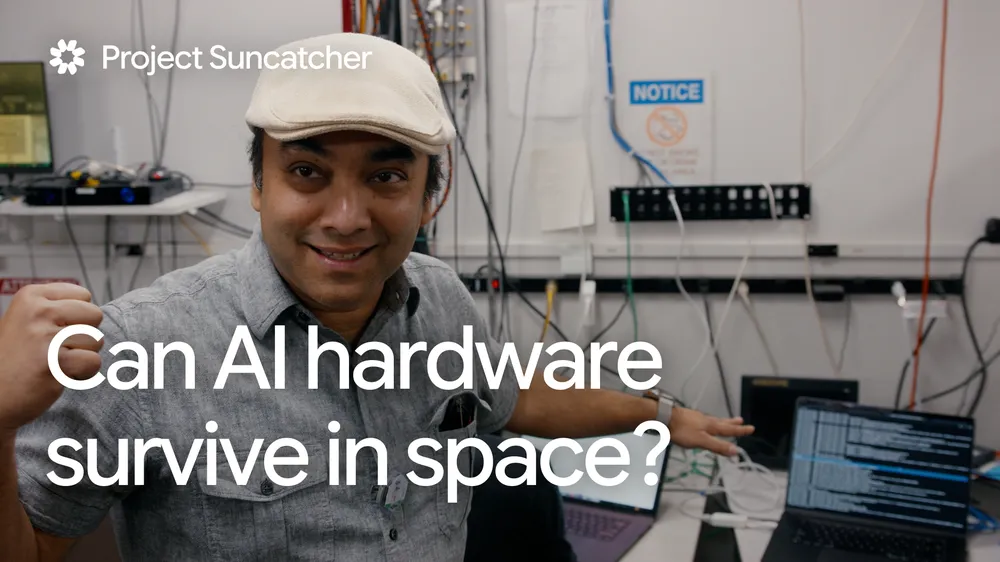
Google's answer was to test before flying. The team took its hardware to the UC Davis Crocker Nuclear Laboratory and put it in front of a proton beam — while the chips were actively running AI workloads. That combination matters: a chip that survives radiation while idle might still fail when it is thinking.
The early results are encouraging. Google's exact words: "Initial results have shown that our Trillium TPUs hold up remarkably well." Trillium is the generation of TPU hardware in these tests, and its radiation tolerance is the single most important scientific bet in the project.
Source: Google Blog
Cooling chips where there is no air
Here is the counterintuitive part. Orbit is cold, but cooling is harder there, not easier. On Earth, data centers move heat away with air or liquid. In the vacuum of space there is no air at all, so heat has to be managed differently.
Suncatcher's design uses heat pipes and radiators. Heat pipes carry thermal energy away from the processors, and radiators release it into space. Google tested the whole arrangement in a thermal vacuum chamber, which simulates orbital conditions on the ground. A satellite that cannot shed heat effectively will cook its own chips, no matter how much sunlight it collects.
What happens next week: Transporter-18
The prototype satellite's flight on Transporter-18, SpaceX's upcoming rideshare mission, is a survival experiment, not the opening of a space data center. Rideshare missions bundle many small satellites onto one rocket, which makes them an affordable way to fly experimental hardware.
The satellite, flying with partner Planet, will gather real performance data on how TPUs behave in orbit — radiation effects, thermal behavior, and overall reliability. Google has not published an exact launch date and time, so watch its blog and SpaceX's mission updates for the specifics.
In the meantime, the same engineering instincts apply closer to the ground: if energy systems, aerospace, or AI infrastructure sound like the career you want, the open programs on Truescho list current scholarships and internships in exactly these fields.
The 2027 milestone: lasers between moving satellites
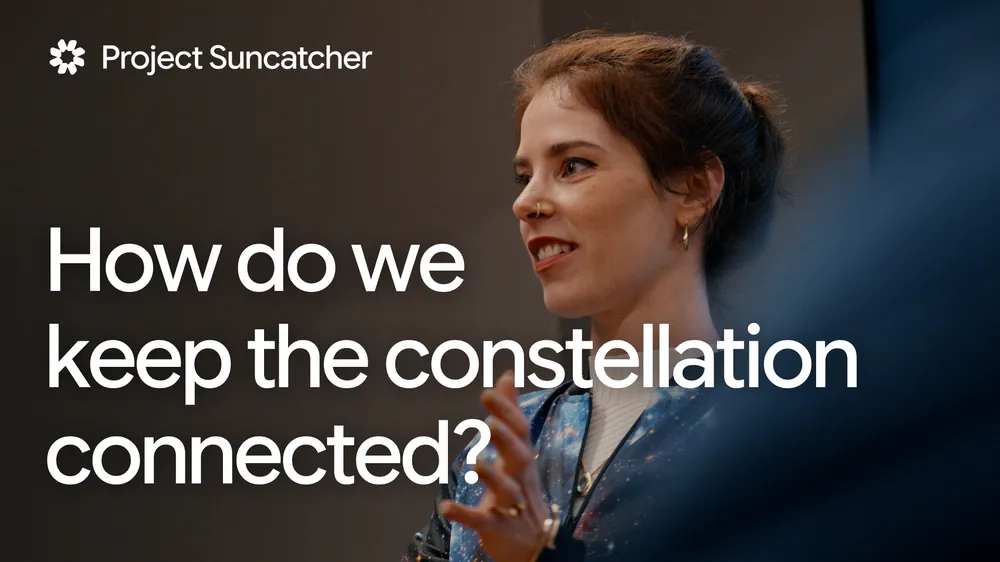
One satellite is a test. The actual vision is clusters — satellites carrying dozens of TPUs each, linked by high-bandwidth lasers, working together as a distributed AI system in orbit.
The hard part is aiming. Two satellites moving independently in orbit must keep a laser link locked between them. Google describes the required precision as "similar to hitting a coin-size target from miles away while both points are in motion." The company plans to test exactly that in 2027, when it puts two satellites in orbit to demonstrate the laser links, and then begin scaling up.
Source: Google Blog
Source: Google Blog
Quick comparison: a TPU satellite vs an Earth data center
| Factor | Suncatcher satellite (space) | Traditional Earth data center |
|---|---|---|
| Solar power | Up to 8x more than on Earth, near-constant sunlight | Reduced by clouds, night, and atmosphere |
| Cooling | Heat pipes and radiators; no airflow possible | Air or liquid cooling systems |
| Radiation | Proton beam testing needed; bitflips watched closely | Largely shielded by the atmosphere |
| Physical stress | Up to 10g sustained at launch, 50-100g on components | None beyond normal transport and earthquakes |
| Hardware | Dozens of TPUs per satellite in future clusters | Racks of processors, serviceable by humans |
| Status today | Prototype flying on Transporter-18 | Mature and operating worldwide |
The honest conclusion from that table: Earth remains dramatically easier, which is exactly why Suncatcher is a multi-year moonshot rather than a product launch. The bet is that the 8x energy advantage compounds over time as launch costs fall.
What this means for you
Nothing here goes on sale next week, and there is no subscription to buy. The meaning is bigger and longer-term. First, it signals that the AI industry's energy problem is serious enough that one of the world's largest companies will shoot its own chips into orbit to escape it. Second, it creates real career pull in aerospace engineering, power electronics, and orbital systems — fields where demand is growing faster than the talent supply.
For students choosing a direction, this is a rare moment where three disciplines — AI, energy, and space — are visibly merging. The TPUs being radiation-tested at UC Davis are cousins of the chips that run the Gemini models you use, including the Gemini 3.8 Live model launched on September 15 and the Live Avatar system revealed the very same day as this Suncatcher update.
The open questions Google has not answered
The update is detailed about physics and quiet about money. Google has not shared project costs, the compute capacity of the prototype, or an exact launch date. The radiation results are labeled "initial," not final. There is no published timeline for an operational cluster beyond the 2027 two-satellite laser test, no stated failure-rate targets, and no discussion of what happens to the hardware at end of life. Anyone calling this a space data center today is ahead of the evidence.
Frequently asked questions
What is Project Suncatcher?
Project Suncatcher is Google's research project, first announced in 2025, to test whether AI chips can survive and work in space. The first prototype satellite launches on SpaceX's Transporter-18 rideshare mission in partnership with Planet. The long-term goal is scalable machine learning infrastructure in orbit, powered by nearly constant sunlight.
Who launched Project Suncatcher — Google or Planet Labs?
Google leads Project Suncatcher; it is a Google moonshot published on the company's own blog. Planet is the mission partner for the prototype flight. The Transporter-18 ride itself is provided by SpaceX, so three companies are involved, but the chips, tests, and research goals belong to Google.
Which SpaceX mission will carry the Suncatcher satellite?
Transporter-18, one of SpaceX's rideshare missions, which carry many small satellites on a single flight. Google's update points to a launch next week, in partnership with Planet, although no exact date and time has been published. The prototype rides alongside other customers' payloads to gather real orbital data.
Can AI data centers work in space?
In principle, yes, and that is what Suncatcher is testing. Chips must survive launch vibration, radiation, and vacuum conditions with no airflow for cooling. Google's initial proton beam results show its Trillium TPUs hold up remarkably well, but an operational cluster of networked satellites remains years away.
What are Google's TPU satellites?
TPUs are Tensor Processing Units, the custom chips Google built to train and run its AI models. A TPU satellite would carry these chips into orbit to run machine learning workloads using solar power gathered in space. Suncatcher's first prototype launches to collect performance data.
How do satellites stay cool in a vacuum?
There is no air in space, so fans cannot move heat away from a chip. Suncatcher uses heat pipes and radiators instead: heat pipes carry thermal energy away from the processors, and radiators release it into space. Google tested the system in a thermal vacuum chamber.
How much more solar power do satellites get than Earth?
Up to eight times more. Google says satellites in low Earth orbit enjoy near-constant sunlight and can generate up to eight times more solar power than the same hardware on Earth. No clouds, no weather, and almost no atmosphere stand between the panels and the sun.
What happens in 2027 for Project Suncatcher?
Google plans to put two satellites in orbit to test laser links between them, the key step toward clusters of satellites carrying dozens of TPUs. The pointing precision needed is similar to hitting a coin-size target from miles away while both points are in motion. Scaling follows from there.
What to watch next
Three checkpoints will tell you whether Suncatcher is real. First, the Transporter-18 launch and confirmation that the prototype is healthy in orbit. Second, the orbital performance data on the Trillium TPUs over the following months. Third, the 2027 two-satellite laser demonstration — the hardest engineering gate on the published roadmap. If space and AI are topics you want to work in rather than read about, start with the study programs on Truescho and see where the world's top engineering schools rank in our university rankings.
Sources
- Google Blog — Behind Project Suncatcher, our moonshot to put AI in space (September 24, 2026)
- Google on YouTube — Project Suncatcher overview video
- Google on YouTube — Keeping flying satellites connected with lasers
- Google Blog — Gemini 3.8 Live and Extended Thinking