
For years, tuning your feed has meant silent signals: clicks you did not make, videos you lingered on, a "less of this" button that felt like shouting into a well. On August 20, 2026, Google announced it is changing that contract. In a post on its official blog signed by Mrinalini Loew, General Manager of Google's Search Ecosystem, the company introduced a set of personalization features across Search, Discover, and Google News — and the headline feature is the ability to tell Discover, in plain written words, exactly what you want more and less of.
The announcement is small in form and large in implication. It moves feed control from inferred behavior to explicit conversation, and it hands publishers a new direct channel to their readers. This guide breaks down all three features, the rollout timeline, what was not announced, and what it means for international users and publishers alike.
Source: Google's official blog — blog.google
Feature one: the Preferred Sources button
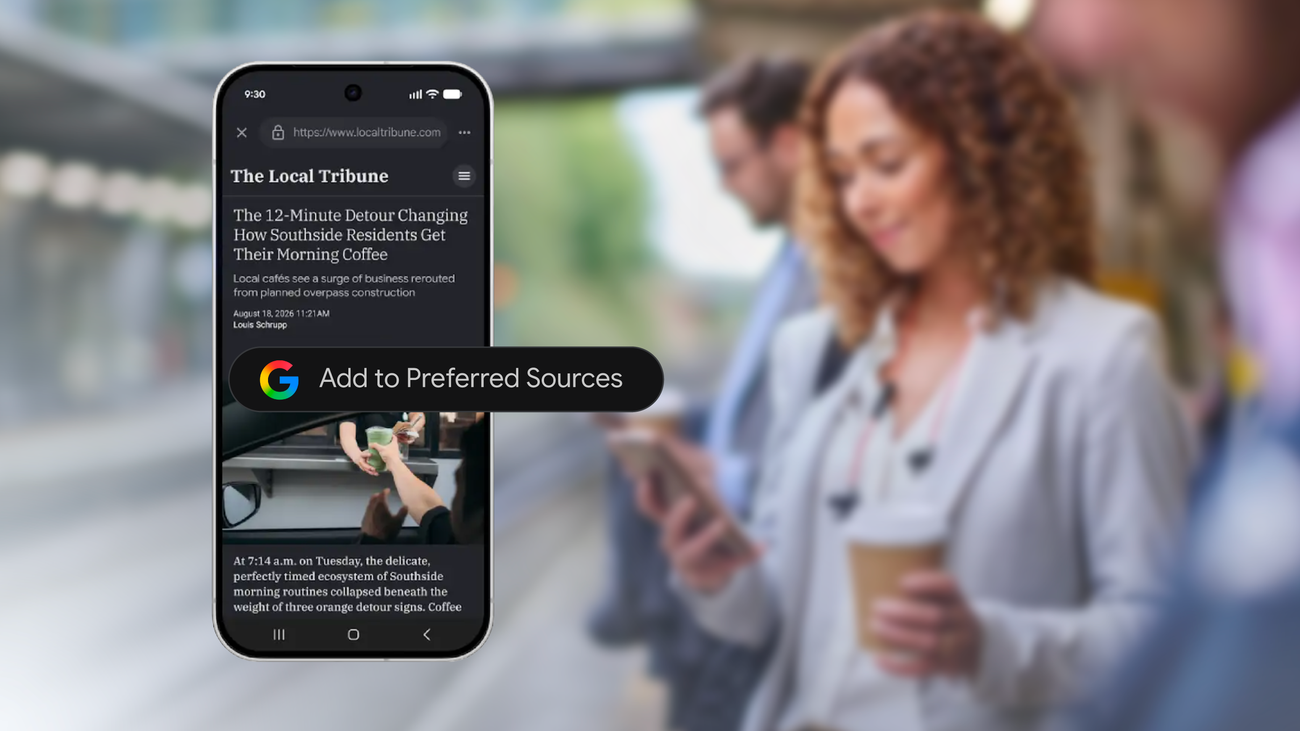
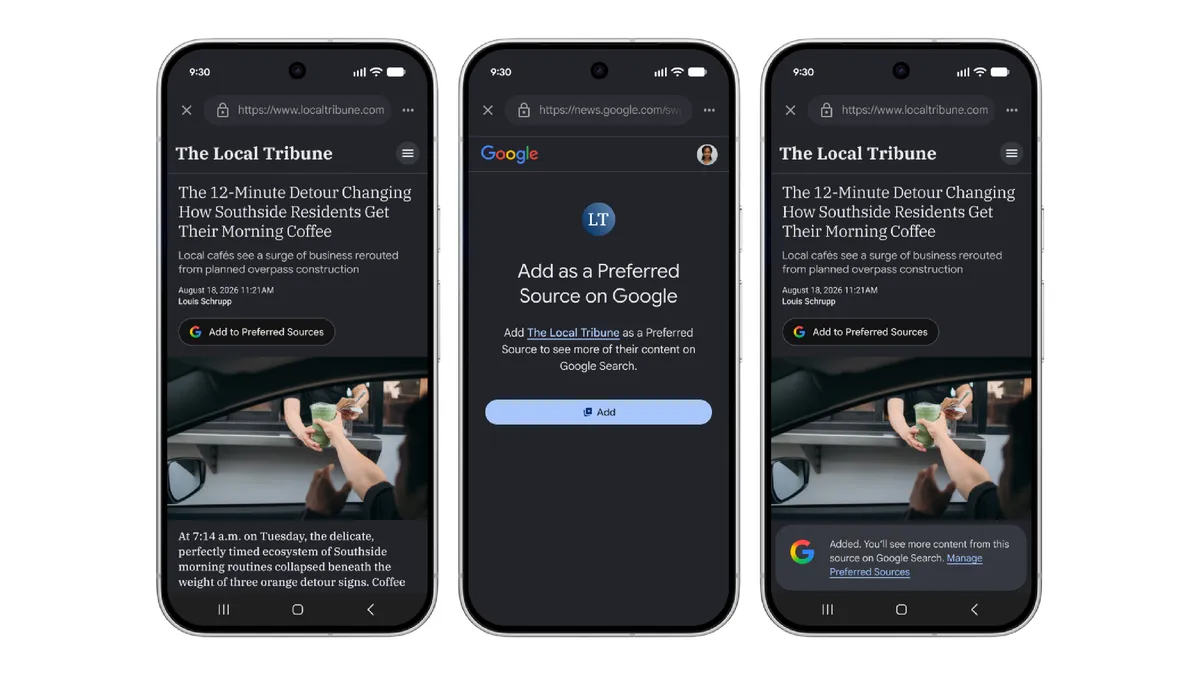
The first announcement is an interactive "Preferred Sources" button that publishers can embed on their own pages. When a reader clicks it, the site is added as a Preferred Source on Google — and the button immediately returns the reader to the exact spot where they left off on the publisher's page. The publisher keeps the visitor; the reader keeps their place; Google keeps the preference.
The effect shows up in three surfaces that matter more every month: Top Stories in Search results, the AI-generated summaries at the top of Search, and AI Mode, Google's conversational search experience. In plain terms, if you mark a publication as preferred, its content is more likely to appear in your news results and to be cited in AI-generated answers. For anyone worried that AI search would sever the bond between readers and the publications they trust, this is Google's counter-move — and it comes with a striking number attached: people have already selected more than 600,000 unique sources through the program.
For publishers, the button code and implementation guide live in Google's Search Central documentation, which makes this one of the rare AI-era features a site can adopt in an afternoon rather than a quarter — and it complements Google's wider push for AI-content transparency, which we covered in our piece on Google's AI ads labels.
Source: Google's official blog — blog.google
Feature two: tuning Discover in your own words
This is the change most users will actually feel. "Soon it will be as easy to tune your Discover feed as it is to text a friend," Google wrote — and the examples the company gave tell you exactly how it works. Want kitchen renovation ideas, eco-friendly only? Videos about weekend road trips, but absolutely no camping?
In the coming days, inside the Google app, you will be able to tap the three-dot menu on any card in your feed and type the topics or links you want to see more or less of, in your own words. The feed adjusts on the fly and remembers your requests. There is no taxonomy to navigate and no settings maze: the language model has effectively become the settings menu. For anyone tracking AI inside Google's everyday products — from Gemini's arrival in Chrome on Android to this — the direction is unmistakable.
It is worth pausing on what this represents. Every major feed today — TikTok, Instagram, X, YouTube — is tuned through behavior and negative signals. Google is betting that people will happily type what they want if the system actually listens. Whether users adopt written curation at scale is an open question, but the direction is unmistakable: conversational input is becoming a first-class control surface, not a gimmick.
Feature three: customizable audio briefings in Google News
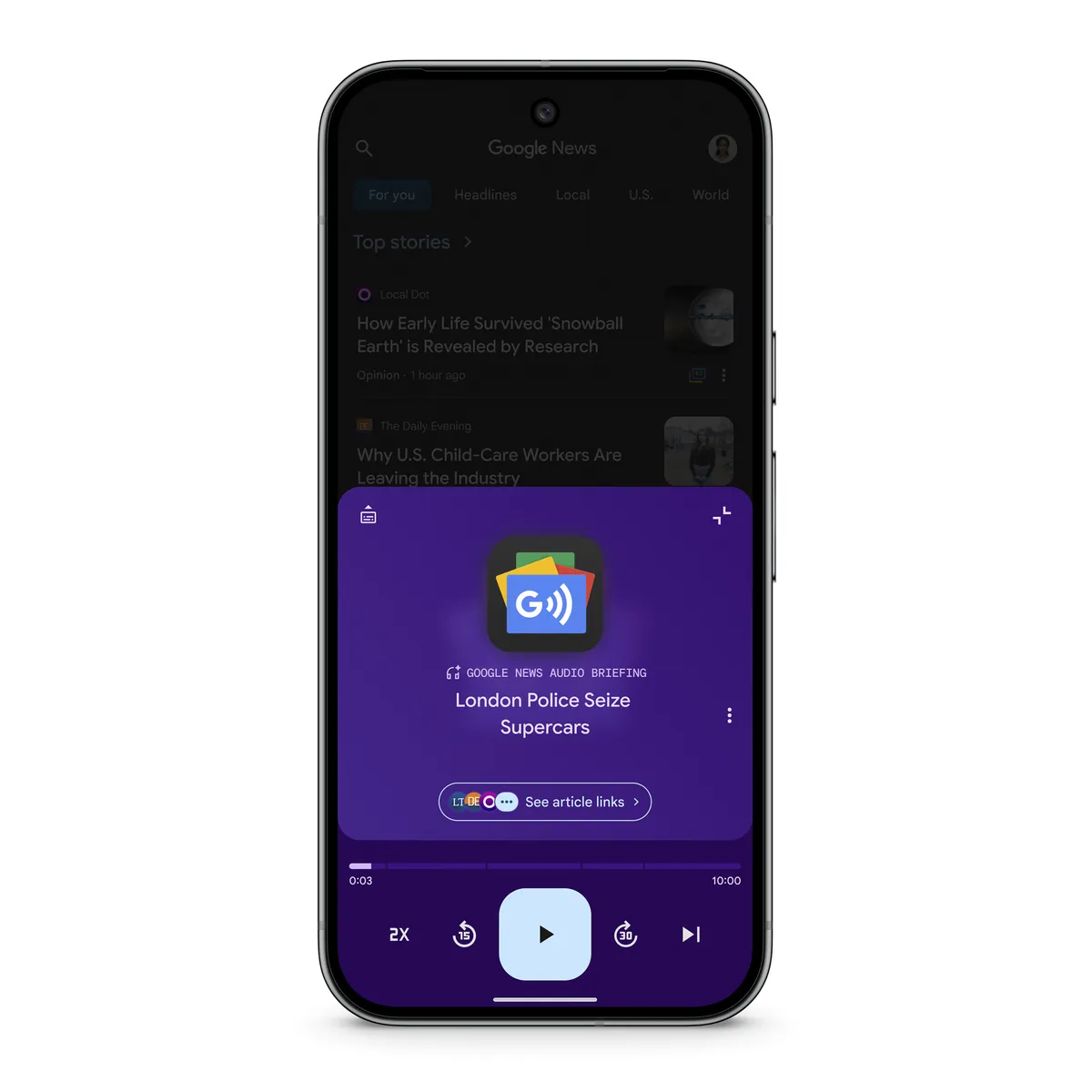
The third feature targets people who consume news by ear. In the Google News app on Android, you can now curate your daily audio briefings by choosing the specific topics you want covered, with clear source attribution and links out to the full articles — replacing the one-size briefing with something closer to a personal radio schedule.
Google also said that publishers participating in its news AI pilot program will contribute deeper dives into key stories within the briefing, which quietly turns the audio digest into a showcase for participating publishers rather than a summary that replaces them. For commuters and gym-goers, this closes a long-standing gap: the audio experience was always far less personalized than the written feed.
Source: Google's official blog — blog.google
What this means outside the United States
Discover is one of the largest content surfaces on Android worldwide, and Android is the dominant platform across the Gulf, the wider Middle East, and most emerging markets. Three implications stand out for international users.
First, written customization should in principle work in any language the underlying model understands well — including Arabic — but Google has not published the list of launch languages or markets for the typed-refinement feature. Based on the company's usual pattern, expect a phased rollout; treat "in the coming days" as "on Google's schedule, not yours."
Second, the Preferred Sources button benefits Arabic-language publishers directly. A reader in Riyadh or Amman who trusts a specific outlet can now push that outlet's presence up across news results and AI answers, shifting some reward from algorithmic guessing to explicit reader choice. Regional publishers who embed the button early gain a cheap advantage.
Third, the audio briefing matters more in car-centric Gulf cities than almost anywhere else. Long commutes in Riyadh, Dubai, and Doha are already prime podcast and radio territory; a briefing you can steer by topic, with attribution and links, fits that behavior exactly.
Quick comparison: how the major feeds handle tuning
| Platform | Current tuning method | What Google's announcement adds |
|---|---|---|
| TikTok | Implicit, derived from watch behavior | Explicit written requests with memory |
| Instagram and Facebook | Mostly implicit, some negative signals | Positive and negative requests in free text |
| X | Mutes and keyword blocks, largely negative | Conversational refinement tied to trusted sources |
| YouTube | "Not interested" and topic settings | Feed control unified with source preference |
The structural difference: Google is moving part of the control surface from silent clicks to natural language — which is why coverage quickly dubbed it a chatbot-tuned feed.
Honest limitations
Three caveats belong in any sober read of this announcement. The typed Discover feature is not live for everyone yet — "coming days" means a gradual rollout whose languages and markets Google has not specified, so you may check your Google app tomorrow and find nothing. Deeper personalization sharpens the filter-bubble problem: a feed that obeys your written wishes can become a tighter bubble than one that occasionally surprises you, and the discovery that makes Discover valuable depends on a dose of the unexpected. And the Preferred Sources button requires publishers to adopt it; if your favorite site never embeds it, the feature will simply not exist there, and adoption incentives vary widely across publishing markets.
FAQ
When does typed Discover customization arrive on my phone?
Google says "in the coming days," rolling out gradually inside the Google app via the three-dot menu on feed cards. No exact per-market dates have been published.
Can I write my interests in Arabic?
Google has not announced the launch language list. The system is built on natural-language understanding, but phased rollouts often start with a subset of languages, so the definitive answer is what appears on your device.
What does the Preferred Sources button do for me as a reader?
Clicking it on a site you trust makes that publication appear more often across Top Stories, the AI-generated summaries at the top of Search, and AI Mode, and the button returns you instantly to where you were reading.
Does the feed remember what I type, or reset each session?
Google states the feed adjusts on the fly and remembers your requests — the tuning is cumulative, not a temporary session filter.
Is the customizable audio briefing available on iPhone?
The announcement covers the Google News app on Android specifically; no iOS availability for the curated audio briefings was mentioned.