
Google's AMIE: AI Conducts Video Medical Consultations at Human Doctor Level 2026
Last updated: August 13, 2026
On August 11, 2026, Google Research in collaboration with Google DeepMind announced a breakthrough in their AMIE (Articulate Medical Intelligence Explorer) system: the ability to conduct real-time video medical consultations with patients, performing at a level on par with board-certified primary care physicians. This announcement marks a significant milestone in AI's journey toward clinical medical practice.
What is AMIE?
AMIE is a research medical AI system from Google, designed for clinical reasoning and medical dialogue. Previous versions demonstrated expert-level performance in text-based diagnostic dialogue, served as a differential diagnosis aid for clinicians, and showed specialist-level capabilities in oncology, cardiology, and ophthalmology.
The new announcement concerns AMIE (Video) — a new configuration that conducts synchronous clinical video consultations and can:
- Recognize non-verbal clinical cues (facial expressions, body language, signs of distress).
- Guide patients through virtual physical examinations (e.g., showing the area of pain to the camera).
- Perform diagnostic reasoning in real time during the conversation.
Why Video, Not Just Text?
Text-based interfaces "discard the visual and auditory dimensions of clinical practice," as the research explains. Patients must translate physical symptoms into written descriptions, losing diagnostic information. Text-only systems cannot independently observe clinical cues or guide physical examination.
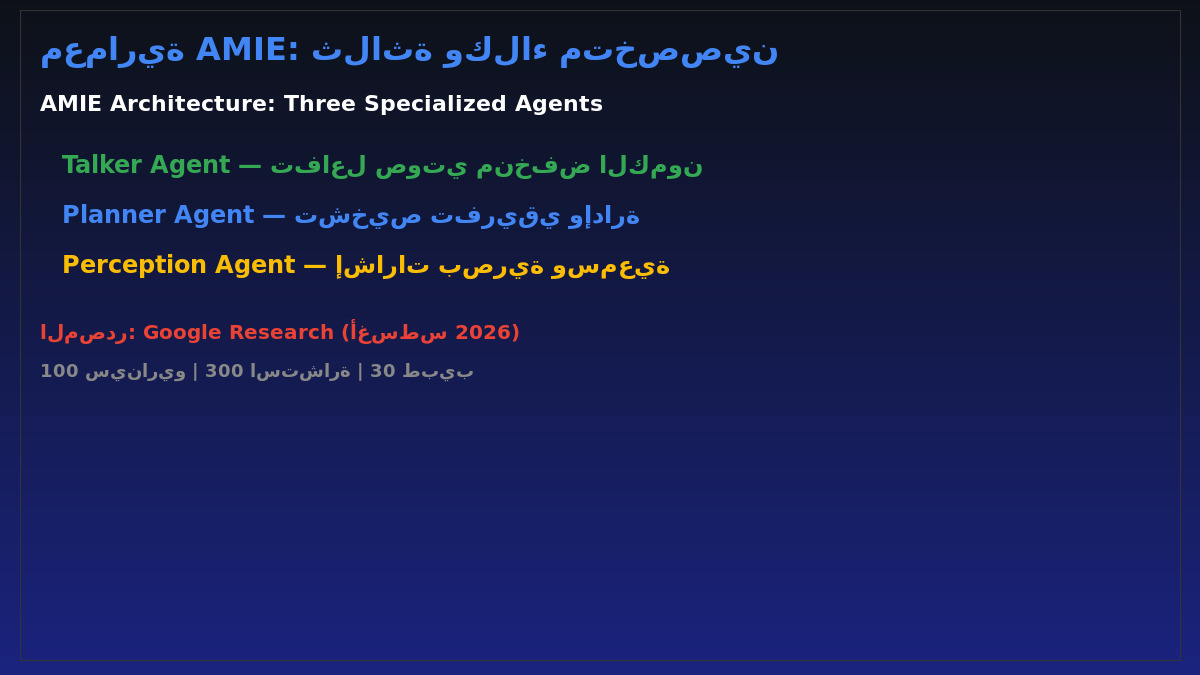
Architecture: Three Specialized Agents
The core technical problem: a single agent cannot simultaneously maintain natural conversational speed, perform deep clinical reasoning, and process audio-visual streams. To solve this, Google used an asynchronous multi-agent design:
1. Talker Agent
The patient-facing agent that drives responsive, low-latency spoken interaction while maintaining natural conversational flow, incorporating guidance from the other agents.
2. Planner Agent
Operates in the background, continuously refining clinical reasoning by "updating differential diagnoses and management plans while identifying information gaps, and re-prioritizing diverse clinical goals."
3. Perception Agent
Continuously reviews audio and visual streams, "identifying clinically relevant non-verbal cues (such as visible signs of distress, physical findings, or auditory signals) and contextualizing these observations."
This decoupled design allows the system to maintain natural conversational latency without unacceptable delays from reasoning or perception processing.
The Study: Design and Methodology
The study was published as "Towards expert-level medical AI for real-time video consultations." It was a randomized study using an OSCE (Objective Structured Clinical Examination) design:
Scale and Scope
- 100 clinical scenarios across five body systems: cardiopulmonary, abdominal, HEENT (head/eyes/ears/nose/throat), neurological/psychiatric, and musculoskeletal.
- 300 live consultations conducted by 15 trained professional patient actors.
- 30 board-certified primary care physicians (PCPs) (10 as consulting clinicians, 20 as evaluators).
- Three study arms:
- AMIE (Video): Real-time video configuration
- AMIE (Text): Text-only baseline to isolate audio-visual contribution
- PCP (Video): Board-certified PCPs using the same video interface
All consultations were evaluated by an independent panel of 20 experienced primary care physicians using established clinical rubrics.
Key Results
1. Expert-Level Clinical Performance
Clinical evaluators rated AMIE (Video) on par with PCPs across core clinical competencies: history-taking thoroughness, diagnostic accuracy, management appropriateness, and communication quality. AMIE (Video) also matched or exceeded AMIE (Text) on these dimensions.
2. Superiority in Physical Observation and Examination
AMIE (Video) was rated significantly higher than both PCPs and AMIE (Text) in:
- Eliciting physical signs.
- Proactively guiding patient actors through virtual examination maneuvers.
- Case-specific perception and examination rubric scores.
3. Patient Actor Preferences
Patient actors "strongly preferred the synchronous video interface over text-based chat," rating it:
- Significantly easier to use.
- More effective for communicating health concerns.
- Higher for AMIE (Video) on empathy, rapport, and confidence in care compared to both PCPs and AMIE (Text).
What This Means for Global Healthcare
1. The Doctor Shortage Crisis
Many regions worldwide face severe physician shortages, especially in rural and remote areas. If systems like AMIE reach clinical application, they could help:
- Expand healthcare access in underserved regions.
- Support physicians with higher diagnostic accuracy and time savings.
- Provide initial consultations before specialist visits.
2. Telemedicine Transformation
The global telemedicine market is experiencing massive growth. Systems like AMIE could become part of future healthcare infrastructure, enabling more sophisticated remote consultations than current video-call-based telemedicine.
3. Medical Ethics and Regulation
Before deploying any medical AI system, several concerns must be addressed:
- Patient consent and transparency about AI use.
- Legal liability in case of diagnostic errors.
- Privacy and protection of health data.
- Cultural and linguistic competence — the system must support diverse languages and cultural contexts.
Quick Comparison: AMIE vs Human Doctors
| Metric | AMIE (Video) | Primary Care Physician |
|---|---|---|
| History Taking | On par | On par |
| Diagnostic Accuracy | On par | On par |
| Management | On par | On par |
| Physical Examination | Higher | Baseline |
| Empathy/Rapport | Positive preference | Reference |
| Visual Perception | Continuous | Attention-limited |
Current Limitations (Critical)
The following limitations must be strongly emphasized:
- Not with real patients — the study was conducted entirely with professional patient actors in simulated settings, not with real patients presenting with their own health conditions.
- Real-world complexity — patient actors cannot fully replicate the complexity and unpredictability of real clinical encounters.
- Scope of conditions — scenarios were limited to conditions authentically portrayable through acting, omitting presentations where audio-visual perception would be diagnostically consequential.
- Perceptual errors — targeted automated evaluations revealed "occasional perceptual and reasoning errors" despite overall high performance.
- Technical issues — the system exhibits "intermittent technical issues that can disrupt conversational naturalness."
- Prototype nature — the system relies on Project Astra, which is still in prototype stage.
Real-World Translation in Progress
Google has already begun translating research into practice through:
- A framework for physician-centered oversight of AMIE.
- A clinical feasibility study with Beth Israel Deaconess Medical Center providing initial evidence for safety and utility of text-based AMIE in clinical practice.
- An ongoing nationwide randomized study with Included Health evaluating AI in real-world virtual care.
Frequently Asked Questions
Can AMIE replace doctors?
No, not in the foreseeable future. AMIE is a research system designed "to augment care," not replace doctors. The current study was conducted with patient actors, not real patients, and the system needs years of research before clinical application.
When will AMIE be available to the public?
Google has not announced a timeline for making AMIE available to the public. The system remains in the research phase with ongoing studies in collaboration with medical institutions.
Does AMIE support languages other than English?
Google has not announced specific language support for AMIE. The system is built on Gemini and Project Astra, both of which support multiple languages to varying degrees of quality.
How accurate is AMIE's diagnosis compared to doctors?
In the published study, clinical evaluators rated AMIE (Video) on par with board-certified primary care physicians in diagnostic accuracy, with AMIE excelling in virtual physical examination.
What are the risks of using AI in medicine?
Risks include: diagnostic errors, lack of cultural awareness, privacy concerns, and legal liability. These risks require robust safety systems and human oversight.
How is AMIE different from ChatGPT and other chatbots?
AMIE is specifically designed for clinical medical reasoning, with a multi-agent architecture including visual and auditory perception. General-purpose chatbots are not designed or tested for clinical practice and should not be used as such.
Sources: Google Research Blog, August 2026.