
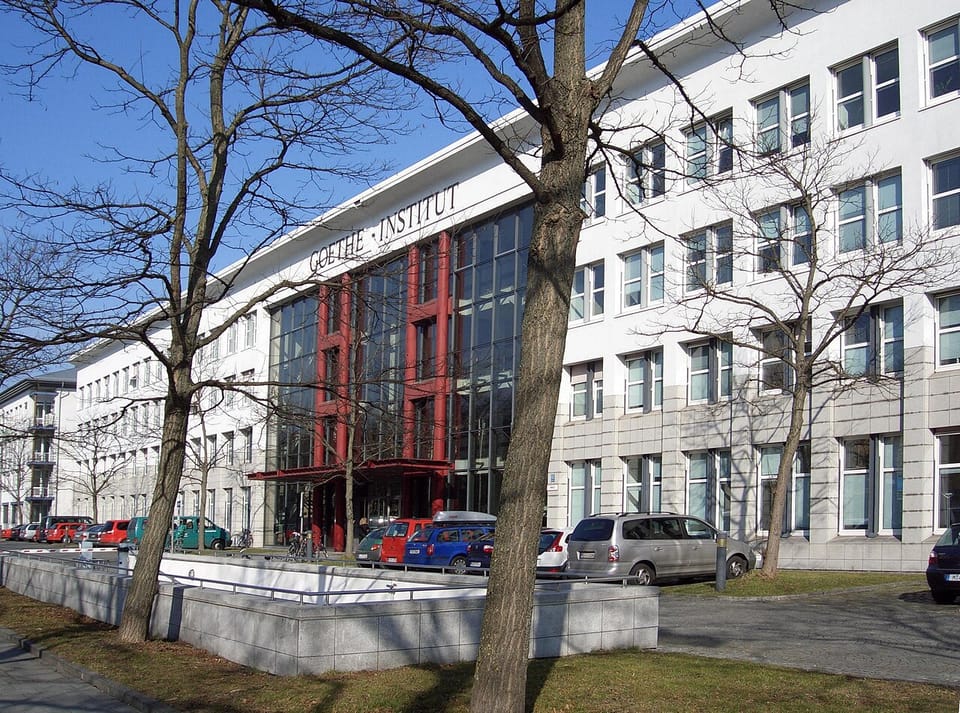
"I will wait until my German is perfect, then register." That sentence is spoken by thousands every year, and it is the biggest myth surrounding the Goethe B1 exam. The exam does not test perfect German; it tests functional independence: following the main points of a familiar text, writing a sensible personal message, describing an experience and defending an opinion in connected sentences. The second myth is that you either pass the whole paper or repeat the whole paper — when the exam is structurally modular, and understanding that alone can save you hundreds of euros and months of re-sitting skills you had already mastered.
The Goethe-Zertifikat B1 is the most widely taken certificate of the Goethe-Institut, Germany's official cultural institute worldwide, and it sits at level B1 of the Common European Framework of Reference — the level we describe in detail in our guide to German language levels A1 to C2. In this guide: the four sections with exact timings, the passing rule in plain numbers, the free official practice material and how to actually use it, how fees work across six Goethe institutes in the Arab region with official links, a straight comparison with telc B1, and a four-week preparation plan a busy person can genuinely follow. It is written for candidates everywhere — Cairo, Rabat, Tunis, Amman and beyond — because the exam structure is identical at every official center worldwide; what changes locally is dates, fees, and registration procedure.
What the Goethe B1 Exam Is and Why So Many Files Depend on It
The Goethe-Institut awards certificates at every CEFR level, but B1 occupies the threshold position: it is the line where you are recognized as an independent user of the language rather than a beginner leaning on memorized chunks. That is why different files converge on it: naturalization in Germany generally requires proof of at least B1, university foundation programs commonly accept it as a minimum, and family-reunion, work, and training files list it again and again.
It also intersects the study route: anyone planning a language course in Germany needs to understand the level ladder before booking anything, which we covered in our guide to the Germany language course visa so you neither pay for a course below your need nor above your capacity.
The certificate itself is issued exclusively by the Goethe-Institut, and the exam runs at its official centers worldwide. Its weight comes from the issuer being an official German cultural institution recognized internationally — German files open with it without a debate about certificate quality.
Exam Structure: The Four Sections by the Numbers
The exam is built on four independent skills, each with its own time and format:
| Section | Skill | Duration | What you actually do |
|---|---|---|---|
| Lesen | Reading | 65 minutes | Mixed texts from notices to articles with graded comprehension questions |
| Hören | Listening | 40 minutes | Recordings of everyday situations, dialogues, and public announcements |
| Schreiben | Writing | 60 minutes | Practical writing tasks: an informal message and a formal reply |
| Sprechen | Speaking | 15 minutes | Paired exam with another candidate: introduction, topic discussion, joint planning |
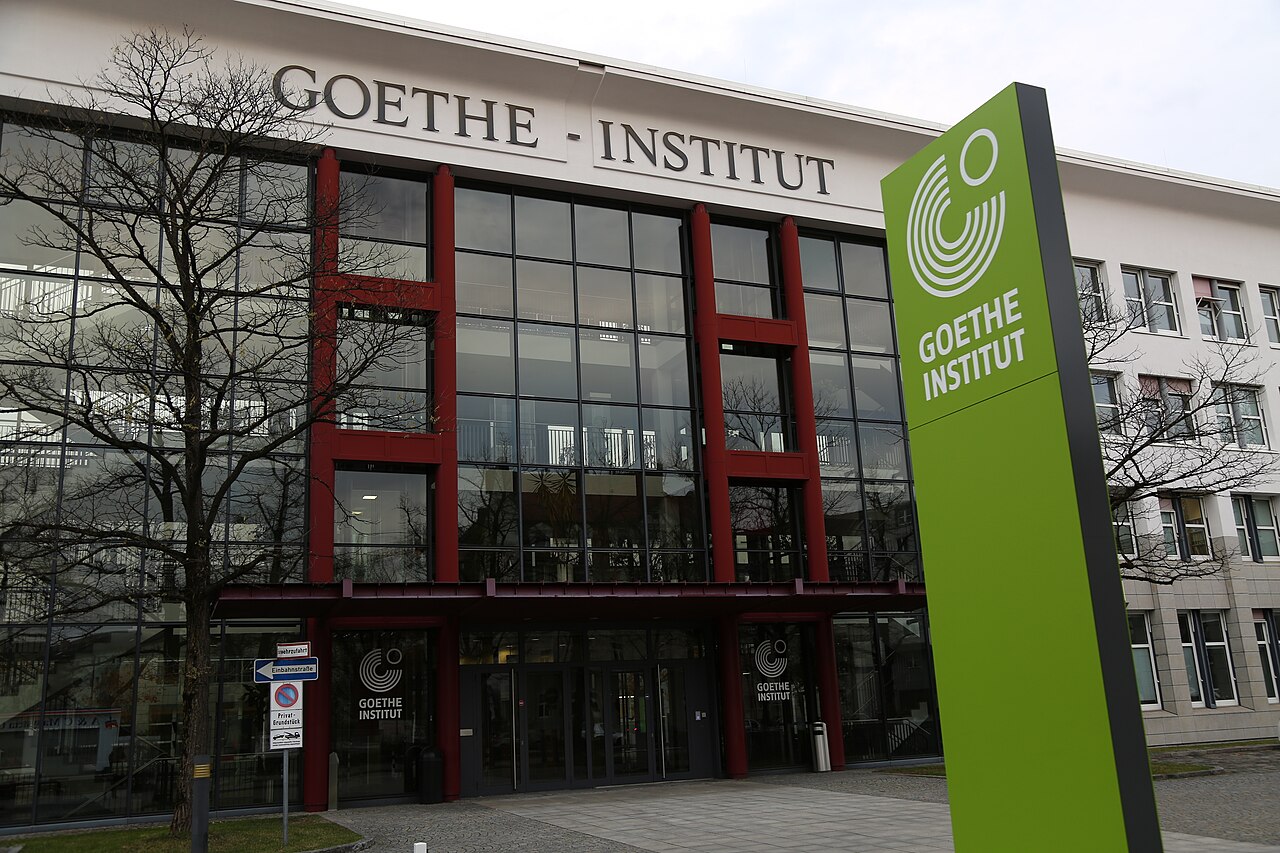
Source: Wikimedia Commons — Goethe-Institut building

Two observations explain the design. First, the three written sections together run well over two and a half hours, so sustained concentration is a trainable skill, not a detail. Second, speaking is conducted with a fellow candidate, not in a solo interview, because the goal is measuring live communication — rehearse in exactly that format or it will surprise you on exam day.
Source: Wikimedia Commons — Duden dictionary

The Passing Score: 60 Percent per Skill, Not One Total
Here is where most confusion lives. Passing the Goethe B1 exam is not one aggregate score you clear; it is a condition applied to each section: you need at least 60 percent in every one of the four skills. A 90 in reading does not rescue a 55 in listening — failing one skill means re-sitting that skill alone, not the whole exam.
This rule should dictate your entire preparation strategy: budget for your weaknesses before your strengths. Arab candidates, typically strong readers, often clear reading first time and stumble in listening or speaking — then waste weeks doing pleasant reading drills instead of the uncomfortable listening work they actually need. Run a full diagnostic model on day one of preparation and order your week around your two weakest skills, not your two favorite ones.
The offsetting good news: because sections are independent, you can register for them separately and re-sit only the failed one at a later session; the certificate assembles from your passing parts. That saves time and money, but it does not abolish seriousness — passing parts remain valid for a sensible window to complete the certificate, so do not park a failed section for many months and then discover you need to re-sit what you had already passed.
Free Official Practice Material — and How to Use It Properly
The fact candidates pay for unnecessarily: official practice models are free on the exam's official page at the Goethe website, under the training materials label Übungssatz, including complete papers for all four sections with listening files and answer keys. There is no need to buy expensive compilations that recycle older versions of the same models.
Proper use runs in three phases. Diagnosis: one complete timed model in your first preparation week to locate weak skills by score. Dissected training: break the model into parts and drill one question type to mastery, logging mistakes in a daily review notebook. Simulation: at least two complete models under real continuous timing in the final week, stopping dead when each section's time expires — exactly as the hall will.
Because official question style has a fingerprint different from generic textbook exercises, add the official vocabulary list for the exam to your plan — the institute publishes the targeted vocabulary, and studying an entire dictionary without boundaries is pure waste of your weeks.
Exam Fees: How They Are Set and Why They Differ by Country
"How much does the exam cost?" has one bluntly simple answer: each Goethe institute sets its own fees locally and revises them periodically — there is no single worldwide price. Cairo differs from Rabat, which differs from Dubai, driven by local operating costs and each branch's policy. The pricing rules, however, rhyme everywhere:
- Fees are paid in local currency per the institute's current table at registration time.
- Registering for a single section costs less than the full exam, since each skill is priced separately.
- Current course participants at the institute usually pay less than external candidates.
- Re-sitting a failed section is priced like that section alone.
Here is the working table for six Arab-region Goethe institutes, with each institute's official exam page — check it before registering, because it is the only authoritative reference:
| City | Institute | Official exams and fees page |
|---|---|---|
| Cairo | Goethe-Institut Cairo | goethe.de/ins/eg/kai |
| Alexandria | Goethe-Institut Alexandria | goethe.de/ins/eg/ale |
| Rabat | Goethe-Institut Rabat | goethe.de/ins/ma/rab |
| Casablanca | Goethe-Institut Casablanca | goethe.de/ins/ma/cas |
| Tunis | Goethe-Institut Tunis | goethe.de/ins/tn/tun |
| Amman | Goethe-Institut Amman | goethe.de/ins/jo/amm |
On the institute's page, open the examinations section and look for the fees table — it lists current local-currency prices per level and per individual section. Whether you register for the full exam or one section, keep the registration receipt and its number; it is your reference for any later correspondence about results or queries.
When you build your budget, plan the exam twice from the start. Not pessimism — engineering: allocate the full exam fee once, and treat the difference as the reserve for re-sitting your weakest section if needed. Small line items eat budgets too: re-issuance fees for a lost certificate, change-of-date fees some institutes charge, and travel or lodging if your center is in another city. Count them before, not after.
Goethe or telc B1? The Comparison That Settles the Dilemma
telc is the other major German certificate provider in Europe, and its B1 is generally accepted by German authorities alongside the Goethe certificate. The difference is not legal value; it is structure and exam experience:
| Criterion | Goethe B1 | telc B1 |
|---|---|---|
| Structure | Four fully independent sections: reading, listening, writing, speaking | Combined written block plus a separate oral block |
| Reading | 65 minutes | 90 minutes covering reading and language elements |
| Listening | 40 minutes | about 30 minutes |
| Writing | 60 minutes | 30 minutes, one writing task |
| Speaking | 15 minutes with a partner | about 15 minutes with a partner, plus 20 minutes preparation |
| Format | Paper or digital depending on center | Paper or computer-based |
| Free official model | On the official Goethe exam page | Full Übungstest 1 with solutions and audio on the official telc page |
The practical rule: if your receiving institution names both, choose the nearer center and the friendlier date. If it names Goethe specifically, do not gamble. Candidates planning spaced sittings or nursing one weak skill lean naturally toward Goethe's fully modular design; candidates who prefer performing speaking after calm preparation find their comfort in telc's twenty-minute prep. Before deciding, ask your local center two direct questions: do you run the blocks together or separately, and which oral format runs this season? Logistics between centers sometimes outweigh structural differences.
The Goethe B1 Exam in Cairo: What Candidates Know From Experience
The search spike around "Goethe B1 exam Cairo" is no accident — Egypt is one of the largest Arabic-speaking exam markets, with the Cairo and Alexandria institutes receiving thousands of candidates a year, course participants and externals alike. The practical consequence: multiple exam dates across the year, but seats in peak seasons sell out early, especially summer and the run-up to German university application deadlines.
Season-tested advice: watch the dates page weekly from six weeks before your target, and register the moment a suitable seat opens — waiting until you "feel ready" is the top reason seasons are lost. If you are taking individual sections, ask the institute about their specific schedule, since not every session opens every section. Candidates traveling to Cairo should book lodging near the exam venue for the night before; a rushed morning commute can undo months of preparation over one gate-closing notice.
A nearby-city bonus experienced candidates use: with two institutes in one country, someone who missed a session in one city has found a seat in the other two weeks later. The key is direct monitoring of both official pages — a seat that appears in the morning can vanish by noon in peak season.
And after passing comes the step most people forget: documentation. German authorities typically want a certified copy, and other institutions may want a certified translation — a path with its own rules that we mapped in certified translation for the German embassy.
How Much Preparation from A2 to B1? An Honest Estimate
No magic number fits all learners, but a realistic floor exists: moving from a solid A2 to genuine B1 readiness is usually not one course and not one month. Four variables set the length: weekly exposure hours, your prior languages (good English makes chunks of German vocabulary familiar), whether you get regular real speaking practice, and your own consistency.
A better indicator than raw hours: your performance on the official B1 model. Scoring around half of reading and listening after an A2 course means you are on track and need a consolidation phase; a wider gap means the smart start is reinforcing A2 before paying for an exam you would repeat. An exam taken twice at full fee costs more than a month of extra preparation.
Do not overshoot in the other direction either: the candidate who postpones registration "one more full year" loses learning momentum. Registering for a session about three months into serious preparation creates the deadline that disciplines study, and a possible single-module fail is cheaper and less harmful than open-ended delay that ends with no certificate at all.
After You Pass: Validity and the Documentation Step
A question that arrives with the celebration: does the certificate expire? Goethe certificates are issued with unlimited validity — the paper proves your performance on exam day, for life. But note the fine distinction: some receiving institutions — embassies, universities, employers — internally prefer a certificate taken within roughly the last two years, so verify your specific institution's preference rather than the general rule.
After passing, keep the original somewhere safe and never surrender it — everyone accepts a certified copy. Anyone submitting the certificate to a non-German-speaking authority will likely need a certified translation, a step with established procedures we documented in the translation guide. And if B1 is a waypoint toward a German degree, plan the next stretch early: most academic programs ask for B2 or C1, and that gap is not one extra course — sequence your path now instead of discovering it after you land.
A Four-Week Preparation Plan You Can Actually Keep
The plan assumes ninety minutes a day, six days a week — a rate that fits working people, not just the fully free:
| Week | Focus | Fixed daily tasks |
|---|---|---|
| 1 | Diagnosis and base | Full timed model on Saturday; alternating reading and listening drills with a vocabulary notebook (15 new words daily) |
| 2 | Listening and reading | One official listening daily with second and third replays; one timed reading; evening error-log review |
| 3 | Writing and speaking | One 60-minute writing task every two days; two language-exchange conversations weekly; light daily listening continues |
| 4 | Full simulation | Two complete timed models, one on Sunday; review of highest-error grammar; full rest the day before the exam |
Midway through, label your safe sections and your danger sections, and tilt the final two weeks toward the danger. This is precisely where structured support shows its value: Truescho's online German B1 exam preparation runs individual packages of 8 or 16 sessions, each sixty minutes one-on-one with a teacher specialized in teaching German to Arab learners, and the larger package ends with a mock exam in Goethe or telc format that puts you in the exam room, virtually, before the official date.
And if you weigh multiple language tracks at once, we previously collected official-style TCF French exam practice questions with answers for exactly that comparison stage.
Exam-Day Errors That Sink Prepared Candidates
The hall is full of people who mastered the language and lost to details. Arrive forty minutes early to absorb entry procedures without rushing. Bring the exact passport or ID you registered with — a different document means a different candidate to the administration. Leave your phone at home if you can; a ringing device in an exam hall is its own catastrophe.
In listening: always preview the questions before the recording starts — knowing what you hunt for converts noise into information. In writing: budget five minutes to plan and ten to proofread; a clean complete answer beats a full, truncated one. In speaking, do not fear self-correction — the examiner measures communication, not perfection, and silence is the only real opponent.
Anxiety is not an enemy to delete but energy to manage. A full night's sleep before the exam outperforms one more hour of review, and entering after a light breakfast and a short walk steadies your pulse better than any last-minute recitation. And remember what this guide established first: the modules are independent, a failed one is re-sat alone, and the single-paper terror was a myth from the opening paragraph.
The Route in Five Lines
Four independent sections. Sixty percent in each. Free official models on the exam page. Fees set locally — read your institute's table. Seats vanish in season, so early registration is half the pass. What remains after these lines is one executive decision: open your institute's page, pick your target session, return to the four-week plan, and start the first diagnostic model tomorrow morning.
Want someone to carry this step for you? Truescho's individual preparation package walks you to Goethe B1 exam day with an organized plan and a prior mock in the exam's own format — join the German preparation course.
Sources:
- Official Goethe-Zertifikat B1 exam page
- telc German B1 structure and free official mock
- Common European Framework of Reference for Languages
- Goethe-Institut worldwide institute portal
Frequently Asked Questions
How many sections does the Goethe B1 exam have?
Four: reading 65 minutes, listening 40 minutes, writing 60 minutes, and speaking 15 minutes with a partner.
What is the passing score for Goethe B1?
At least 60 percent in each of the four sections individually — not one aggregated total.
Can I take just one section of the exam?
Yes. The exam is modular by design; you register for the skill you need and re-sit only a failed one later.
Where can I find a free Goethe B1 practice test?
On the exam's official page at the Goethe website under Übungssatz training materials, covering all four sections with listening files and answer keys; telc's equivalent free model is on its official page too.
Why do exam fees differ between countries?
Each Goethe institute sets and publishes its fees locally, revising them periodically — there is no worldwide price; the institute's own page is the only authoritative reference.
Does the Goethe B1 certificate expire?
It is issued with unlimited validity, though some receiving institutions prefer a recent certificate as an internal rule — check yours.
How often is the exam held each year?
It varies by institute; large centers like Cairo open multiple sessions across the year, and seats in peak seasons go first.
Goethe or telc for a first attempt?
If your institution accepts both, pick the nearer center and better date; if it names Goethe, take Goethe. Structure-wise, Goethe is fully modular while telc runs a combined written block with a prepared oral.