
GLM-5.3 by Z.ai: Frontier Coding and Emergent Cyber Capabilities — Full Guide (August 2026)
On August 14, 2026, Chinese AI lab Z.ai released GLM-5.3, an update built entirely on post-training over the same base model as GLM-5.2. The company's own summary is blunt: "Scaling post-training is all we did for GLM-5.3." The result is a model with dramatic gains in complex coding and long-horizon agent tasks — plus a cyber capability that surprised even its creators. This guide covers the real numbers, how GLM-5.3 compares with Claude and GPT models, how to start using it today, and the honest limitations you should weigh before switching. (Last updated: August 14, 2026)
What's New: The Post-Training Scaling Play
The most important technical detail: GLM-5.3 does not use a new base model. Every improvement comes from reinforcement learning on a massive, diverse set of task environments. Z.ai built pipelines that synthesize these environments end to end — tasks designed to look like real units of expert work, some representing several days of work for an experienced engineer.
One example from the official announcement: in an ML infrastructure task, the model gets the same working environment a human engineer would — compute clusters, storage systems, internal documentation, codebases, and experiment results. It must diagnose bottlenecks across the training stack, implement optimizations, run experiments, and deliver a measurable end-to-end speedup while preserving correctness. A judge agent attempts every task before it is approved for training, verifying that it is actually solvable.
All of this runs on slime, Z.ai's open-source post-training framework for RL scaling, with Megatron on the training side and SGLang on the rollout side.
The Numbers: Big Jumps in Agent Benchmarks
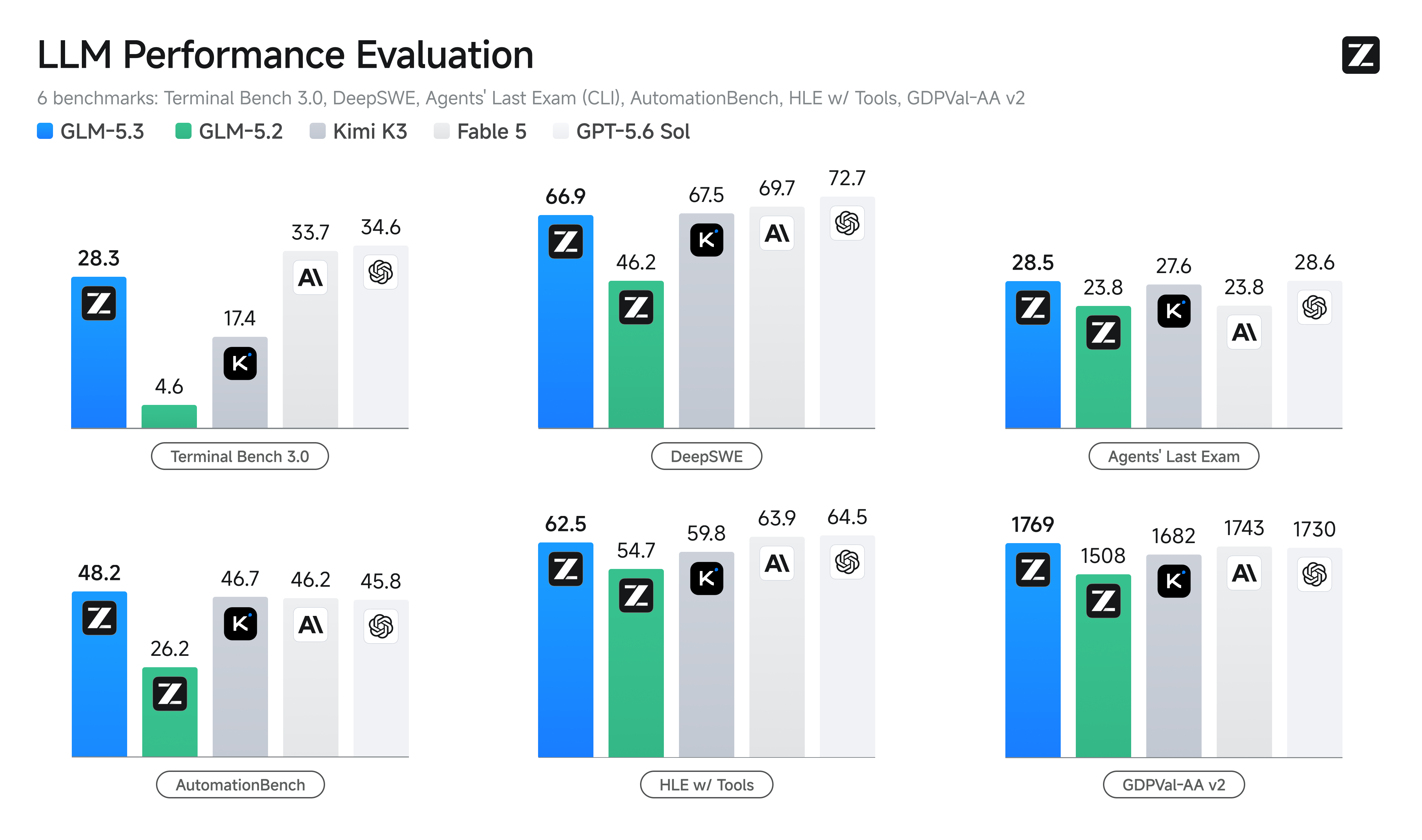
The improvements are not incremental. Compared with GLM-5.2:
| Benchmark | GLM-5.2 | GLM-5.3 | What it measures |
|---|---|---|---|
| Terminal-Bench 3.0 | 4.6 | 28.3 | Real multi-step terminal tasks |
| DeepSWE v1.1 | 46.2 | 66.9 | Realistic repository-level software engineering |
| Agents' Last Exam | 23.8 | 28.5 | One of the hardest agent evaluations |
A jump from 4.6 to 28.3 on Terminal-Bench 3.0 means the model went from "barely completes a terminal task" to being a serious contender among frontier models — and this benchmark family is among the closest to a developer's daily work.
Z.ai Code Bench: Beating Claude Opus 4.8 While Spending Less
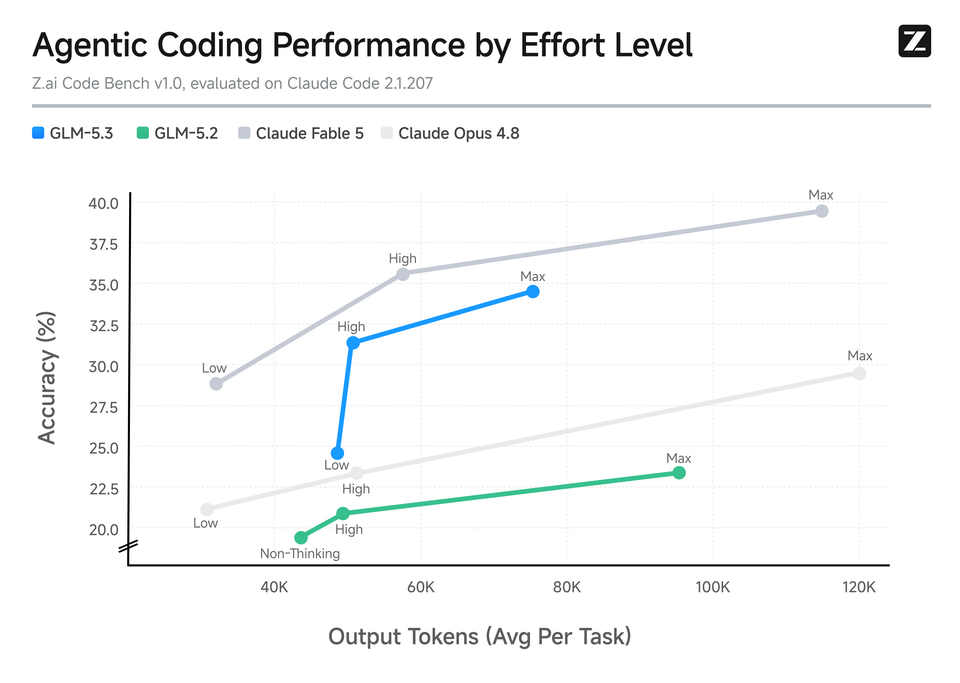
Alongside the release, Z.ai introduced Z.ai Code Bench, an in-house benchmark that evaluates coding agents under realistic user scenarios in complex local development environments, measuring both end-to-end task completion and fine-grained checklist accuracy. Being private, it also reduces contamination risk from public test sets. Headline results:
- At Max effort, GLM-5.3 reaches 34.5% at roughly 75K output tokens per task, versus 23.4% at 96K tokens for GLM-5.2 — better results with fewer tokens.
- At High effort, GLM-5.3 reaches 31.4% at around 50K tokens, surpassing Claude Opus 4.8 at 29.5% — which needed 120K tokens, more than double the budget.
- The model still trails Claude Fable 5, which reaches 39.5% at Max effort.
Source: Official GLM-5.3 announcement — Z.ai
Emergent Cyber Capability: Best-in-Class on CyberGym
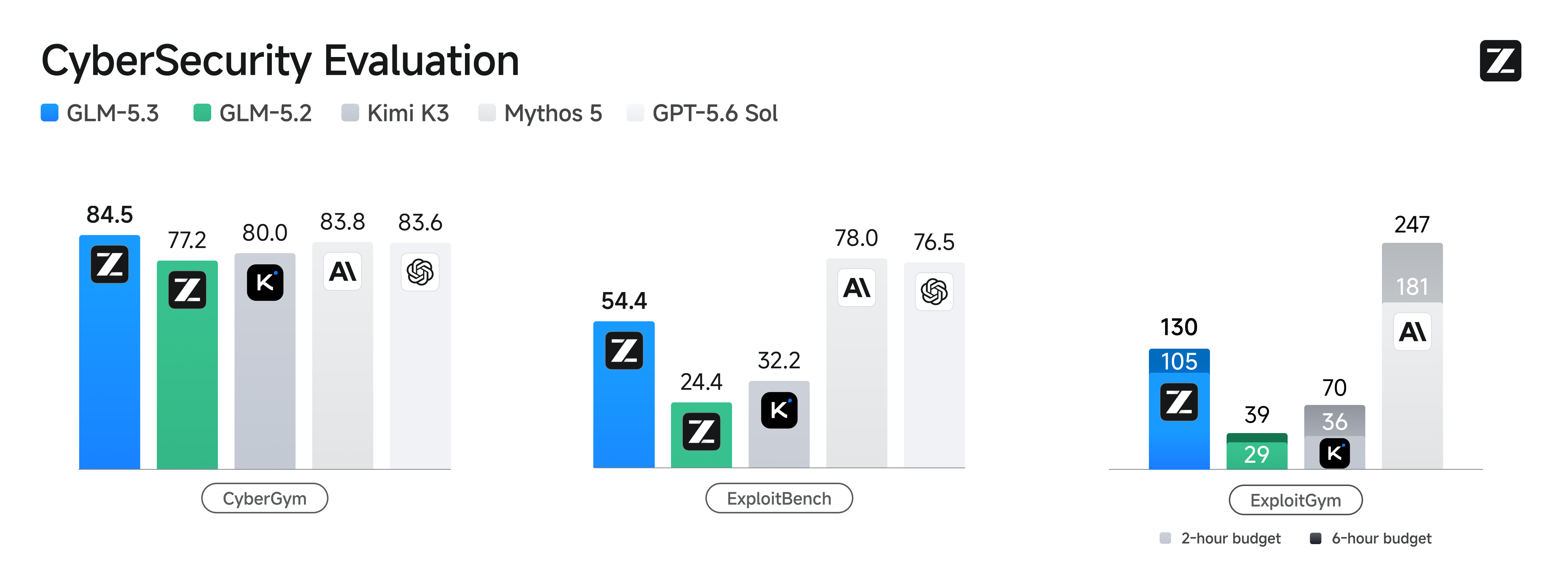
This is the part that generated the most discussion on launch day. While adding vulnerability-discovery data to training, Z.ai expected incremental improvement in finding flaws. Instead, the model began reasoning across multiple stages of exploitation, forming coherent plans for complete exploitation chains. Results across three benchmarks:
- CyberGym (identify and validate vulnerabilities from white-box source code): GLM-5.3 scores 84.5% — the best result on the benchmark, ahead of Mythos 5 (83.8%) and GPT-5.6 Sol (83.6%).
- ExploitBench (deeper reasoning about real vulnerability exploitation): GLM-5.3 reaches 54.4%, more than double GLM-5.2's 24.4% — but still behind Mythos 5 (78.0%) and GPT-5.6 Sol (76.5%).
- ExploitGym (exploitation tasks under time-normalized budgets): 105 tasks completed within two hours, 130 within six hours.
And it is not just a lab result. Since GLM-5.2, Z.ai has worked with several security teams in China to run the models against real-world codebases. After expert review, screening, and deduplication, the model identified 2,436 vulnerabilities across 269 projects, including 1,097 medium-to-high severity issues — spanning system kernels, operating systems, browser engines, open-source infrastructure, web applications, and network protocols. The oldest flaw dates back to 1981, and the average vulnerability lived 26.6 years before discovery.
Source: Official GLM-5.3 announcement — Z.ai
What This Means for Developers Worldwide
1. Immediate availability. GLM-5.3 is live now through Z.ai's API worldwide — no waitlist. Developers anywhere can start within minutes.
2. The Coding Plan is the economical route. If you work inside coding tools, the GLM Coding Plan subscription is the budget-friendly path; the model works with ZCode, Claude Code, OpenCode, and similar agent harnesses. For context, see our earlier coverage of the GLM 5.2 release and our GLM Coding Plan guide.
3. Open weights in about two weeks. Z.ai confirmed the model weights will be publicly available within two weeks — meaning free local deployment for anyone with sufficient hardware, joining other open heavyweights we have covered such as Kimi K3 by Moonshot and DeepSeek's Harness framework.
4. Limited-time perks. Through August 31, 2026: a cache program with 98%+ hit rates (repeated context billed at the lower cached rate — roughly 30% more effective tokens) and a 1.5x temporary quota boost.
5. For security teams: a model scoring 84.5% on CyberGym that can run complete verification chains is a serious asset for defensive code review — though enterprise buyers should also evaluate dedicated platforms such as OpenAI's Daybreak.
Quick Comparison: GLM-5.3 vs the Field
| Benchmark | GLM-5.3 | GLM-5.2 | Claude Opus 4.8 | Claude Fable 5 |
|---|---|---|---|---|
| Z.ai Code Bench (High) | 31.4% @ ~50K tokens | — | 29.5% @ ~120K tokens | — |
| Z.ai Code Bench (Max) | 34.5% @ ~75K tokens | 23.4% @ ~96K tokens | — | 39.5% |
| CyberGym | 84.5% | 77.2% | — | — |
| ExploitBench | 54.4% | 24.4% | — | (Mythos 5: 78.0%) |
| Openness | Open in ~2 weeks | Open | Closed | Closed |
The practical takeaway: GLM-5.3 currently offers the best performance-per-token in long-horizon coding and agent work, and tops vulnerability discovery — but it is not the absolute leader everywhere. Fable 5 remains stronger at maximum-effort coding, and ExploitBench still favors specialized closed models. For a wider picture of this week's model landscape, see our guides to Grok 4.6 by xAI and Gemini 3.7 Flash by Google.
How to Get Started Today
Via the API: the model name is glm-5.3. It supports three thinking effort levels — low, high, and max (default is max). Officially recommended sampling settings: temperature=1.0 and top_p=0.95.
Migration warning: if your application currently uses thinking.type: "disabled", requests will fail with GLM-5.3. Migration to the new format (the reasoning_effort field with low/high/max) is required.
Inside coding tools: GLM-5.3 powers the new "Goal mode" (plan, code, test, and verify until the target is met) and Remote Control for monitoring long-running tasks from your phone. Official details are in the Z.ai developer documentation.
Honest Limitations to Weigh Before Switching
- Not the leader in deep exploitation: ExploitBench leaves GLM-5.3 (54.4%) well behind Mythos 5 (78.0%) and GPT-5.6 Sol (76.5%).
- Behind Fable 5 at max effort: 34.5% versus 39.5% on Z.ai Code Bench.
- Weights not yet released: the "two weeks" promise means the only access route today is Z.ai's own services.
- Breaking API change: apps using the old
thinking.typeformat will break until migrated. - Environment pipelines still need humans: Z.ai itself acknowledges that generating and verifying training environments still requires meaningful human-in-the-loop work.
- Legal and ethical scope: a model that can plan complete exploitation chains must only be used by security teams within legally authorized engagements — defensive review, your own assets, or explicitly authorized testing.
Frequently Asked Questions
What is GLM-5.3 by Z.ai?
A frontier AI model released on August 14, 2026, built on the GLM-5.2 base with entirely post-training improvements, excelling at complex coding, long-horizon agent tasks, and cybersecurity vulnerability discovery.
Is GLM-5.3 better than Claude Opus 4.8?
On Z.ai Code Bench at High effort, yes: 31.4% versus 29.5% while consuming far fewer tokens. However, Claude Fable 5 still leads at Max effort (39.5% versus 34.5%).
Is GLM-5.3 open source?
Not yet at launch. It is available immediately via API and coding-plan subscriptions, and Z.ai has committed to releasing the model weights publicly within two weeks.
How much does GLM-5.3 cost?
Z.ai has not announced a separate new price; usage follows the GLM Coding Plan subscriptions and standard API rates, with a cached-token discount and a temporary 1.5x quota boost through August 31, 2026. Check the official subscription page for current pricing.
Can my security team use GLM-5.3?
Yes, for defense and code review within authorized scope — the model found 2,436 real vulnerabilities across 269 projects. Exploitation capabilities must only be used on assets you own or are legally authorized to test.
How do I enable deep thinking in GLM-5.3?
Use the reasoning_effort field with low, high, or max (default is max), with the officially recommended settings temperature=1.0 and top_p=0.95.