
753 billion parameters. 755.7 gigabytes of weight files. Free for anyone to download, starting Thursday evening, August 28, 2026. That is the size of the event that just landed in the open-source AI world: Chinese lab Z.ai published the complete weights of GLM-5.3 on Hugging Face — and by the company's own benchmark numbers, the most capable open-weight coding model available today. For developers, this is the moment a frontier-class model stopped being something you rent and became something you can own.
Last updated: August 29, 2026 — all figures below come from the official model repository, its README, and the Hugging Face API.
What actually landed on Hugging Face?
The official zai-org/GLM-5.3 repository contains 153 files totaling 755.7 GB, according to the Hugging Face API at the time of writing. The weights ship in FP8 compression, and the model runs a mixture-of-experts architecture coded glm_moe_dsa.
The timing is verifiable too: the repository's last modification stamp reads August 28, 2026 at 15:22 UTC, matching the moment the news spread across developer communities — one discussion thread alone passed 640 points within hours, and the model page crossed 1,170 likes in its first day.
One technical detail from the official model card matters: GLM-5.3 uses the same base model as GLM-5.2 — every gain comes from post-training. The difference is not more size; it is more targeted training on complex, long-horizon agentic and coding work. We covered that capability jump in depth when the model itself launched — see our full GLM-5.3 launch explainer.
Source: Z.ai official account
Performance by the numbers
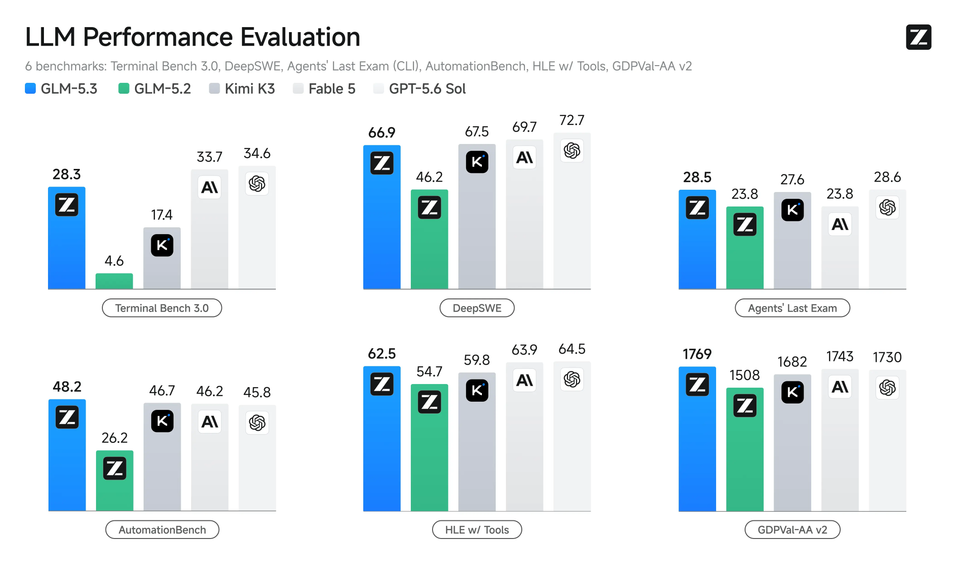
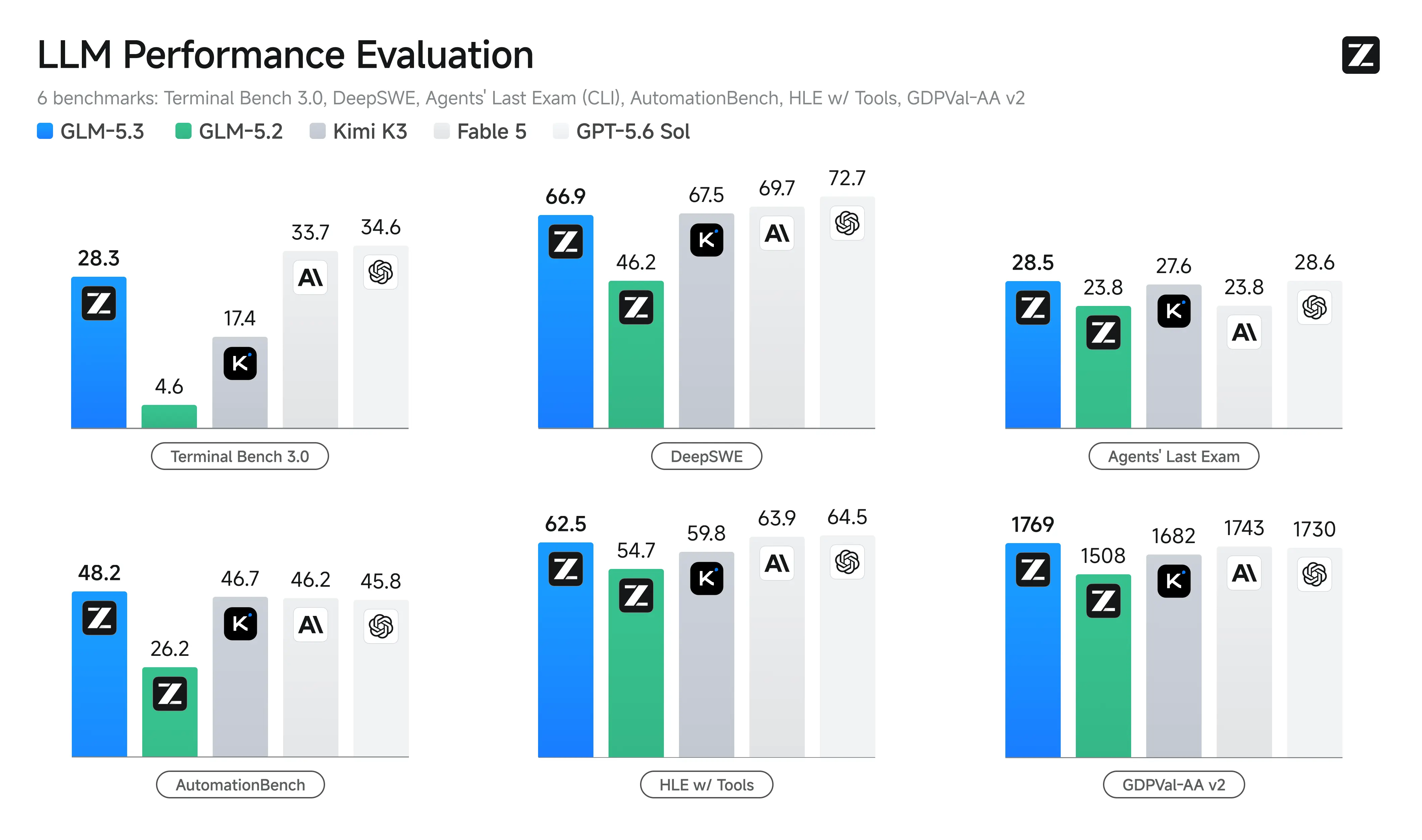
The benchmark table in the official model card puts GLM-5.3 in direct competition with the strongest closed models, with a clear leap over GLM-5.2:
| Benchmark | GLM-5.3 | GLM-5.2 | Kimi K3 | Opus 4.8 | GPT-5.6 Sol |
|---|---|---|---|---|---|
| Terminal Bench 2.1 | 88.2 | 81.0 | 88.3 | 85.0 | 88.8 |
| Terminal Bench 3.0 | 28.3 | 4.6 | 17.4 | 21.1 | 34.6 |
| DeepSWE (v1.1) | 66.9 | 46.2 | 67.5 | 58.0 | 72.7 |
| CyberGym | 84.5 | 77.2 | 80.0 | 78.1 | 83.6 |
| Agents' Last Exam | 28.5 | 23.8 | 27.6 | 25.7 | 28.6 |
The picture is clear: a 50% improvement on Z.ai's internal Code Bench, the top spot among open-weight models on Terminal Bench 3.0 and Agents' Last Exam, and performance that hugs models costing dramatically more per token — especially if you self-host or use a discount API provider.
Source: Z.ai official GitHub repository
The "emergent cyber capability" you should know about
Z.ai itself flags a surprise: offensive cyber capabilities developed faster than expected during post-training. The model leads CyberGym for vulnerability discovery (84.5), and its largest gains sit further up the exploitation chain — more than doubling GLM-5.2 on exploitation benchmarks. The company framed the release as part of a pre-announced "responsible path to cyber defense": the same capability that worries regulators is what red teams and security operations units need. Expect this release to be cited in both contexts.
The license: free for almost everyone
We read the attached license file in full. The practical summary: full MIT-style permissions — use, modify, distribute, sell copies, build commercial products — with one substantive condition. If you run a "Model as a Service" business (giving third parties meaningful control over model inputs and parameters via API) and your aggregate revenue exceeds $10 billion over any 12 months, you must pass Z.ai's security review before commercial use. For everyone besides the world's dozen-or-so tech giants, the model is effectively free, with the standard requirement to keep the copyright notice.
How do you run GLM-5.3 locally?
The model card lists the officially supported serving frameworks: vLLM, SGLang, Transformers, KTransformers, Unsloth, and TokenSpeed, plus support for Huawei's Ascend NPU platform. The model exposes a reasoning_effort parameter (low/high/max) to trade thinking depth for speed, and a clear_thinking chat-template option.
Let's be honest about the hardware: 755.7 GB of weights is not a home-lab project. Running the model at full capability takes a multi-GPU server with fast storage. This drop is aimed at cloud inference providers, large enterprises, and research labs. For individual developers, the practical benefit arrives on the other side of the equation: the pricing pressure this release puts on API access.
Why the timing matters
This drop did not happen in a vacuum. The Hugging Face API shows the repository was created on August 25 and last modified on August 28 — files were staged and verified over several days before the public announcement, the pattern of a calculated major release rather than a leak. And it lands at the peak of an open-weights race:
- Kimi K3 from Moonshot remains the largest open model ever released at 2.8 trillion parameters (see our full Kimi K3 guide) — but biggest is not automatically best at agentic coding.
- DeepSeek and Qwen hold strong positions in the official comparison tables published with this release — four Chinese models in one table alongside Opus and GPT summarizes the shift in technical gravity.
- The opposing camp is pulling back from openness: Anthropic recently staked out a cautious position on open-weight models (see our analysis of Anthropic's open-weights stance), while OpenAI keeps its models fully closed and has just used access as commercial leverage in pulling its models from Cursor.
Against that backdrop, every frontier-class weights drop is leverage for the developer community: a ready alternative that reduces dependence on any single vendor's pricing decisions or contract disputes.
What this means for developers worldwide
- Cheaper access, immediately. Every provider that adds GLM-5.3 creates a new price point competing with closed frontier models — and Z.ai's own coding subscriptions already undercut most rivals.
- Real data sovereignty. Governments, banks, and healthcare teams in regulated markets can now run a model of this class entirely inside their own infrastructure — not a single token leaves the building.
- A language caveat. The model card officially lists English and Chinese. That does not mean it fails at other languages, but they are outside the documented scope — test it on your own multilingual tasks before committing.
- The Cursor context. Landing the same week as OpenAI pulling its models from Cursor, open weights just became a more rational hedge against vendor disputes than ever.
Quick comparison: GLM-5.3 versus the open-weight field
| Model | Size | Edge | Status |
|---|---|---|---|
| GLM-5.3 | 753B (MoE, FP8) | Coding and agentic leader among open models | Open — August 28, 2026 |
| Kimi K3 | 2.8T parameters | The largest open model ever released | Open — our full guide |
| GLM-5.2 | Same base | Previous generation, proven and cheap | Open — our detailed review |
Honest limitations
The numbers above are self-published by Z.ai (with full evaluation protocols in the technical appendix) and have not yet been through broad independent replication. Self-hosting is out of reach for individuals, the license is custom rather than standard MIT, and non-English/Chinese languages are undocumented. If you want fast access without servers, the realistic route today is the official coding subscriptions or third-party API providers.
Frequently asked questions
Is GLM-5.3 really free?
The weights are free to download, use, modify, and deploy commercially under the GLM-5.3 license. The only carve-out: "Model as a Service" businesses above $10 billion in annual aggregate revenue must pass Z.ai's security review first.
What does it take to download and run?
The download is 755.7 GB across 153 files. Full-capability serving realistically requires a multi-GPU server; individuals are better served via API providers or official subscriptions for now.
Does GLM-5.3 support languages beyond English and Chinese?
English and Chinese are the only languages documented in the official model card. Test your own language workloads before relying on it.
How is it different from GLM-5.2?
Same base model, intensive post-training: Terminal Bench 2.1 rose from 81.0 to 88.2, and DeepSWE from 46.2 to 66.9, with the biggest gains in long-horizon agentic and security work.
Where do I download it?
From the official zai-org/GLM-5.3 repository on Hugging Face; the model card documents deployment for every supported framework.