

GLM 5.2 by Z.ai (2026): Official Pricing, Coding Workloads, and Access Options
Last updated: August 2026
$1.4 / $0.26 / $4.4 per 1M tokens (input / cached input / output). 1M context. 128K max output. Those are the load-bearing numbers from Z.ai’s official developer docs—not a reseller screenshot. If you are budgeting coding agents for a remote team, start there, then decide between raw API and the GLM Coding Plan.

Source: Hugging Face zai-org/GLM-5.2
Methodology (two lines)
We only quote primary sources fetched for this article: Z.ai GLM-5.2 docs, Z.ai pricing, Coding Plan overview, subscribe page, the June 16, 2026 announcement, and the public model card. Third-party leaderboard scores are omitted unless you can reproduce them on your stack.
Official API price table (USD / 1M tokens)
| Model | Input | Cached input | Output |
|---|---|---|---|
| GLM-5.2 | 1.4 | 0.26 | 4.4 |
| GLM-5.1 | 1.4 | 0.26 | 4.4 |
| GLM-5 | 1.0 | 0.2 | 3.2 |
| GLM-5-Turbo | 1.2 | 0.24 | 4.0 |
| GLM-4.7 | 0.6 | 0.11 | 2.2 |
Cached input storage is listed as limited-time free on the pricing page. Always re-check before you sign an annual commitment.
What GLM-5.2 is optimized for
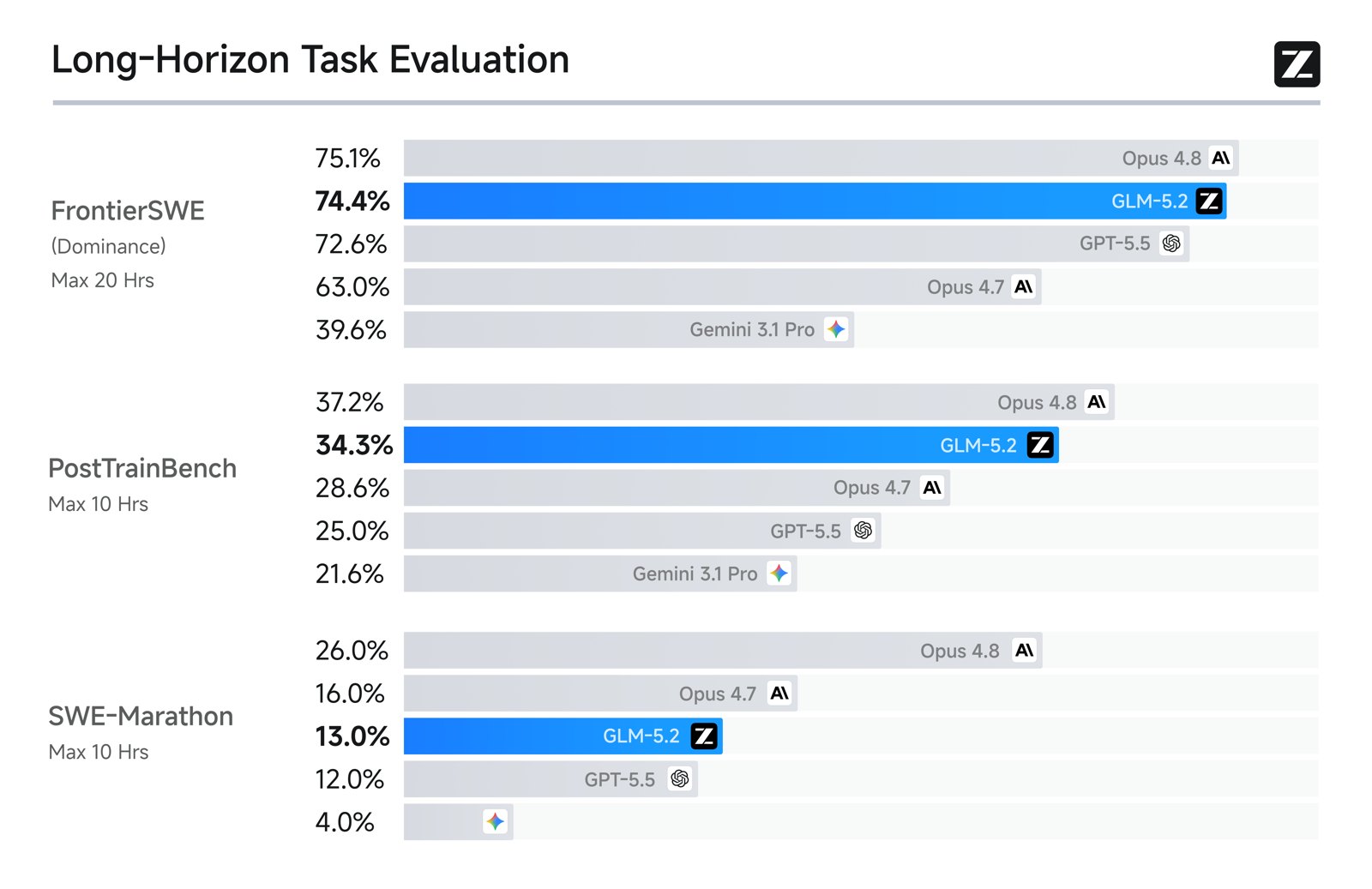
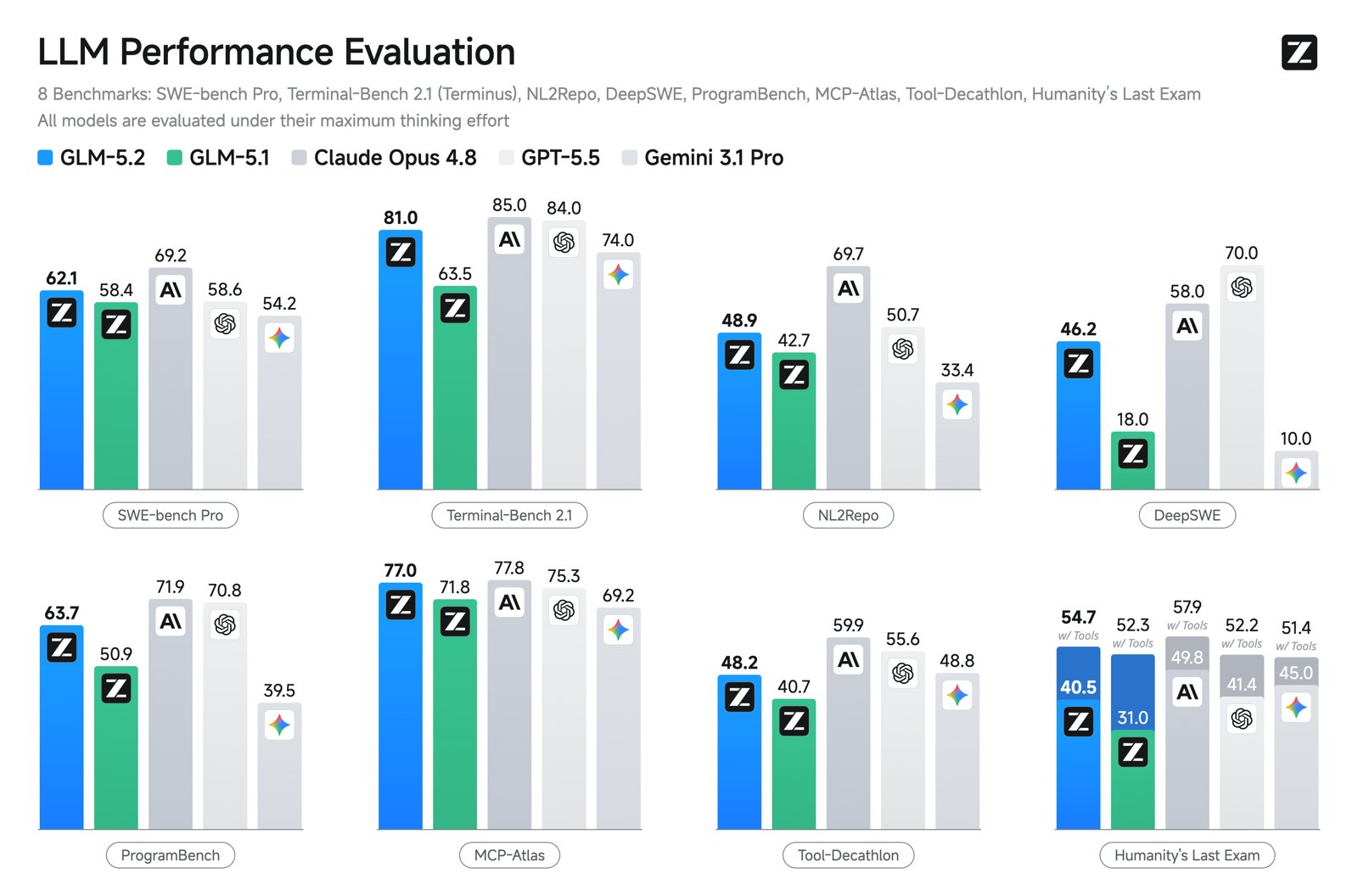
Z.ai positions GLM-5.2 as a flagship foundation model for long-horizon tasks: project-scale engineering context, multi-step refactors, and higher reliability when a single task must carry requirements → implementation → verification. Documented capabilities include thinking modes, streaming, function calling, context caching, structured output, and MCP tool integration.
Public weights: huggingface.co/zai-org/GLM-5.2 (HF tags include license:mit at fetch time). Local/inference frameworks mentioned by Z.ai include transformers, vLLM, SGLang, and related stacks.
Source: Z.ai Docs — GLM-5.2
Coding Plan credits (official)
| Plan | 5-hour credits | Weekly credits |
|---|---|---|
| Lite | 2,000 | 10,000 |
| Pro | 12,000 | 60,000 |
| Max | 28,000 | 140,000 |
Supported models on the plan docs include GLM-5.2, GLM-5-Turbo, and GLM-4.7. The plan is built for coding clients such as Claude Code, Cline, and OpenCode.
Credit math for GLM-5.2 multipliers (docs): input 6.9, cached input 1.7, output 24, combined as(in·6.9 + cache·1.7 + out·24) / 10,000.
Peak window: Mon–Fri 14:00–18:00 UTC+8. Off-peak model usage is charged at 50% of standard credit rates per the Coding Plan overview. Marketing posts may add temporary promotions—read your live plan terms.
Estimated weekly tokens for GLM-5.2 assuming ~90.9% cache hit (official range):
| Plan | Approx. tokens / week |
|---|---|
| Lite | 43–87M |
| Pro | 263–526M |
| Max | 613–1226M |
Subscribe UI list prices (verify at checkout): Lite from about $18/month with discounted annualized displays (e.g. $12.6 shown on promo UI), higher tiers for Pro/Max.
Source: Z.ai documentation CDN via GLM-5.2 docs
Worked API cost example
Assume one agent session:
- 200k new input tokens
- 800k cached input tokens
- 50k output tokens
Cost ≈ 0.2×1.4 + 0.8×0.26 + 0.05×4.4 = $0.28 + $0.208 + $0.22 ≈ $0.71.
Twenty similar sessions/week ≈ $14/week before add-on tools (Web Search is listed at $0.01 per use on the pricing page). Use this as a spreadsheet template, not a promise.
Where GLM-5.2 fits agent workflows
| Workflow | Why GLM-5.2 is in the shortlist | Watch-outs |
|---|---|---|
| Repo audit | Long context retention | Still needs human threat modeling |
| Multi-file refactor | Long-horizon stability claims | Peak credit multipliers |
| Tool-using agents | Function calling + MCP | Each tool call has cost |
| JSON/CI integration | Structured output support | Schema validation still required |
| Self-host | Public weights | GPU/ops cost shifts off the API bill |
OpenCode pairing
Z.ai lists OpenCode among Coding Plan tools. OpenCode’s own Go docs also list GLM-5.2 among available models (lists change). Practical path:
- Create Z.ai access (API key and/or Coding Plan).
- Connect inside OpenCode via
/connector use Go if GLM remains listed. - Prefer Plan/read-only passes before Build on production branches.
Full agent shell guide: OpenCode open-source coding agent.
Regional access notes (no fiction)
Confirmed from public pages: USD pricing in docs, developer console/docs at docs.z.ai, chat entry at chat.z.ai. Not confirmed here: every local card brand in every country. Remote engineers typically validate a small top-up first, use business cards/fintech that support international SaaS, or route through an agent subscription that already includes the model (for example OpenCode Go when listed).
Honest limitations
- Peak-hour credit burn can surprise teams living in UTC+8 afternoons—or remote teams overlapping that window.
- Self-hosting frontier-class weights is an infrastructure project, not a toggle.
- “1M context” does not cancel bad prompts or missing tests.
- Third-party gateways may show different sticker prices; compare apples-to-apples against Z.ai’s table.
- Promotions (free cache storage, off-peak multipliers) expire—budget the non-promo case.
Decision matrix
| If you… | Choose |
|---|---|
| Build internal agents with spiky traffic | Pay-as-you-go API |
| Live inside Claude Code / Cline / OpenCode all day | Coding Plan |
| Need multi-provider terminal control | OpenCode + GLM key/plan |
| Must keep weights on-prem | HF/ModelScope + vLLM/SGLang |
| Only want cheapest autocomplete | Smaller/cheaper GLM tier may suffice |
Adjacent Truescho reads: Grok 4.5, DeepSeek V4, Claude Sonnet 5, AI tools hub.
FAQ
How much is GLM 5.2 per million tokens?
$1.4 input, $0.26 cached input, $4.4 output on Z.ai’s pricing page (USD).
What is the context window?
1M tokens context length; 128K max output tokens per the model overview.
Is GLM 5.2 open source?
Weights are publicly posted (HF/ModelScope) with an MIT license tag on HF at fetch time—read the full license text for your compliance process.
Coding Plan or API?
Plan if you want credit envelopes inside coding IDEs/agents; API if you need raw token billing in your own software.
Can I use it with OpenCode?
Yes—documented on Z.ai’s Coding Plan tooling list; also appears in OpenCode Go’s model table when current.
Are there free tiers?
Some older flash models are listed free on the pricing table; GLM-5.2 itself is priced. Do not assume 5.2 is free.
What about team seats?
See Team Plan pages in Z.ai docs for org limits—do not invent seat counts here.
Where is the announcement?
z.ai/blog/glm-5.2 (June 16, 2026).
What to do next
- Price one real repo task with the API formula above.
- If you live in coding agents, trial Lite before Pro/Max.
- Wire OpenCode or your preferred agent; enforce human review.
- Re-read live pricing before quarterly renewals.
- Keep learning via Truescho courses and the AI tools directory.
Credit burn lab (copy into a spreadsheet)
Example task tokens: 100k input, 900k cached, 20k output.
GLM-5.2 multipliers: 6.9 / 1.7 / 24
Credits = (100000×6.9 + 900000×1.7 + 20000×24) / 10000 = 270 credits.
Lite 5-hour pool is 2,000 credits → roughly seven such tasks per window if nothing else runs. That single calculation explains why “unlimited-feeling” agent sessions collide with Lite.
Peak vs off-peak
If off-peak truly bills model usage at 50% credits, the same task costs ~135 credits. Teams that can shift refactors outside Mon–Fri 14:00–18:00 UTC+8 buy capacity without upgrading tiers.
API vs Plan decision worksheet
Answer yes/no:
- Do >70% of tokens originate inside Claude Code / Cline / OpenCode?
- Do you hate forecasting raw token invoices?
- Do you need the same key inside a custom backend agent framework?
- Do you require air-gapped weights?
If 1–2 yes and 3–4 no → Coding Plan first.
If 3 yes → API.
If 4 yes → self-host path.
Engineering standards that models cannot replace
- Branch protections and required reviews
- Migration runbooks
- Observability before refactors
- Threat modeling for auth changes
- License compliance for generated dependencies
GLM-5.2 can draft patches; it cannot own your uptime.
Learning path for international students
- Reproduce a public bug fix with tests.
- Attempt the fix yourself for 45 minutes.
- Ask GLM-5.2 for review, not the first draft.
- Rewrite using what you learned.
- Publish a short post-mortem in your portfolio.
Pair with Truescho courses and scholarship/opportunity discovery on Truescho opportunities if you are funding education alongside skill building.
Cluster reading order
- This article (model economics)
- OpenCode agent shell
- Grok 4.5 or DeepSeek V4 for alternatives
- AI tools hub
Procurement checklist for startups
- [ ] Legal review of cloud AI data use
- [ ] Key vault in place
- [ ] Budget owner named
- [ ] Lite/API pilot metrics defined
- [ ] Peak-hour policy written
- [ ] Rollback plan for bad agent merges
- [ ] Quarterly re-quote of official prices
Benchmark honesty policy (ours)
We do not paste viral leaderboard screenshots into production decisions. If Z.ai publishes methodology-backed figures on the official blog, cite them with date stamps. If a Twitter thread claims “beats Model X by 40%,” ignore it until you reproduce on your repository suite.
Create a golden task pack:
- Flaky test diagnosis
- API versioning migration sketch
- CSS/layout bug in a real component
- SQL query rewrite with explain plan
- Docs generation from types
Run the pack on GLM-5.2 and one alternative monthly. Keep winners based on accept rate, not vibes.
Token caching strategy
Because cached input is $0.26 / 1M vs $1.4 / 1M fresh input, long agent threads that repeatedly touch the same project files can become dramatically cheaper after warm-up—if the provider’s cache behaves as billed. Design sessions to reuse context instead of spawning brand-new cold chats for every three-line change.
Incident story pattern (composite)
A remote squad enabled Max thinking on every lint fix for a week and burned weekly credits by Wednesday. After policy changes—default low effort, peak-aware scheduling, and Plan-first refactors—the same Pro tier lasted the full week with higher merge quality. The model did not change; the process did.
Vendor lock-in escape hatch
Store:
MODEL_IDBASE_URLAPI_KEYvia secret manager
in environment config. Whether you call Z.ai directly or through an agent like OpenCode, the escape hatch is the same. Practice failing over to a backup model once per quarter.
Expanded FAQ for procurement
Can finance forecast this?
Yes—at the plan level (credits/week) better than pure API. Still keep a 20% contingency for peak bursts.
Does 1M context mean we paste the monorepo?
No. Prefer targeted @ file inclusion (in OpenCode) or explicit path packs. Context is a budget, not a landfill.
Should legal review Z.ai terms?
Yes for company use. This article is technical reporting, not legal advice.
What if Hugging Face weights lag API quality?
Possible. Treat local weights and hosted API as related but not identical products; validate separately.
Extra call-to-action for builders
When your spreadsheet says GLM-5.2 wins on cost/quality for your golden tasks, operationalize it through the agent you already trust—often OpenCode or Claude Code—then re-audit prices quarterly from the official docs pages listed in Sources.
Arabic/English bilingual teams
Many global teams mix Arabic requirements with English codebases. Practical rule:
- Keep identifiers, APIs, and code comments in English unless your team standard says otherwise.
- Keep tickets and acceptance criteria in the language reviewers actually use.
- Ask GLM-5.2 to separate “user-facing Arabic copy” from “engineering English” in the same task to avoid mixed tokens in source control.
Secondary cost drivers people forget
- Tool calls (search/reader/MCP) on top of token multipliers
- Failed loops that retry the same broken approach
- Re-seeding full monorepos on every new chat
- Human waiting time while a long think run continues needlessly
- Currency conversion / card FX on personal budgets
Add a 15% contingency line in freelance quotes when AI usage is billable to clients.
Lightweight evaluation protocol (half day)
Morning: run golden tasks 1–3 on GLM-5.2.
Afternoon: run the same on your backup model.
End of day: score accept/reject + $ + minutes.
Ship the winner as default for two weeks, then re-test.
This beats endless Reddit debates.
Final procurement paragraph
GLM 5.2 earns a place on 2026 shortlists because Z.ai publishes concrete token prices, a 1M context product claim, coding-plan credit envelopes, and explicit compatibility with popular coding agents. Treat those as inputs to your measurement system. When the spreadsheet clears your bar, integrate through OpenCode or your standard agent, keep humans on the merge button, and re-verify official pricing pages every quarter.
One more operating note
If your golden-task pack shows GLM-5.2 within 10% quality of a pricier model at substantially lower spend, default to GLM-5.2 for long refactors and keep the pricier model as an escalation path only. Document that escalation rule so teammates do not “upgrade” every prompt out of habit.
Sources
Start with Truescho
Build skills, compare tools, and plan your next move on truescho.com.
Get Started Free →
Data appendix: building your own cost dashboard
Track these columns for 14 days:
- Task type (bugfix / feature / docs / refactor)
- Input tokens, cached tokens, output tokens
- Tool calls (search/reader/MCP)
- Wall-clock minutes
- Human rework minutes
- Plan tier or API project name
Then compute $ per accepted PR and rework minutes per PR. Those two numbers decide upgrades more honestly than model launch videos.
Off-peak scheduling for distributed teams
If half your developers are in UTC-5 and peak credits apply 14:00–18:00 UTC+8, your morning may be their burn window. Publish a shared note:
- Heavy refactors: outside peak when possible
- Light nits: anytime
- Emergencies: accept peak burn consciously
Self-host decision tree
- Do you have a compliance requirement for on-prem weights? If no, prefer API/plan.
- Do you have GPUs and an owner for uptime? If no, prefer API/plan.
- Do you need elastic bursts? API wins.
- Do you need air-gapped inference? Self-host wins—budget engineering time.
Quality bar for coding acceptance
Never merge model output that lacks:
- Passing tests you trust
- Diff size review
- Secret scanning
- Explicit statement of assumptions
GLM-5.2 can draft the work; your team still owns production risk.
Cluster links for continued research
Closing data point
The defensible story in August 2026 is simple: GLM-5.2 publishes clear token prices, a 1M context claim, coding-plan credit envelopes, and first-class mentions inside popular coding agents. Your job is to convert those published numbers into a spreadsheet on your repositories—then buy the smallest plan that survives that spreadsheet.