

The most common question we receive from readers in Lagos, Nairobi, Amman, Karachi and Cairo is the same: "I want to move to Germany, but I don't speak German — is that a dealbreaker?" The legally documented answer in 2026 is no. Germany's skilled-immigration reform built official pathways where German is either replaceable with English, scored as bonus points, or simply not required by law at all. This guide walks through five legal routes with the official rules and the numbers currently in force — and tells you plainly where the "no German needed" shortcut honestly ends.
One rule governs everything below: "no German" never means "no language". Every route here requires either documented practical English (usually B2) or basic German (A1). The difference between the routes is which of the two languages the authorities will accept, and at what level. Anyone promising you relocation with neither is selling a fantasy.
Route 1: The Opportunity Card (Chancenkarte) — English B2 instead of German
The Opportunity Card is the clearest example of Germany's official openness. Its points system accepts one of two language options explicitly: German at A1 level, or English at B2 level. An applicant who speaks no German at all can pass the language gate with a valid B2 English certificate and complete the required six points from the other factors: qualification (a university degree or vocational training of at least two years), work experience, age, and prior ties to Germany.
The documented financial condition for applicants without a job offer: proof of funds covering the job-search year at 13,092 euros (1,091 euros per month) via a blocked account or equivalent, plus permission to work part-time up to 20 hours weekly to ease the burden. The card grants a 12-month residence for job or training search, and converts into a work residence permit once you sign a contract. We re-verified these figures against the official pages on 29 August 2026; the full points breakdown is in our complete Germany Opportunity Card 2026 guide.
Route 2: The EU Blue Card — working in English at international companies
German law does not require German language for the EU Blue Card at all. What it requires is a recognised qualification and an employment contract above a salary ceiling recalibrated each year — and this is the decisive number for 2026: 50,700 euros per year for standard occupations (about 4,225 euros per month), and 45,934 euros for bottleneck professions and recent graduates. For IT professionals there is a documented exception allowing the Blue Card even without a university degree, if you can prove sufficient practical experience at the salary level set for that exception.
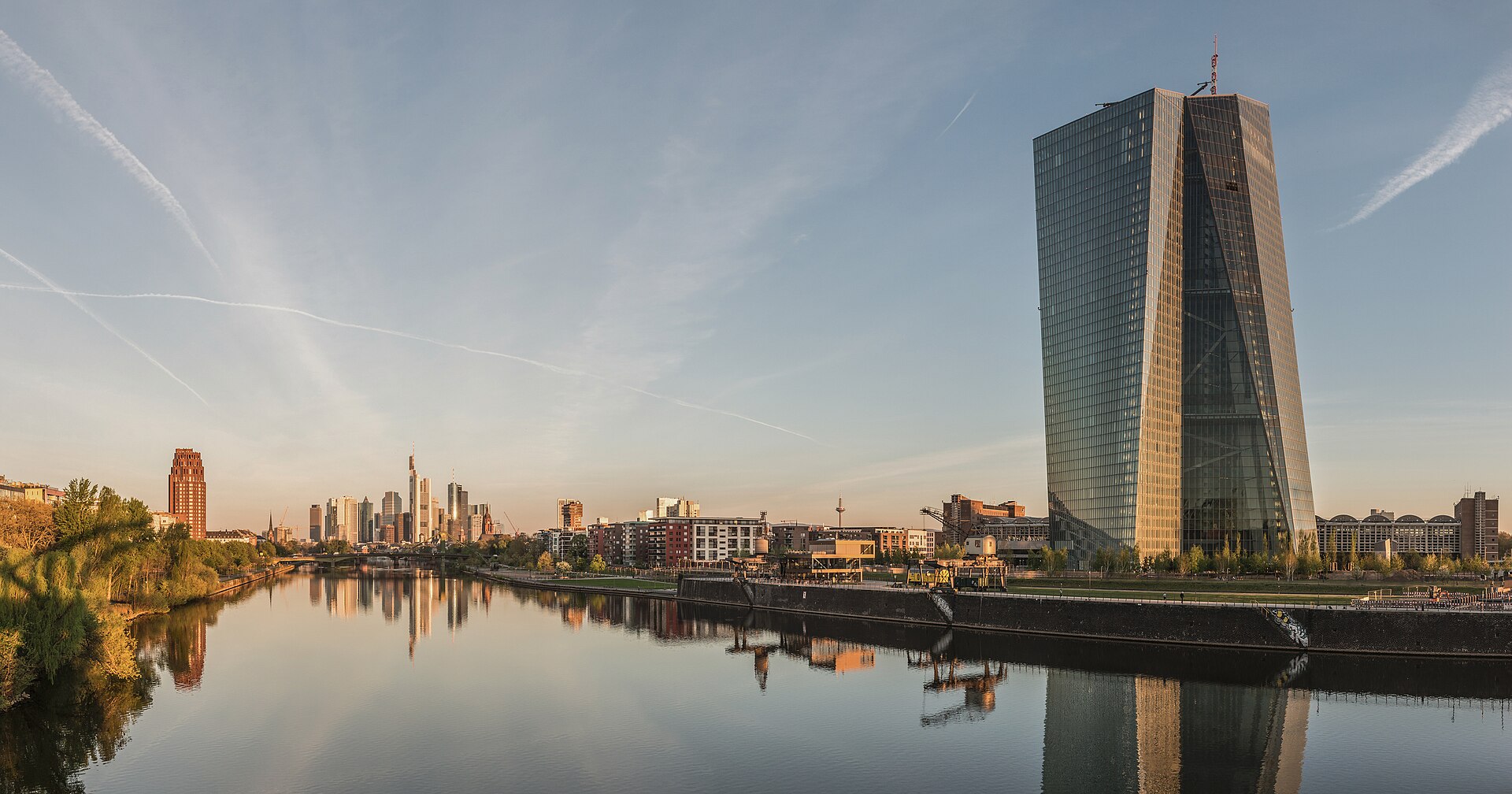
Where do you actually work without German? At international employers in Frankfurt, Berlin, Munich and beyond, where the official working language is English — software engineering, data roles, technical engineering and research above all. The city in the image below — Frankfurt with the European Central Bank towers above the Main — is the flagship example: thousands of employees there do their entire jobs in English.
One additional documented advantage: Blue Card holders reach permanent residence faster than almost any other category, and the full thresholds and legal timelines are in our EU Blue Card Germany 2026 guide.
Route 3: Studying in English — full degree programmes without a word of German
This is the most plannable route. German public universities run bachelor's, master's and doctoral programmes taught entirely in English, and admission requires no German — it requires an academic English certificate (IELTS, TOEFL, or an equivalent the university accepts). The official DAAD international programmes database is the first filter: select "English" as the language of instruction and you get the full list of eligible programmes across disciplines and universities.
The financial side remains among the cheapest in the developed world: most public universities charge effectively no tuition, and your real cost is living expenses, proven through a blocked account holding a yearly amount that is updated annually (verify the figure in force when you apply). The tactical bonus: after graduation you receive a job-seeking residence that opens Routes 1 and 2 from inside Germany. Start from our updated guide on studying in Germany and, if you want full funding, review DAAD scholarships for 2027–2028.
Route 4: Shortage occupations — language as points, not barrier
The German authorities maintain an official list of chronically in-demand professions, covering six main categories including nursing and healthcare, information technology, engineering, construction and early education. What matters here: entry into these fields is possible through the Opportunity Card without a prior job contract at all, and German is not a uniform entry condition — IT is the most English-tolerant category, while nursing and care realistically require B1–B2 because they are direct human-communication professions.
We say it honestly: this route is "half-English" — parts of it enter on English and complete the German on arrival through courses the recognition law provides for regulated professions. The complete list of occupations and the no-prior-contract entry method is in our Germany shortage occupations 2026 guide.
Route 5 (the honest exception): vocational training — Ausbildung
We will not deceive you: the Ausbildung dual vocational-training route is the true exception to "no German". Trainees study and work inside German workshops, hospitals and companies where training is conducted in German at every practical level, and institutions realistically require B1 before you start. Two things keep it on this list: its salary is guaranteed by law on a rising scale (we broke the numbers down in our Ausbildung salary 2026 guide), and after B1 it is the fastest permanent-residence track for people without a university degree. If that is your profile, your correct plan is one year of German first, then Ausbildung.
Comparison table: which route fits you?
| Route | Minimum language | Qualification required | Decisive advantage |
|---|---|---|---|
| Opportunity Card | English B2 or German A1 | Degree or 2-year training | Entry without prior job offer |
| EU Blue Card | No legal language test (English in practice) | Degree (or IT experience exception) | Fastest permanent residence |
| English-taught study | Academic English | Secondary / bachelor's | Near-zero tuition + post-study permit |
| Shortage occupations | Varies by category (English in IT) | Varies by profession | Chronic demand, official list |
| Ausbildung | German B1 realistically | Secondary or less | Salary guaranteed by law |
What this means for you specifically
If your English is B2, you can open an Opportunity Card file today without a single German lesson: get certified translations of your qualification, a ZAB evaluation where required, and audit your points against the six-factor test. If you are a tech graduate with experience, the number that runs your life is the Blue Card ceiling: 45,934 euros for your professional family, 50,700 for the rest. And if your budget cannot carry a full financing year, Route 3 is your alternative: an English-taught application at living-cost-only pricing. The golden rule in all cases: do not postpone arrival waiting for "perfect German" — start on the route your current language qualifies you for, and finish your German in Germany, where each level actually changes your salary.
Common mistakes that cost years
First, confusing "does not require German" with "does not need German" — one is a visa condition, the other is a market reality; English-only jobs exist and are concentrated, but every German level you add multiplies your options. Second, relying on self-assessed or unrecognised English evidence — B2 conditions must be documented through specified certificates, and points are never granted on self-evaluation. Third, calculating the salary ceiling wrongly — the 2026 figures above renew every January with social-insurance reference values, and a 2025 number is invalid today. Fourth, neglecting credential recognition (Anerkennung) before travelling in regulated professions, and hitting the recognition wall only after arrival.
Frequently asked questions
Can you actually live in Germany with zero German?
In the large cities and international environments, yes — for years, especially for students in English-taught programmes and tech employees. But career progression, official paperwork and daily life improve dramatically with every German level, and employer-funded and integration courses are widely available.
What is the minimum English certificate accepted for the Opportunity Card?
English B2 is the documented alternative to German A1, and it must be evidenced by a recognised certificate valid at the time of application.
Does the Blue Card legally require German?
No. The law conditions it on qualification, contract and salary ceiling only; language is practically the employer's question.
Can I apply to an English-taught programme without IELTS?
Some universities accept alternatives (TOEFL, or proof that your prior instruction was in English); this varies by programme, and the DAAD database states each programme's exact requirement.
Which route is fastest to permanent residence?
The EU Blue Card carries the shortest legal timeline to permanent residence among the five routes, and it shortens further with documented German.
Sources
- Make it in Germany (official portal) — Opportunity Card page: https://www.make-it-in-germany.com/en/visa-residence/types/job-search-opportunity-card
- Make it in Germany (official portal) — EU Blue Card page: https://www.make-it-in-germany.com/en/visa-residence/types/eu-blue-card
- Federal Office for Migration and Refugees (BAMF) — Opportunity Card: https://www.bamf.de/EN/Themen/MigrationAufenthalt/ZuwanderungArbeit/Chancenkarte/chancenkarte-node.html
- Official DAAD international programmes database: https://www.daad.de/en/study-and-research-in-germany/international-programmes-in-germany/
The bottom line: in 2026, language in Germany is no longer a locked gate but an ordered menu of options. Start now by browsing the study and career opportunities updated daily on Truescho, pick the route your current language qualifies you for — and make German your second project after arrival, not an imaginary precondition before it.