
Germany's Six Official Shortage Occupations in 2026 — and How to Enter Without a Job Offer
Last updated: 31 August 2026 — categories from the official German government portal "Make it in Germany"; salary thresholds from the 2026 EU Blue Card rules
Nursing first, then physicians, engineers, IT specialists, scientists, and skilled craftspeople. These are the six categories Germany's official skilled-worker portal, Make it in Germany, formally classifies as shortage occupations — each with a dedicated section on the government site. More important than the classification is what comes with it: a reduced EU Blue Card salary threshold of €45,934.20 per year for bottleneck professions, and the ability to enter Germany without a job offer through the points-based Opportunity Card. Estimates from the German Institute for Economic Research (IW) that circulate in German policy debates put the country's need at roughly 400,000 skilled immigrants per year to offset the retirement of the baby-boomer generation — a gap that cannot be filled domestically. That gap is your opening.
What this means for you
If you are a nurse, physician, engineer, software developer, scientist, or skilled tradesperson, your German file is not that of "an immigrant asking for a chance" — it is a file in a profession officially listed as scarce. The difference is practical: a lower Blue Card salary floor, permanent residence in 21 months for Blue Card holders with B1 German, and a no-job-offer entry route via the Opportunity Card, which grants 12 months on monthly savings proof of €1,091. After enough years of residence, the file opens the door to German citizenship after five years and a €255 fee.
The six official categories — what they involve and why the shortage
1. Nursing (Pflege)
The country's deepest sectoral shortage as the population ages. Work spans hospitals and elderly-care centres, and the route runs obligatorily through credential recognition: your nursing qualification needs a German equivalence assessment, and B1–B2 German is the practical floor for patient contact. The smart side door: several states let you begin as a nursing assistant and upgrade inside the system.
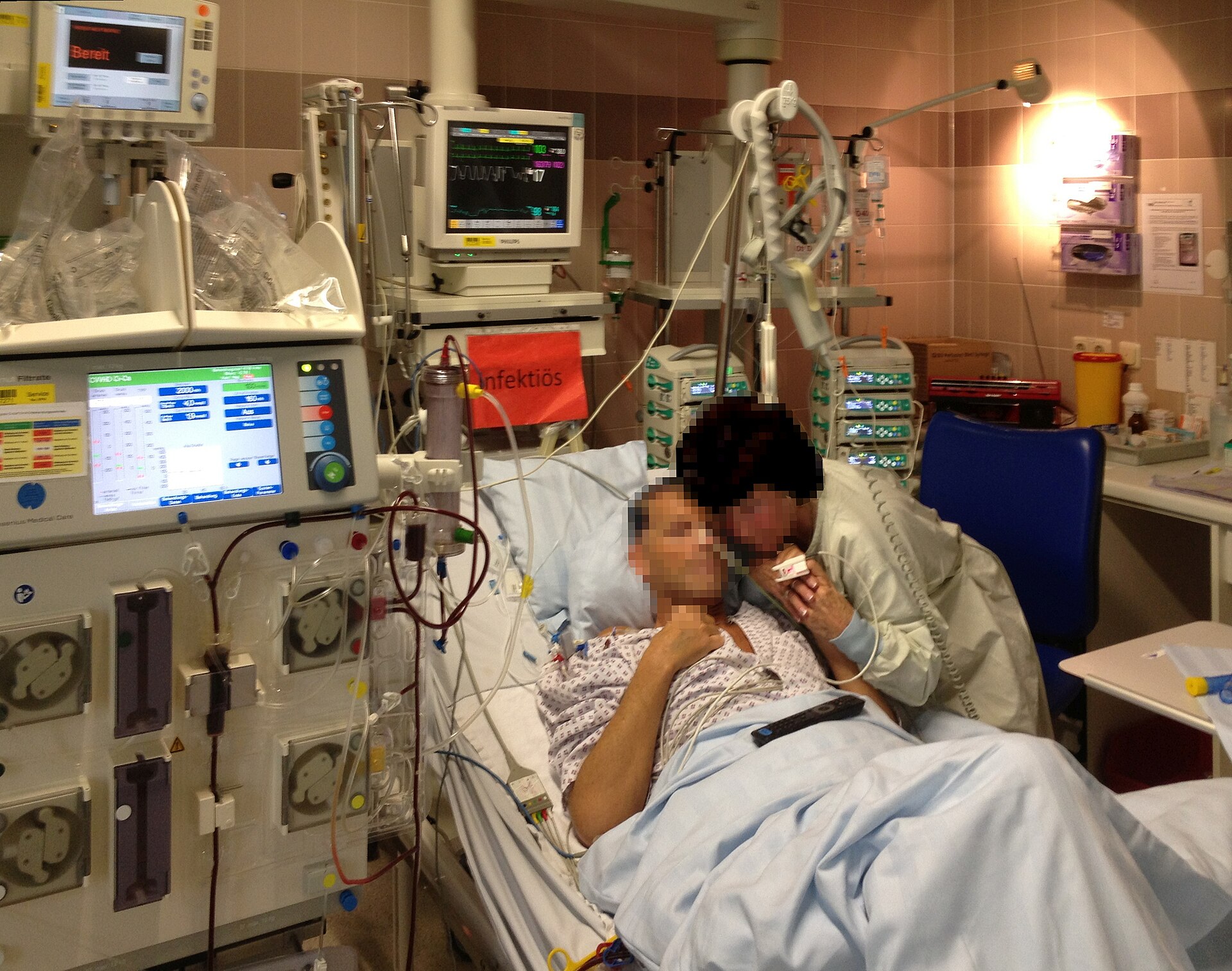
Source: Wikimedia Commons — photo by Pittigrilli (CC BY-SA 4.0)

2. Physicians (Ärzte)
The shortage concentrates in regional hospitals and rural areas. The decisive step is the Approbation — the federal medical licence — which requires degree equivalence through the competent state authority plus medical-level German. Physicians from outside the EU typically enter on a skilled-worker visa or a Blue Card at the reduced threshold.
3. Engineers (Ingenieure)
Steady demand in mechanical, electrical, construction, and energy technology. Documented experience plus a recognized degree opens both routes: the skilled-worker visa with full recognition, or the Opportunity Card using points for experience, age, and language.
4. IT specialists
The one category with its own exceptional rule: you can obtain an EU Blue Card without a university degree if you can prove at least three years of professional IT experience, at the reduced 2026 threshold of €45,934.20. English suffices in many companies, which makes IT the fastest category of all to staff.
5. Scientists and researchers (Wissenschaftler)
Routes run through universities and research institutes (including postdoc packages) with salaries under collective agreements. Doctoral holders have flexible residence paths — which is why many Arab researchers begin their German journey through the DAAD scholarship with its €934 monthly stipend.
6. Skilled craftspeople (Handwerker)
Electricians, plumbers, builders, HVAC and energy technicians. The category least known among Arab professionals and the fastest to hire. The official route: equivalence assessment of your vocational certificate, then the skilled-worker visa — or coming to Germany for dual vocational training (Ausbildung) on a monthly training salary paid by the employer.
The numbers that govern the game in 2026
| Indicator | Value in force, 2026 |
|---|---|
| Blue Card threshold, regular occupations (§18g para. 1) | €50,700 per year |
| Reduced threshold — shortage occupations, recent graduates, IT without degree | €45,934.20 per year |
| Permanent residence for Blue Card holders with B1 German | after 21 months |
| Opportunity Card financial proof (per the portal FAQ dated 28 August 2026) | €1,091 per month / €13,092 per year |
| Opportunity Card points required | 6 out of 11 |
| Permitted part-time work while job-seeking on the Opportunity Card | up to 20 hours per week |
The reduced threshold is not a favour: it is tied to an official formula equal to 45.3% of the pension contribution ceiling, and it covers three groups — shortage-occupation workers, graduates within their first three years, and IT specialists without a degree.
Three doors in — choose by where you stand
Door one: a job offer in hand. The shortest path: an offer above the threshold goes straight to the Blue Card; below full recognition, the §16d visa covers work with partial qualifications. At this door your German- or English-format CV is the real gatekeeper — get it reviewed with our professional CV and resume service.
Door two: no job offer — the Opportunity Card. Six points (qualifications, experience, age, language, Germany connection, qualified spouse) buy you 12 months to interview from inside Germany, with the right to 20 hours of weekly part-time work. The non-negotiable base condition: a two-year-plus degree or vocational training, plus A1 German or B2 English.
Door three: dual vocational training (Ausbildung). For practical and craft occupations especially: you train inside a company on a monthly salary, and passing leads to a recognized German certificate and a near-guaranteed job. The least competitive applicant pool from the Arab world — and its highest odds.

Source: Unsplash
The three doors side by side: which fits your file?
| Criterion | Job offer in hand | Opportunity Card | Vocational training |
|---|---|---|---|
| Required before travel | Job offer + recognized credential | 6 points + €13,092 | Training seat + language certificate |
| Time window to find the opening | Not applicable | 12 months | Length of the training contract |
| Income during the first stage | Above the threshold from day one | 20 hours of part-time work | Training salary from the employer |
| Suits | Documented experienced professionals | Graduates and opportunity seekers | Tradespeople and career starters |
| What follows | Blue Card, then permanent residence | Conversion to a work visa after signing | German certificate + near-guaranteed hire |
No door is "best" in absolute terms; your file decides: full recognition goes straight to door one, a credential needing top-ups starts at door two, and a manual trade without formal papers launches from door three.
What intermediaries won't tell you before you pay
The labour-migration market is full of ready-made promises, and four signals demand an immediate stop:
- "A guaranteed job contract for a fee": hiring in Germany runs through the employer directly or licensed agencies, not contract sellers; any offer to buy a contract for money is fraud or a legal violation.
- "The Blue Card is guaranteed": the Blue Card is a decision of the foreigners' authority after file review — no intermediary can guarantee it.
- "You never need German for nursing": without B1, nursing is practically a closed hiring path, whatever the marketing says.
- "Credential recognition is a formality": for nursing, medicine, and the trades it is the core of the file and may require months of top-up courses — anyone claiming otherwise is selling an illusion.
The golden rule: any decisive financial or legal information is taken from the official source (the government portal or the embassy); an intermediary, if used at all, is for logistics and translation only.
Credential recognition (Anerkennung): the step that decides everything
For nursing, medicine, and the trades, recognition is not a formality — it is the core of the file: an assessment of your qualification against German standards, possibly requiring top-up courses or an aptitude test. Start the procedure from your home country before travelling — it runs by post and needs certified translations through our official document translation service — because several skilled-worker visa types are built on its outcome. For unregulated university degrees (engineering, IT), the Anabin database evaluation usually suffices, which is faster and simpler.
A 90-day plan before any move
- Days 1–15: place yourself in one of the six official categories and run the self-check tools on the Make it in Germany portal.
- Days 16–45: start recognition or the Anabin check for your category, prepare a German-format CV, and open a language file with a concrete target (A2 to start, B1 for nursing and the Blue Card fast track).
- Days 46–70: price your route between the three doors with a path-selection consultation — €13,092 in blocked funds for an Opportunity Card year, or a job offer above €45,934.20.
- Days 71–90: file the visa application at the embassy aligned with your documents, and plan first housing and address registration (Anmeldung) for right after arrival.
Frequently asked questions about Germany's shortage occupations
Can I really enter without a job offer?
Yes — through the Opportunity Card: six points plus proof of €1,091 per month buys 12 months of job-seeking with up to 20 hours of weekly part-time work.
Does IT require a university degree for the Blue Card?
No. Documented professional experience of three years qualifies IT specialists at the reduced threshold of €45,934.20 per year.
German or English — which matters more?
English suffices functionally at many IT employers and international firms; B1 German is the practical floor for nursing and medicine — and it unlocks permanent residence after 21 months on a Blue Card.
Do Opportunity Card months count toward permanent residence?
They count as lawful residence, but real settlement starts when you convert to a Blue Card or skilled-worker visa after signing a contract.
What is the difference between a craftsperson and a skilled worker?
A skilled worker holds a recognized qualification (university degree or two-year-plus vocational training); a tradesperson without formal credentials enters through dual vocational training first.
Sources and references
- Make it in Germany — Professions in demand (official portal)
- BAMF — Federal Office for Migration and Refugees
- Truescho — EU Blue Card Germany 2026 salary thresholds
Start your journey with Truescho now
The official shortage list is not a statistic to read; it is a decision map. Pick your category, start recognition, close the language gap — the rest is procedure with an end date. The Truescho team accompanies you from path selection to visa.