

Germany's Opportunity Card Without 6 Points: The Two Groups That Skip the Points Test
Last reviewed: September 2026
The Opportunity Card (Chancenkarte) is Germany's job-seeker residence permit, and the rule that decides everything is simpler than most applicants realize. According to the Federal Foreign Office's Consular Services Portal, two groups qualify as "skilled workers" and receive the card without any points requirement at all: people with a vocational qualification obtained or recognized in Germany, and people with a university degree obtained or recognized in Germany. Everyone else enters the six-point scoring system, with financial proof of €1,091 per month. This guide walks through both routes exactly as the official sources state them, including the law itself (Section 20a of the German Residence Act) and the Federal Employment Agency's 2026 explainer.
Who Qualifies With No Points? The Two Exempt Groups
Germany separates applicants whose qualifications are already "done" from those who still need an equivalence assessment. If you belong to either of these two groups, you apply as a skilled worker and the points table simply does not apply to you:
- Vocational graduates: you completed a qualified vocational training program in Germany, or your foreign vocational qualification has been officially recognized (or declared equivalent) in Germany.
- University graduates: you earned your degree in Germany, or your foreign degree is recognized or assessed as comparable in Germany.
The Consular Services Portal states it plainly: applicants in these categories "can apply for the Opportunity Card as a skilled worker without having to achieve a minimum number of points." You still need to meet the basic requirements — a valid passport and proof that you can support yourself for the duration of your stay — but there is no language threshold listed among the basic requirements for this route, because your recognized qualification carries the application.
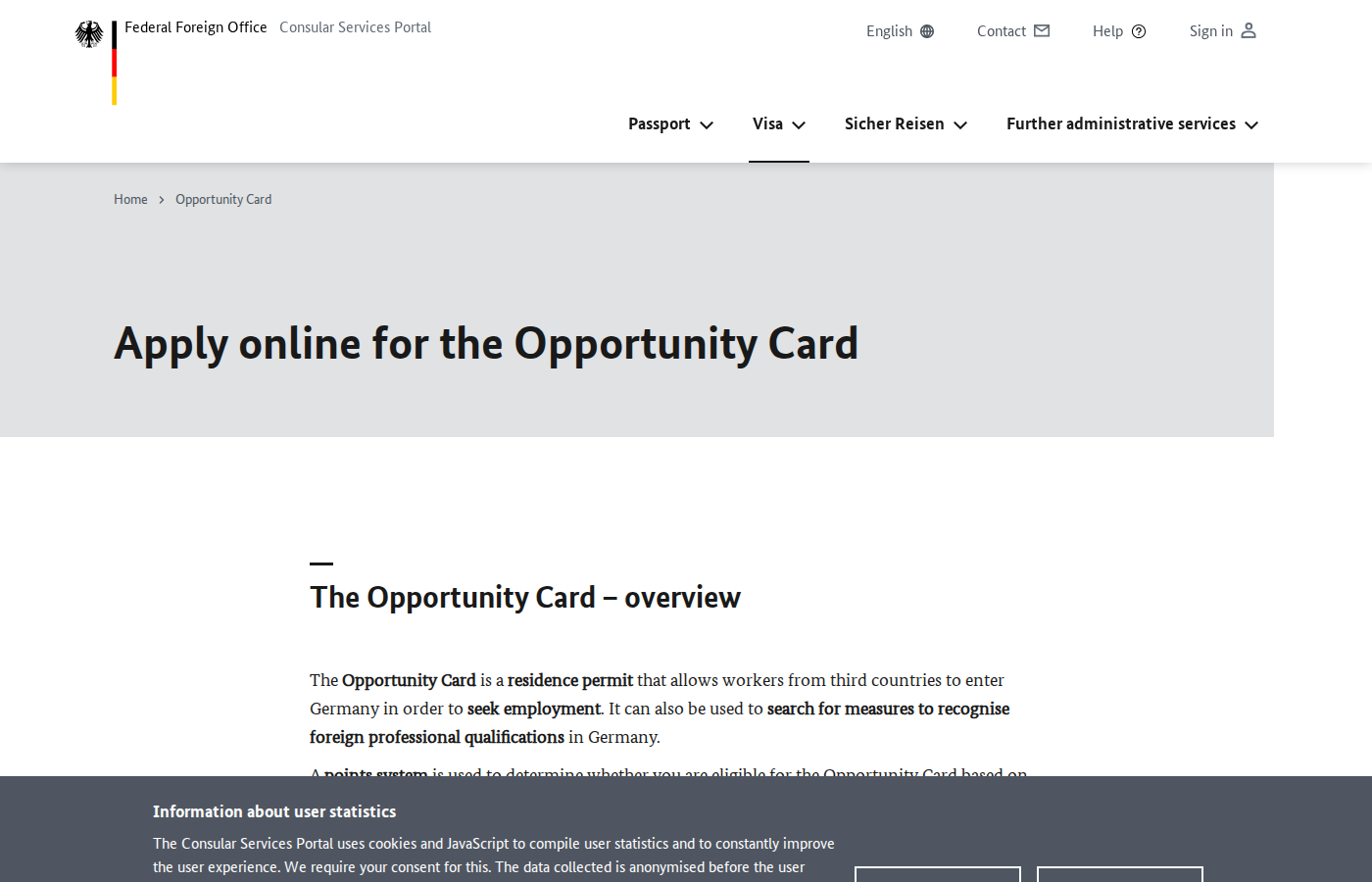
Source: German Federal Foreign Office Consular Services Portal — Opportunity Card
For graduates from Lagos, Manila, Karachi, or Nairobi, the practical first step is checking whether your university and degree appear in the anabin database with H+ status and an "entirely" or "conditionally comparable" assessment. If they do, your degree counts as state-recognized and the points test disappears. Certificates issued by German Chambers of Commerce Abroad (AHK) are accepted as-is.
The Six-Point Route: The Official Scoring Table
If your qualification is not recognized in Germany, you switch to the points route. To enter it at all you need a state-recognized qualification from the country where you earned it — a university degree or at least two years of vocational training — plus German at A1 level or English at B2 level. Then you collect six points or more from this official table:
| Criterion | Official points |
|---|---|
| Partial recognition of your foreign qualification (or a regulated profession requiring compensatory measures) | 4 points |
| Professional experience matching your qualification | 2–3 points |
| Language skills (German A2 up to B2+; extra point for English C1) | 1–4 points |
| Age under 35 | 2 points |
| Age 35 to 40 | 1 point |
| Qualification in a shortage occupation | 1 point |
| Legal residence in Germany for 6+ months in the last 5 years (study, language, work — not tourism) | 1 point |
| Applying together with your spouse at the same German mission | 1 point |
The most efficient combinations are predictable: a 29-year-old with German B1 (2 points), two years of relevant experience (2 points), and a shortage-occupation qualification (1 point) still needs one more point — which English C1 or a partner's joint application can provide. Plan your evidence early, because every claimed point must be supported by certificates.
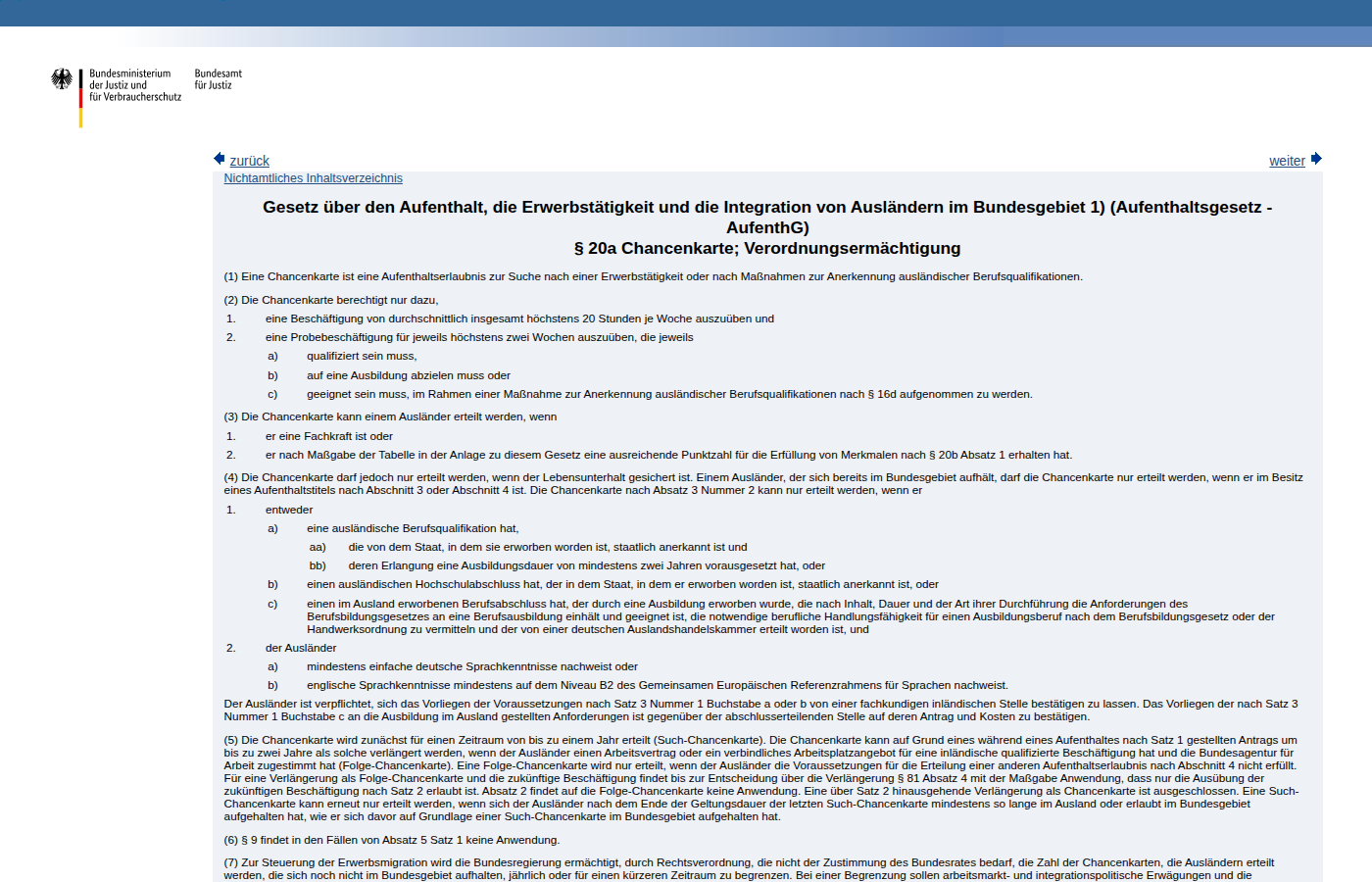
Source: Federal Official Legal Information — Section 20a Residence Act
The €1,091 Question: Proving You Can Support Yourself
For 2026, the standard figure is €1,091 per month — roughly €13,092 for a full year of job seeking. The immigration authorities accept two main forms of proof: a blocked account (Sperrkonto) funded with the full amount and released in monthly installments, or a formal declaration of commitment (Verpflichtungserklärung) signed by someone living in Germany who accepts legal responsibility for your living costs.
Open the blocked account well before your embassy appointment. In high-demand consular districts, both the bank confirmation and the appointment slot can take weeks, and applications fail more often on documentation logistics than on eligibility itself.
What the Card Actually Gives You
The Opportunity Card is issued initially for up to one year of job searching. During that year you may:
- Work part-time up to 20 hours per week alongside your search.
- Take trial employment of up to two weeks per employer, provided the role is qualified or tied to training or recognition measures.
- Convert a job offer into a longer stay: with an employment contract or binding offer for qualified employment, you can obtain a follow-up Opportunity Card for up to two additional years (with Federal Employment Agency approval) or switch to a standard work residence permit.
Notably, the Federal Employment Agency's approval is not required for the job-seeker card itself, nor for the part-time and trial work during it, according to the Agency's own 2026 bulletin. But there are boundaries: unskilled "helper" jobs do not qualify for the follow-up card, the card cannot be extended beyond the follow-up period, and a fresh job-seeker card requires you to have stayed outside Germany (or legally inside it) for at least as long as your previous Opportunity Card lasted.
How to Apply, Step by Step
- Classify yourself first. Is your qualification recognized in Germany? Then apply as a skilled worker — no points. If not, use the points calculator inside the Consular Services Portal to see where you stand.
- Assemble documents: passport, degree or vocational certificate with certified translation, experience letters, language certificate if you have one, and the €1,091/month financial proof.
- Apply online at digital.diplo.de or book an appointment at the German embassy or consulate responsible for your country of residence.
- Watch for service-provider fees. Some German missions work with external providers that pre-check applications for a fee; you will be told during the process if this applies to you.
- After arrival: register your address, collect your electronic residence card, and start applying immediately — twelve months pass quickly.
For the broader picture, read our complete guide to Germany's Opportunity Card in 2026 and our overview of legal routes to work and study in Germany without German. You can also browse verified study and work opportunities on Truescho or hand your application file to our team through the Apply For Me service.
The Two Routes at a Glance
| Comparison point | Skilled-worker route | Six-point route |
|---|---|---|
| Entry requirement | German or Germany-recognized vocational qualification or degree | Degree or 2+ years of vocational training recognized in the issuing country |
| Points | Not required at all | At least 6 from the official table |
| Language | Not listed among the basic requirements | German A1 or English B2 minimum |
| Financial proof | €1,091 per month | €1,091 per month |
| Qualification check | Proof of recognition (ZAB / anabin, or completed equivalence) | Points calculator inside the portal |
The practical takeaway: if your qualification already clears the recognition bar, your route is shorter and cheaper because you skip every point tied to age, experience, and language. If you are on the points route, calculate on paper before spending anything: German B1 (2 points) plus two years of documented experience (2 points) plus being under 35 (2 points) already gives you the full six, while a shortage occupation or a joint application with your partner provides the safety margin if one of the three falls short.
Common Mistakes That Sink Applications
- Claiming points without documents. The portal states plainly that all details relating to the criteria must be supported by evidence or certificates. Any point on your form without a matching document is a near-certain refusal.
- Skipping the anabin check. Applicants too often discover only after paying fees that their university does not hold H+ status — which shifts the file from the skilled-worker route to a points route they never prepared for.
- Opening the blocked account too late. Bank confirmations can take weeks in peak season, and a consular appointment booked without financial proof in hand means a rescheduling that costs a month or more.
- Contradicting your own CV. A single date mismatch between your documents is enough to cast doubt on the entire file; verify every date and job title before submitting.
Frequently Asked Questions
Do I still need six points if my degree is recognized in Germany?
No. The Consular Services Portal states that applicants with a German or Germany-recognized vocational qualification or university degree apply as skilled workers without any minimum points. You only need the basic requirements, such as the passport and financial proof.
Is German language required for the Opportunity Card?
Only on the points route, where the minimum is German A1 or English B2. Higher German levels earn extra points (up to three for B2 or above), and English C1 adds one more. The skilled-worker route does not list a language requirement among its basic conditions.
How long is the card valid, and can it be extended?
The job-seeker card is issued for up to one year. If you sign a contract or binding offer for qualified employment during that time, you can extend by up to two more years via the follow-up Opportunity Card, subject to Federal Employment Agency approval, or move to a standard work permit.
How much money do I need to show?
The standard 2026 figure is €1,091 per month — about €13,092 for a year. You prove it with a blocked account funded in advance or a formal declaration of commitment from a resident of Germany.
Can I work while searching for a job?
Yes. Card holders may work up to 20 hours per week in part-time employment and take trial jobs of up to two weeks each, as long as the work is qualified or connected to training or recognition measures. No Federal Employment Agency approval is needed for this.
Sources
- German Federal Foreign Office Consular Services Portal — Opportunity Card — official requirements, points table, and application entry point
- Section 20a of the German Residence Act (AufenthG) — the binding legal text for both routes
- Federal Employment Agency (BA) — ZAV bulletin on the Opportunity Card, 2026 — official explainer of the skilled-worker categories, points, and funds
- Truescho — Germany's Opportunity Card 2026: complete guide — our detailed walkthrough of the application journey