

Germany Ends the 1-Year Crypto Tax Break: What the 2027 Draft Means for Your Bitcoin and Ethereum
Last updated: October 2026
Germany's famous one-year holding tax break for crypto would end for coins bought after December 31, 2026 under a Finance Ministry draft dated September 30, 2026 — and it is still only a draft, not enacted law. The Germany crypto tax 2027 holding period reform would move Bitcoin, Ethereum and other exchange crypto-assets into the flat capital-gains regime: 26.375% on every sale, no matter how long you hold, with platforms withholding tax automatically from 2028. Crypto you already own stays grandfathered under the old one-year rule.
Short answer: Nothing has changed yet. A Finance Ministry draft dated September 30, 2026 would end the one-year holding exemption for crypto acquired after December 31, 2026, taxing future gains at a flat 26.375%, with platform withholding from 2028. Coins bought before 2027 stay fully grandfathered. The draft still needs cabinet, Bundestag and Bundesrat approval.
Where the process stands right now: the draft is in inter-ministerial coordination. On October 8, 2026 the Bundestag rejected — by 445 votes to 132 — a stricter rival bill from the Greens that would have applied personal income tax rates of up to 45% to crypto bought after 2025. On October 12, the Petitions Committee held a public hearing on petition 201716, backed by 44,439 signatures, and the ministry said it is sticking to its plan. On October 13, an expert survey published by BTC-ECHO asked how likely the holding-period abolition is to become law within six months — the median expert answer was 70%. In other words: passage is the likelier path, so prepare, and do not treat any headline as final.
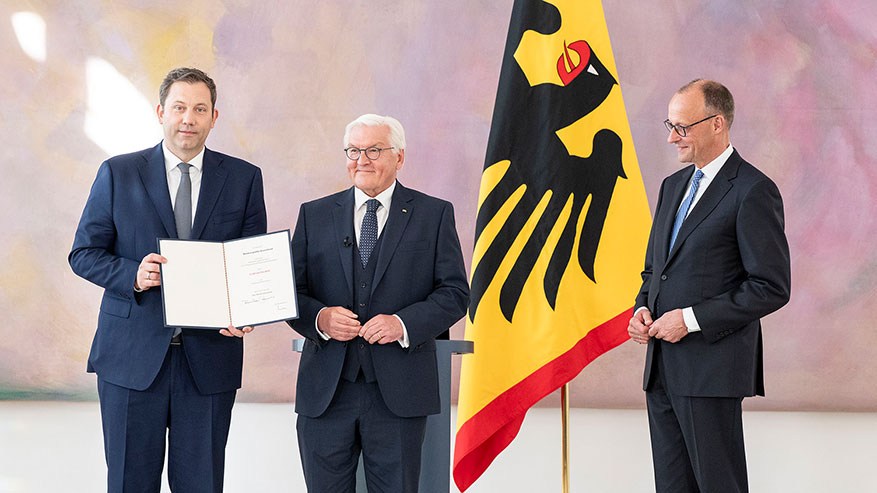
The draft comes from Finance Minister and Vice Chancellor Lars Klingbeil's ministry, the same department whose March 2025 administrative letter still defines how crypto is taxed today.
Source: German Federal Ministry of Finance — official gallery
Who This Applies To — and Who Is Exempt
German tax law follows your residency, not your passport. If you have a residence or habitual abode in Germany — unbeschränkte Steuerpflicht, or unlimited tax liability — your worldwide crypto gains fall under these rules, whether you are a German national in Hamburg or a British developer in Berlin on day 400 of your relocation. Citizenship is irrelevant; a US citizen who is a German tax resident is covered, and a German citizen living abroad generally is not.
Four groups matter here:
- German tax residents — holdings acquired before January 1, 2027. Fully exempt from the change. The draft's transition rule (§52) applies the new regime only to crypto acquired or transferred to you after December 31, 2026. Your existing coins keep the one-year exemption permanently, even if you sell them in 2030 — provided you can prove when you bought them.
- German tax residents — anything bought from 2027 onward. Fully inside the new system: flat 26.375%, no holding-period escape, platform withholding from 2028.
- New arrivals. You are covered from your first day of tax residence, including expats who moved for work or on an EU Blue Card — our guide to the German EU Blue Card 2026 explains when exactly residence begins for tax purposes.
- People thinking about leaving. Moving your life — and your tax residence — out of Germany is not a clean escape: disposals after departure can raise exit-tax questions, and the CARF data-exchange law passed on October 8 (more below) means foreign platforms will report German-linked activity. Anyone comparing jurisdictions should weigh the German exit tax before pricing out, say, a Dubai crypto license under VARA in 2026 — and should note that European neighbours are not standing still either; the Netherlands, for instance, is moving toward taxing presumed returns under Box 3, as covered in our Netherlands 30 percent ruling 2026 explainer.
Non-residents without a German tax presence are generally outside the scope of this law for private crypto sales. The trigger is where you live, not where the exchange is.
Which Assets the Draft Covers — and Which It Leaves Out
The draft borrows the EU MiCA regulation's definition of an "exchange crypto-asset" (Tauschkryptowert, per Article 3(1)(5) of Regulation (EU) 2023/1114). In practice that means Bitcoin, Ether and comparable tokens launched for exchange purposes. The explanatory memorandum literally names "Bitcoin und Ether."
Explicitly excluded: NFTs, security tokens, asset-referenced tokens, most e-money tokens and certain stablecoins, and real-asset tokens. Those stay under the existing framework — including §23 with its one-year exemption — so the apocalypse headlines about "all crypto taxed at 26.375%" are simply wrong.
The ministry has also published an official explainer video on what crypto-assets are, worth two minutes for anyone who wants the state's own framing:
Source: German Federal Ministry of Finance — #Finanzisch video series
The video is in German; the ministry publishes a written text version for anyone who prefers reading.
Old Rule vs New Rule: The Complete Comparison
This is where the Germany crypto tax 2027 holding period change becomes concrete. Today, crypto sits in §23 of the Income Tax Act as a private disposal transaction: sell within a year and your personal income tax rate applies; hold longer than a year and the gain is tax-free. The draft deletes that exemption for post-2026 purchases and reclassifies crypto gains as capital income under §20 — the same bucket as dividends and share profits.
| Point of comparison | Old rule — §23, in force today | New rule — draft, from Jan 1, 2027 |
|---|---|---|
| Legal classification | Private disposal transaction | Capital income (new §20 Abs. 2 Nr. 9) |
| Holding period | Tax-free after 1 year; stretches to 10 years if the asset itself generated income | Irrelevant — no holding exemption for post-2026 buys |
| Tax rate | Your personal income tax rate on short-term gains, up to 47.475% including the 5.5% solidarity surcharge | Flat 26.375% (25% Abgeltungsteuer + 5.5% solidarity surcharge), plus church tax if you pay it |
| Purchase date that matters | Any | Only acquisitions after Dec 31, 2026; anything earlier is grandfathered under §23 |
| Exemption threshold | €1,000 per year (Freigrenze) — but exceeding it by one euro makes the entire gain taxable | €1,000 saver's allowance (Sparer-Pauschbetrag), €2,000 for jointly assessed couples, deducted from capital income |
| Platform withholding | None — you self-declare in your annual return | Mandatory from Jan 1, 2028 |
| Losses | Crypto losses offset other §23 private-sale gains | Offset against capital income such as dividends and interest; stock losses remain restricted to stock gains (§20 Abs. 6) |
| Staking and lending | Taxed as "other income" at your personal rate; lending can trigger the 10-year extension | Reclassified as capital income (new §20 Abs. 1 Nr. 12) |
| Airdrops and gifts | Zero acquisition cost under the ministry's 2025 guidance | Zero acquisition cost codified (§20 Abs. 4b) — the full sale price counts as gain |
Two lines in that table deserve emphasis. First, the difference between the old €1,000 Freigrenze and the new €1,000 allowance is not cosmetic: the old rule was a cliff edge (exceed it and everything is taxed), the new one is a genuine deduction. Second, the loss-offset row is a quiet improvement — crypto losses becoming offsetable against dividends and interest is something the old private-sale system largely blocked.
What You Would Actually Pay: Four Worked Scenarios
Numbers beat adjectives. All four scenarios below assume the draft passes as written — the outcome industry experts consider likelier than not, putting a 70% median probability on the abolition becoming law within six months.
Scenario 1: Bought in 2024, sold after one year — €0 tax
You bought Bitcoin for €10,000 in 2024 and sell for €40,000 in 2026, more than a year later. Gain: €30,000. Tax: €0. The one-year exemption wipes it completely. This is the exact example the draft's own arithmetic is built on: a gain of €10,000 on coins bought December 30, 2026 and sold two years later remains tax-free under the transition rule.
Scenario 2: Same trade, purchase date moved to 2027 — €7,912.50
Identical economics, but you bought the €10,000 position on January 15, 2027 and sold at €40,000 in 2029. Gain: €30,000, taxed at 26.375% = €7,912.50. If your €1,000 saver's allowance is unused that year, the taxable base drops to €29,000 and the bill falls to €7,648.75. On the worked example circulated in FinanceFeeds' coverage of the draft — a €10,000 gain — the tax is €2,637.50. Holding three years or ten makes no difference.
Scenario 3: Short-term seller at the top bracket — you would save ~21 points
The draft has an awkward secret: one group benefits. A top-bracket investor selling within a year today pays up to 45% plus the 5.5% surcharge — 47.475%, or €14,242.50 on a €30,000 gain. At the 42% bracket it is 44.31%. Under the flat 26.375%, that same short-term gain costs €7,912.50 — roughly 21 percentage points less. Long-term holders lose everything they had; frequent traders at high incomes get a cut. Low-income occasional sellers can even end up paying more than their personal rate would have charged.
Scenario 4: No records, sale after 2027 — the 50% trap
This is the scenario no competitor's news story explains, and it is the draft's sharpest edge. From 2028, if you sell through a platform and it cannot or will not accept your proof of a pre-2027 acquisition date, the platform must treat the coins as bought after December 31, 2026 — and withhold 25% of 50% of the gross sale proceeds. Sell €40,000 of documented-but-unprovable coins and €5,000 is withheld, even if your real gain was zero or the coins were grandfathered. German tax advisors have warned the over-withholding can reach ten times the tax actually owed. You would have to reclaim the excess through your annual return — months later, with the burden of proof on you. (The stock-market equivalent uses a 30% assumption; crypto's draft is deliberately harsher.)
Airdrops and Gifts: The 0-Euro Rule Nobody Is Writing About
Buried in the draft's new §20 Abs. 4b is a rule that will surprise people who received tokens for free: for airdrops and gifts, the acquisition cost is set at €0. Receive 1,200 euros' worth of tokens in an airdrop in 2027, sell them later at the same value, and the entire €1,200 is taxable gain at 26.375% — a tax bill of €316.50 on zero economic profit. The same logic applies to gifted coins: the recipient's later sale is taxed on the full proceeds.
This codifies what the ministry's March 6, 2025 administrative letter already practiced, but writing it into statute removes any argument room. If you are a frequent airdrop hunter, your record-keeping problem just became a direct tax problem.
From Draft to Law: The Full Timeline
- End of April 2026 — Finance Minister Lars Klingbeil floats taxing crypto like securities, with initial revenue estimates around €2 billion.
- September 30, 2026 — The ministry publishes the Referentenentwurf (departmental draft): "Draft Law on the Reform of Taxation of Certain Crypto-Assets in Private Assets." It enters inter-ministerial coordination; presentation to the cabinet is described only as "intended." The draft projects revenues of €70 million in 2027, €175 million in 2028 and €350 million per year from 2029–2031 (of which, in 2031: €179 million federal, €158 million state, €13 million municipal). A formal evaluation is required six years after entry into force.
- October 8, 2026 — Plenary session 99: the Bundestag rejects the Greens' alternative (Drucksache 21/5752), which would have imposed personal income tax rates of up to 45% on crypto bought after December 31, 2025 and claimed "at least €5 billion" in revenue. The vote: 445 against, 132 for, 53 ballots not cast. CDU/CSU voted 198-0 against, AfD 134-0 against, SPD 112-0 against; the Greens (76) and Left (54) voted for. A Left-party motion (21/5824) was withdrawn by show of hands. Crucially, this vote killed the stricter rival — the ministry's milder 26.375% route is the one still alive.
- October 8, 2026, same evening — The Bundestag passes the CARF implementation law (21/7195): automatic international exchange of crypto data — names, tax IDs, asset types, gross amounts, transaction counts. Silence stops being a strategy at exactly the moment the withholding regime begins.
- October 12, 2026 — The Petitions Committee holds a public hearing (12:00, room 3.101, Marie-Elisabeth-Lüders building, livestreamed on bundestag.de) on petition 201716, filed by Nicole Nowak. It gathered 44,439 signatures, clearing the 30,000 quorum on August 6, with signing closing September 15. Government representatives confirm the ministry is sticking to its plan — and float extending the same abolition to the one-year exemption for gold and other economic assets, a defensive move against the charge that crypto is being singled out.
- October 13, 2026 — BTC-ECHO publishes its expert survey; liberal FDP MP Frank Schäffler states the crypto item is not yet even in inter-ministerial coordination and will not reach the cabinet on October 14, contradicting press reports of an imminent cabinet date.
- What remains — Inter-ministerial coordination, cabinet approval, three Bundestag readings, Bundesrat consent, publication in the Federal Law Gazette. Only then does the January 1, 2027 effective date (Article 2 of the draft) become real.

Source: German Federal Ministry of Finance — official gallery
Will the Draft Survive? What Experts and the Numbers Say
The BTC-ECHO survey of October 13 asked one question: how likely is it that the abolition of the holding period becomes law within six months? Among 46 industry experts (41 responded), the median answer was 70% and the average 65%. Among 274 community respondents (254 answered), the median was 75% and the average 69% — with a full third of the community at 90% or higher.
The political arithmetic backs the scepticism. At least 12 MPs from the Union bloc — whose votes the government needs — have voiced opposition. The petition's hearing produced unusually frank quotes: tax advisor Dr. Ingo Heuel called the draft "not yet ready for a decision," Green financial politician Afra Stöhr said the outcome is "not finally decided," and petitioner Nicole Nowak left the hearing "positively surprised." Ulrike Lierow-Schad of the Federal Blockchain Association argued for "confirmed rights and innovation instead of hasty changes." Tax advisors are already flagging constitutional questions if crypto is treated more harshly than gold or foreign currency — which is precisely why the ministry floated ending gold's exemption too.

Source: German Federal Ministry of Finance — official gallery
Against that: the ministry has not moved an inch publicly, the chancellor's coalition designed the 25% route deliberately as the moderate option, and the revenue projection (€350 million a year at steady state) is modest enough to be politically defensible. During the October 8 debate, Left MP Isabelle Vandre claimed only about 3% of crypto investors declare their gains correctly — a self-serving statistic, but one that captures why the ministry wants withholding at source. Compare the scale of government ambition elsewhere: Washington's own US crypto tax bill for 2026 shows the same pattern of states chasing a newly visible tax base.
The honest summary: the direction (some flat tax, some withholding, grandfathering of old holdings) looks durable; the specific abolition of the one-year break is genuinely contested.
Case Study: Rachel Bennett, Berlin
Rachel Bennett, 38, a British UX consultant, has been a German tax resident in Berlin since 2021 — paid in euros, taxed in Germany, no plans to leave. Her portfolio at today's prices:
- 0.15 BTC bought in May 2024 for €10,000, now worth €40,000
- ETH bought in February 2026 for €6,000, now worth €9,000
- A governance-token airdrop received in mid-2026, currently worth €1,200
- A planned €5,000 BTC purchase in January 2027
Here is what the draft does to each position. Her BTC and ETH are both grandfathered: whenever she sells them — December 2026 or December 2031 — the one-year rule still applies, so her €30,000 BTC gain and €3,000 ETH gain remain tax-free (the ETH crosses its one-year mark in February 2027; selling before that would trigger her personal income tax rate, exactly as today). The January 2027 purchase sits in a different sleeve: if she later sells it for €8,000, the €3,000 gain costs her 26.375% — €791.25, reduced further by any unused saver's allowance. The airdrop is the sting: with a €0 basis under §20 Abs. 4b, selling the full €1,200 position produces a €316.50 bill on a token she never paid for.
The trap Rachel must actively avoid is the re-conversion: if in March 2027 she swaps her grandfathered €40,000 BTC position into ETH, that ETH is a post-2026 acquisition. Sell it later at €52,000 and she owes 26.375% on the €12,000 gain — roughly €3,165 — where simply holding the BTC would have cost nothing. Her to-do list is short: export every trade record before December 31, label the pre-2027 wallets separately from anything she buys next year, and make any planned token swaps with open eyes about which bucket the proceeds land in.
Your Action Checklist Before December 31, 2026
The cutoff that matters is the purchase date, and the documentation that matters exists only if you create it. Roughly ninety days remain.
- Export complete trade histories from every exchange and wallet you have ever used — CSV and PDF, including closed accounts. This is the single highest-value hour you can spend.
- Reconstruct acquisition dates and FIFO lots. German law applies first-in-first-out for identical tokens; the draft makes your lot dating the difference between €0 tax and 26.375%.
- Physically separate pre-2027 and post-2027 holdings — separate wallet addresses or subaccounts, so a future audit can trace which bucket every coin came from.
- Document transfers between platforms with transaction IDs, so moving coins to cold storage in 2027 cannot be misread as a fresh acquisition.
- Audit every pending airdrop and gift, and note the fair value at receipt.
- If a swap of older coins is on your mind, price the re-conversion trap first — post-2027 swaps move value out of the grandfathered bucket.
- Verify your tax residency status — including whether a planned move abroad triggers exit-tax exposure rather than an escape.
If you are mapping Germany against other English-friendly bases — residency routes, tax regimes, relocation costs — the country guides on truescho.com/en lay out the comparison in one place, and this page is updated whenever the draft reaches its next station.
Seven Costly Mistakes to Avoid
- Treating the draft as enacted law. Nothing changes until cabinet, Bundestag and Bundesrat finish. Selling everything in a panic in October 2026 could itself trigger the short-term personal-rate tax you feared.
- Assuming the opposite — that the draft is dead. The October 8 vote rejected the harsher Greens' plan, not the ministry's. The 26.375% route is the one the coalition actually intends to pass.
- The re-conversion trap. Swapping grandfathered coins for new tokens after January 1, 2027 quietly moves the entire value into the taxable bucket.
- Selling in 2028 with no records. The 50% fallback rule withholds 25% of half your gross proceeds — advisors have modelled over-withholding of up to ten times the true tax.
- Forgetting the €0 basis on airdrops. Free tokens mean the whole sale price is gain. A "worthless-looking" airdrop can still generate a real bill.
- Confusing the €1,000 Freigrenze with the €1,000 saver's allowance. Under the old rule, one euro over the limit taxed the whole gain; under the new one it is a true deduction. Which rule applies depends entirely on when you bought.
- Ignoring the CARF data exchange. From the same October 8 sitting, platforms will report names, tax IDs and gross amounts across borders. Non-declaration was always illegal; now it is also visible.
Frequently Asked Questions
Is crypto still tax-free after 1 year in Germany under the 2027 draft?
Only for coins acquired before January 1, 2027. The draft keeps the one-year exemption for existing holdings but ends it for anything bought after December 31, 2026, which would be taxed at 26.375% regardless of holding length. Until the draft passes, the old rule still applies to everyone.
What is Germany's crypto tax rate from 2027?
26.375%: the 25% flat Abgeltungsteuer plus the 5.5% solidarity surcharge, before any church tax. Unlike today, the rate would no longer depend on your personal income tax bracket or how long you held. The €1,000 saver's allowance (€2,000 for jointly assessed couples) still offsets capital income.
Does the December 31, 2026 cutoff protect crypto I already own?
Yes. Under the draft's transition rule, the new regime applies only to crypto acquired or transferred to you after December 31, 2026. Coins bought earlier keep the one-year exemption permanently — even if you sell in 2030 — provided you can document the acquisition date when asked.
Does the 10-year rule apply to staked or lent crypto in Germany?
Under current §23 law, yes: the holding period stretches from one year to ten when the asset itself generated income, which is why stakers lived in legal uncertainty. The draft resolves it differently — staking and lending income become §20 capital income, and the ten-year question evaporates because the one-year exemption is gone for post-2026 buys anyway.
Will German crypto exchanges withhold tax automatically from 2028?
Yes, that is the plan. From January 1, 2028, platforms must withhold the 26.375% on sales by German tax residents, as banks already do for shares. Without accepted proof of a pre-2027 acquisition date, the platform assumes a post-2026 purchase and withholds on 50% of gross proceeds.
How do I prove my coins were bought before 2027 if the exchange closed?
Export everything now: trade histories, deposit confirmations, wallet transaction records with blockchain timestamps, bank transfer evidence, old exchange PDFs. Without accepted proof, the draft's fallback deems your coins post-2026 acquisitions and withholding applies to half the sale proceeds — reclaimable only through your annual return.
Can crypto losses offset stock gains under the new rules?
Partly. Because crypto gains move into §20 capital income, crypto losses become offsetable against other capital income such as dividends and interest — something the old private-sale rules largely blocked. The long-standing restriction remains that stock losses can only offset stock gains (§20 Abs. 6 EStG).
Does German crypto tax apply to non-residents or new arrivals?
Residency decides, not citizenship. If Germany is your tax residence — including expats on an EU Blue Card or employees who relocated for work — your worldwide crypto gains are covered from day one. Non-residents are generally outside it, but leaving Germany can raise exit-tax questions of its own.
Are airdrops and gifts taxable in Germany from 2027?
No tax on receipt, but the draft assigns them an acquisition cost of €0 (§20 Abs. 4b). When you later sell airdropped or gifted tokens, the entire sale price counts as taxable gain at 26.375% — there is no purchase cost to deduct. Record the fair value at receipt regardless.
Is crypto-to-crypto swapping taxable in Germany?
The swap itself is not a taxable disposal: exchanging Bitcoin for Ethereum does not trigger the sale tax. But it restarts the one-year clock under the current rule, and after 2027 swapping grandfathered coins for new tokens moves the value into the fully taxable post-2026 bucket.
Your Next Move
Three things are certain inside the uncertainty. First, the Germany crypto tax 2027 holding period reform is a draft, not a law — experts put a 70% median probability on the abolition becoming law within six months, the ministry is pushing, and the coalition designed it to pass. Second, the December 31, 2026 cutoff protects everything you already hold, permanently, if and only if you can prove when you bought it. Third, the 50% withholding fallback makes documentation the difference between €0 and a five-figure problem.
So the rational sequence is: export your records this month, separate your pre-2027 holdings, watch the cabinet and Bundestag stations — this page gets updated at each one — and treat any December decision as a tax-timing question, never as a reason to buy or sell an asset you would not otherwise touch. This article is tax information, not tax or investment advice; for positions that matter, a German Steuerberater with crypto experience is worth the fee.
For more English-language guides on German and European tax, residency and relocation topics, browse truescho.com/en.
Sources
- German Federal Ministry of Finance — draft law "Reform der Besteuerung bestimmter Kryptowerte im Privatvermögen" (Referentenentwurf PDF, September 30, 2026)
- Gesetze im Internet — §23 EStG (current law on private disposal transactions)
- German Bundestag — plenary protocol session 99 (October 8, 2026 vote record)
- BTC-ECHO — expert survey on the probability of the holding-period abolition (October 13, 2026)
- FinanceFeeds — Germany crypto tax exemption and the Bundestag vote