
Germany's dual vocational training system — the famous Ausbildung — pays you a monthly salary while you learn a trade, and here is the part that surprises almost everyone outside Germany: that salary is not a courtesy from the company. Section 17 of Germany's Vocational Training Act (Berufsbildungsgesetz, BBiG) sets a legally binding minimum wage for every trainee in the country and forces it to rise every single year of the program. Section 16a of the Residence Act then opens a dedicated visa route for non-Europeans who secure a training contract. This guide, last updated on 2 September 2026, walks through both laws using their official published texts, with the complete salary ladder, the residence permit rules, and a practical application path.
Whether you are a secondary-school graduate in Lagos weighing Europe's options, an electrician's apprentice in Manila planning a move, or a student in Delhi comparing Germany's three main pathways, this article gives you the verified numbers first.
What Ausbildung Actually Is: The Dual System Explained
The word Ausbildung literally means "training," but in the German context it refers to a dual (Duales System) program that splits your week between two places:
- The company that hires you as a trainee (Auszubildender) and pays you a monthly salary from day one.
- The vocational school (Berufsschule), usually one or two days a week, where you study the theory behind your trade.
What makes this structurally different from apprenticeships in most countries:
- A real employment contract — you are an employee of the company, with a training contract registered with the responsible chamber (IHK for industry and commerce, HWK for crafts).
- A legally guaranteed salary — unpaid vocational training does not exist in the German system; paying below the statutory floor is a direct legal violation.
- A nationally recognized qualification — you finish with a state examination and a professional title valid across Germany and, in practice, across the EU.
- A defined duration — most programs run between two and three and a half years depending on the trade.
Germany recognizes more than 300 state-approved training occupations, from industrial electrical engineering and mechatronics to nursing assistance, office management, culinary arts, and IT specializations. For a wider picture of Germany's legal entry routes, see our guide to the Germany Opportunity Card for job seekers.
The Salary the Law Guarantees: The Full Ladder in Numbers
Section 17 of the Vocational Training Act does not leave trainee pay to negotiation. The law states that training companies must grant trainees "appropriate remuneration" and that this pay "increases as vocational training progresses, at least once a year."
It then fixes a binding monthly minimum for the first year, indexed to the year your training starts:
| Training start year | Statutory monthly minimum (year 1) |
|---|---|
| 2020 | €515 |
| 2021 | €550 |
| 2022 | €585 |
| 2023 | €620 |
This is not a guideline. The law says remuneration is explicitly "not appropriate" if it falls below this floor — meaning a company paying less is breaking the law, and the trainee can escalate to the responsible chamber.

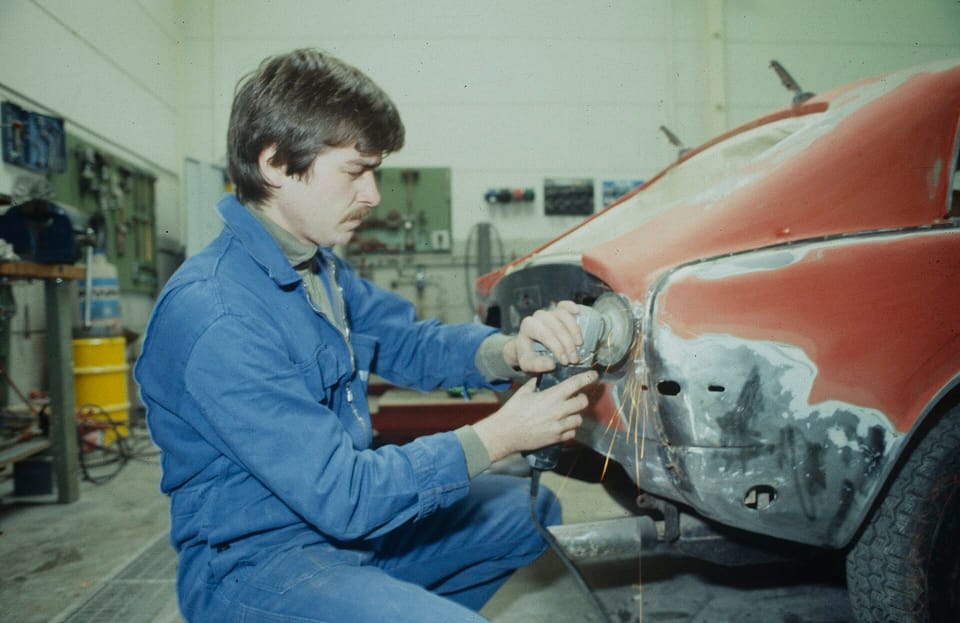
Source: Wikimedia Commons — draughtsman trainee photo (CC BY-SA 4.0)

The first-year floor is only the beginning. The law also mandates annual step increases as a percentage of your start-year amount:
| Training year | Mandatory increase over the year-1 amount | Monthly pay for someone who started in 2023 |
|---|---|---|
| Year 1 | base amount | €620 |
| Year 2 | +18% | €732 |
| Year 3 | +35% | €837 |
| Year 4 (four-year trades only) | +40% | €868 |
One Critical Note About 2026 Numbers
The statute contains an automatic escalation mechanism: the first-year minimum is recalculated every year (starting 1 January 2024) based on the average of actual training wages in Germany, and the Federal Ministry of Education and Research publishes the new figure in the Federal Law Gazette (Bundesgesetzblatt) by 1 November each year, applying to everyone who starts training the following year.
The practical translation: if you start an Ausbildung in Germany in 2026, your guaranteed floor is higher than €620, because the ladder has been legally indexed upward every year since 2024. The €620 → €732 → €837 → €868 table above is the ladder written verbatim into the law for the 2023 intake, shown here because it is the last detailed ladder embedded in the statute text itself. Your 2026 number is published in the Federal Law Gazette, and the company hiring you is bound by it automatically.
There is one more clause worth its weight in gold: collective agreements (Tarifverträge) between unions and employer associations routinely exceed the legal minimum, and sectors like skilled trades, nursing, and IT pay well above the floor. The statutory number is a guaranteed floor — never a ceiling.
The Full Math: What a 2023 Starter Earns Over Three Years
Let's make the law concrete with a direct calculation for a three-year trade (the most common length), started in 2023:
- Year 1: €620 × 12 = €7,440
- Year 2: €732 × 12 = €8,784
- Year 3: €837 × 12 = €10,044
Guaranteed total before any voluntary company top-up: €26,268 over the training period — money you are legally entitled to for learning a profession, in a country where the qualified technicians this system produces earn far more once certified.
That figure excludes what companies add voluntarily or under collective agreements (many trades contracts include housing and transport allowances), and it excludes the side-income right that the Residence Act gives visa holders — covered next.

Source: Wikimedia Commons — apprentice at work photo (CC BY-SA 4.0)

The Visa Route for Non-Europeans: What Section 16a Says
The question every international reader actually cares about: can you join this system from outside the EU? The answer lives in Section 16a of the German Residence Act (Aufenthaltsgesetz), titled "Vocational training; advanced vocational training." Its key provisions:
- The residence permit is granted for company-based training once the Federal Employment Agency (Bundesagentur für Arbeit) approves under Section 39, or when the training is exempt from approval under the Employment Ordinance or an intergovernmental agreement.
- A preparatory German language course is included in the permit purpose — a detail most summaries miss. The law states the residence purpose explicitly covers attending a German language course preparing you for vocational training, including occupation-specific courses under the German Language Promotion Ordinance.
- Side employment up to 20 hours per week — Section 16a expressly entitles training-permit holders to take additional work unrelated to the training, up to 20 hours weekly. That is real room to strengthen your monthly budget.
- The language requirement is nuanced: for qualified vocational training, proof of sufficient German is demanded unless the training institution tests your language itself or a preparatory course is part of the plan. In practice most applicants from abroad target roughly B1, but the law leaves room when the company itself is satisfied with your level.
- A safety net if the seat disappears: if your training contract ends for reasons you are not responsible for, the law grants you up to six months to find a replacement training position without losing your residence status.
This structure is what separates the Ausbildung route from irregular migration paths: from day one you stand inside a documented legal frame, with guaranteed pay and written rights.
Wondering how it compares with the points-based job-seeker route? We broke the two down in Germany's Opportunity Card explained.
A Week in the Life: How the Dual System Actually Works
To see the system in practice, picture a typical week for an industrial electronics trainee in Stuttgart:
- Three to four days at the company, starting at 7:00 a.m. in the workshop: assembling control panels, learning to read technical drawings under a designated trainer (Ausbilder), and executing progressively harder real tasks.
- One or two days at Berufsschule: technical math, electrical fundamentals, safety law, and occupational German. School exams count toward your final result.
- The weekly training report (Berichtsheft): you document what you learned each week and your trainer signs it — mandatory paperwork, and neglecting it can block your final exam admission.
- A mid-term exam and a final exam in front of the chamber (IHK). Passing the final is what awards your professional title.
After three years you emerge with a certificate, three years of documented work experience inside a German company, and a trade — which is precisely why German employers love the system: it produces exactly the employees their workflow needs. Graduates from Vietnam, India, Tunisia, and the Philippines now fill trainee classes in German factories and hospitals that could not recruit enough Germans.
Comparison: Ausbildung vs. University vs. Opportunity Card
| Criterion | Ausbildung (vocational training) | German university | Opportunity Card (Chancenkarte) |
|---|---|---|---|
| Income while enrolled | Legally guaranteed monthly salary | Optional student jobs (20 h/week) | Your savings (financial proof required) |
| Language requirement at entry | Practical German, usually ~B1 or company test | B2/C1 German by program | A1 German or B2 English |
| Duration | 2–3.5 years | 3–5 years | Up to 1 year job search |
| Academic requirement | Secondary school certificate or equivalent | University-entry qualification | Recognized degree + points criteria |
| What you end with | Recognized trade + 3 years' experience | Bachelor's/Master's degree | Work contract, then work permit |
| Best suited for | Hands-on learners wanting income now | Those who can wait for academic study | Experienced professionals job-hunting on-site |
No path is universally "better" — the honest answer is that Germany's labor market needs all three profiles. If your horizon extends beyond the first years, our German citizenship rules and permanent residence guide maps what comes after.
Where Your Odds Are Highest: The Occupations Germany Needs
Germany's skilled-labor shortage is structural, and that shortage is exactly what opens trainee seats to internationals. The sectors most actively recruiting trainees right now:
- Electrical and electronics trades: industrial electrician, mechatronics, automation technology.
- Healthcare: nursing assistance, medical assistant, medical device technology — expanding fast as Germany's population ages.
- Carpentry, construction, and metalwork: traditional trades that pay well and receive too few German applicants.
- Automotive technology: vehicle service technicians, especially for the growing electric fleet.
- Hospitality and baking: chef, baker, hotel specialist — sectors employing internationals for decades.
- IT dual programs: combined training-and-school IT specializations expanding quickly.
The detailed shortage-occupation list with official sources is in our guide to Germany's shortage occupations and the 2026 skills list.
A Practical Path: From Research to Signed Contract
- Choose your target occupation from the list of 300+ state-approved training trades and confirm its duration.
- Get your school certificate documented and, where needed, evaluated via Germany's official "Anabin" recognition database.
- Build your German to working level — every extra level widens your options; workshop communication happens in German.
- Search for an Ausbildungsplatz through the Federal Employment Agency's official portal and dedicated training boards. Applications need a German-style CV (Lebenslauf), certificates, and a short motivation letter.
- Interview — usually by video for applicants abroad — expecting questions about motivation and day-to-day German comprehension.
- Sign the training contract specifying trade, duration, and salary at or above the statutory floor.
- Apply for the visa under Section 16a at the German consulate in your country: training contract, financial proof (your legally salaried contract usually counts), health insurance, and identity documents.
- After arrival: register your address, open a bank account, get your tax ID — then start training (and your included language course where applicable).
The documents that matter most: the signed training contract, acceptable language proof or a company letter, a passport valid beyond the training period, and health insurance coverage until the employment contract kicks in.
After Graduation: From Training Permit to Permanent Residence
The system's quiet advantage is that graduation is a structured new beginning. Once you pass the final chamber examination and hold your professional title, you convert into a qualified worker (Fachkraft) eligible for residence under the dedicated sections of the Residence Act for vocationally qualified staff. The company that trained you will usually offer a permanent contract directly — most companies train precisely in order to hire.
From there, the longer doors open step by step: renewable work residence leading to permanent settlement, family reunification under standard rules, and eventually citizenship after the required years of residence — the timelines and conditions are mapped in our German citizenship 2026 guide.
Common Mistakes That Sink Applications (and Honest Warnings)
- Arriving with English only: the workshop, the Berufsschule, and the final exams run in German for almost every trade.
- Paying "agents" for a guaranteed seat: legitimate applications go directly through companies and official portals; there is no lawful brokerage fee for a training seat.
- Accepting an offer without a registered contract: the official Ausbildungvertrag registered with the chamber is your protection; verbal promises are worth nothing.
- Neglecting the weekly Berichtsheft: repeated lapses can bar you from the final exam.
- Comparing the year-1 floor to Gulf salaries: the modest first-year number is the bottom rung of a legal ladder; qualified German technicians earn multiples of the trainee floor after certification.
- Forgetting the 20-hour side-work right: many trainees live on the floor when the law lets them supplement it — plan your budget with that lever included.
One professional-honesty note: every legal figure in this article comes from the officially published statute texts, but consulate decisions vary by country and personal situation. Treat this guide as a map and confirm specifics with the German consulate handling your case before any expensive step.
Frequently Asked Questions About Ausbildung in Germany
How much is the trainee salary in Germany in 2026?
The legal minimum is recalculated automatically each year. For the 2023 intake it was €620 in year one, rising to €732 and €837 in years two and three. If you start in 2026, your floor starts higher than €620 under the same statute — the new figure is announced in the Federal Law Gazette by 1 November of the preceding year, and most real-world offers, especially in technical trades and nursing, clearly exceed the floor under collective agreements.
Can non-Europeans apply for vocational training in Germany?
Yes. Section 16a of the Residence Act explicitly provides a residence permit for company-based vocational training once the Federal Employment Agency approves (or an exemption applies). You need a training contract from a German company and usually proof of sufficient German or enrollment in a preparatory course. The permit even includes the preparatory occupational German course and allows side work up to 20 hours weekly.
What is the difference between Ausbildung and university in Germany?
Ausbildung is paid, hands-on company training paired with vocational school, usually 2–3.5 years, ending in a state-recognized professional title. University is a longer academic path (3–5 years) without a guaranteed salary, ending in a degree. Ausbildung suits people who want a trade and income quickly; university suits fields that genuinely require a degree, such as medicine or academic engineering.
What German level is required for an Ausbildung visa?
The law requires "sufficient German language knowledge" for qualified training, unless the company tests your language itself or a preparatory course is planned. In practice, B1 is the realistic target for most trades, and reaching B2 before you travel measurably improves both your admission odds and your bargaining position on salary.
Can I lose my residence permit if my training contract ends?
Not immediately. Section 16a grants up to six months to find a replacement training position if your contract ends for reasons you are not responsible for, such as a department closing. Quitting voluntarily without an accepted reason weakens your position. Sticking to the contract and informing the foreigners' office early about any change is what protects your status.
Does the law really force the salary to rise every year?
Yes, explicitly. Section 17 states pay "increases as vocational training progresses, at least annually," and the minimum step-ups are fixed in the statute itself: 18% above the year-1 amount in year two, 35% in year three, and 40% in year four for four-year trades. Any contract ignoring these percentages is unlawful.
Does the cost of living eat the whole salary?
The year-one floor is modest against big-city rents, which is exactly why trainees use the legal right to 20 hours of weekly side work, or choose mid-sized cities with lower costs. Some collective agreements add housing allowances. Realistic budgeting for the first settling-in months — before your first paychecks — is a necessity, not a luxury.
Sources and References
- Section 17, German Vocational Training Act (BBiG) — full official text
- Section 16a, German Residence Act (AufenthG) — full official text
Start Your Journey with Truescho
Between a salaried vocational track, funded scholarships, and global job opportunities, the right choice needs a clear map — and that is what we build. Browse the latest scholarships and career opportunities updated daily on Truescho, find the option that matches your situation, or go deeper with our Germany guides linked above. A thousand-mile journey starts with one well-documented step.