
German Language Levels A1–C2: Skills, Study Hours and Choosing Your Target
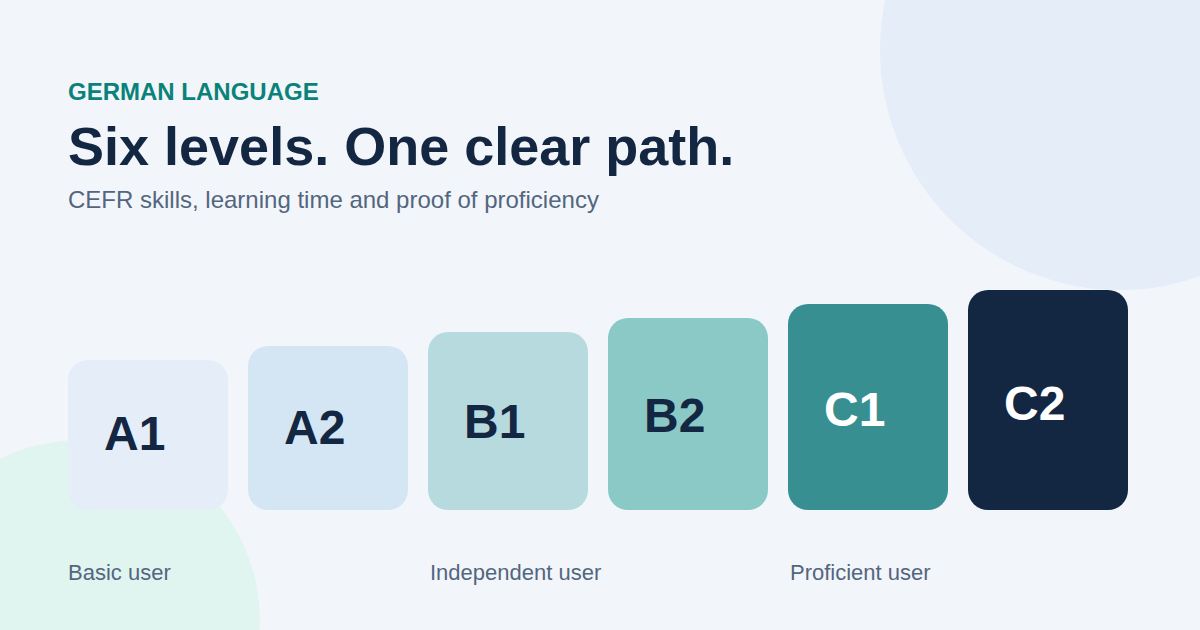
German language levels follow six main CEFR reference points: A1, A2, B1, B2, C1 and C2. They describe what you can do with the language, rather than the number of courses you have purchased. Your useful target depends on the activity you need to perform and the evidence a university, employer or authority accepts.
An A1 learner may manage a supported introduction; a C1 learner can work with demanding academic or professional communication. Neither label alone grants admission, a visa or employment. This guide separates ability, approximate learning effort, course packages and formal proof, using official sources reviewed on 28 October 2026.
Understand the six CEFR levels
The Council of Europe's CEFR overview groups A1–A2 as basic, B1–B2 as independent and C1–C2 as proficient language use. These categories concern communication across activities. You may read more confidently than you speak, so one informal impression does not describe your complete profile.
| Level | What the level broadly describes | An original illustrative task |
|---|---|---|
| A1 | Basic personal information and immediate needs, with support | Introduce yourself and ask where a room is. |
| A2 | Familiar, routine exchanges and simple descriptions | Describe your usual workday or arrange a basic appointment. |
| B1 | Connected communication about familiar matters | Explain a problem, describe an experience and give reasons for a plan. |
| B2 | More complex material and reasonably developed arguments | Compare proposals and defend a position in a discussion. |
| C1 | Flexible, detailed academic and professional communication | Follow a demanding lecture and produce a structured analytical response. |
| C2 | Highly precise comprehension, expression and synthesis | Reconstruct and evaluate complex arguments from several sources. |
These task examples are teaching illustrations, not an assessment rubric or a certificate. A memorized introduction does not establish A1 across all skills. Equally, encountering an unfamiliar specialist word does not prove that an advanced learner lacks the stated level.
C2 is not a promise of knowing every word, sounding like every native speaker or being qualified for every profession. It describes very advanced communicative competence. A German-speaking engineer and historian may still need to learn each other's specialist vocabulary.
Read study-hour estimates without adding incompatible numbers
The Goethe-Institut Belgium course guidance provides approximate instructional effort and its equivalent in 45-minute lessons. Motivation, prior language learning, learning environment and practice opportunities affect the actual time required. Treat these figures as orientation for reaching a target, not a compulsory timetable for each person.
| Target level | Reference range in 45-minute lessons | Approximate clock hours shown by Goethe |
|---|---|---|
| A1 | 80–200 | 60–150 |
| A2 | 200–350 | 150–260 |
| B1 | 350–650 | 260–490 |
| B2 | 600–800 | 450–600 |
| C1 | 800–1,000 | 600–750 |
| C2 | 1,000+ | 750+ |
The clock-hour column is rounded in the source. One 45-minute instructional unit equals 0.75 clock hours; for example, 350 units equal 262.5 hours exactly, while the source uses an approximate rounded figure. Do not mix exact recalculations and rounded estimates without explaining which you are using.
These are reference estimates for reaching the respective targets. Do not add A1's range to A2's range and continue upward as if every row were a mandatory additional block. Nor should you subtract broad endpoints to advertise a guaranteed B1-to-B2 duration. Your starting knowledge and course structure determine the remaining work. Goethe's B1 examination information similarly describes the lessons needed to achieve the level as dependent on prior knowledge and learning conditions.
A provider's module may be much smaller than a target-level effort estimate. A1.1 and A1.2 are organizational subdivisions, not additional CEFR levels. Another school may divide A1 differently. Ask what the specific module covers and what assessment determines progression instead of comparing course names alone.
Turn learning effort into a realistic calendar
First convert the timetable into clock hours. Two 90-minute classes give three clock hours a week; two 60-minute tutoring sessions give two. Neither arrangement becomes ten hours because the brochure describes it as intensive. Then add a realistic independent-practice plan and account for holidays, missed sessions and review.
For a transparent arithmetic illustration, take the B2 reference range of 450–600 instructional clock hours. At an assumed ten such hours per week, this corresponds to 45–60 weeks, or approximately 10.5–14 months using 4.3 weeks per month. This is an equivalent-contact-time illustration, not a prediction that every beginner will pass B2 within that period. Independent study and the quality of learning remain relevant.
If the same amount of instructional work were scheduled at twenty hours per week, its calendar duration would be roughly half. That calculation does not prove that doubling attendance doubles learning speed. A person balancing work, caregiving and study may need a different pace to retain and practise the language effectively.
| Planning question | A useful answer to obtain |
|---|---|
| What is my current profile? | Placement evidence for reading, listening, writing and speaking. |
| What does the course timetable count? | Lesson duration, guided instruction and separate self-study workload. |
| Which modules remain? | A placement-based sequence, rather than the entire catalogue. |
| How will progress be checked? | Feedback, assessed tasks and appropriately chosen practice tests. |
| What happens if I need more time? | Options for revision, repetition and a later examination date. |
For Arabic-speaking learners starting between A1 and B1, Truescho's online German course provides one-to-one 60-minute sessions, placement and marked homework in packages of eight or sixteen sessions. The sixteen-session package includes a Goethe- or telc-style mock. These packages do not guarantee completion of a level and do not include an official certificate or examination fee.
Match the target to a specific purpose
A language level describes skills; an application rule specifies evidence and other conditions. Identify the receiving organization and exact route before deciding which examination to book. General advice that “B1 is enough for Germany” is too broad to make a reliable plan.
| Purpose | Language orientation | What must be checked separately |
|---|---|---|
| Certain spouse-reunification cases | Basic German, commonly A1 | Sponsor status, nationality, exemptions and the responsible mission's evidence rules. |
| Vocational-training route | Normally at least B1 for the relevant visa conditions | Training-provider assessment, preparatory arrangements and any higher occupational requirement. |
| Naturalisation | B1 is generally the language condition | Accepted alternative evidence, exemptions and all other eligibility conditions. |
| German-taught university study | Programme-specific academic German evidence | Exact certificate, component results, submission timing and possible exceptions. |
| English-taught university study | The programme may assess English instead | Admission language rules and the German needed for daily life, placements or employment. |
| General employment | Depends on tasks, employer and profession | Professional recognition and any sector-specific language examination. |
For spouse reunification, the BAMF information on basic German evidence explains the general requirement and exceptions. Do not infer that every spouse applicant must provide the same certificate, or that an A1 pass completes the whole visa process. Consult the responsible German mission for the actual case.
The federal vocational-training visa guidance describes the usual B1 expectation and relevant assessment or preparation conditions. An employer, vocational school or regulated occupation may demand stronger communication. Our Ausbildung guide provides background on the training route, while official requirements should govern your application decisions.
For citizenship, the government naturalisation information describes B1 in the language requirements. Alternative educational evidence and exceptions can apply. A C1 certificate should not be interpreted as an automatic accelerated citizenship entitlement; language is only one part of the process. See our German citizenship guide for related planning questions and confirm the current official conditions.
Choose the examination product, not just the brand
Goethe, telc and ÖSD offer examinations across CEFR levels, but their individual products serve different audiences and purposes. TestDaF focuses on academic German. A course participation certificate, a placement result and a recognized examination result are different documents.
| Provider or examination | Relevant distinction | Before booking |
|---|---|---|
| Goethe-Zertifikat | Select the named examination and level, including the appropriate age format | Check whether that exact certificate is accepted by your recipient. |
| telc German examinations | General, professional, dual-level and university-oriented products differ | Do not assume that generic C1 and C1 Hochschule are interchangeable. |
| ÖSD | Examinations are offered from A1 to C2 | Confirm the product, level and receiving body's requirements. |
| TestDaF | Reports academic-language results across four parts; TDN 3–5 span B2–C1 | Check required component results, not just a casual “C1 equivalent” label. |
| DSH | A university-language examination with its own result levels | Ask the university which DSH result and examination arrangements apply. |
The official telc German overview shows why product names matter. A vocationally focused test and a general-language test can assess overlapping levels while serving different purposes. The ÖSD information likewise explains its examination range; acceptance must still be checked with the recipient.

Source: screenshot of the official telc German examination overview.
For TestDaF, official result guidance identifies TDN 4 in each of the four parts as the general language-proof benchmark for university study. Institutions can have particular rules, and meeting language conditions is not the same as receiving an academic admission offer. Do not average a weaker component away unless the receiving institution explicitly permits that approach.
Uni-assist's language-certificate guidance advises checking which evidence each university accepts. Keep the exact policy with your course shortlist. An English-taught degree may have a different language route; our overview of studying in Germany without German helps frame the questions, but each programme's published requirements control admission.
Separate a course fee from the cost of reaching a level
There is no single national price for A1, B1 or C1. Providers differ in location, group size, delivery mode, module divisions, teaching hours and included materials. An advertised package price tells you what that package costs; it does not establish the total cost of your learning pathway.
A verified local example is the Goethe-Institut Bangalore 2026 course brochure. Its Super Intensive format lists 160 teaching units of 45 minutes, equivalent to 120 clock hours, at ₹28,500 per course. The listed course options include A1, A2, B1, B2.1 and B2.2. Books and examinations are excluded. The schedule includes a 27 October–9 December 2026 period; availability and the current booking quote should be checked directly.
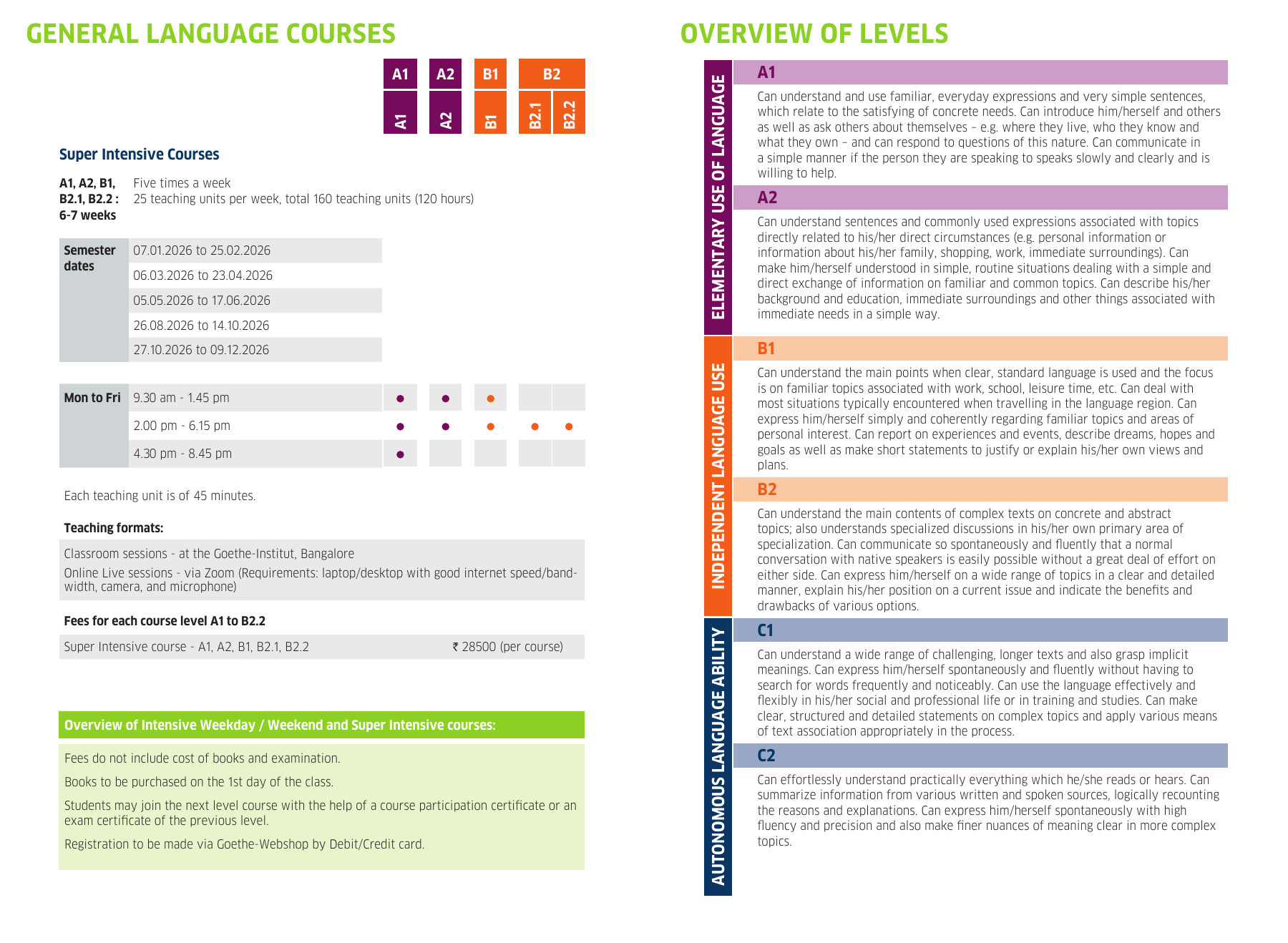
Source: page 6 of the Goethe-Institut Bangalore 2026 course guide. The price is for the specified local course format, not a worldwide fee for a CEFR level.
The distinction becomes important at B2: the example lists B2.1 and B2.2 separately. If a learner needed both and both were charged at the stated package price, the arithmetic would be 2 × ₹28,500 = ₹57,000 before excluded costs. That is a conditional calculation, not a personalized quote or a promise that those two purchases establish competence. The example does not supply a price for every C1 or C2 route.
| Budget component | What to ask the provider |
|---|---|
| Instruction | How many modules remain after placement, and how long is each lesson? |
| Materials | Are books, digital access and practice resources included? |
| Assessment | Are internal tests included, and what do their results mean? |
| Official examination | Which exam fee is separate, and where can it be taken? |
| Additional learning | What happens if you need another module or more feedback? |
| Practical costs | Are travel, accommodation or equipment relevant to this format? |
Avoid converting the example into another currency using an old exchange rate. Compare providers using the same unit and included services. A cheaper module may contain fewer guided hours, while a more expensive individual session may offer feedback on a specific problem that a large class cannot address as directly.
Build a four-skill plan around your starting point
Use the Council of Europe's self-assessment grid to describe what you can currently do, then obtain appropriate placement or tutor feedback. Self-assessment helps identify gaps; it is not a substitute for a required certificate. Keep a brief record of tasks and corrections so progress is based on evidence rather than the number of chapters completed.
| Skill | A useful practice record | What feedback should address |
|---|---|---|
| Listening | Topic, recording length, misunderstood information | Whether difficulty came from vocabulary, speed, sound recognition or inference. |
| Reading | Text type, purpose and evidence supporting answers | Whether you understood the argument or relied on matching isolated words. |
| Writing | Task, draft, correction and revised version | Meaning, structure, accuracy and suitability for the audience. |
| Speaking | Prompt, recording and specific follow-up attempt | Comprehensibility, interaction, organization and recurring language gaps. |
For a hypothetical A1 family-route learner, the first planning task is to confirm whether the case requires proof and which test is accepted, then practise the relevant basic communication alongside a wider foundation. For a hypothetical B1 training applicant, practical interaction with a school or workplace deserves attention in addition to test tasks. For a prospective university student, academic reading, listening and structured writing may become central as the target advances. These are constructed planning profiles, not accounts of actual applicants or guaranteed pathways.
Choose a course only after connecting its content to your target. Ask how it develops weaker skills, how homework is reviewed and when practice assessments occur. If the plan involves a dedicated language stay, read our German language-course visa guide and check current official conditions separately from the course's educational claims.
Frequently asked questions
Are A1.1 and A1.2 separate CEFR levels?
No. They are course subdivisions used by a provider within A1. Other institutions can divide the same reference level differently. Compare the learning objectives, teaching units and progression assessment rather than assuming that identically named modules contain the same amount of work.
How many months does it take to reach B1?
There is no reliable single answer for everyone. Your starting knowledge, instruction, independent practice and feedback affect the timeline. The Goethe reference range is 350–650 lessons of 45 minutes for reaching the target, subject to learning conditions. A personal schedule needs placement evidence and a realistic weekly workload.
Does completing a course give me an official level certificate?
Not automatically. A participation record shows something different from an examination result. Ask what document the provider issues and whether your university or authority accepts it. An official examination may require a separate booking, fee and successful performance across specified components.
Is B1 always enough for Ausbildung?
No. The federal training-visa guidance describes a usual B1 expectation under its conditions, but the training institution, employer or profession may require more. Check the actual training offer and immigration route. A language result also does not replace the other requirements or secure a contract.
Can I use any C1 certificate for university admission?
Do not assume so. Universities specify accepted examination products and results, sometimes by component. A general C1 label, a university-oriented certificate and a course attendance record are not automatically interchangeable. Save the exact programme policy and obtain clarification before paying for an exam.
Are the study-hour ranges additional hours for every level?
They should not be treated as mandatory extra blocks to add together. They orient learners toward the effort associated with reaching each target. Your previous knowledge changes the remaining workload, while individual course modules have their own hours. Keep those two kinds of numbers separate.
Can an online placement test replace a Goethe or telc exam?
Only if the receiving organization explicitly accepts that particular evidence for its purpose. A placement test normally helps choose a suitable course or identify gaps; it does not automatically provide the certificate required for an application. Check the named document and assessment conditions rather than the level displayed alone.
Choose your next course with a clear evidence requirement
Identify the target task, verify the recipient's requirements, establish your current profile and compare the remaining modules in clock hours and total cost. For Arabic-speaking learners working within A1–B1, explore individual German tutoring and discuss a realistic plan after placement. Keep official exam booking and certificate requirements separate from the tutoring package.