
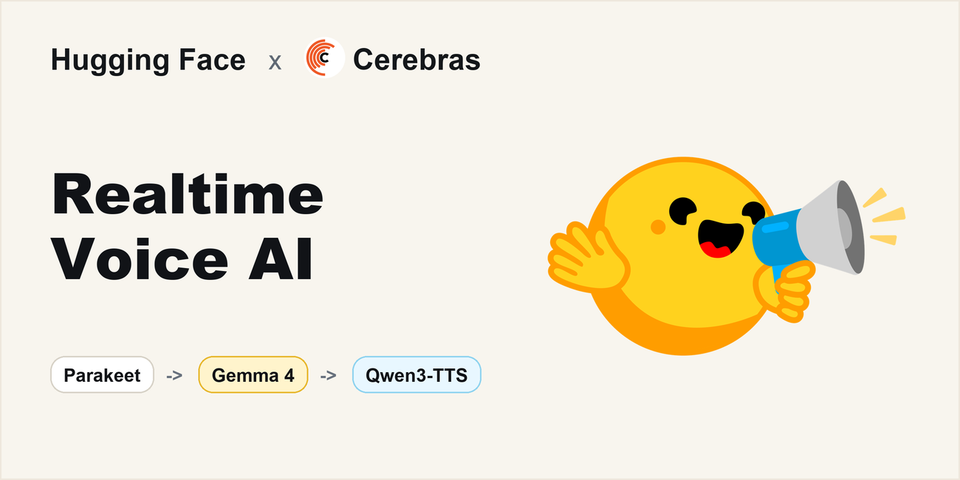
AI Voice Revolution: Hugging Face & Cerebras Bring Gemma 4 to Real-Time Voice AI
The AI landscape has just taken a massive leap forward in conversational technology. Hugging Face, in partnership with Cerebras, has unveiled an open-source, modular architecture that enables Google DeepMind's Gemma 4 to power real-time voice AI with unprecedented low latency.
This breakthrough operates on a cascaded, fully modular speech-to-speech loop featuring:
- Speech Recognition (ASR): Nvidia's Parakeet.
- Language Model (LLM): Google DeepMind's Gemma 4 (31B parameters) running on high-speed Cerebras hardware.
- Text-to-Speech (TTS): Alibaba's Qwen3TTS.
Quick Comparison
| Feature | Traditional Voice Systems | Hugging Face x Cerebras Pipeline |
|---|---|---|
| Responsiveness (Latency) | Noticeable delays on occasional responses (high P95 tail latency) | Immediate, natural flow powered by Cerebras inference |
| Flexibility | Often closed "black box" APIs | Fully open-source and modular (swappable layers) |
| Primary Use Cases | Basic voice assistants | Embodied AI, robotics (powering 9,000+ Reachy Mini robots) |
| Core LLM | Proprietary or slower models | Gemma 4 (31B) by Google DeepMind |
What This Means For You (Gulf & Arab Developers Impact)
This architecture opens up unprecedented opportunities for developers and enterprises in the Middle East:
1. Next-Gen Arabic Customer Service: By eliminating the awkward multi-second delays, businesses can build Arabic voice assistants that feel truly human and interactive.
2. Data Sovereignty & Customization: Since the pipeline is entirely open and modular, regional enterprises can swap the default ASR or TTS with localized models trained specifically on Gulf dialects, keeping sensitive voice data strictly within their local servers.
3. Smart City Robotics: With the surge in smart city initiatives across the GCC, this low-latency pipeline is perfectly suited for embodied AI—powering reception and service robots with real-time conversational capabilities.
Limitations
While highly capable, developers should consider a few constraints:
- Cerebras Hardware Dependency: The groundbreaking speed solving the P95 tail latency relies heavily on the Cerebras computing architecture, which may present accessibility or cost barriers for smaller teams wanting to self-host compared to standard GPUs.
- Resource Intensive Pipeline: Managing a cascaded loop of three large models (Parakeet, Gemma 4 31B, Qwen3TTS) simultaneously introduces higher infrastructure demands and operational complexity.
- Cascaded vs. End-to-End: Because the system translates Speech -> Text -> Text -> Speech, it inherently drops the acoustic nuances (like emotion or speaker tone) from the user's original voice, a limitation usually avoided by native end-to-end voice models.
FAQ
Q: Where can I try this out or find the code?
A: You can test the interactive demo on Hugging Face Spaces. The full open-source code is available on GitHub under huggingface/speech-to-speech.
Q: What is the "P95 tail latency" issue they solved?
A: In many systems, while average response times are fine, occasional requests take multiple seconds to process (the 95th percentile). Cerebras dramatically stabilizes inference speed, eliminating these frustrating delays to make interactions feel reliable and "alive."
Q: Am I locked into using Gemma 4 or Qwen3TTS?
A: No. The pipeline is intentionally modular. You can inspect, modify, or completely swap out the ASR, LLM, or TTS layers to adapt the stack for your specific robotics, assistant, or research project.