
Gemini Visible Watermark Toggle 2026: How to Turn It Off
Last updated: August 2026
On 14 August 2026 at 1:39 p.m., Josh Woodward, vice president of Gemini at Google, posted that a papercut was fixed: users can now toggle visible watermarks on or off in Gemini and Flow, with Search coming next. The change covers images, videos, and songs, except where local law requires the mark to stay on.
The Gemini visible watermark toggle, announced on 14 August 2026, hides the on-image, on-video, and on-song logo in Gemini and Flow. It covers Nano Banana images, Omni videos, and Lyria songs. Invisible SynthID and C2PA metadata remain. Search support is still coming. Turning the logo off is not the same as making a file "not AI."
That single distinction is the whole story. Google is separating a cosmetic stamp from a forensic one. The table below is the comparison that matters, and it belongs before any settings walkthrough.
| Layer | Gemini after 14 August | Claude after 14 August | What remains if you hide the visible mark |
|---|---|---|---|
| Visible mark on image / video / song | Optional in Gemini and Flow, except where law requires it | No visible stamp on text | Gone only where the toggle is allowed |
| Invisible mark | SynthID stays on | SynthID-Text on supported text | Yes — still there |
| File metadata | C2PA stays on | C2PA on supported Claude files | Yes — still there |
| User-facing checker | Gemini or Search can still flag AI media | Official text API not shipped yet | Search support for the toggle is still pending |
| User identity | Not in SynthID | Not in the Claude watermark | Unchanged |
| Extra price | None stated for the toggle | None stated for text marking | None stated |
Source: Josh Woodward on X
What Josh Woodward actually changed
Woodward's wording is tighter than most headlines that followed it. The visible watermark is now optional in Gemini and Flow. Search is next, not included on day one. The toggle applies to watermarks on all images (Nano Banana), videos (Omni), and songs (Lyria).
The exception is equally tight: countries where law requires the visible mark to remain. Google did not publish a public country list in that post. Do not invent one. If the control is missing or locked in your account, treat local law — not a rumour spreadsheet — as the reason.
A follow-up from the same account removed the last ambiguity: "visible watermarks are now optional, invisible SynthID watermarks and C2PA metadata are still being used… you can still use Gemini or Search to see if an image was AI-generated."
That sentence is the product policy. Google is not retiring provenance. It is retiring a logo that designers, editors, and social teams have been cropping around for a year.
The rollout, as reported from Woodward's announcement, is Settings > Media Watermark, landing in the coming days from the 14 August post. If you open Gemini the same afternoon and do not see the row yet, you are not doing it wrong. You are early.
Do not confuse this consumer-media toggle with ad labelling. Paid inventory still sits under a different rule set, which we covered in Google's AI ads label. A clean Gemini still can be a labelled ad once money is attached.
Visible toggle vs invisible SynthID vs C2PA
Three marks now travel with Gemini media. Only one of them is optional.
The visible watermark is the logo or corner badge a human notices. That is what the new toggle removes, when law allows. It is also the only mark a client in São Paulo will complain about on a pitch deck.
SynthID is Google's invisible watermark. It is designed to survive many ordinary transformations and to be readable inside Google's own surfaces. Woodward's follow-up says you can still use Gemini or Search to see whether an image was AI-generated. The toggle does not delete this layer.
C2PA is an open provenance standard: a signed Content Credential in the file's metadata. Camera makers and editors already use it. It is not a logo. It is a claim about how the file was made or edited. Screenshots and some re-exports can strip it. Google is not turning it off with the visible toggle.
Claude, on the same calendar day, went the other direction on text: an invisible SynthID-Text pattern plus C2PA on supported files, and no pretty logo to hide. If you need the text side of that story, read how Claude's text watermark works. Gemini's 14 August news is about generated media, not about a Claude-style text key.
A freelancer in Manila who turns the Gemini logo off and then drops the still into a storyboard has a cleaner frame. A platform or a Google surface can still know the file started in Gemini. Those two facts are not in conflict.
How to turn off Gemini's visible watermark
Use this only after you accept the sentence above: you are hiding a badge, not erasing history.
- Open Gemini (or Flow, if you are editing video there).
- Go to Settings.
- Open Media Watermark.
- Switch the visible watermark off.
- Generate a fresh still, clip, or song and check the corners before you ship it.
- If you also publish through Search surfaces, wait. Woodward said Search is coming next, not that it flipped on 14 August.
- If the control is absent or greyed out, stop. That is the legal-exception path. Do not hunt unofficial "remover" apps.

Source: Josh Woodward on X
A few practical notes that the post does not spell out, but follow from it:
- Apply the setting before you generate the asset you care about. Do not assume every older file is retroactively cleaned.
- Flow and Gemini are in scope now. Search is not, yet.
- Nano Banana, Omni, and Lyria are the named families. Do not extend the claim to every Google model that has ever drawn a picture.
- A crop that used to exist only to hide the badge is no longer mandatory for client work — unless you are in a jurisdiction that keeps the badge on.
A designer in Lagos preparing a brand exploration, a newsletter editor in Jakarta, and a campus creator in Nairobi all get the same functional win: the file can look like a file. They do not get a file that is "untraceable."
What Credentio adds for developers
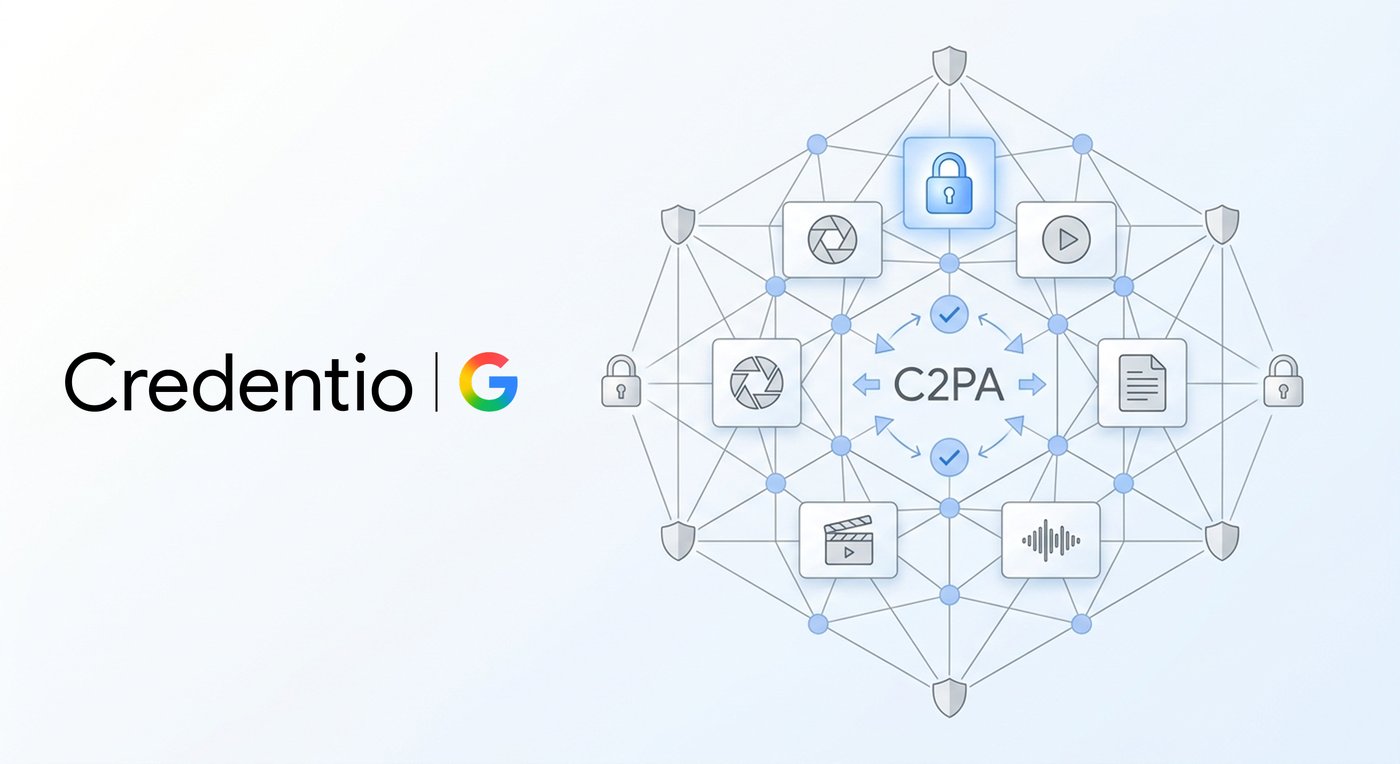
One day before the toggle, on 13 August 2026, Google Developers introduced Credentio: an open-source C++ library for C2PA Content Credentials. It is not the toggle. It is the other half of Google's week — the verification half.
Source: Google Developers Blog
Credentio is the same code Google says already serves about 40 conformant C2PA-enabled products and "tens of billions" of generated assets — images, video, audio, and documents across many formats. It starts with specification versions 2.2 and 2.4. The repository lives at mediaprovenance.googlesource.com.
The design choice that matters for a team in Karachi or São Paulo is local-first validation. Files do not have to be uploaded to Google to be checked. That removes a bandwidth tax on large video, and it keeps the bytes inside your own environment.
What Credentio does today is validate credentials: trust lists (including official C2PA and TSA lists), manifests, assertions, signatures, and a detailed verdict. Google says generation and embedding of credentials are planned, not the first release.
So the week of 13–14 August has a clean split:
- Creators get a visible-logo off switch in Gemini and Flow.
- Developers get a local C2PA engine they can put in an app or pipeline.
- Nobody gets a SynthID eraser.
If you already use faster Gemini surfaces such as the ones we covered in Gemini 3.7 Flash, the toggle is an output-policy change, not a model upgrade. The generator can stay the same. The badge policy changed.
Access, pricing, and detection after the toggle
Access. Gemini's consumer footprint is wide across Africa, South Asia, Southeast Asia, and Latin America. That is why this papercut is larger than a lab curiosity. You do not need SuperGrok Heavy or a private beta seat to feel it. You need a Gemini or Flow account in a country that does not legally lock the badge on.
Search is the gap. If your distribution path is "generate in Gemini, discover via Search," wait for Woodward's promised follow-through before you assume the badge is gone on that surface.
Pricing. Google did not attach a fee to the toggle. It is a settings row, not a plan upgrade. Your Gemini or Flow subscription, if any, is unchanged by this announcement. Do not pay a third-party "watermark remover" for a control Google is shipping itself.
Detection. This is the section people will skip, and the one that will bite. After you turn the visible mark off:
- SynthID remains.
- C2PA remains.
- Gemini can still be used to inspect an image.
- Search can still be used to inspect an image, on Woodward's own wording.
- Platform ad policies can still require disclosure. That is a different article and a different obligation.
A marketing lead in Manila who ships a logo-free Omni clip into a paid campaign has not finished compliance work. They have only finished art direction.
If you produce student or client media every week, keep a current map of the major generators in the Truescho AI tools directory.
Where the toggle still cannot help you
The Gemini visible watermark toggle is a real fix for a real annoyance. It is also easy to over-claim.
It cannot strip SynthID. It cannot strip C2PA. It cannot make Search blind. It cannot legalise an ad that your ad network still wants labelled. It cannot, by itself, satisfy a university that asks "was this image generated?" It cannot run on Search on day one. It cannot override a country that requires the badge.
It also cannot travel backwards through every screenshot already posted. Old files keep whatever marks they were born with, plus whatever a later re-export destroyed.
Google's own framing is the honest one: creative control on the surface, safety marks underneath. If a vendor, a Discord account, or a browser extension tells you they "removed Gemini's watermark" and means SynthID, they are selling a different product from the one Woodward announced.
Use the toggle when a client in Lagos or a journal in Jakarta needs a clean frame. Keep your own notes on which model produced the file. That notebook will outlast any corner badge.
Frequently asked questions
How do I turn off Gemini's visible watermark?
Open Gemini or Flow, go to Settings, then Media Watermark, and switch the visible mark off. The control was announced on 14 August 2026 and rolls out over the following days. Search is not in the first wave. If the row is missing or locked, local law may require the badge to stay.
Does turning off Gemini watermark remove SynthID?
No. Woodward's follow-up is explicit: invisible SynthID and C2PA metadata remain. You can still use Gemini or Search to see whether an image was AI-generated. Anyone who says "Gemini deleted the watermark" after this toggle is describing the logo, not the forensic layers.
Which Gemini models does the toggle cover?
Woodward named three families: Nano Banana for images, Omni for video, and Lyria for songs. The surfaces in the first wave are Gemini and Flow. Do not assume every historical Google image model is included. Do not assume Search already respects the same switch.
Can Search still detect Gemini images after the toggle?
Yes, on the policy Woodward stated. Invisible SynthID remains, and Search is listed as a surface that can still identify AI-generated images. Separately, the visible toggle for Search "is coming next," so a Search-generated asset may still show a badge after Gemini and Flow have gone optional.
What is Google Credentio?
Credentio is Google's open-source C++ library for validating C2PA Content Credentials locally, starting with spec versions 2.2 and 2.4. Google says it is the same engine behind about 40 of its C2PA products. Files stay on your machine. It does not turn off SynthID, and it is not the Gemini settings toggle.
Sources
- Josh Woodward on X, 14 August 2026 — official Gemini visible-watermark announcement
- Introducing Credentio — Google Developers Blog, 13 August 2026
- Credentio source — Google Media Provenance
- C2PA — Coalition for Content Provenance and Authenticity
- How Claude's text watermark works — Anthropic, for the same-week text comparison
Our verdict
Turn the Gemini visible watermark off if you ship stills, clips, or songs to humans who should not be staring at a lab logo. Leave your expectations there. The useful file is now easier to use. The provenance file is still a Gemini file. That is the trade Google chose on 14 August, and it is the trade a professional should accept on purpose, not by accident.