
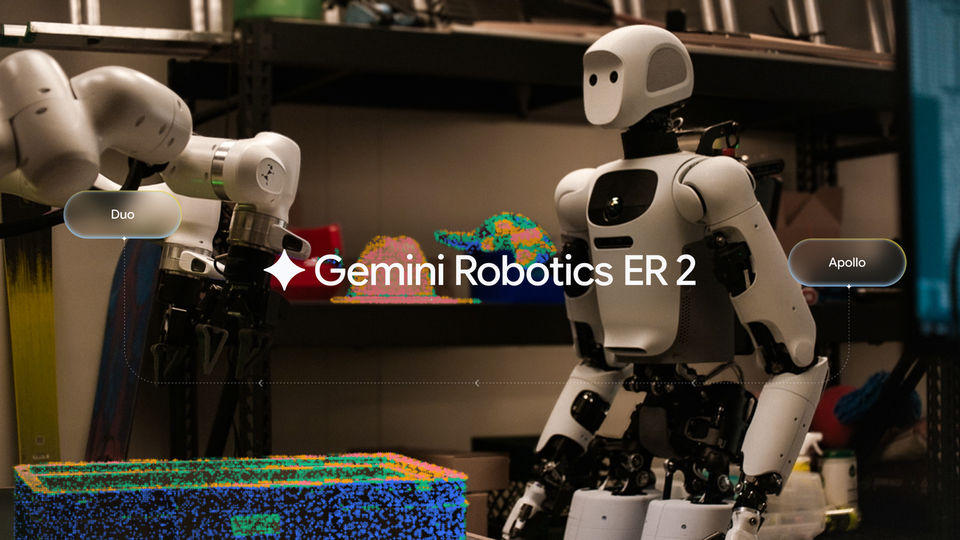
On 30 July 2026, Google DeepMind via the Google Blog launched Gemini Robotics ER 2 — an Embodied Reasoning model positioned as a high-level brain for robots. It watches continuous video, plans multi-step tasks, orchestrates low-level control tools, and enables multi-robot collaboration. This is a deliberate late explainer (~9 days after launch) for readers still searching what it means in practice: Gemini API and Google AI Studio access, published metrics, safety claims, and implications for developers, universities, and industrial pilots.
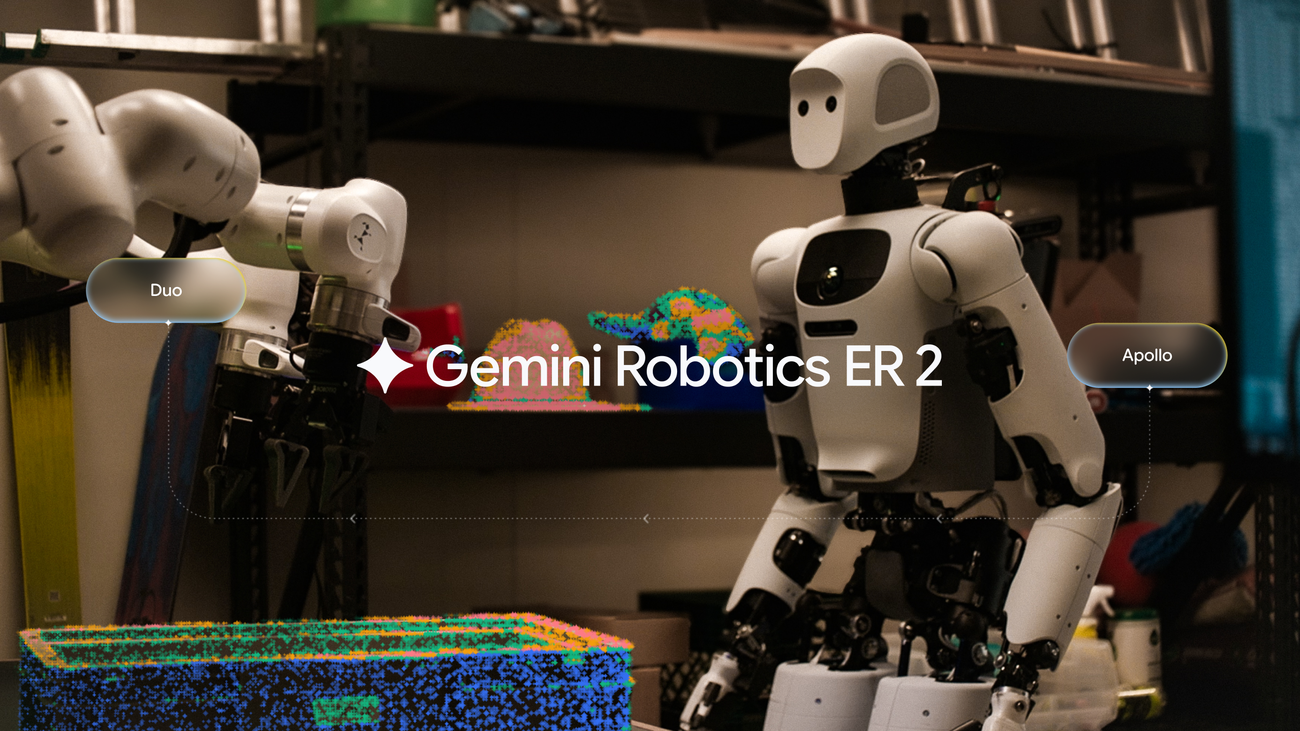
Source: Google Blog — Introducing Gemini Robotics ER 2 (30 July 2026)
What ER 2 is (and is not)
ER = Embodied Reasoning. In the architecture Google describes, ER 2 is the high-level layer: chat with humans, understand the physical scene, plan, call tools (Google Search or developer-defined functions), then hand motor execution to a VLA (Vision-Language-Action) model or navigation/control APIs. The system is designed so the robot can think about the next step while acting — reducing jarring stop-and-think pauses.
Versus ER 1.6, the pitch emphasizes continuous video progress tracking, self-correction, knowing when a step is truly done, and multi-robot collaboration.
Headline official metrics
| Capability | Stated figure |
|---|---|
| Progress classification accuracy | 57.4% |
| Moment-finding accuracy | 91.3% |
| Moment-finding mean absolute distance | 0.96 s |
| Execution speed vs larger model classes (as framed) | about 4× |
| Availability | Gemini API + Google AI Studio (public developer access) + private preview on Gemini Enterprise Agent Platform |
Official charts compare ER 2 vs ER 1.6 across real VLA, sim VLA, and human tele-op control modes.
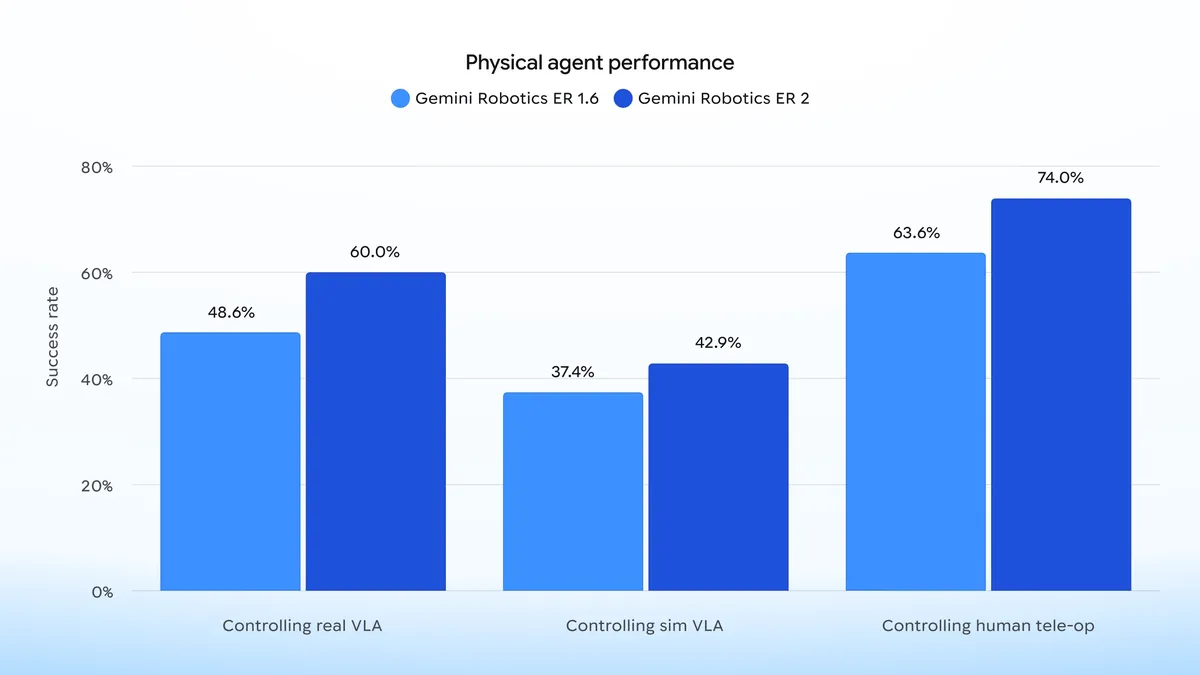
Source: Physical agent performance chart on Google Blog
Core capabilities
1) Physical agent + tool orchestration
Developers declare low-level control interfaces as tools and stream multimodal video/audio/text. ER 2 improves orchestration over 1.6 across evaluation modes. Integration with the Gemini Live API targets latency-sensitive control loops.
Demo narrative: Boston Dynamics Spot fetches an object from natural language by orchestrating navigation and manipulator APIs — with code samples on Google’s GitHub robotics repositories.
2) Temporal intelligence: is the task done?
Robotics fails when systems cannot tell completion (tightening a bulb, tying a trash bag). ER 2 contributes:
- Continuous progress classification over video frames (bins from 0–20% through 80–100%).
- Moment finding to locate the critical frame (when to stop pouring coffee).
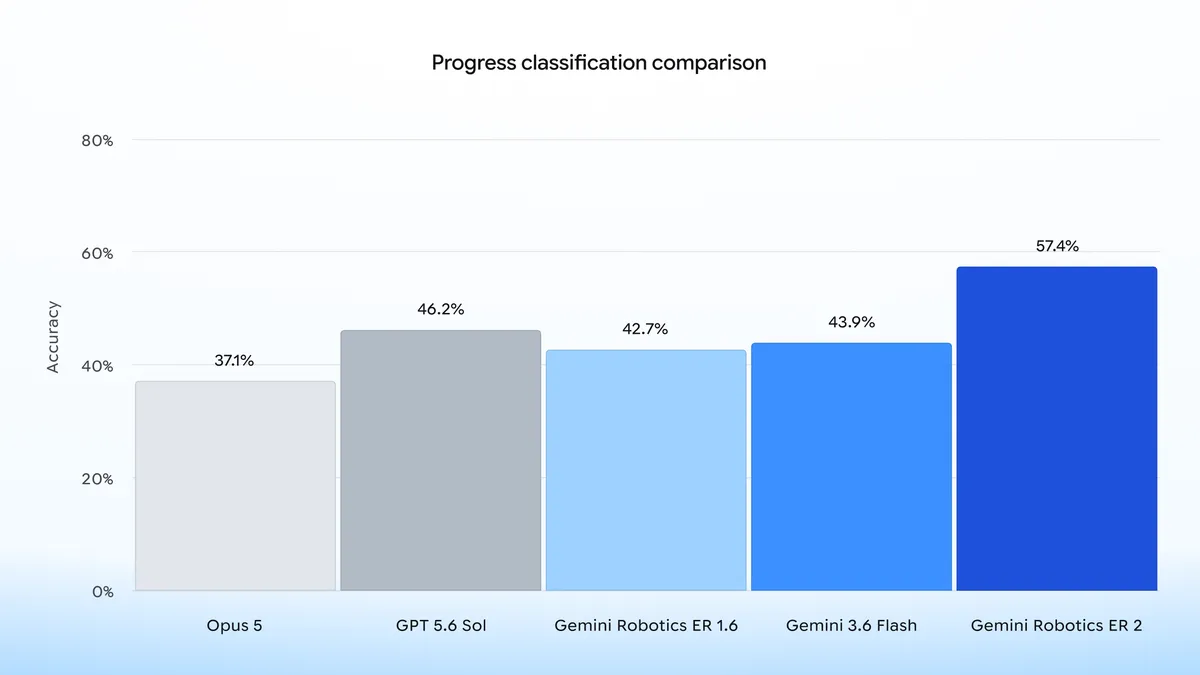
Source: Google Blog charts
3) Multi-robot collaboration
Different embodiments excel at different work. Related DeepMind materials show collaboration paths such as Apptronik Apollo 2 with Franka F3 Duo. Shared semantic understanding supports handoffs a single robot cannot complete alone.
4) Broader spatial intelligence
- Success/failure detection on raw video, not only static snapshots.
- Instrument reading beyond simple dials — digital displays, linear scales, rulers, liquid thermometers across ~10 instrument types.
- Stronger spatial VQA via Gemini multimodal gains.
5) Embodied safety
Google calls ER 2 its safest robotics model to date on Safety Instruction Following and Human Proximity benchmarks — e.g., stopping a humanoid when a person is nearby and resuming when clear. Details live in the safety technical report PDF.
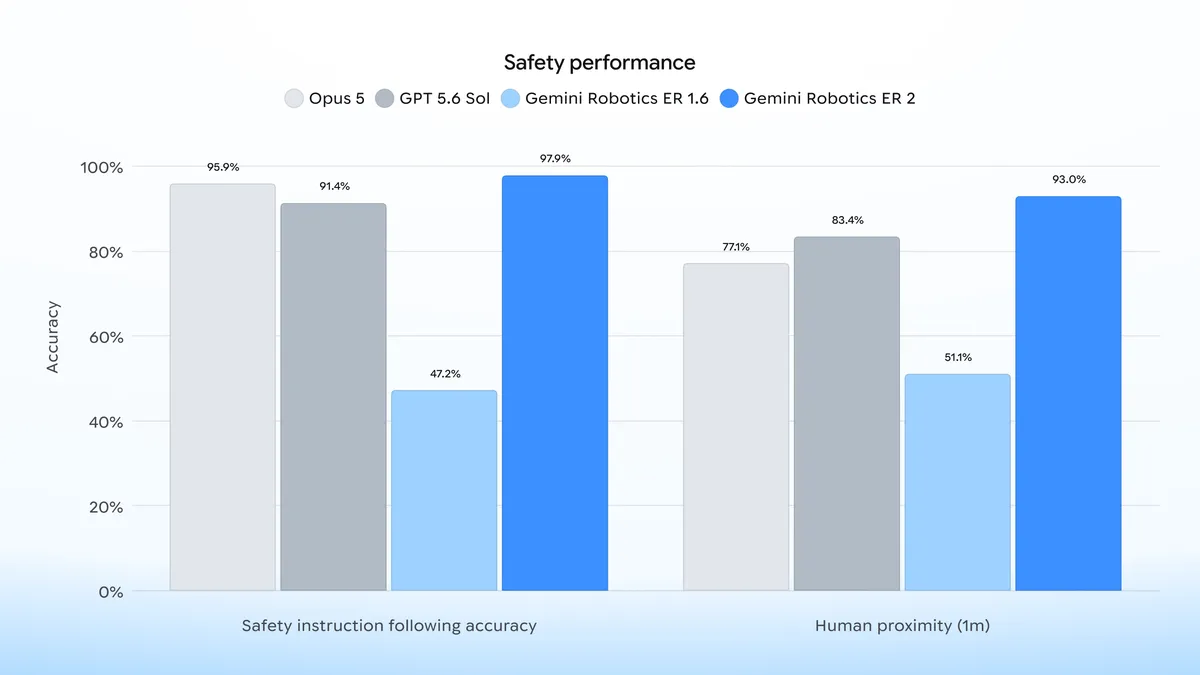
Source: Google Blog safety chart
What this means for you
Robotics developers and students
Start with the Gemini API robotics overview, AI Studio model, and GitHub samples. You can prototype planning on recorded video before owning a robot arm.
Warehousing and light industry (including Gulf pilots)
A high-level brain that coordinates vision, planning, and heterogeneous fleets is relevant to semi-automated warehouses. Pilot one measurable task (pick, fetch, visual inspect) with a human safety owner.
Universities and labs
ER 2 lowers the barrier to physical-agent research: cloud reasoning + partner/local VLA. Budget for bandwidth, video retention policies, and on-prem constraints.
Everyone else
This will not rewrite your phone UI tomorrow. It signals that Gemini agents are expanding from screens into carefully scoped physical orchestration.
Quick comparison
| Dimension | Gemini Robotics ER 2 | ER 1.6 | Classic VLA-only stacks | Text-only agents |
|---|---|---|---|---|
| Role | High-level brain | Prior ER | Motor/policy execution | No robot control |
| Continuous video progress | Yes (57.4% progress) | Weaker | Varies | N/A |
| Moment finding | 91.3% / 0.96s | Lower | Limited | N/A |
| Multi-robot collab | First-class theme | Weaker | Rare as platform | N/A |
| Developer access | API + AI Studio | Prior | Often research-only | Chat apps |
Honest limitations
- Real-world success still depends on VLA quality and hardware — ER 2 cannot fix a weak body.
- 57.4% progress accuracy means many errors remain; never unsupervised high-risk deploy.
- Enterprise paths may still be private preview.
- Industrial video is sensitive — worker and facility privacy.
- Network latency can break closed-loop control if everything is cloud-only.
- No Arabic-specific robotics eval was published; English prompts may lead early quality.
A practical 4-week adoption path
- Week 1: Run official notebooks on recorded videos.
- Week 2: Bind one tool (nav or gripper mock API).
- Week 3: Add a hard safety stop on person detection (even external detector).
- Week 4: Measure cycle time and retry rate vs a fixed script.
- Only then: discuss a supervised floor pilot with a safety officer.
Extended industrial questions for decision-makers
CapEx vs OpEx: ER 2 shifts some intelligence cost to API usage while robots remain CapEx. Model your token/video streaming cost per shift hour before promising ROI slides.
Integration reality: Most factories already run PLCs, WMS, and proprietary AMRs. ER 2 helps if you can expose clean tool APIs; it will not magically speak every legacy protocol.
Human factors: Operators must understand when the high-level brain is uncertain. Prefer designs that request clarification over silent failure — Google’s safety framing explicitly values constraint following and human proximity.
Regulatory: Physical agents touch workplace safety rules that chatbots never face. Involve EHS early; do not treat a model card as a CE mark.
FAQ
Is ER 2 available to developers now?
Yes via Gemini API and Google AI Studio per the announcement; some enterprise routes are private preview.
Does it replace low-level controllers?
Not necessarily — it plans and orchestrates, handing execution to VLA/other interfaces.
Why mention Spot?
It is a partner demo of natural-language orchestration over navigation and manipulator APIs.
Good for student projects?
Yes for vision+planning experiments with cloud budget and video-data caution.
Where are deep technical details?
Model card, safety PDF, and the companion DeepMind post.
Architecture notes for builders
ER layer vs VLA layer
Treat ER 2 as a shift supervisor and the VLA as a skilled operator. The supervisor watches cameras, sequences work, calls search when needed, and requests retries. The operator executes short motor skills. Excellent supervision with a weak operator yields pretty plans and failed grasps; the reverse yields skills without coherent jobs.
Bidirectional streaming and Live API
Closed loops need low latency. ER 2 + Gemini Live API aims to avoid one-second freezes to “think.” In regions where cloud round-trips are long, measure real RTT before committing production control to a pure cloud brain.
Sim → real
Google evaluates sim, tele-op, and real VLA modes. A mature path is simulation → tele-op → partial supervision → conditional autonomy. Skipping sim raises breakage cost.
Sector scenarios (grounded, not sci-fi)
Retail warehouse
Task: fetch a known-bin carton. ER 2 owns logical progress checks; the AMR executes. KPIs: cycle time, human interventions/hour, near misses.
University lab
Task: place labeled tools into holders. Students learn tool schemas and measure moment-finding when “tool seated” occurs.
Light visual inspection
Task: is the panel framed and is the needle in range? Broader instrument reading reduces one-off CV engineering — humans still review false alarms.
Limited hospitality fetch
Natural-language fetch in semi-structured spaces (Spot-class demos). Not a full labor replacement; a UI + proximity-safety test.
Governance and liability
Who owns a failure when a cloud model drives a robot? Contracts should separate model provider, integrator, and site operator. Log ER 2 decisions (why stop, why retry) for audits. Do not deploy in human spaces until you reproduce human-proximity behavior on your floor, not only on a marketing chart.
Reading map after 30 July
- Main Google Blog post (this event).
- ER 2 model card.
- DeepMind whole-body / Robotics 2 companion post.
- Safety PDF.
- GitHub
gemini_robotics_erandlive-apisamples.
That order prevents name soup (ER 2 vs Robotics 2 vs On-Device 2).
Buyer questions before signing a PoC
- What single task defines PoC success?
- What maximum human intervention rate is acceptable?
- Where is worker video stored and is consent handled?
- Do we already expose stable robot APIs?
- Who owns the hard emergency stop outside the model?
Why a late explainer still wins
Nine days later, Arabic and international searchers still need durable explainers that separate metrics from myths. Lane B coverage is for that durable intent — engineers comparing platforms — not for fake “just now” headlines.
Bottom line
Gemini Robotics ER 2 (30 July 2026) moves Google’s agent story into serious physical orchestration: video, time, tools, fleets, and human-proximity safety. If you are catching up days later, the practical takeaway is: prototype on the API if you build robots; do not oversell full-factory autonomy without local execution quality and safety ownership.
Sources: Google Blog — Gemini Robotics ER 2 (30 July 2026); model card; DeepMind — Gemini Robotics 2; Safety PDF.
Practical toolkit to start today
- Gemini API robotics overview: authenticate first, run a sample before writing a custom agent.
- Google AI Studio with
gemini-robotics-er-2-preview: fast interactive trials on short video clips. - Samples repo: read the Getting Started notebook, then the live-api branch for streaming patterns.
- Model card: review safe-use limits before investor or internal demos.
- Safety report: lift Human Proximity and Instruction Following items into PoC acceptance tests.
Suggested internal evaluation table
| Test | How to measure | Initial accept gate | Notes |
|---|---|---|---|
| Fetch-task completion | Success/fail over 30 trials | ≥70% unassisted | Raise bar before production |
| Nearby person detection | Inject a person into the scene | 100% stop | One fail = no deploy |
| Moment finding | Compare to human-labeled frame | Mean error <2s | Camera-dependent |
| Retry behavior | Attempts until success | Mean ≤3 | Watch oscillation |
| Cloud cost | $/operating hour | Within pilot budget | Log video resolution |
Left on the next-run queue
Neighboring stories not covered here because of the quality-first 3-piece cap: Anthropic’s Tino Cuéllar appointment, deeper OpenAI third-party cyber evaluation notes, and any later API pricing moves. They remain candidates for the next run.
Lane B methodology note
This article is intentionally published days after launch because durable search demand for “Gemini Robotics ER 2” continues after the first English news wave. We date the event as 30 July 2026 in the lede and avoid fake “just now” framing. Later availability or pricing changes should update this URL rather than spawn a near-duplicate.
For adjacent AI news on Truescho, keep the funnel from explainers into /en/tools/ai experiments without overselling immediate labor replacement.
If you reached this far as an engineer comparing platforms: start one measurable two-week experiment rather than a long slide deck. Measurement punctures hype faster than any article — including this one.
Final words: helpful robots will not arrive all at once; they arrive as narrow tasks that are measured, secured, then expanded. ER 2 is a planning tool on that journey, not the destination.