
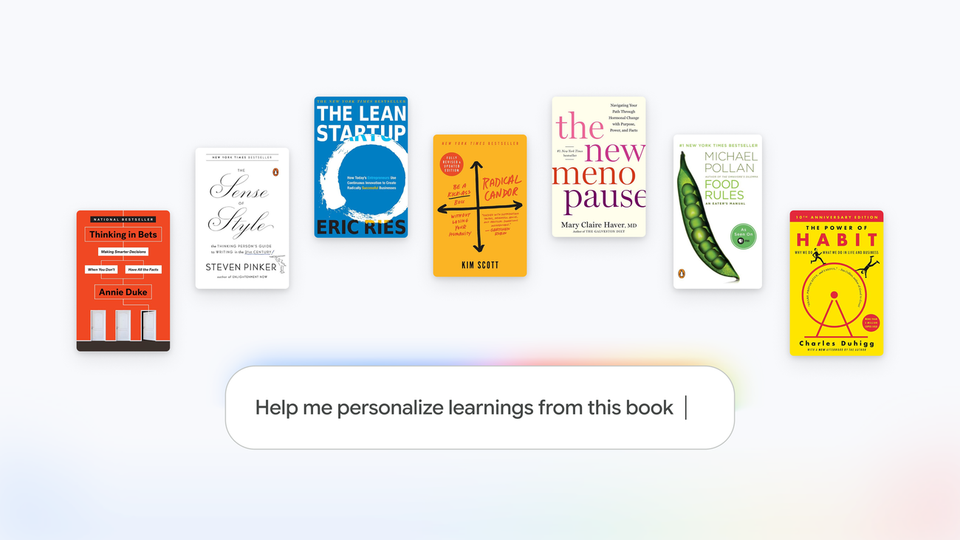
You probably own a dozen books you have read once and never reopened. On August 27, 2026, Google turned that quiet shelf into something new: a feature called Expert Intelligence in Gemini Notebook (the app formerly known as NotebookLM) that lets you bring ebooks you have purchased on Google Play Books directly into your notebooks — then question them, summarize them, quiz yourself on them, and generate infographics and audio overviews grounded in the actual text. It is the first full bridge between book ownership and AI assistance, and it launches with more than 100,000 titles from Penguin Random House, Macmillan, O'Reilly, and other major publishers. This explainer, updated August 29, 2026, covers what launched, how the rights model works, and the honest limits.
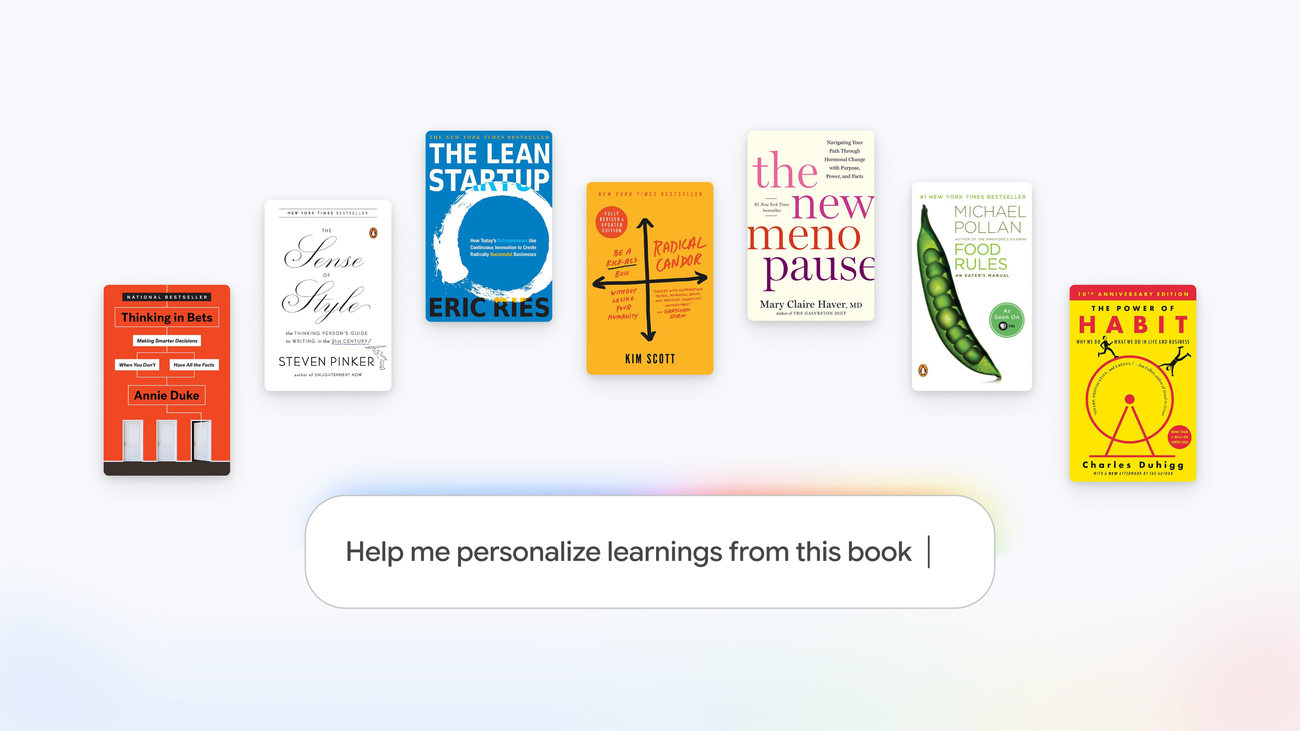
Source: Google official blog — Expert Intelligence in Gemini Notebook
What Expert Intelligence actually is
Google's announcement describes it as "a cross Google initiative that helps you engage with your trusted sources through Google AI products." The first product integration is books: add select ebooks you own from Google Play Books to a Gemini Notebook, and the assistant's answers become "grounded directly in that book" rather than in general model knowledge.
That distinction is the entire value proposition. A general-purpose chatbot answering "what does Kim Scott recommend for difficult feedback conversations?" is interpolating from training data it cannot cite. The same question asked inside a notebook containing your purchased copy of Radical Candor is answered from the text itself, with the source one click away. For students, researchers, and professionals who depend on being able to trust — and verify — what their AI tells them, source-grounding is the difference between a toy and a tool. It is also the natural evolution of what made NotebookLM popular with students in the first place, as we covered in our student guide to NotebookLM: flashcards, quizzes, and study videos for free.
How the feature works, step by step
- Own the book. Buy the ebook on Google Play Books with your normal Google account — genuine ownership is the entry ticket.
- Check eligibility. On a book's Play Books detail page, eligible titles list Gemini Notebook under the "Tools" badge.
- Add it to a notebook. One click brings the book in as a full source; The Verge's launch coverage confirms you can also view the book's full text inside the notebook.
- Work with it your way. Ask questions answered from the book, or generate infographics, Audio Overviews, quizzes, and plans from its contents.
That loop — from owned source to finished study material — extends the study stack Google has been assembling this season, alongside the new AI study tools built into Google Search we documented earlier.
The launch catalog: 100,000+ books from major publishers
At launch, Expert Intelligence supports more than 100,000 books from publishers Google names explicitly: Bloomsbury, De Gruyter Brill, Johns Hopkins University Press, Macmillan Publishers, O'Reilly Media, and Penguin Random House. The mix matters. Academic and reference houses (Johns Hopkins UP, De Gruyter Brill) serve researchers; O'Reilly serves working developers; Penguin Random House and Macmillan cover the commercial mainstream. This is not a symbolic fifty-title pilot — it is a serious first catalog.
Featured Notebooks: authors curating their own books' AI editions
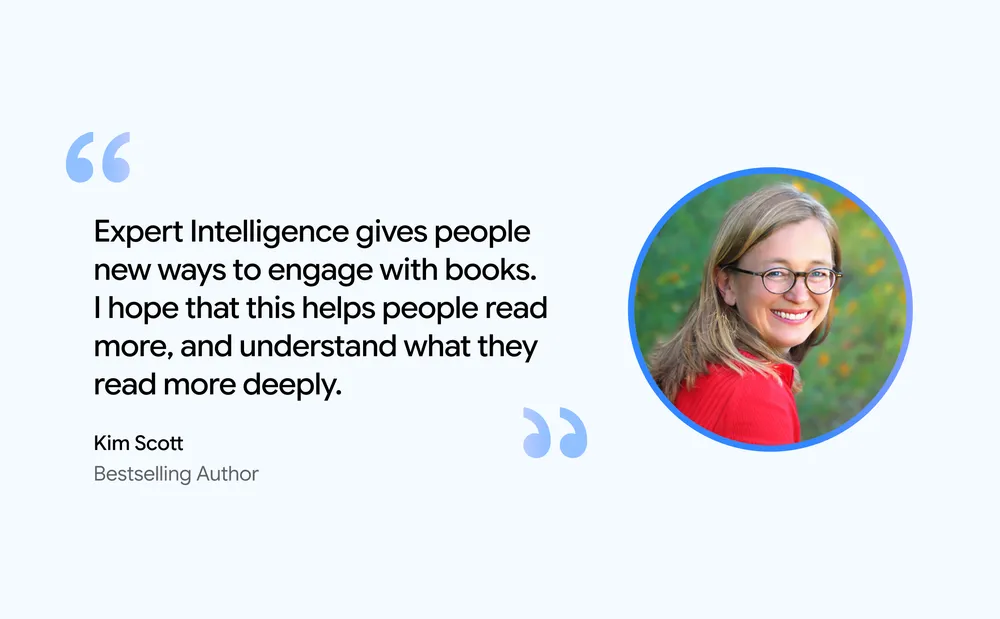
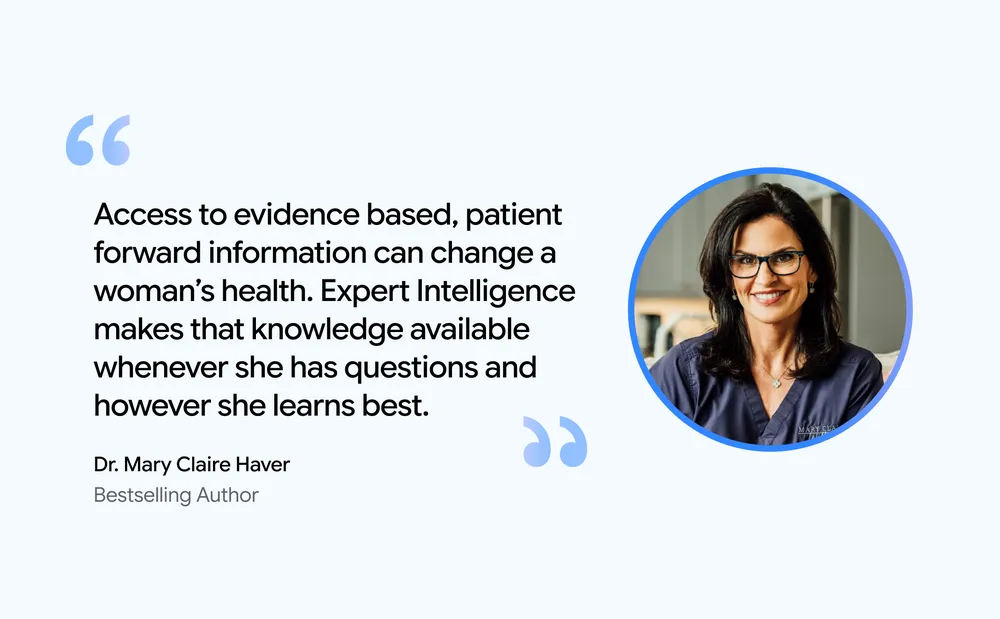
Alongside the catalog, Google collaborated with more than fifteen bestselling authors — the announcement names Steven Pinker, Michael Pollan, and Jennifer Wallace, and The Verge's briefing added Kim Scott — to build Featured Notebooks: curated notebook editions of their books, supplemented with additional source material and an introductory letter from the author.
Think of it as an interactive edition of the book that the author personally assembled. After a year of public friction between publishers and AI companies, authors voluntarily building AI companions to their own titles is a genuine turn — and arguably the most strategically significant detail in the whole announcement.
In the briefing The Verge attended, Google Labs editorial director Steven Johnson demonstrated the range: a full recipe book generated from Michael Pollan's Food Rules, and a management notebook grounded in Kim Scott's Radical Candor answering a live question about handling a difficult conversation with an employee. Those two examples frame the feature's true scope — not passive summarization, but productive generation standing on a source you own.
Source: Google official blog — Expert Intelligence in Gemini Notebook
Source: Google official blog — Expert Intelligence in Gemini Notebook
The rights model: how Google protected the publishers
The design is unambiguous about ownership:
- To interact with a book in Gemini Notebook, you must own it through Google Play Books.
- If a notebook containing a book is shared, collaborators are prompted to purchase their own copy to engage further; otherwise the book becomes unavailable in their shared view.
Far from cannibalizing sales, every curious collaborator converts into a buyer. Google sweetened the launch with a limited promotion — one free ebook for US-based accounts using the code EXPERTINTELLIGENCE, while supplies last — a perk that does not extend outside the United States, and which we note here because accurate reporting beats flattering reporting.
What this means for you
- University students. A core textbook (where available in the catalog) becomes an inexhaustible question engine with auto-generated quizzes before exams — the same philosophy behind the AI study tools in Google Search, now with a complete owned book as the grounding source.
- Lifelong professional learners. Management, marketing, and development titles — O'Reilly's catalog alone is a career — become a permanent reference desk you can interrogate months after reading.
- Consultants and knowledge workers. The consulting habit has always been "re-read the three books that shaped the framework before the engagement." Now the pre-engagement ritual becomes a queryable notebook: pull the model's steps, generate a client-ready infographic from Chapter 4, and produce a briefing audio overview for the drive to the airport — all grounded in the edition you actually own, with page-traceable answers you can defend in the room.
- Book clubs and study groups. Shared notebooks finally have a sane economics: each member buys the book once, everyone questions the same curated notebook, and the author's Featured Notebook becomes the group's common ground instead of five conflicting PDF copies.
- Researchers. Academic reference works from the announced university presses, combined with your own PDFs in the same notebook, shorten the literature-triage loop considerably.
- The real cost. Gemini Notebook itself is free; the books are not. Budget by your local Play Books pricing before converting your library into notebooks.
- Language reality. Every publisher named at launch publishes in English. Readers comfortable in English get immediate value; everyone else waits for a second wave of publishers — in the meantime, our best Gemini prompts for students and free Gemini alternatives for students remain the practical starting points.
Quick comparison: Expert Intelligence vs classic NotebookLM uploads
| Criterion | Expert Intelligence (new) | Classic NotebookLM uploads |
|---|---|---|
| Source | Purchased Play Books titles (100,000+ at launch) | Any file you upload (PDFs, links, text) |
| Requirement | Book ownership via purchase | Free, no ownership condition |
| Text quality | Publisher-grade official text | Depends entirely on your file |
| On sharing | Each collaborator must buy the book | Source passes along as-is |
| Author extras | Author-curated Featured Notebooks | None |
| Best for | Reference books you return to for months | Lecture notes, articles, working documents |
Heavy Gemini users weighing whether the paid tier is worth it will find the full breakdown in our complete Gemini Advanced guide.
How to turn your library into a working knowledge system
The feature compounds only if you treat it as a system rather than a novelty. A practical playbook for any serious reader — student or professional:
- Start with exactly three reference books you genuinely reopen: one foundation text in your field, one skill you are actively building, one data reference. Converting your entire library on day one produces noise, not knowledge.
- Organize notebooks by project, not by book. A "thesis" notebook holding your methodology book plus your own PDFs, and a "career growth" notebook mixing management titles with your notes — multiple sources in one notebook are what make answers balanced instead of one-sided.
- Generate a quiz after every reading session. Ten minutes of questions generated from the chapter you just read retains more than an hour of passive re-reading.
- Wire the rest of your stack in. Add your own articles and files to the same notebooks, and turn recorded lectures into queryable sources with smart transcription via Gemini 3.5 Transcribe.
- Audit monthly. A book you have not questioned in two months has either delivered its value or never deserved the purchase — either way, that signal should drive your next buying decision.
What this means for publishing and education markets
The ripple effects run past the individual reader. For the first time since chatbots arrived, publishers hold a model that grows their sales instead of leaking them: every shared-book interaction ends in a purchase, and the authors who joined the launch have repositioned themselves from potential AI victims to AI partners. If the model proves out — and the opening catalog suggests seriousness — expect two waves: additional publishers joining (including academic and regional houses), and competing book platforms shopping for an AI partner of their own.
For education the calculus is sharper. Once textbook support ships as promised, the economics of the hundred-dollar course text that students read two chapters of begin to bend. A student in Lagos, Karachi, or São Paulo paying full price for partial use may instead buy at a lower effective price point that bundles the book with a permanent AI companion. That transition will not happen in a quarter — but its starting gun was this announcement.
What comes after books: Google's stated roadmap
Google left little to speculation. Starting with books in Gemini Notebook, Expert Intelligence will expand to the Gemini app and AI Mode in Search, and will add new source types: third-party subscriptions, business research reports, and textbooks. That last item — textbooks — is the one with genuine pricing-disruption potential for students worldwide, particularly in markets like India, Indonesia, and Brazil where textbook costs drive real decisions each semester.
Honest limitations
- The catalog is English-first. All announced publishers are English-language houses; no Arabic, Spanish-first, or regional-publisher wave has been announced.
- Purchase is mandatory. No library-lending path exists.
- The free-book promotion is US-only (code EXPERTINTELLIGENCE, while supplies last).
- One book is one perspective. Grounded answers are truer than free generation, but a single-source notebook still carries one author's biases — stack multiple sources in the same notebook for balance.
- Institutional caution. Before routing work or study material through any cloud AI tool, check the data-processing terms attached to your specific account.
- Books freeze knowledge at publication time. Technical and medical titles in particular can carry chapters that reality has since moved past — pair a book-grounded answer with a live source before acting on anything fast-moving.
- Study tools reinforce study, they do not replace it. Generated quizzes and summaries tighten revision; they do not sit the exam for you. That rule has survived every generation of AI study aids so far, and this launch does not change it.
FAQ
Is Expert Intelligence free to use?
Gemini Notebook is free, but each book must be purchased on Google Play Books; the announcement introduces no separate subscription for the feature.
Can I use it in languages other than English?
You can generally prompt Gemini Notebook in other languages, but the entire announced launch catalog comes from English-language publishers, and no regional publishers have been announced yet.
Can I share a notebook that contains a book?
Yes, but collaborators must purchase their own copy of the book to engage with its content — otherwise the book is unavailable inside the shared notebook.
How is this different from uploading a book PDF to NotebookLM?
Expert Intelligence gives you the publisher's complete official text plus author-curated Featured Notebooks, while a scanned PDF inherits your copy's errors — and sharing a purchased book preserves publisher rights in a way passing a PDF around does not.
Will it help university students specifically?
Yes — and the stated roadmap explicitly names upcoming textbook support plus business research reports, making this one of the more consequential student-AI developments of the year, alongside the AI study tools now in Google Search.