
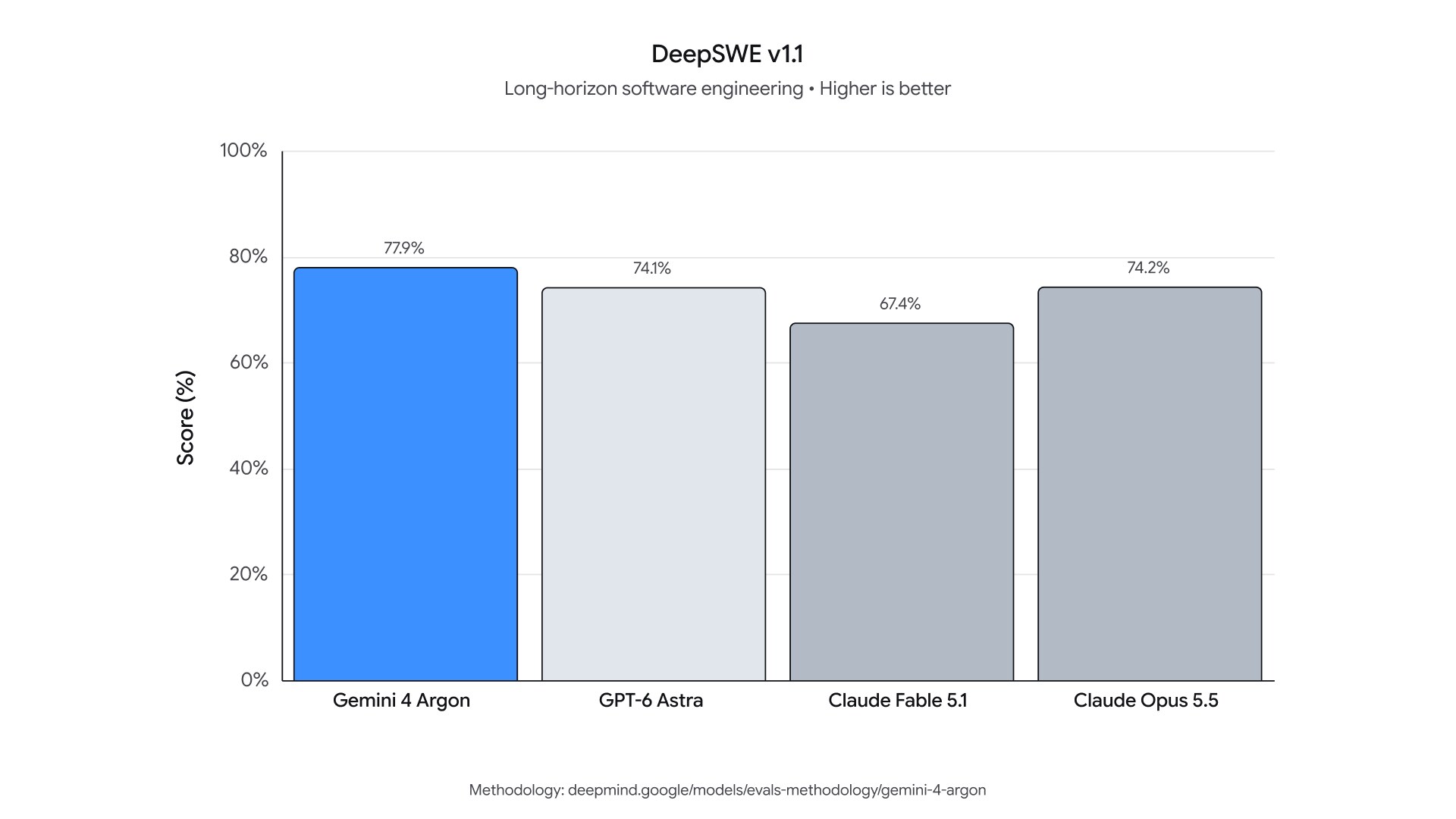
77.9% on the DeepSWE long-horizon software engineering benchmark, 1 million tokens of output in a single response, and an introductory price of just $2 per million input tokens — those are the headline numbers Google published on the evening of September 30, 2026, alongside the launch of Gemini 4 Argon, its newest frontier model. The launch is a direct bid to pull developers' attention back from OpenAI and Anthropic. Last updated: October 2026.
The official announcement on Google's blog describes Argon as a model built for "sustained deep reasoning across complex, long-horizon workflows," with an unmistakable focus on coding, automation, and cybersecurity. But the real surprise is not the benchmarks — it is the rollout strategy: the first version ships only to "trusted cyber defenders" before the general public gets access.
Source: Logan Kilpatrick on X
What exactly is Gemini 4 Argon?
Gemini 4 Argon is the first publicly announced member of the Gemini 4 family and Google's new frontier-tier model. It combines three core capabilities in a single system: sustained reasoning across tasks that can stretch over hours, multimodal understanding of text, images, documents, and video, and coding plus cybersecurity abilities that Google says outperform everything it has shipped before.
The headline technical change is the output ceiling: one million tokens per response, up from 64,000 in the previous generation. In practice, that means the model can write an entire software project, or digest a long document and produce a detailed report, in one uninterrupted answer — a long-standing pain point with current models on extended tasks. The full context window is also 1 million tokens, roughly 1,500 A4 pages of material.
The official numbers: where Argon actually leads
Google published a string of results on external benchmarks. The strongest:
| Benchmark | Area | Argon result | Note |
|---|---|---|---|
| DeepSWE v1.1 | Long-horizon coding | 77.9% | New state of the art |
| AutomationBench (Zapier) | Workflow automation | 51.3% | Ranked #1 |
| LVBench | Long-video understanding | 91.7% | State of the art |
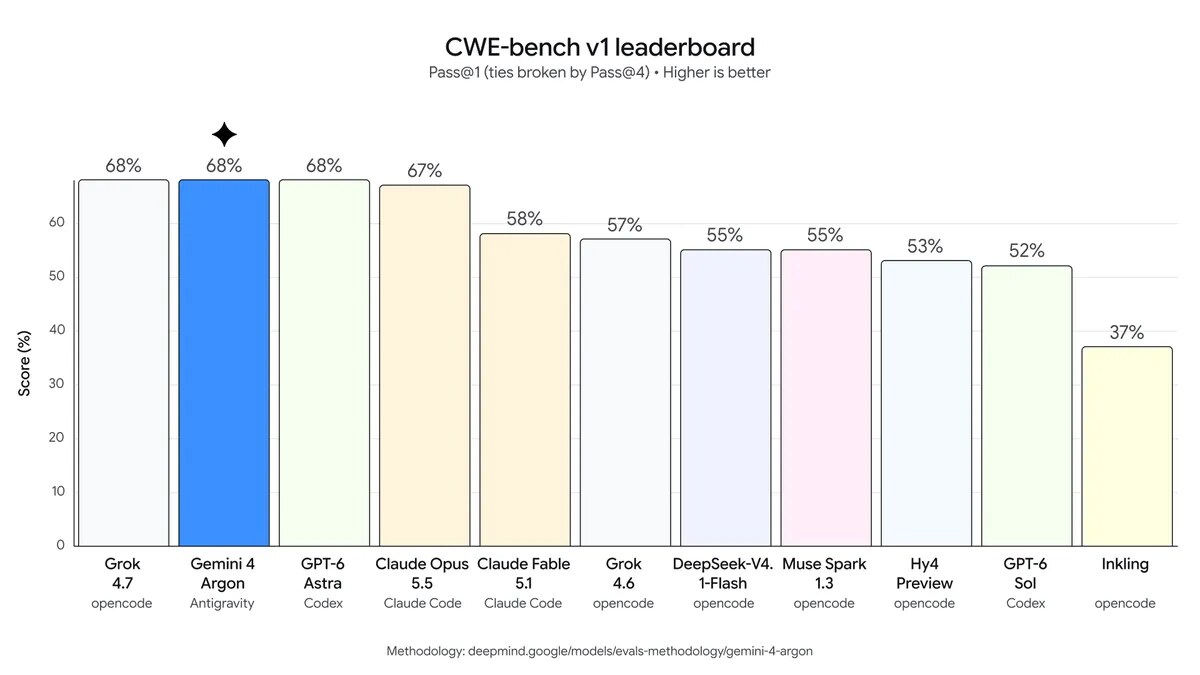
| CWE-bench v1 | Vulnerability remediation | 68% | Tied for first |
| Gray Swan | Prompt-injection robustness | Leader | Strongest abuse resistance |
The picture is not uniformly rosy. Artificial Analysis, an independent evaluation lab tied to no frontier company, gives the model a general Intelligence Index of 52.56 — eighth place among 223 evaluated models, well clear of the median (26) but short of the very top of the leaderboard. In plain terms: Argon is a specialist, exceptional at coding, automation, video, and cyber work, not an all-category champion.
Source: Google's official blog
Inside Google, the company says the model has already produced real engineering wins: a 40% improvement over a published baseline in a quantum optimization task, more than 300 TiB of memory freed in its infrastructure (with an estimated total saving of 500 TiB to 1 PiB), and migrations of 800,000+ lines of the Fuchsia Zircon kernel from C to Rust — the kind of work that used to occupy engineering teams for months.
Pricing: less than half of the direct competitors
This is the part independent developers will care about most:
| Item | Introductory price |
|---|---|
| Per 1M input tokens | $2.00 |
| Per 1M output tokens | $10.00 |
| Cached input | $0.10 (95% off) |
On Artificial Analysis's blended 7:2:1 usage rate, effective cost falls to about $1.47 per million tokens. That puts sustained document analysis and coding agents within budget for student projects and small teams, not just enterprise contracts. For a practical sense of scale: pushing a 300-page book (roughly 200,000 input tokens) through the API costs well under half a dollar including its output.
One warning for planners: these are introductory prices only. The announcement itself sets post-introductory pricing at $4 per million input tokens and $20 per million output tokens — roughly double — so budget your projects on the later rates, not the launch ones.
The unexpected angle: a frontier model without cyber guardrails
The strangest decision in this launch is access. The first Argon release is available through Google's Fairwind Program to "trusted cyber defenders" only — corporate security teams, incident-response centers, and vetted vulnerability researchers. And that version ships without cyber guardrails, because finding vulnerabilities requires a model that can reason like an attacker.
Wiz, the cloud security company and an early participant via the Scan for Good initiative, reports the model found a critical vulnerability in healthcare software that other frontier models missed. The public version, by contrast, refuses harmful cyber and CBRN requests while permitting dual-use research, per Google's Frontier Safety Framework. Google also participated in the U.S. government's voluntary pre-release model access process — a first-generation signal of how much regulatory attention frontier launches now attract.
Source: Google's official blog
What does this mean for you?
If you are a student or researcher: general availability starts with paid tiers, so free-tier users will wait for a later phase. Until then, models like Gemini 3.8 Flash remain a solid free option for coursework, and you can track technology scholarships and programs on Truescho's opportunities platform.
If you are an indie developer or small team: at $2 per million input tokens, Argon undercuts most direct rivals by more than half. If your product leans on coding agents or long document processing, the economics argue for a switch — once Google announces the access channel available in your region, since the announcement names no specific platform yet.
If you are building a career in cybersecurity: this is the first time a major lab has shipped a frontier model explicitly aimed at defensive cyber work. That is a strong signal about where jobs are heading; our earlier coverage of Gemini 3.8 Flash's cyber benchmarks is a good practical primer on the space.
Quick comparison: Argon versus what came before
| Metric | Gemini 3.8 Flash | Gemini 4 Argon | Direction |
|---|---|---|---|
| Output ceiling | 64K tokens | 1M tokens | 15x jump |
| Input price / 1M | Low | $2.00 | Very competitive |
| Long coding tasks | Very good | World-leading (77.9%) | New leader |
| Live voice conversation | Its strength | Not the focus | Unchanged |
| Availability | Immediate, broad | Phased, paid-first | Narrower |
If you have been using Gemini 3.8 Live for real-time voice, Argon is not a direct replacement — each model now has its own specialty. And even if you rely on Claude Opus 5.5 from Anthropic, the realistic setup for many projects will be both: Opus for long-form writing and analysis, Argon for coding and automation.
When can you actually use it?
Google is explicit about a phased rollout: paid API customers and Google AI Ultra subscribers first (the top of its subscription ladder), then developers, then enterprises, and finally consumers — with no specific platform or app named in the announcement for the later phases. The company says broad release will come "as soon as possible," with no dates and no country list published. Treat any source quoting an "official" free-tier date or naming a specific access channel with suspicion — neither appears in the announcement.
Limitations worth knowing before you judge
First, the published results come from benchmarks Google selected, and the only independent general-intelligence measurement currently available places the model eighth worldwide — strong, but not dominance. Second, the "trusted defenders" phase means the model's full cyber capabilities cannot be publicly tested for now, leaving several claims outside independent verification. Third, the announced prices are explicitly introductory and may change, as they have after past launches. Finally, there is no official word yet on dialect-level speech support for languages like Arabic or Hindi in this generation — a gap we noted in our Gemini 3.8 TTS review that remains open with the new family.
Frequently asked questions
What is Gemini 4 Argon?
It is the first announced model in Google's Gemini 4 family, launched on September 30, 2026 as a frontier model specialized in long-horizon reasoning, coding, automation, and cybersecurity, priced at $2 per million input tokens and $10 per million output tokens.
Does Argon beat GPT-6.1 Sol and Claude Opus 5.5?
On long-horizon coding, automation, and vulnerability discovery, Google's official numbers show a clear lead (77.9% on DeepSWE). But Artificial Analysis's independent index ranks it eighth among 223 models for general intelligence, so the advantage depends on the task rather than being absolute.
When can regular users try Gemini 4 Argon?
Per the announcement, rollout starts with paid API customers and Google AI Ultra subscribers, then expands gradually to developers, enterprises, and consumers. No specific date for a free tier has been published.
Why is initial access limited to trusted cyber defenders?
Because those teams receive a version without cyber guardrails so the model can reason like an attacker while hunting vulnerabilities. Google chose to gate that dual-use capability behind its Fairwind Program for vetted organizations instead of releasing it broadly.
Are the $2 and $10 prices permanent?
No. They are introductory prices as stated in the announcement, which sets the post-introductory rates at $4 per million input tokens and $20 per million output tokens. Developers should build cost projections on the later rates, not the launch ones.
Sources
- Official announcement on Google's blog — full launch details, benchmarks, and pricing
- TechCrunch launch coverage — independent report from launch night
- Gemini 4 Argon on Artificial Analysis — independent evaluation and blended pricing
- Hacker News discussion — developer reaction (1,400+ points)
Following launches is not the same as building skills. Students who want structure can start with Truescho's free GPA calculator to track academic performance, or browse updated scholarships and study opportunities to plan the next step into a job market that increasingly asks for exactly these AI skills. The practical next move: test the model the day it reaches your account, and judge with your own workload — not with headlines.