
Google Launches Gemini 3.8 Live and Extended Thinking: Real-Time Voice AI That Thinks While It Speaks
Google ended months of speculation on September 15, 2026, by launching two new live dialogue models: Gemini 3.8 Live and Gemini 3.8 Live Extended Thinking. The company calls them its most advanced conversational voice models yet, and the headline capability is exactly what the names suggest — models that reason and speak simultaneously, execute background tasks without breaking the conversation, and switch automatically between 97 supported languages mid-sentence. Both are live today in the Gemini app, Google Workspace, Search, and the Gemini API.
The announcement, published at 17:00 UTC on the official Google blog by the Gemini Audio team, lands at a moment when voice has become the new frontier of the model race. OpenAI shipped its full-duplex GPT-Live-1 voice model to API developers days earlier. Google's answer goes a step further on two fronts: measured quality and price.
What each model actually does
The two releases are complementary, not competing versions of the same thing.
Gemini 3.8 Live is the scale-and-cost workhorse. It combines conversational intelligence with fluid dialogue and real-time visual grounding — point your camera at a whiteboard, a form, or a chess board, and the model reasons about what it sees while you keep talking. Google positions it as the default choice for low-latency voice agents and production assistants.
Gemini 3.8 Live Extended Thinking is the heavy model built for high-complexity, multi-step tasks. Its defining behavior: it acknowledges your request with natural verbal cues — "let me check that…" — then narrates its progress live while it works through background steps, instead of leaving dead air. In Google's demos it converts rough sketches into working React components and coordinates multi-step bookings through asynchronous function calls, all mid-conversation.
That last phrase matters more than any benchmark. Asynchronous function calling is now the default behavior: the model accepts your instruction, keeps chatting, and delivers the tool's result when it's ready. Voice stops being a question-answer format and becomes an interface for real work.
The numbers behind the claim
Independent evaluations released with the announcement make this launch unusually easy to verify:
Source: Google official blog — Gemini 3.8 Live announcement
- #1 overall on Artificial Analysis' Speech-to-Speech Quality Index with 82.6 — the industry's reference ranking for speech models, where Extended Thinking now sits above every previously released competitor.
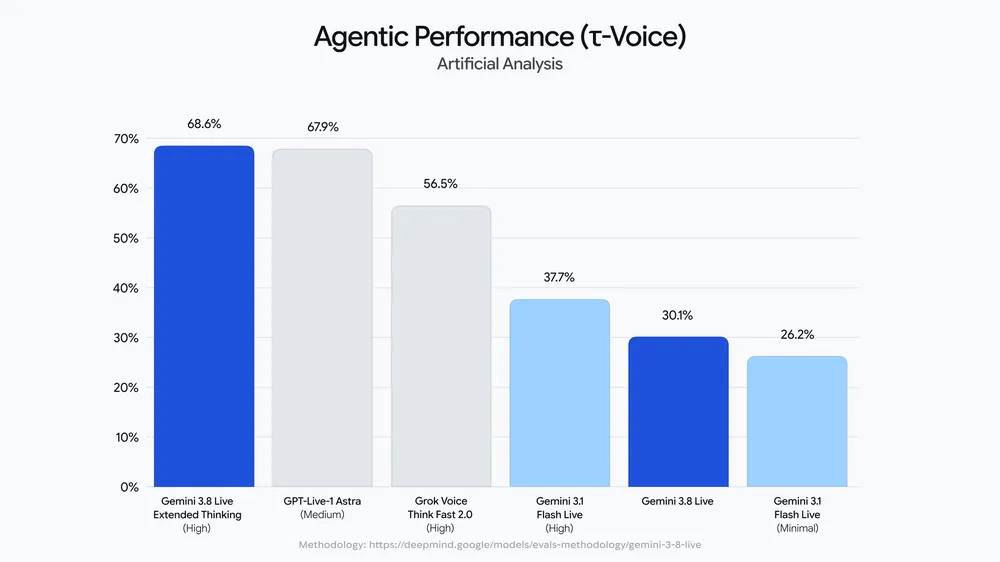
- 68.6% on τ-Voice and 35.1% on Sierra's τ-Voice-banking — agentic task-completion benchmarks that measure whether a voice agent can finish a full workflow, not just reply politely.
- 97.7% on Big Bench Audio, the strongest audio-comprehension score Google has published for a live model.
- Second place in the Speech Agent Arena for the base 3.8 Live model — the open voting arena where real users compare assistants blind.
- On ServiceNow's EVA-Bench for enterprise voice workflows, Google says its models push the Pareto frontier: the best simultaneous balance of accuracy and conversational quality recorded to date.
Source: Google official blog — Gemini 3.8 Live announcement
Developer pricing: the quiet headline
For a launch dominated by quality claims, the pricing page may be the most disruptive part. On the standard paid tier:
| Resource | Price |
|---|---|
| Audio input | $3.00 per 1M tokens (~$0.005/min) |
| Audio output | $12.00 per 1M tokens (~$0.018/min) |
| Text input | $0.75 per 1M tokens |
| Text output | $4.50 per 1M tokens |
| Image/video input | $1.00 per 1M tokens (~$0.002/min) |
| Free tier | Available for both input and output |
| Search grounding | 5,000 free requests/month, then $14 per 1,000 |
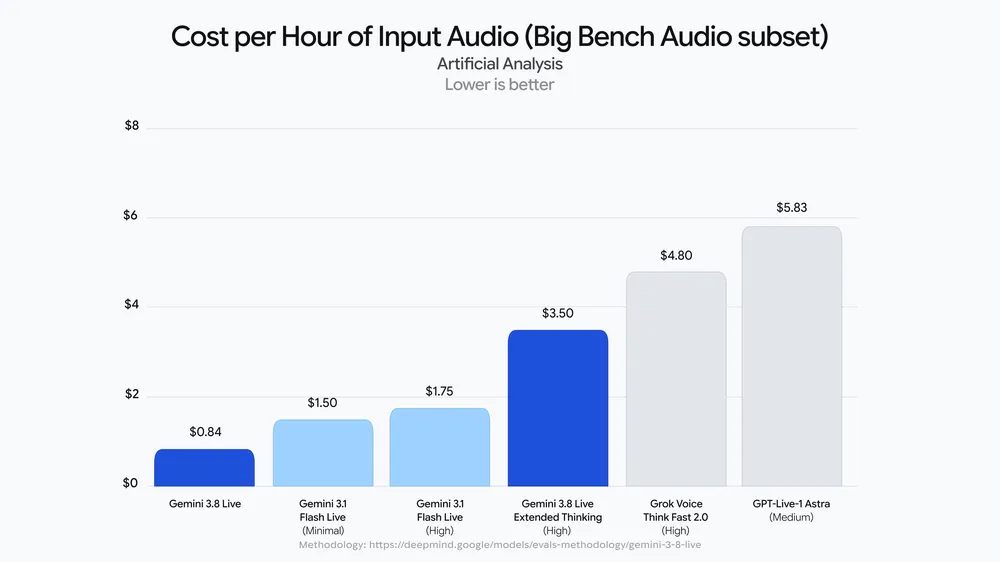
Compare that with the roughly $0.05-per-minute voice pricing OpenAI announced for GPT-Live-1, and Google is effectively an order of magnitude cheaper on audio input. For startups building voice agents that run for hours, that difference decides whether the product survives its unit economics.
The API details confirm this is production infrastructure, not a demo: input context up to 131,072 tokens, output up to 65,536, inputs spanning text, image, audio, and video, interleaved reasoning, and scheduling options (SILENT, WHEN_IDLE, INTERRUPTED) for when background tools should report back. Proactive audio is permanently enabled — the model decides when to interject. Partner platforms including LangChain, LiveKit, Pipecat, Vercel, and Agora announced same-day support, so a two-person team can stand up a production voice agent without building audio infrastructure.
Where to try it today
Four surfaces are live as of announcement day:
- The Gemini app — natural conversation with visual input on mobile.
- Google Workspace — Docs Live, Gmail Live, and Keep Live now run on the new models, an upgrade we covered when voice control first arrived in Workspace.
- Search Live — step-by-step, real-time troubleshooting directly in Google Search results.
- Gemini API — the Live API for developers, with the free tier for prototyping.
Questions everyone is asking
Does Gemini 3.8 Live support Arabic?
Yes. The official Live API language list includes 97 languages with Arabic (ar) among them, and the model switches between them automatically mid-conversation — start a sentence in Arabic, finish it in English, and it follows. Quality across Arabic dialects specifically still deserves hands-on testing before production reliance.
How much does Gemini 3.8 Live cost in the API?
Audio input is $3.00 per million tokens (about $0.005 per minute) and audio output $12.00 per million tokens (~$0.018/min) on the paid tier. Text input runs $0.75 and text output $4.50 per million tokens, with a free tier available for prototyping.
What is the difference between Gemini 3.8 Live and Extended Thinking?
The base model is built for scale and low cost in everyday voice interactions; Extended Thinking is the heavier model for complex, multi-step tasks, narrating its progress aloud while it works instead of leaving silence. Production assistants typically use the base model and escalate to Extended Thinking when a task demands planning.
Is Gemini 3.8 Live free to use?
In the Gemini app the new models power existing free and paid experiences, and the API offers a free tier with lower rate limits suitable for building and testing. Google has not announced a separate subscription for the two models.
Where can I try Gemini 3.8 Live today?
Four surfaces: the Gemini app on mobile, Workspace tools including Docs Live, Gmail Live and Keep Live, Search Live inside Google Search results, and the Gemini API's Live API for developers.
The honest limitations
Three caveats belong in any serious evaluation. First, the live models do not support structured outputs, caching, code execution, or file search — capabilities the text models have — so hybrid architectures will need a text model alongside. Second, "97 languages" does not mean uniform quality across all of them; Google's own docs note that native-audio models auto-select language, and production teams should test their specific language pairs before committing. Third, per-minute pricing derives from actual token consumption, so real-world costs for long sessions need measurement, not estimation — the free tier exists precisely for that.
Worth noting too: this is a voice-dialogue launch, not a replacement for the text models. If you're choosing a reasoning or coding model, the Gemini 3.8 Flash release remains the relevant comparison point.
Why this launch matters
For two years, voice assistants settled into a predictable rhythm: you speak, they transcribe, a text model answers, a synthetic voice reads it back. Each handoff between transcription, reasoning, and synthesis leaked context and added delay — which is why early voice assistants felt like talking to a search box with a human interpreter in the middle. The transcript-in-the-middle approach capped quality at the level of a phone call with a search engine. Gemini 3.8 Live's generation is different — speech-native models that plan, act, and speak in one continuous loop, at a price point that makes always-on assistants economically viable for the first time.
The competitive sequence tells the story: OpenAI's voice API, then Google's answer with better measured scores at a fraction of the audio price, within the same fortnight. Whoever wins, the direction is set. The next wave of AI products won't be typed into — they'll be talked with.
Sources
- Google Official Blog — Introducing Gemini 3.8 Live and 3.8 Live Extended Thinking — the primary announcement with all benchmarks
- Gemini API docs — gemini-3.8-live model page — token limits and capabilities
- Gemini API Live guide and language list — the 97 supported languages
- Gemini API pricing page — official audio and text pricing
- 9to5Google — Gemini 3.8 Live Extended Thinking powers Gemini Live, Gmail & Keep — independent coverage
Whether you're benchmarking voice agents for a product or just want the strongest Gemini experience without the global price tag, the Truescho digital shop offers shared subscription plans that make premium AI tools affordable — explore the platform's scholarship and study-abroad resources while you're there.