
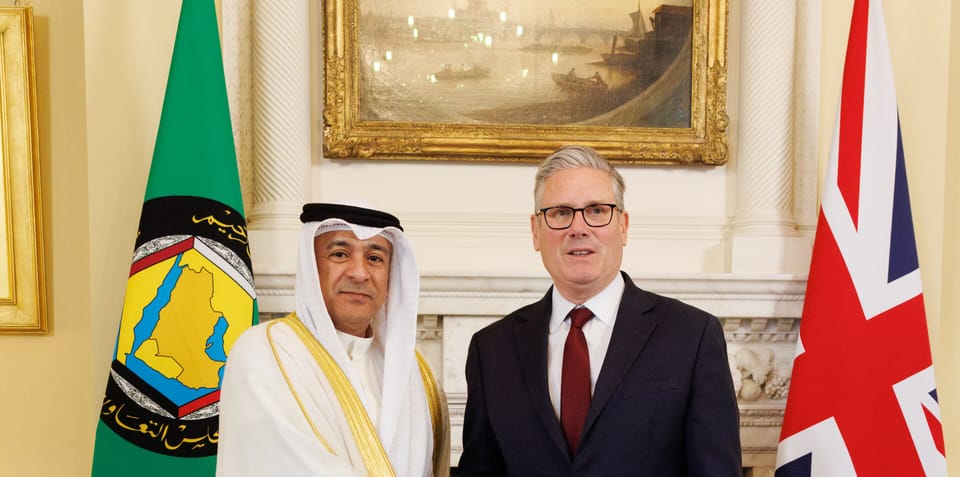
Gulf Cooperation Council Secretary-General Jasem Mohamed AlBudaiwi has revealed that the EU-GCC summit in Riyadh on October 24, 2026 will carry "many deliverables", and that the two blocs are "very close to reaching the beginning of the process to waive the Schengen visa for GCC citizens." The statement, given in an exclusive interview on the sidelines of the GCC-UK Strategic Partnership Forum in London, places a file awaited by millions of Gulf citizens at the top of the agenda of the first European-Gulf summit ever hosted by the Saudi capital. While no waiver has been announced yet, the words of the most senior executive official of the Gulf system, delivered weeks before the summit, are the strongest official signal to date that the file has moved beyond the study phase and into the procedural phase.
What the Secretary-General said, verbatim
In the interview, AlBudaiwi said: "On October 24, we will have the second EU-GCC summit coming, with many deliverables", adding: "We are very close to reaching the beginning of the process to waive the Schengen visa for GCC citizens, for the five countries, the five remaining countries." That final clarification matters: the arrangement targets Saudi Arabia, Qatar, Oman, Bahrain and Kuwait, while the United Arab Emirates needs no new agreement at all, because its citizens already enjoy Schengen visa exemption under an agreement signed with the European Union in 2015.
AlBudaiwi's phrasing — "the beginning of the process" — is precise. It points to the launch of a negotiation and ratification track inside European institutions, not to an immediate, automatic waiver on summit day. Within the European system, visa exemptions require bilateral agreements negotiated with each country individually, approved by the Council of the EU and consented to by the European Parliament before they enter into force. That is the gap between "the process begins" and "the exemption applies", and any traveler reading the headlines this week should keep it firmly in mind.
Source: Arab Views with Faisal J. Abbas on YouTube — exclusive interview with GCC Secretary-General Jasem AlBudaiwi on the Schengen waiver process.
The five target states, and where the UAE stands
The likely beneficiaries of the waiver span five Gulf states with a combined population of more than 45 million: Saudi Arabia (around 35 million), Oman (around 5.2 million), Kuwait (around 4.9 million), Qatar (around 3 million) and Bahrain (around 1.6 million). The UAE, by contrast, moved first: its visa-exemption agreement with the EU was signed on May 7, 2015, and has allowed Emirati citizens to move freely through the Schengen area for short stays ever since — the exact template the other five are now pursuing.
Over the past two years, the European Commission has reviewed the files of several Gulf states as part of its wider visa-policy modernization agenda. But AlBudaiwi's statement is the first to tie the file explicitly to a fixed political date — the October 24 summit — giving the dossier more momentum than at any point since Gulf appeals for exemption began more than a decade ago.
The Riyadh summit in context: only the second EU-GCC leaders' summit
The October 24, 2026 gathering in Riyadh is just the second summit between the European Union and the Gulf Cooperation Council at leaders' level. The first was held in Brussels on October 16, 2024, co-chaired by the then president of the European Council and the Emir of Qatar, Sheikh Tamim bin Hamad Al Thani. The Riyadh summit is expected to cover economic partnership, energy, trade and security, alongside the mobility file that has become its most publicly watched item.
AlBudaiwi also downplayed the prospect of a free-trade agreement being announced in Riyadh, noting that negotiations between the two blocs continue — which, paradoxically, raises the stakes on the Schengen file as the summit's most announceable piece of visible progress. The United Kingdom, for its part, signed its own free-trade agreement with the GCC earlier this year, sharpening European interest in showing tangible deliverables of its own.
What "the beginning of the process" actually means in EU procedure
To understand what can realistically happen after the summit, it helps to separate the European visa-waiver track into three distinct stages:
- A political declaration or understanding. The summit may issue a joint statement expressing both sides' intent to proceed — exactly what the phrase "beginning of the process" anticipates. This formally opens negotiations between the European Commission and each Gulf state individually.
- Bilateral exemption agreements. The Commission negotiates under a mandate from EU member states. Each agreement covers passport standards, document security, biometric travel documents and readmission clauses, and may be reciprocal or one-directional in design.
- Ratification and entry into force. Every agreement must be approved by the Council of the EU and gain the European Parliament's consent before it takes effect. Based on the UAE precedent — signed May 7, 2015 and in force within weeks once ratifications completed — the realistic window after a positive summit declaration is months, not days.
The most plausible post-summit scenario, if October 24 produces a favorable announcement, is therefore the formal opening of negotiations within months — not Gulf citizens boarding visa-free flights in November. Even so, crossing from "under study" to "in negotiation" would be a qualitative shift for a region that has waited over a decade for this file to move, and analysts expect the summit's parallel tracks on trade and energy to add pressure toward a faster timetable.
Visa-free Schengen: what this means for you in practice
If and when the waivers are completed, short-stay travel to Europe changes fundamentally for citizens of the five states across four concrete dimensions:
- Goodbye to visa queues. No more appointment-hunting at application centers, no more waits that stretch for weeks during summer and holiday seasons, and no more spending 90 euros per adult (roughly 100 US dollars) on fees for every application — with approval never guaranteed.
- Free movement across 29 European countries. The Schengen area comprises 29 states: 25 EU members plus Iceland, Norway, Switzerland and Liechtenstein, including the two newest full members, Bulgaria and Romania, since January 2025. A Gulf passport holder would cross any of those borders with a passport alone.
- The 90/180 rule. The exemption covers short stays of up to 90 days within any 180-day period, for tourism, business, family visits and events. Long-degree study and employment still require their dedicated national visas under each country's rules.
- A simple electronic pre-travel registration. Like other visa-exempt travelers, Gulf citizens will eventually need to obtain an ETIAS travel authorization once the system becomes operational — a simple online permit similar to the US ESTA, involving no consulate visit. The system has not yet entered into force, and no date relevant to Gulf travelers has been announced.
For international students from the Gulf in particular, visa-free access would open a practical door to Europe's universities: short campus visits, admissions interviews and open days in Germany, France, the Netherlands, Switzerland and the rest of the Schengen zone become trivially easy — a real advantage in competitive admissions cycles. If you are mapping funded European options, Switzerland is a Schengen member, and our updated guide to the Swiss Government Excellence Scholarships 2027-2028 walks through eligibility and deadlines in (Swiss Government Excellence Scholarships 2027-2028: the full guide). For a weekly refreshed list of fully funded openings worldwide, see (Fully funded scholarships open right now).
Two tracks, not one: Schengen for Gulf citizens, and the unified GCC visit visa
It is worth keeping the two mobility files straight, because they are often confused in headlines. The first is the Schengen exemption for Gulf citizens traveling to Europe — the October 24 summit file. The second is the unified GCC visit visa, which lets expatriate residents and visitors move between the six Gulf states on a single visa while visiting the region, already operating through approved consultation offices as we explained in (The GCC unified visa 2026: approved offices, explained). One opens Europe to Gulf citizens; the other opens the Gulf to the world. Together they anchor the region's ambitions as a global mobility hub.
How to prepare while the announcement is pending
Since the waiver is not yet in force, realistic planning is what saves time and money:
- Do not cancel booked travel waiting for the waiver. If you must travel to Europe in the coming weeks, apply for the visa normally. Any retroactive effect of a summit announcement is extremely unlikely, and seasonal appointments fill early.
- Check your passport now. European exemptions typically require a passport valid for at least 6 months beyond the departure from the Schengen area, held in a modern biometric format. Renewing early protects you from refusals later.
- Follow official channels only. After the summit, expect a wave of premature "visa-free now" claims. The authoritative sources are your country's foreign ministry and the official delegations of the EU; we will update this article the moment a verified announcement is made.
- Budget for the trip, not just the visa fee. A waiver saves about 90 euros per adult and 45 euros per child aged 6 to 12 on each application — but accommodation and travel medical insurance remain practical requirements for a smooth trip.
Frequently asked questions about the Schengen waiver for GCC citizens
Are GCC citizens actually visa-free for Europe now?
No. As of this article's publication, no exemption is in force for citizens of Saudi Arabia, Qatar, Oman, Bahrain or Kuwait. The official statement says the two sides are "very close to reaching the beginning of the process", and the decisive date is the Riyadh summit on October 24, 2026, where an announcement launching the waiver track is expected. UAE citizens, by contrast, have been exempt since the 2015 agreement.
When will Saudis, Qataris and other Gulf citizens travel to Europe without a visa?
There is no official date yet. The normal path after any summit announcement is the negotiation of bilateral agreements requiring European ratifications, which can take from several months to a year or more. The official phrase "beginning of the process" specifically means actual implementation is not necessarily close, so follow official channels before building travel plans around the waiver.
What is the difference between Schengen and ETIAS?
Schengen is a border-free zone of 29 European countries; exemption from its visa means entry with a passport alone. ETIAS is a pre-travel electronic authorization that will be required of visa-exempt travelers — including Gulf citizens once their exemptions apply — when it becomes operational. It is obtained online for a modest fee and does not replace a passport or grant residence rights.
Does the waiver cover studying and working in Europe?
No. The waiver under discussion covers short stays of up to 90 days in any 180-day period for tourism, business and visits. Extended academic study and salaried work require dedicated national visas — student visas and work permits — under each European country's own rules, outside the Schengen exemption.
Why is the EU-GCC summit being held in Riyadh?
Because it is only the second summit in the history of relations between the two blocs, and the two sides agreed that Riyadh would host it after the first summit in Brussels in October 2024, reflecting the rotation of summit venues and the weight the Gulf carries in Europe's energy, trade and security calculations.
Sources
- Oman Observer — Exclusive interview with GCC Secretary-General Jasem AlBudaiwi (October 11, 2026)
- Arab Views with Faisal J. Abbas — Exclusive: GCC Schengen Visa Waiver Process Set to Begin (YouTube)
- European Commission — Visa policy and Schengen exemptions
- European Commission — European Travel Information and Authorisation System (ETIAS)
- Council of the EU — First EU-GCC Summit Joint Statement, Brussels, October 16, 2024
Note: this article tracks a developing story. We will update it the moment the Riyadh summit announcement is made on October 24, 2026, or any subsequent official step in the waiver process is taken.