
Falcon-Emirati-7B: Abu Dhabi's AI Model That Actually Speaks the Dialect
Last updated: October 2026
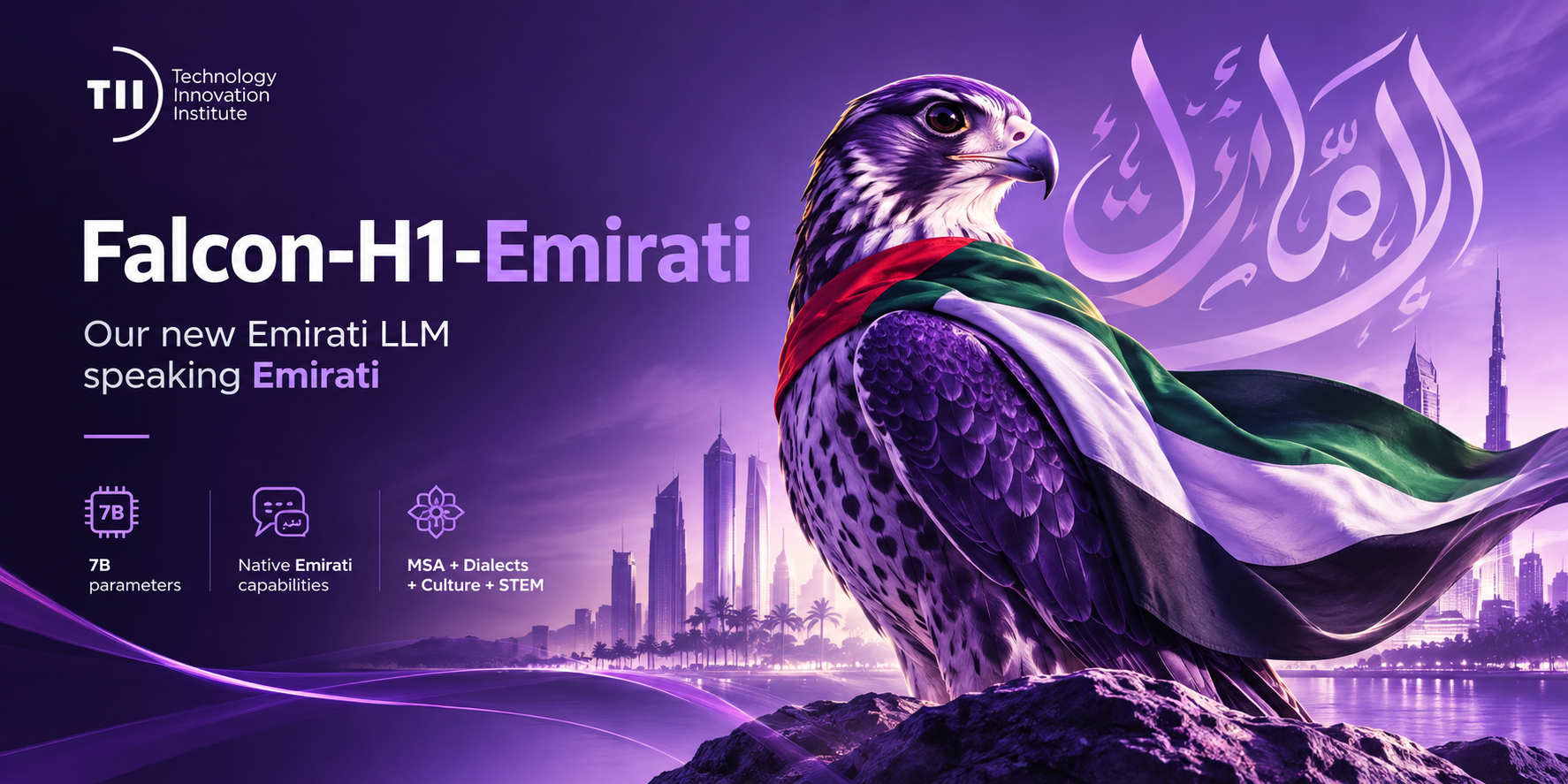
84.83% is the score the new Falcon-Emirati-7B just posted on Alyah, a native Emirati Arabic benchmark built from 1,173 questions collected from native speakers — beating every Arabic and multilingual model tested against it, including models several times its size. The Technology Innovation Institute (TII) in Abu Dhabi released the model on October 6, 2026, and it is the first large language model purpose-built to understand and speak Emirati Arabic: its vocabulary, its tone, and the cultural context behind its idioms, rather than defaulting to Modern Standard Arabic.
Here is what TII actually built, why it chose 7 billion parameters over 34, and why the benchmark table matters far beyond the Gulf.
Source: TII's official blog on Hugging Face
Where the number comes from: the Alyah benchmark
Before believing any claim that a model "understands the dialect," you need a test written by the dialect's own speakers. Alyah was built by the TII team as 1,173 multiple-choice questions gathered from native Emirati speakers, covering culture, vocabulary, and expressions that simply never appear in Modern Standard Arabic corpora. The officially published results:
| Model | Alyah score |
|---|---|
| Falcon-Emirati 7B | 84.83% |
| All other tested Arabic & multilingual models | Below Falcon-Emirati on the overall score |
The lead did not stop there. On ArabCulture-Dialogue (283 UAE-specific cultural scenarios), Falcon-Emirati scored 85.57%, against 83.39% for Saudi Arabia's ALLaM, 73.79% for Jais-2, and 71.50% for Qatar's Fanar-2 — meaning a 7B model outperformed rival models that are larger and far better funded.
Source: TII's official blog on Hugging Face
What Falcon-Emirati-7B actually is
A large language model developed by the Technology Innovation Institute in Abu Dhabi, built on the Falcon-H1-Arabic base at the 7-billion-parameter size. Its hybrid architecture fuses Mamba SSM blocks (linear-time efficiency on long sequences) with Transformer attention (precision on long-range detail) — the signature Falcon-H1 design whose larger variants run context windows up to 128K and 256K tokens.
The decisive difference from everything that came before: this model was trained on the dialect itself, from three officially disclosed sources — authentic Emirati web and forum text, Modern Standard Arabic content about Emirati culture and heritage, and synthetic dialect data strictly constrained by Emirati glossaries and style rules so that MSA never leaks into the outputs.
Why 7B and not 34B? A decision that reveals the engineering logic
The obvious question: why not ship the biggest model possible? TII's answer in the official blog is unusually candid: the 34B variant costs too much to run for a dialect chat model, and the 3B variant "lacked headroom for cultural depth." 7B was the sweet spot.
The engineering message travels well beyond Abu Dhabi: dialect competence is not bought with scale. The team tested much larger rival models and they lost — a result that matters to any country planning a sovereign language model without burning its budget on parameters that do not serve its dialect.
Dialect fidelity: the gap the numbers expose
The sharpest measurement in the entire blog is "dialect fidelity": does the model answer in the dialect it was asked in, or retreat to Modern Standard Arabic? The evaluation used an LLM judge with partial credit:
| Model | Dialect fidelity score |
|---|---|
| Falcon-Emirati 7B | 0.52 |
| ALLaM | 0.05 |
| gemma-3-27b | 0.03 |
| Jais-2 | 0.02 |
| Fanar-2 | ≈0.00 |
That is not an incremental improvement — it is a different category. As TII's own blog puts it, rival models "know the right answer but say it in Modern Standard Arabic by default," while Falcon-Emirati is the only model that keeps answering in the requested dialect across every Alyah category. One caveat that reveals the field: Fanar-2-27B abstains from answering 26.2% of the time, while all other tested models stay under 5%.
Source: TII's official blog on Hugging Face
How to try it yourself, free
The officially announced access point is Falcon's own chat application:
- Open
chat.falconllm.tii.aein your browser. - Select the Falcon-Emirati-7B model from the model list.
- Ask your question in Emirati Arabic directly — try a colloquial expression or a question about a local tradition that generic chatbots usually fumble.
No paid account and no waitlist at the announced link — which alone distinguishes the experience from the gated front-ends of the big American labs. If you are comparing AI tools for study workflows more broadly, our guide to free Gemini alternatives for students covers the practical options side by side.
Why this matters for international readers
- Dialect AI is now a sovereign capability. A national research institute shipped a state-of-the-art dialect model, an open benchmark (Alyah is released on Hugging Face), and a reusable training recipe — a template other language communities can copy, from Swahili to Tagalog to Quechua.
- Scale ≠ dialect competence, now with receipts. The dialect-fidelity table is among the cleanest public demonstrations that model size does not close the culture gap — a finding developers in Nigeria, India, or Indonesia designing local-language tools should read twice.
- The Gulf AI race just moved to a new tier. Abu Dhabi escalated from "Arabic-capable" to "dialect-native" — a depth of focus that changes what regional rivals must now match.
The Gulf AI map: Abu Dhabi, Riyadh, Doha, Rabat
Falcon-Emirati lands inside an open race. Saudi Arabia pushed ALLaM and the Mistral–HUMAIN partnership for Arabic models, Qatar built Fanar at QCRI, Morocco recently shipped its Darija model with Mistral, and Riyadh also unveiled the HUMAIN M3 model. The next time someone tells you Arabic models "are all the same," show them the dialect-fidelity table above.
Honest limits: what is not solved yet
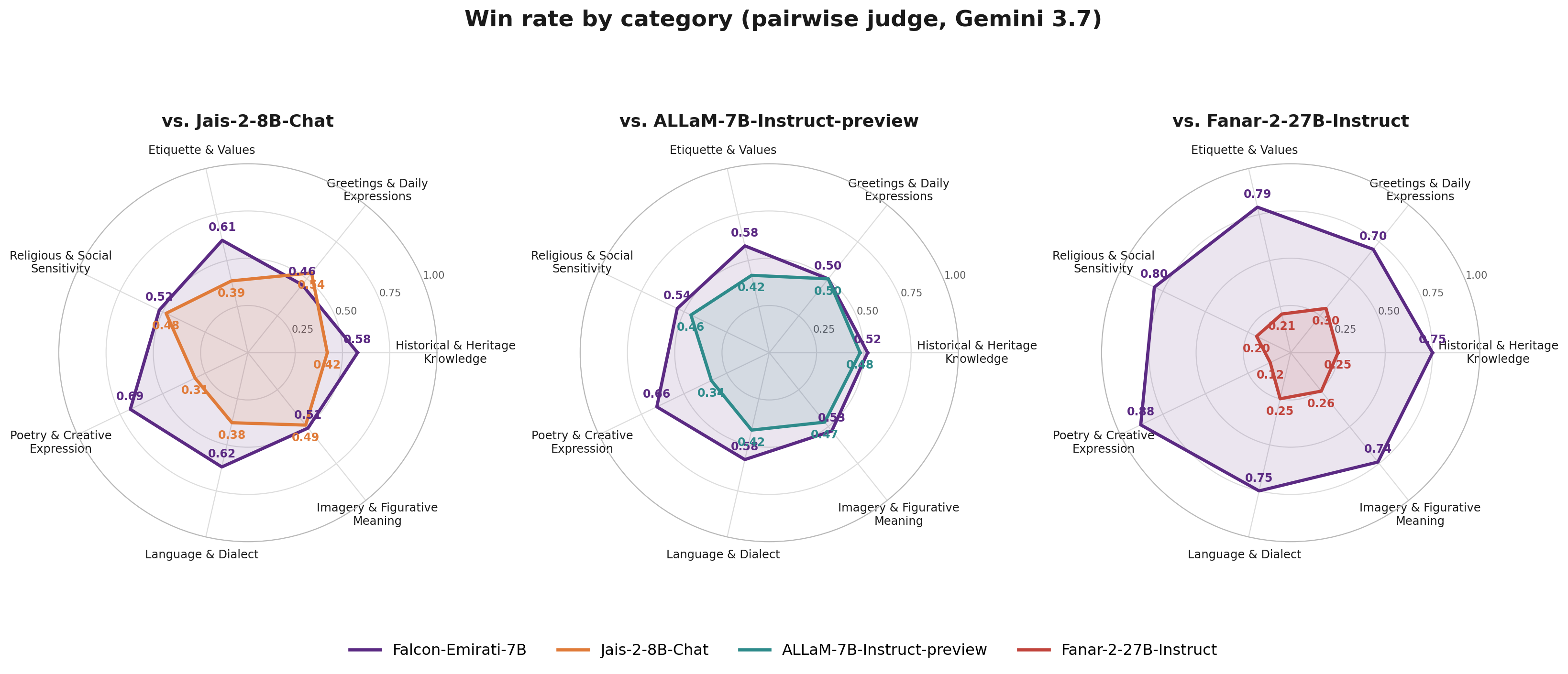
- Falcon-Emirati's weakest category was greetings and daily expressions — losing 0.46–0.54 to Jais and tying ALLaM at 0.50, precisely because that category sits closest to Modern Standard Arabic.
- The specialization is Emirati: the blog claims no documented mastery of other Gulf dialects (Saudi, Qatari, Kuwaiti) at the same depth.
- The announced access point is the chat app; at publication time the blog did not link a downloadable weights card or a public API.
- This release is text-only — no voice, no images.
Frequently asked questions
What is Falcon-Emirati-7B and who made it?
A 7-billion-parameter large language model from the Technology Innovation Institute in Abu Dhabi, purpose-built for Emirati Arabic. Built on the Falcon-H1-Arabic base, it scored 84.83% on the native Alyah benchmark, ahead of every Arabic and multilingual model tested, including larger ones.
How does Falcon-Emirati compare to ALLaM and Jais?
On the UAE cultural benchmark ArabCulture-Dialogue, Falcon-Emirati scored 85.57% versus 83.39% for ALLaM, 73.79% for Jais-2, and 71.50% for Fanar-2. On dialect fidelity the gap is wider: 0.52 versus 0.05 for ALLaM and 0.02 for Jais-2.
Can I try Falcon-Emirati for free?
Yes. The officially announced access point is TII's chat app at chat.falconllm.tii.ae — select the Falcon-Emirati-7B model and write in Emirati Arabic. No subscription or waitlist was announced for the web app.
Why do Arabic dialects break large language models?
Training data for Arabic is dominated by Modern Standard Arabic — news, books, formal web text — while dialects live mostly in speech and informal forums. Models therefore learn the "right answers" in MSA and default to it even when asked in a dialect, as TII's fidelity scores show.
What is the Alyah Emirati benchmark?
A 1,173-question multiple-choice benchmark collected from native Emirati speakers by TII, released as an open dataset on Hugging Face. It is the first evaluation written by the dialect's own speakers rather than adapted from MSA assumptions, and any model can be scored on it.
Sources
- TII official blog — Falcon-Emirati — the full announcement with all numbers
- Alyah benchmark dataset — the open evaluation tool
- Falcon-H1-Arabic family announcement — the base model family
- Falcon chat app — the announced interface
If you track AI tools for studying and research and want this kind of numbers-first breakdown for every major release, Truescho curates the tools and opportunities that matter — get started free.