
Try transcribing a business meeting in Gulf Arabic on any global transcription service and you will understand why Arabic-speaking professionals consider speech-to-text the last broken promise of the AI revolution. Global models handle English with error rates near 5%, then stumble so badly on Arabic dialects that manually fixing the transcript becomes slower than typing it from scratch. On October 7, 2026, Abu Dhabi stepped into that gap: the Technology Innovation Institute (TII) announced Falcon ASR, an Arabic-first speech recognition model built around dialects — Emirati Arabic front and center — and posted the best result ever recorded on the open Arabic ASR leaderboard. This is a complete look at what was announced, the exact numbers, how to try it today, and why it matters well beyond the Gulf.
Source: TII's official Hugging Face blog
What exactly did TII announce?
The Technology Innovation Institute in Abu Dhabi — the lab behind the well-known Falcon model family — announced Falcon ASR, a 1.6-billion-parameter speech recognition model. It builds on the institute's earlier Falcon3-Audio work, documented in a peer-reviewable arXiv paper titled "Competitive Audio-Language Models with Data-Efficient Single-Stage Training on Public Data".
The essential difference from everything that came before: where global models treat Arabic as an add-on layered over an English-first foundation, Falcon ASR was built Arabic-first — with intensive training on the Emirati dialect, Modern Standard Arabic, and other Gulf dialects, alongside English, French, Spanish, and Portuguese in the same weights, with no language flag required at inference time.
Nor is this the Gulf's first move toward AI that understands Arabic as people actually speak it. It follows the Emirati-dialect Falcon language model and Jais 3 from MBZUAI with its Arabic-native model family. What sets Falcon ASR apart is its target: the single most practically painful task in the Arabic AI stack — turning spoken language into text.
The official numbers: is it actually the best?
The figures below come from TII's official announcement, and they are auditable because they are anchored to public leaderboards:
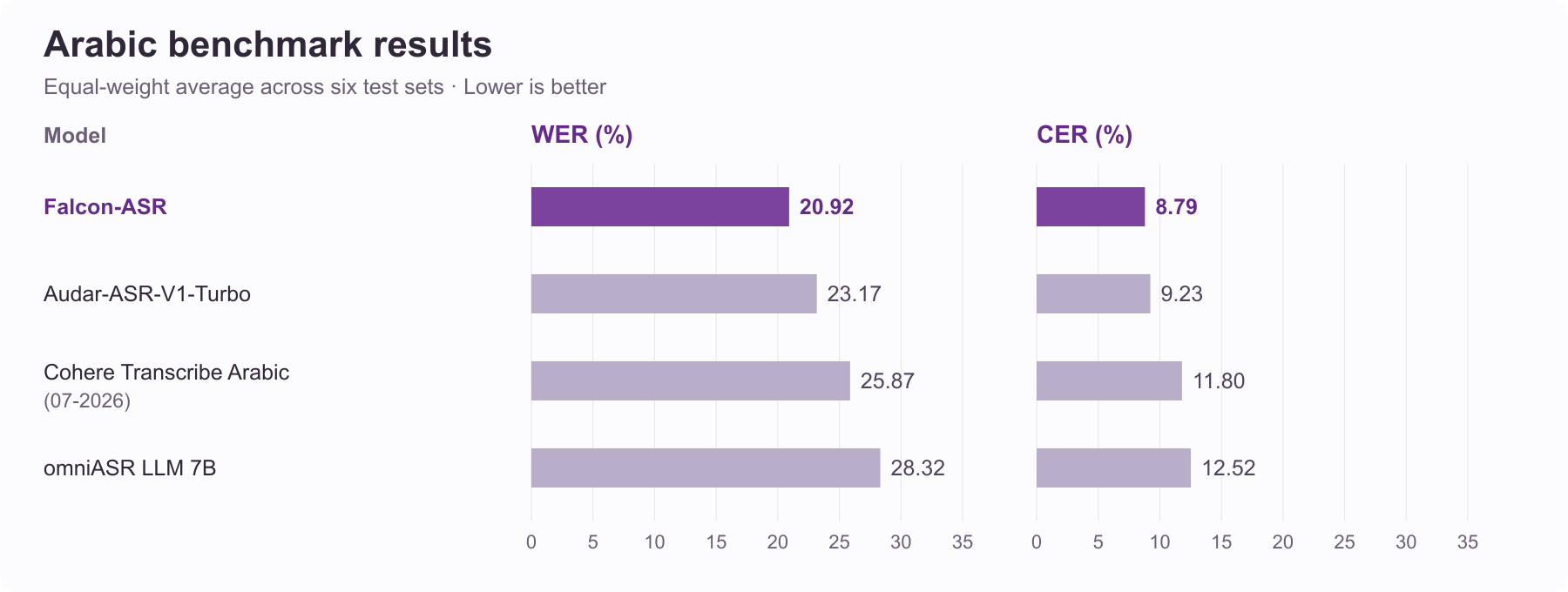
- Arabic (the headline benchmark): an average word error rate of 20.92% across 6 test sets under the Open Universal Arabic ASR Leaderboard protocol — versus 23.17% for the best previously published result in the September 30, 2026 snapshot. That is a full 2.25 percentage points ahead of the best published global competitor.
- Emirati dialect specifically: on an internal evaluation set of held-out, human-validated recordings, the model scored 22.73% WER and 10.19% character error rate — 4.07 points better than the next-best system (Qwen3-Omni) in the same evaluation.
- English: a mean WER of 5.74% across 7 test sets on the HF Open ASR Leaderboard — world-class performance in what is, for this model, a secondary language.
Source: TII's official Hugging Face blog
For context: before this announcement, the world's best Arabic transcription systems were mis-recognizing roughly one word in every four to five when dialects were involved. Breaking below 21% on a public leaderboard protocol moves Arabic transcription into what businesses can realistically call the commercially usable zone — especially combined with word-level timestamps, the feature that turns a transcript from a blob of text into an editable, navigable asset.
Built for the real world, not the lab
Real transcription does not happen in a silent studio. Meetings have overlapping speakers, phone calls arrive compressed, field recordings carry background noise, music, and room echo. TII states that training data deliberately simulated all of it: background noise, overlapping speech, music, room reverberation, telephony effects, and speed and pitch variation — and that this was applied to the Emirati recordings themselves, explicitly targeting meetings, calls, and everyday recordings.
Source: TII's official Hugging Face blog
How can you try it today from the Gulf?
As of this article's date (October 16, 2026), public access runs in two phases:
- Available now — the free demo: an official interactive Space on Hugging Face named tiiuae/falcon-asr-demo, which transcribes audio clips up to 60 seconds directly in the browser. Test it with a clip in your own dialect before passing judgment on any benchmark.
- Coming soon — API and apps: TII says API access and native applications are "planned," without dates. Important caveat: the model's weights have not been released for public download as of this writing, and no final license has been announced — treat any repository claiming to be the official download with suspicion.
What this means for you
- Arabic journalists and content creators: accurate dialect transcription means hours of manual correction saved on every podcast episode or interview. Have your team run the demo on real samples from your archive now, so you can judge business viability the moment the API ships.
- Gulf companies and institutions: Arabic meeting minutes, call archiving, sales intelligence boards — the use cases are ready-made. For organizations sensitive about data leaving the region, a promising Gulf-built model is an option worth waiting for rather than defaulting entirely to Western services.
- Arabic-speaking developers: speech has been the weakest link in Arabic AI toolchains. A model with word-level timestamps enables real-time captioning tools, meeting summarizers, and video search in Arabic. Watch for the weights — an open release would open an entire startup category.
- Linguistics researchers: publicly documented performance on a specific Gulf dialect, under a repeatable protocol, is rare in Arabic NLP. It is a useful reference point for any comparative dialect work.
- For simple everyday needs: don't wait — our free AI tools directory covers basics you can use right now.
Quick comparison: Falcon ASR vs current options
| Criterion | Falcon ASR (TII Abu Dhabi) | Major global services | Earlier open models |
|---|---|---|---|
| Best published Arabic WER | 20.92% (public leaderboard) | 23.17% best published pre-announcement | Generally higher on dialects |
| Emirati dialect | 22.73% (official eval) | Not specialized | Weakly documented |
| Word-level timestamps | Yes | Partially, for some | Varies |
| Multilingual in one model | Arabic + 4 languages | Broad | Mixed |
| Public access today | 60-second demo | Ready subscriptions | Free downloads |
Note: the comparison is against the "best published" figures from the announcement and leaderboards cited — some closed commercial services do not publish their numbers on public leaderboards at all.
Why this announcement matters strategically
Three reasons make a speech recognition launch bigger than it looks:
- Arabic is the world's largest underserved language in speech AI: more than 400 million speakers with a fraction of the service quality, because benchmarks, datasets, and budgets follow English. Any documented breakthrough in that gap pulls the rest of the stack along with it — translation, summarization, voice agents.
- Dialects are the next battlefield: Modern Standard Arabic is relatively "solved." The real gap across the Gulf, North Africa, and the Levant is everyday dialect. TII chose Emirati Arabic as its first target — echoing the earlier Emirati-dialect Falcon model and setting up a regional race on dialects.
- Regional competition is compounding: Abu Dhabi is no longer alone. Jais 3 from the UAE covered Arabic-native language models, and the global voice race is accelerating as seen in the Grok Voice 3.0 launch. The ultimate beneficiary is the Arabic-speaking user who has long paid full price for services that did not understand them.
Word-level timestamps: the detail that changes everything
"Word-level timestamps" can read like a throwaway line in a feature list. In practice, it is the difference between a dead transcript and a working tool. A word timestamp means every word in the output is anchored to its exact moment in the source recording. That single property unlocks use cases that are impossible without it:
- Video and podcast editing: search for a word in the transcript and the player jumps to that exact second in the audio — instead of listening through an hour of tape for one quote.
- Translation and multilingual content: automatic alignment between the Arabic transcript and any translation, the foundation of any professional Gulf-to-global media workflow.
- Legal and compliance review: in finance and regulated sectors, being able to answer "who said what, at which second" turns a transcript from a summary into evidence.
- Searchable video: platforms and search engines can index spoken Arabic content word by word instead of relying only on titles and descriptions.
Most global services offer timestamps at the sentence or segment level. Dropping down to the word level, in a single model that also handles Gulf dialects, is precisely the kind of detail that distinguishes a model built for a specific market.
How to read the error numbers yourself
So the percentages are not just abstractions, here is the quick reading guide specialists use:
- WER (word error rate): the share of words the model got wrong (inserted, deleted, or substituted) out of the total in the recording. A 20% error rate means roughly one word in five needs review — but the distribution is not uniform: errors cluster around names, numbers, and terminology, while sentence structure usually stays intact. That is why real-world editing is much faster than the raw percentage suggests.
- CER (character error rate): more precise than WER for Arabic specifically, because a single letter substitution can flip a word's meaning entirely. A 10.19% character error rate on Emirati audio means the "skeleton" of the text is correct, and most fixes are letter substitutions rather than rewrites.
- The measurement protocol matters: the same model scores differently on different test sets. That is why TII anchored its claims to fixed public leaderboards (6 Arabic test sets, 7 English ones) — otherwise it is always possible to "shop for" easier tests. Whenever you compare two services in the future, always ask: measured on whose data?
Who built it? TII in brief
The Technology Innovation Institute is Abu Dhabi's advanced research arm, and within a few years it has become a familiar global name in open models since launching the Falcon family, which has repeatedly topped open-model leaderboards. Its bet on Arabic speech is not a solo act but an extension of an integrated Emirati ecosystem: MBZUAI on the academic side and language models via Jais 3, and TII on specialized applied models. The difference is that TII's products usually carry a "commercially adoptable tool" character — and a public demo within days of the announcement signals an intent for real usage, not just a research paper.
What does this mean for translators?
The Arabic translation industry — from conference interpreting to content localization — rests on one foundation: accurate transcription first, translation second. Every percentage point shaved off the transcription error rate flows directly into final translation quality, because translators typically work from the transcript, not the raw audio. A model that understands Gulf dialects with word-level timestamps makes it possible to build real-time conference translation pipelines for the Gulf events market at lower operating cost — and that market is enormous in a region hosting thousands of international events every year.
Honest limitations
- Weights are not publicly downloadable as of this article's date, and the license is unannounced — all practical evaluation currently runs through the official demo only.
- The demo caps clips at 60 seconds — not production-usable yet.
- No API, no pricing — "planned" is all that exists, so do not build production timelines around it.
- The Emirati figures come from internal evaluation (held-out, human-validated recordings), not a public leaderboard — credible, but produced by the announcing party.
- Six languages only — anyone needing medical French, Urdu, or Turkish will still need another solution alongside it.
- 1.6B parameters — a sensible size for speech, not a giant reasoning model; complex contextual understanding and summarization are not part of the announced scope.
Frequently asked questions
What is Falcon ASR?
A speech-to-text model from the Technology Innovation Institute in Abu Dhabi, 1.6 billion parameters, announced October 7, 2026, and currently the top performer on the open Arabic ASR leaderboard with an average error rate of 20.92%.
Does it understand Arabic dialects or only Modern Standard Arabic?
Its core training covers Modern Standard Arabic, the Emirati dialect, and other Gulf dialects, plus English, French, Spanish, and Portuguese — all within the same model weights, with no manual language tagging.
How do I try it now?
Through the official free demo on Hugging Face (the tiiuae/falcon-asr-demo Space), which transcribes clips up to 60 seconds directly in the browser.
Can the model be downloaded and run locally?
Not yet. The weights were not publicly released as of October 16, 2026, and the license is unannounced; TII says API access and native applications are planned.
Is accurate Arabic transcription actually commercially important?
Yes. Meeting minutes, call archiving, content production, education, and research are all sectors currently paying for slow manual editing — and cutting dialect error from 23% to 21% meaningfully reduces editing time on long recordings.
The bottom line
Falcon ASR is not just another model joining a long list. It is the first auditable, public-protocol breakthrough on a problem every Arabic transcription user knows personally: dialects. The numbers are published, the methodology is documented in a research paper, and the demo is live for anyone to test. Everything now waits on one decisive step: releasing the weights or shipping the API with clear pricing. When that happens, Abu Dhabi will have closed one of the largest remaining gaps in the Arabic AI wall. We will update this article as soon as either lands.