
EU Blue Card Germany 2026: Salary Thresholds, Requirements and the Fast Track to Permanent Residence
A software architect in Bengaluru compares two offers on the same morning: a remote contract, and a Stuttgart role at €52,400 a year. The comparison turns on the EU Blue Card Germany 2026 numbers: a standard salary threshold of €50,700, a reduced threshold of €45,934.20, and a settlement permit possible after 21 months. The German offer is not just a job — it is the fastest documented route to permanent residence in Germany.
This guide assembles those figures, the qualification rules, the application route, the costs and the family-reunion advantages in one place. It is written for engineers, doctors, developers and accountants planning a move, not for lawyers, and every section ends in what to prepare.
Last updated: August 2026
What the EU Blue Card Is in 2026
The EU Blue Card is Germany's residence title for third-country professionals with a recognised university qualification — or, in a defined exception, proven IT experience — and a job offer that meets a statutory salary threshold. It sits at the top of Germany's skilled-migration ladder because the EU Blue Card Germany 2026 status carries privileges ordinary work permits do not: easier permanent residence, strong family rights, the flexibility to change employers, and mobility between European Union member states after a qualifying period.
The legal foundations are recent and stable. The Skilled Immigration Act (Fachkräfteeinwanderungsgesetz), fully in force since 2024, rebuilt the pathway around the Blue Card, and the EU Blue Card Directive 2021/1883 harmonised key features across member states. The standard threshold sits in Section 18g, Paragraph 1 of the Residence Act, which is why salary figures change each calendar year in step with German social-insurance reference values.
For professionals who still need a German-recognised degree, funded study routes exist in parallel — the DAAD EPOS scholarship for Germany, 2027–2028 intake, for example, covers development-related master's programmes for candidates from eligible countries, and a German degree feeds directly into Blue Card eligibility afterwards.
The card is not a work permit bolted onto a visa; it is a single status that says the holder is a qualified professional whose skills the German economy is short of. That status is what unlocks the 21-month settlement track described below.
Source: German Federal Foreign Office
Salary Thresholds for 2026: The Numbers That Decide Eligibility
The EU Blue Card Germany 2026 salary thresholds apply from 1 January: the standard gross salary threshold is €50,700 per year — about €4,225 per month. If your contract meets that figure and your qualification is recognised, the ordinary route is open regardless of your profession.
The reduced threshold is €45,934.20. It applies to three groups: workers in official shortage occupations, university graduates within their first three years after graduating, and experienced IT specialists without a university degree. The reduced figure is not arbitrary; it equals 45.3% of the pension insurance contribution ceiling, which is why both thresholds move every January.
| Category | 2025 threshold | 2026 threshold (from 1 January) | Change |
|---|---|---|---|
| Standard occupations (Section 18g, Paragraph 1) | €48,300 | €50,700 (≈ €4,225 per month) | Rise of roughly 5% |
| Shortage occupations | €43,759.80 | €45,934.20 | Rise of roughly 5% |
| Recent graduates (within three years of graduating) | €43,759.80 | €45,934.20 | Rise of roughly 5% |
| IT specialists without a university degree | €43,759.80 | €45,934.20 | Rise of roughly 5% |
| Basis of the reduced threshold | — | 45.3% of the pension contribution ceiling | Recalculated annually |
Two cautions come with the table. First, the salary must be genuine gross annual salary in the contract — signing bonuses and vague variable components do not count like a fixed figure. Second, an offer that cleared the 2025 bar may fall short in 2026, so negotiate on the new numbers, not the old ones.
The thresholds are a floor, not a target. A nurse or developer negotiating at exactly €45,934 leaves no margin for error if the figure is recalculated again, and employers accustomed to the 2025 numbers are the most common source of failed applications in a rising-threshold year.
Who Qualifies for the Reduced Threshold of €45,934.20
The reduced threshold is the door most international professionals will walk through, because Germany's shortage list is broad. The documented 2026 shortage categories include STEM professions, information technology, health care, engineering and teaching — in other words, the fields in which most Blue Card applicants from India, Nigeria, the Philippines, Brazil and Vietnam already work.
For recent graduates, the rule is generous: anyone within three years of finishing their degree qualifies at the lower figure, even if their occupation is not on the shortage list. That makes the first job after a German or recognised foreign degree significantly easier to fund for both sides, since the employer's salary commitment drops by roughly €4,800 a year compared with the standard bar.
For everyone else, the question is whether the specific occupation maps to a shortage category. Job titles vary between countries; what matters is the classification of the role's content, not the wording on a business card.
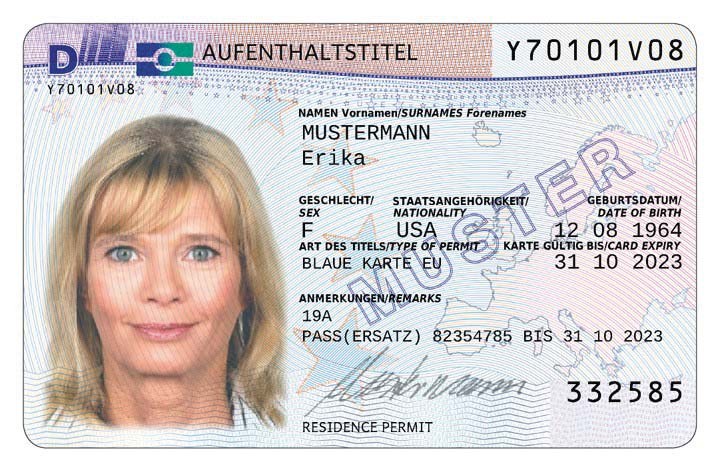
The card that successful applicants eventually hold looks like this — a standard German residence document carrying the EU Blue Card designation:
Source: Wikimedia Commons

The IT Route: Qualifying Without a University Degree
The single most under-used provision in the 2026 rules is the IT specialist exception. Experienced software professionals can qualify for a Blue Card without any university degree, provided they can evidence proven professional experience in the field and meet the reduced salary threshold of €45,934.20.
The logic is straightforward: German employers hiring senior developers care about shipped systems, not diplomas. The evidentiary burden, however, sits with the applicant. Reference letters from previous employers, detailed project descriptions, contracts and, where available, client attestations carry the application. Self-declared expertise does not.
Applicants can close the documentation gap by requesting experience letters from former employers now, years before any application, and by assembling portfolios while still employed. The experience must be genuine, recent professional practice — the authorities assess demonstrated capability, not accumulated job titles.
For a self-taught engineer in Lagos, Karachi or Ho Chi Minh City earning well below the threshold locally, the provision changes the arithmetic entirely. It converts years of real work into a qualifying credential, provided a German employer signs a contract at or above €45,934.20 — a mid-level salary in Germany and a transformative one almost anywhere else.
Applying: Embassy Visa or Switching Inside Germany
There are two routes to the card, and choosing between them is the first real decision of the process. The standard route is a national visa for employment applied for at the German embassy or consulate in your country of residence; once in Germany, the visa is converted into the EU Blue Card at the local immigration office (Ausländerbehörde). The alternative, for people already lawfully resident in Germany on another permit, is to switch status directly with the immigration authority.
The document set is consistent across both routes: a valid passport, evidence of a recognised higher-education qualification — checked against the Anabin database or through a recognition procedure — a signed employment contract meeting the applicable threshold, and supporting evidence such as the IT experience file described above. Employers are not required to run a labour-market test for Blue Card roles, which removes a delay older German work-visa categories were famous for.
Budget for the official fees in advance. The national visa costs approximately €75, and issuing the residence permit costs around €100; fees for minors are reduced to about €37.50. None of these are one-off surprises — they are published figures, and a relocation package should reference them rather than guesses.
Timing is the part applicants consistently underestimate. Appointment backlogs at German missions and at overloaded immigration offices are real; reports from Berlin describe waiting periods stretching toward a year and a half for a residence-permit appointment. The countermeasure is procedural: book the embassy slot before you need it, file complete documents on the first attempt, and weigh a city's appointment situation alongside the salary when choosing between offers.
If you are still assembling the profile — a degree to recognise, a threshold-clearing offer, a funded study alternative — browsing current openings and programmes on Truescho opportunities is a practical way to see which employers and paths match your numbers before you commit to a route.
Permanent Residence in 21 or 27 Months
The settlement permit (Niederlassungserlaubnis) is the prize that separates the Blue Card from every other German work status. Holders of the EU Blue Card Germany 2026 who reach level B1 German can apply for permanent residence after 21 months. Holders with basic A1-level German knowledge can apply after 27 months. Standard work-permit holders, by contrast, generally wait five years.
| Route to permanent residence | Waiting time | Key language condition |
|---|---|---|
| EU Blue Card with B1 German | 21 months | Certificate at B1 level |
| EU Blue Card with basic German knowledge | 27 months | A1-level knowledge |
| Ordinary work residence permit | Around 5 years | Standard settlement requirements |
| Spouse of a Blue Card holder | Shorter path planned under the 2026 residence-law reform | Family-reunion track |
The fee for issuing the settlement permit runs between €113 and €147 under Section 44 of the Residence Ordinance — a rounding error against the value of the status it buys: an unrestricted right to live and work in Germany with no renewal anxiety and no employer dependency.
The 21-versus-27-month choice is, in effect, a language exam decision made on the day you accept the job. Six months of evening German classes during your first year in Germany is the difference between settling in under two years and settling in just over two. Most applicants who start language study before departure reach B1 comfortably inside the window.
Note also what the short track does not require: no separate points calculation, no renewed labour-market assessment. The status you already hold is the qualification. Maintain employment and contributions, keep your registration and qualification records current, and the settlement application becomes an administrative step rather than an ordeal.
Family Reunion: Spouses Skip the Language Test and Can Work Immediately
For applicants moving with a partner, the Blue Card carries a family-reunion advantage that other routes cannot match. Spouses of Blue Card holders are exempt from the requirement to prove German language skills before entry — the standard family-reunion hurdle — and the joining spouse receives a residence permit as of right, not at discretion.
That permit comes with unrestricted access to the German labour market. A move that would strand a qualified partner at home under many national systems becomes, under the Blue Card, a two-career relocation: the engineer works in Stuttgart, the accountant works in the same city without waiting years for work authorisation.
A further improvement is on the legislative conveyor. Under the planned reform of the German Residence Act, the path to permanent residence for joining spouses is set to be shortened, closing the gap between the principal applicant's 21-or-27-month track and the family's longer wait. Monitoring that reform matters for couples timing their applications across 2026.
The practical sequence for families mirrors the main application — marriage documents, passports, the principal holder's Blue Card evidence — but the language-test exemption removes the step that most often delays family files by months. The joining spouse's permit is issued after arrival at scarce city appointments, so early booking applies to the family file too.
From Lagos to Leipzig: How One Engineer Priced His Blue Card Move
Chidi Okafor, a 34-year-old mechanical engineer from Lagos, received an offer from an energy-engineering firm in Leipzig at €46,200 gross. The title said engineer; the category said shortage occupation; the salary said €265 above the reduced threshold. On paper, the application was safe — barely.
Instead of accepting the margin, Chidi negotiated. He sent the employer the official threshold table for 2026 — €45,934.20 for shortage occupations against €50,700 standard — and asked for €47,500, arguing that a figure just above the bar protected the application against any document lag pushing his start date into a new calculation. The employer, who had lost a previous candidate to a threshold shortfall, agreed in one call.
His costs stacked up in euros, not naira: approximately €75 for the national visa at the German mission in Abuja, around €100 for issuing the residence permit after arrival, and, later, between €113 and €147 for the settlement permit he intends to file at 21 months with a B1 certificate. His wife, an accounts manager, needs no German certificate before flying, and can work from day one under her own permit.
The plan he wrote on one page reads like a schedule: arrive in month zero, register at the city office in week one, start evening German in month one, sit B1 in month fourteen, file settlement papers in month twenty-two. Nothing in it depends on luck; every number in it comes from the published 2026 rules.
Chidi's case is not exotic. It is what the EU Blue Card Germany 2026 framework produces for any professional who reads the thresholds before negotiating, rather than after. The rules are public, the fees are fixed, and the timeline to permanence is shorter than a phone contract.
Blue Card or Opportunity Card: Two Different Doors
Germany's migration system now offers two prominent doors, and confusing them wastes months. The Opportunity Card (Chancenkarte) is a points-based job-seeker permit: it exists for people who do not yet have a job offer and want to search inside Germany. The EU Blue Card is the opposite — it requires a qualifying job offer and a threshold-clearing salary before you move, and in exchange it delivers the fastest settlement track in the system.
The sequencing question is personal. If you have a recognised qualification, documented experience and interviews pending, applying directly for the Blue Card from abroad is usually cleaner: no points arithmetic, no job-search deadline pressure, and family rights from day one. If your profile is not yet competitive — qualification recognition pending, German below A1, no employer conversations — the Opportunity Card buys time on the ground, and a Blue Card application can follow once an offer lands.
Two further Blue Card features deserve the last word. Holders may change employers after arrival without losing status, which materially improves negotiating power inside Germany. And after a qualifying period, the card opens mobility toward other European Union member states under the harmonised directive — a rarity among national permits, and one more reason the Blue Card functions as a European credential rather than a purely German one.
Frequently Asked Questions About the German EU Blue Card
What is the EU Blue Card salary threshold in Germany for 2026?
From 1 January 2026, the standard gross salary threshold is €50,700 per year, about €4,225 per month. The reduced threshold for shortage occupations, recent graduates and experienced IT specialists is €45,934.20, set at 45.3% of the pension insurance contribution ceiling.
Can I get a German EU Blue Card without a university degree?
Yes, if you are an experienced IT specialist. Proven professional experience in the field replaces the degree requirement, provided your salary meets the reduced threshold of €45,934.20 in 2026. All other occupations still require a recognised higher-education qualification.
How fast can Blue Card holders get permanent residence in Germany?
Blue Card holders can apply for a settlement permit after 21 months with B1 German, or after 27 months with basic A1-level German knowledge. Holders of ordinary work permits generally wait about five years, which makes the Blue Card the fastest documented route.
Can my spouse work in Germany on a Blue Card family visa?
Yes. Spouses of Blue Card holders are exempt from proving German language skills before entry and receive a residence permit in their own right, with unrestricted access to the labour market. A planned 2026 reform of the Residence Act is set to shorten their path to permanent residence.
What is the difference between the EU Blue Card and the Opportunity Card (Chancenkarte)?
The Opportunity Card is a points-based permit for people still searching for a job inside Germany, while the EU Blue Card is for professionals who already hold a qualifying job offer meeting the salary threshold. One door is for job seeking; the other is for working and settling.
How much does the EU Blue Card application cost?
Budget approximately €75 for the national visa and around €100 for issuing the residence permit. The later settlement permit costs between €113 and €147 under Section 44 of the Residence Ordinance, with reduced fees of about €37.50 for minors.
Do IT specialists qualify for a reduced salary threshold in 2026?
Yes. IT specialists without a university degree qualify at €45,934.20 instead of €50,700, as long as they can document proven professional experience. The same reduced threshold applies to shortage-occupation workers and to graduates within their first three years.
Whichever route fits your profile — a threshold-clearing offer today, or a qualification to build first — keeping an eye on live postings and funded programmes on Truescho opportunities is the simplest way to turn these rules into a start date.
Sources
- Make it in Germany — EU Blue Card (official portal)
- European Commission — EU Blue Card Germany
- Berlin service portal — permanent residence for Blue Card holders
- German Federal Foreign Office — EU Blue Card
- EY Tax Alert — new salary thresholds for the EU Blue Card
- Fragomen — planned reform of the German Residence Act, Part 3
- Jobbatical — Germany family reunion visa guide