

EU AI Act Enforcement Begins August 2, 2026
On August 2, 2026, the EU AI Act entered its phase of general applicability. The European Commission's AI Office, together with national authorities across all 27 Member States, began active enforcement. Unlike earlier phasing-in milestones that addressed narrow obligations, this date marks the start of real regulatory supervision over transparency requirements and the activation of Article 50, which compels AI providers and deployers to explicitly inform end-users about their interaction with AI systems.
38 new case officers began checking companies' compliance with transparency duties from this date. Fines under the AI Act are no longer a theoretical threat on paper, they are now enforceable, reaching up to 35 million EUR or 7% of global annual turnover for the most severe violations.
Most importantly, the Act has extraterritorial scope. This means any Gulf or Arab company that provides an AI product whose outputs are consumed within the European Union is subject to its provisions regardless of where it is registered. This guide explains in detail what changed, why it matters to your business, and how to comply.

What This Means for Arab and Gulf Businesses
The most common question in Gulf corporate boardrooms is: We are not European, why does this concern us? The answer lies in the Act's extraterritorial scope.
The EU AI Act does not apply solely to EU-registered companies. It explicitly covers:
- Providers: Any company that develops an AI system and places it on the European market, even if the company is registered in Dubai or Riyadh.
- Deployers: Any company that uses an AI system whose outputs are consumed within the EU.
- Importers and distributors: Any entity that places an AI product under its own name in the European market.
Practical Examples of Affected Gulf Companies
- A Gulf bank providing a chatbot for its European-resident customers must disclose that the customer is interacting with AI.
- A Saudi startup producing AI-generated marketing content distributed to a European audience must label the AI-generated content.
- A UAE educational platform using recommendation engines for European students may be subject to additional obligations depending on risk classification.
- An Arab company using emotion recognition on its employees or customers within the EU must inform affected individuals.
What About Arab Users Outside the EU?
The Act does not directly apply to Arab users consuming AI products outside European territory. However, it indirectly shapes the global experience: major companies like OpenAI, Google, and Anthropic will apply transparency standards globally rather than splitting their products geographically. The Act also does not mandate Arabic language support, but companies serving Arab audiences within the EU will need to provide disclosures in the appropriate user language.
For context on how other platforms navigate these challenges, see our analysis of ChatGPT's arrival on WhatsApp in the EU.
What Does Article 50 Require Exactly?
Article 50 is the heart of the Act's transparency obligations, and it became enforceable from August 2, 2026. It is divided into four main duties:
1. Disclosure of AI Interaction (Article 50(1) and 50(2))
Providers of AI systems must ensure that their system's design allows the end-user to realise they are interacting with an AI system, unless this is obvious from the circumstances. This covers:
- Chatbots: A clear notice must appear at the start of the conversation.
- Content generation systems: If the system generates text, images, or audio, the user must be informed.
- Exception: If AI interaction is obvious from context (e.g., an explicit translation tool), additional notice may not be required, but the burden of proof falls on the company.
In practice, this means any conversational interface must include a statement like: This conversation is powered by artificial intelligence in the user's language.
2. Synthetic Content Marking (Article 50(4))
This is the broadest and most impactful obligation. Providers and deployers of generative AI systems must:
- Attach machine-readable markings to all AI-generated content: text, images, audio, video.
- Provide a detection mechanism that allows third parties to verify whether content was created by AI.
- Ensure markings are tamper-proof and cryptographically signed.
Additional Deadline for Existing Systems
Generative AI systems operating before August 2, 2026 have until December 2, 2026 to implement marking and detection requirements. This gives you a legal window if your system predates the Act, but new systems must comply immediately.
3. Emotion Recognition and Biometric Categorisation Systems (Article 50(3))
Deployers of AI systems that detect emotions or categorise individuals based on biometric data (race, gender, religion, sexual orientation) must:
- Inform affected individuals that they are subject to such a system.
- Disclose the nature and purpose of the system.
- Disclose their rights under the regulation.
4. Deepfakes and AI-Generated Text on Public-Interest Matters
Deployers of AI systems that produce:
- Deepfake videos or images: Must disclose that the content is AI-generated.
- Text on matters of public interest: Must make the same disclosure.
Exception: Content that assists law enforcement or protects artistic works, provided no third-party rights are harmed.
Penalties Table: What You Lose If You Do Not Comply
AI Act penalties are designed to be sharply deterrent, as set out in Article 99:
| Tier | Violation Type | Maximum Fine |
|---|---|---|
| Tier 1 | Prohibited practices (covert psychological manipulation, social scoring, remote biometric identification in public spaces) | EUR 35 million or 7% of worldwide annual turnover |
| Tier 2 | Breach of transparency obligations (Article 50) and GPAI model provider obligations | EUR 15 million or 3% of worldwide annual turnover |
| Tier 3 | Provision of incorrect, incomplete, or misleading information to authorities | EUR 7.5 million or 1% of worldwide annual turnover |
SME Rule
Small and medium-sized enterprises are subject to the lower of the percentage or the fixed amount. For example, a startup with EUR 5 million in global annual revenue breaching Article 50: the maximum fine is EUR 150,000 (3% of EUR 5 million), not EUR 15 million.
Practical Note
Fines are imposed by the national authority of the relevant Member State, not directly by the European Commission (except in GPAI model cases). This means one Member State may be stricter than another, but the ceiling is unified across the Union.
Complete AI Act Timeline
The Act is being phased in over several years, not all at once:
| Date | What Takes Effect |
|---|---|
| February 2, 2025 | Prohibited AI practices + AI literacy requirements |
| August 2, 2025 | Governance rules + General Purpose AI (GPAI) model obligations |
| August 2, 2026 | General applicability + Article 50 + AI Office enforcement |
| December 2, 2026 | Deadline for existing generative AI systems to implement marking/detection |
| December 2, 2027 | High-risk Annex III systems (critical infrastructure, education, employment, law enforcement) |
| August 2, 2028 | High-risk Annex I systems (products covered by existing EU harmonisation legislation) |
How to Comply: Practical Steps
Compliance with the AI Act is not just a technical project. It requires coordination across legal, engineering, and marketing teams.
Step 1: AI Inventory
Before anything else, know what your company uses. This includes:
- Chatbots on your website or app.
- Content generation systems (text, image, audio).
- Recommendation and personalisation engines.
- Data analytics tools using machine learning.
- HR tools (CV screening, employee evaluation).
- Any system using biometric data or emotion analysis.
Step 2: Geographic Scope Assessment
Ask these questions:
- Are the outputs of your AI system consumed within the EU?
- Do you have customers or users in the 27 EU Member States?
- Is your website available in major European languages and targeting a European audience?
- Do you work with European partners who use your system's outputs?
If the answer is yes to any of these, you are subject to the Act.
Step 3: Risk Classification
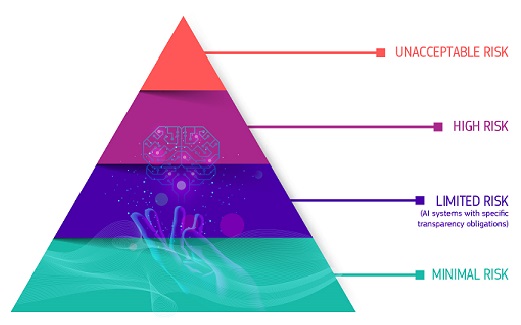
The AI Act classifies systems into four levels:
- Unacceptable risk: Banned entirely (covert psychological manipulation, discriminatory biometric categorisation).
- High risk: Subject to strict obligations (education, employment, critical infrastructure).
- Limited risk: Subject only to transparency obligations (Article 50) — most chatbots and content generation tools.
- Minimal risk: No obligations (spam filters, video games).
Step 4: Implement Transparency Mechanisms
For limited-risk systems:
- Chatbots: Add a clear notice at the start of each conversation.
- Generated content: Use C2PA (Coalition for Content Provenance and Authenticity) marks or similar standards.
- Emotion analysis systems: Add a clear policy and pre-use notice.
- Deepfakes: Add an AI-generated content label on every piece of content.
Step 5: Appoint an AI Compliance Officer
Designate a person within the company (or appoint an external consultant) responsible for:
- Tracking regulatory updates and implementation guidance.
- Coordinating compliance across teams.
- Communicating with European authorities when needed.
- Documenting the company's AI-related decisions.
Step 6: Adopt the Code of Practice
The European Commission released a voluntary Code of Practice for general-purpose AI models, signed by over 180 organisations. Compliance grants a presumption of conformity, meaning authorities will presume your company is compliant unless proven otherwise. This significantly reduces regulatory burden.
Step 7: Document Everything
Documented compliance is provable compliance. Maintain:
- System design decisions and rationale.
- Risk assessments.
- Applied disclosure policies.
- Logs of AI content detection tests.
- Periodic reviews of transparency mechanisms.
EU vs Gulf: A Comparative View
The EU AI Act is not the only framework globally, but it is the most developed. How does it compare with emerging Gulf frameworks?
Kingdom of Saudi Arabia
- Saudi Data and AI Authority (SDAIA) is the primary regulator.
- Personal Data Protection Law (PDPL) parallels the EU's GDPR and intersects with the AI Act on transparency requirements.
- National Framework for Ethics in Artificial Intelligence issued by SDAIA covers general ethical principles.
- National Data Management Office (NDMO) issues sector-specific guidelines.
Key difference: The Saudi framework is more principles-based and less detailed than the EU's, and does not yet impose fines at the same severity level. However, Saudi companies serving Europe must comply with both frameworks.
United Arab Emirates
- National AI Council sets the national strategy.
- Dubai has its own AI strategy, and Abu Dhabi has invested heavily in companies like G42 and Inception (developer of the Arabic Jais model).
- Ministry of AI issues ethical guidelines for the public sector.
- No dedicated AI law at the level of detail of the EU Act as of the date of this article.
Core Comparison
| Aspect | European Union | Saudi Arabia | UAE |
|---|---|---|---|
| Binding law | Yes, since August 2024 | PDPL for data | Not yet |
| Fines | Up to EUR 35M | Limited | Unspecified |
| Extraterritorial scope | Yes | Domestic + derivative | Unclear |
| AI content transparency | Mandatory (Article 50) | Not mandated | Not mandated |
| Application to foreigners | Yes | Unclear | Unclear |
Recommendation for Gulf Companies
Do not wait for a similar local law to be issued. Treat the EU standard as the gold standard to reduce future legal risk and ensure readiness for any upcoming Gulf regulation. Companies that comply now with EU standards will find themselves ahead of competitors when local laws are issued, and will not need to restructure their operations.
For the US context, see our analysis of the White House AI Safety Summit 2026.
Frequently Asked Questions
Does the EU AI Act apply to my Saudi company if I have no European customers?
No, if your system's outputs are consumed exclusively outside the EU and you do not target European users in any way, the Act does not apply. But beware: if your website is available in European languages, accepts payments in euros, or targets a European audience in its advertising, this may be considered targeting that subjects you to the Act. Legal consultation is essential to determine the scope.
Must I label every AI-generated image I create for marketing purposes?
Yes, if those images are directed at an audience within the EU. Article 50(4) requires machine-readable markings on all AI-generated content: images, text, audio, video. For text, the intended scope is news and editorial content on matters of public interest, not necessarily every marketing tweet. However, it is wise to disclose on all AI-generated content to reduce risk.
What about content I created before August 2, 2026?
You are not required to retroactively label content published before the general application date. The Act does not mandate back-labelling your archive. However, any new content published after August 2, 2026 must comply, even if produced by an older system.
Can a chatbot hide its nature without violating the law?
No. Article 50(1) is explicit: the user must realise they are interacting with AI, unless this is obvious from the circumstances. Designing a chatbot to deceive users into thinking they are speaking with a human is a direct violation. The only exception is academic Turing-test research with ethical approval.
Is there an official list of EU-approved systems?
There is no list of approved systems, but the voluntary Code of Practice and Harmonised Standards to be issued by the European Standardisation Organisations (CEN-CENELEC) provide a presumption of conformity. Following the official EU AI Office site is essential to track updates.
Conclusion
The start of EU AI Act enforcement on August 2, 2026 is not merely a European event. It is a global milestone reshaping how AI systems are developed and deployed. Arab and Gulf companies serving European customers, or planning to expand into the European market, have a narrow window to comply.
The core insight: transparency is no longer a commercial choice. Every AI interaction must be disclosed, and every piece of AI-generated content must be marked. Companies that ignore this law risk not just substantial financial penalties, but their reputation and customer trust in a market increasingly sensitive to digital deception.
Starting compliance now, before similar local laws are issued in the Gulf, is not only legal protection. It is a competitive advantage.
Sources:
- EU AI Act Regulatory Framework
- Commission Enforcement Press Release
- Article 99 Penalties