
France Excellence Eiffel 2027: €1,200 a month for a Master's — French universities reopen in October
Last updated: August 2026
From January 2026, the France Excellence Eiffel scholarship pays €1,200 a month at Master's level and €2,000 a month at PhD level. Those figures sit on Campus France's implementation page, and the Truescho editorial team rechecked them in August 2026. They replace the older monthly amount that still appears on some university sites that were never updated.
You cannot file a personal application with Campus France. Only a French higher education institution can submit a nomination. On 22 August 2026, Campus France's English program page still carried leftover wording that the 2026 call was open.
That cycle is finished: it opened on 1 October 2025, institutions had until 8 January 2026 inclusive, and results started from 30 March 2026. French universities such as Université de Caen Normandie (page updated 13 May 2026) say the 2027 campaign starts in early October 2026. Bordeaux INP says the previous window closed and will reopen in early October for 2027–2028. Campus France had not posted a final 2027 national calendar on its homepage at the time of this check.
If you are in Lagos, Mumbai, Manila, Nairobi, Jakarta, Karachi, or Dhaka, your job between now and October is not to refresh a Campus France student form. It is to get a French university or school to nominate you.
Source: Campus France — France Excellence Eiffel
Master's vs PhD: the numbers that decide the file
The Ministry for Europe and Foreign Affairs (MEAE) funds France Excellence Eiffel. Campus France runs the operational side. The monthly allowance, the age cap, and the maximum duration are not the same at Master's and doctoral level, so this comparison belongs at the top of any serious plan.
| Point | Master's | PhD |
|---|---|---|
| Monthly allowance from January 2026 | €1,200 | €2,000 |
| Maximum age on the official page | 29 | 35 |
| Maximum duration | Master 2: 12 months; Master 1: 24 months; engineering degree: 36 months | 12, 18, or 36 months, starting 1 September |
| 36-month doctoral rule | Not applicable | Only for new first-year candidates not already enrolled in France |
| Who submits the file | A French institution only | A French institution only |
| Funded start window | Between 1 September and 30 November; no postponement | Same window; no postponement |
| Extra language month | Maximum one month from August; the course fee is not paid | Same implementation rule |
Those euro amounts are the award. They are not a US-dollar stipend. Convert them against your own naira, rupee, peso, shilling, rupiah, or taka when you build a living budget. Do not copy a dollar figure from a blog that never cites Campus France.
Amina in Lagos targeting a Master 1 in public policy is looking at up to 24 months at €1,200. Priya in Delhi targeting a first-year PhD, with no prior enrolment in France, may be looking at 12, 18, or 36 months at €2,000 — but only if a French doctoral school actually nominates her. Hassan in Karachi who is already registered in a French PhD should not assume the 36-month track is available.
When Eiffel is worth chasing — and when it is not
Eiffel is worth the autumn scramble if all of the following are true. You will still be under the age cap. You can name a specific French Master's, engineering, or PhD program that a public institution can defend. You can live with a September–November start. You accept that a French campus, not you, controls the send button.
It is a poor use of September if you want a January intake, need the scholarship to pay a private program that sits outside the national-diploma exemption, or plan to bring a spouse on the same award. The official implementation page does not treat accompanying family as a covered benefit.
It is also the wrong first move if you have not yet chosen a host. Eiffel is not a central application portal. It is a nomination attached to a French file. Students who treat it like Chevening — a personal online form with a public deadline — waste the weeks when international offices are still willing to read a cold email.
If you are still comparing France with other funded routes, keep a parallel shortlist on Truescho's opportunities board. Search is free. Use it to park Gulf and UK calls while you work the French nomination path, not as a substitute for writing to a campus.
What the stipend covers — and what it leaves on your invoice
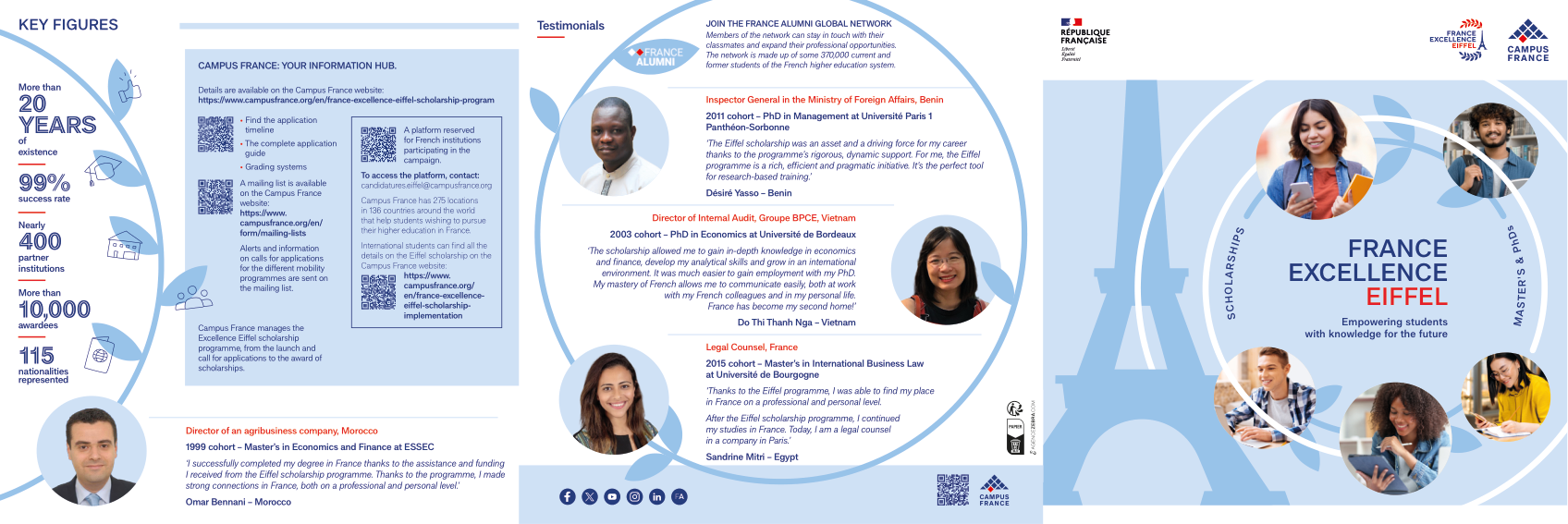
Campus France's December 2025 Master's brochure is the cleanest public snapshot of how the program presents itself to institutions. Read it as a cover sheet, then go back to the implementation page for cash rules.
Source: Campus France — France Excellence Eiffel
| Item | Paid / arranged? | Official limit |
|---|---|---|
| Monthly living allowance | Yes | €1,200 (Master's) or €2,000 (PhD) from January 2026 |
| National diploma tuition in eligible public institutions | Yes, as an exemption | National Master's/PhD diploma or accredited engineering degree in public scientific, cultural, or professional institutions under the higher-education ministry (article R719-49) |
| Other tuition | No | Fees outside that rule are not covered |
| International travel | Partial | Cheapest-class ticket; reimbursement up to 50% of the ministry ceiling |
| Travel inside France | Partial | Second-class train or bus |
| Intensive French course | No (fee) | Scholarship may extend one month from August; the course itself is not funded |
| Housing | Indirect | CROUS offer, a private option via Campus France, or you arrange it yourself |
| Health cover | Yes, with a deadline | Temporary Campus France registration, then mandatory free student social security, then free complementary cover |
| First payment before you start in France | No | You must have started studies in France |
| Accompanying family | Not listed as a benefit | Do not budget the award as a family package |
Two details from the implementation page catch people after the celebration email. First, social-security registration is not optional theatre. You register temporarily through Campus France, then complete the free student scheme at the official foreign-student social-security portal, then take the free complementary cover. If you cannot prove registration within two months, payment can stop in the third month.
Second, the first transfer usually moves through Western Union and then a French bank account in the beneficiary's name. No French start date means no first payment. Andi in Jakarta who delays arrival past the 1 September–30 November window does not get a personal postponement. The program states that the funded start date is not deferred.
Use this as a budget frame, not as a promise that "everything is free." Airfare is capped. Language school is extra. A non-national degree at a private school can still send a tuition bill. If you need a wider France cost picture, read the destination notes in study in France 2026 and then return to the Eiffel rules — the destination article will not override Campus France.
How the application actually works
Campus France's English page is blunt: only applications submitted by French higher education institutions are accepted. The student-facing page for interested applicants exists so you can learn the rules. It is not an upload portal for your PDF.
Source: Campus France — France Excellence Eiffel
The operational map looks like this.
- You identify a French university, grande école, or doctoral school that runs the exact program you want.
- You contact that institution's international office, Master's director, or PhD supervisor and ask whether they will nominate you for France Excellence Eiffel 2027.
- You meet their internal deadline — often weeks earlier than anything Campus France later publishes for institutions.
- The institution prepares the file and sends it to Campus France. The institutional mailbox on the official materials is [email protected].
- Campus France processes files submitted by institutions, not by students. The agency's listed address is 28 rue de la Grange-aux-Belles, 75010 Paris.
Fatima in Nairobi who emails that Paris address with a CV will not open a student file. The mailbox is for institutions. Your email belongs on a university domain in Lyon, Toulouse, Rennes, or Lille.
The same logic applies if a well-meaning relative in France offers to "drop the papers at Campus France." Campus France is not a walk-in counter for individual Eiffel files. The French host has to own the nomination.
For PhD candidates, the host relationship is even tighter. A laboratory that has never heard of you will not spend December assembling an Eiffel dossier. Start with a supervisor conversation in September, not a generic scholarship inbox.
August and September 2026: the weeks before universities reopen
Université de Caen Normandie stated on 13 May 2026 that the 2027 campaign starts in early October 2026. Bordeaux INP points to the same early-October rhythm for 2027–2028. That is university-side intelligence, not a substitute for the missing national calendar. Treat early October as the likely institutional reopen, and use August and September to become an easy yes.
| Window | Do this | Do not do this |
|---|---|---|
| August 2026 | Shortlist programs; confirm you are under the age cap; gather transcripts and a one-page research or study statement | Email Campus France as an individual |
| September 2026 | Write to international offices and supervisors; ask for the internal Eiffel deadline | Wait for the Campus France homepage to flip to "2027 is open" |
| Early October 2026 | Stay in the university process as nomination windows typically reopen | Treat a national January date as your deadline |
| Institution filing (2026 precedent) | Let the host send the file. In the last cycle, institutions had until 8 January 2026 inclusive | Upload a parallel personal application |
| After a nomination | Watch the host's instructions on insurance, housing, and start dates | Plan a delayed start; postponement is not allowed |
Nusrat in Dhaka who waits for a glossy 2027 banner on the Campus France homepage will enter October with no host. Rahul in Mumbai who spends September collecting two Master's shortlists and one named contact in each international office will have something to send the week the window reopens.
A practical September week looks like this. Monday: ten programs, not forty. Tuesday: one email per program, named person if you can find one. Wednesday: follow the faculty pages for any "Eiffel 2027" note, the way Caen and Bordeaux INP already published timing. Thursday: chase the two replies. Friday: refine the study statement against the program that actually answered.
Do not build your calendar around the stale 2026 "call is open" sentence that was still visible in August 2026. Build it around university pages dated 2026 and around a host who will still be in the office in January.
University deadline vs Campus France's January deadline
This is the error that quietly kills strong files.
In the 2026 cycle, 8 January 2026 was the last day for institutions to get files to Campus France. It was not a student deadline. A Master's director in Grenoble cannot invent a dossier on 7 January because you emailed on 6 January from Manila.
Each French host sets an internal cut-off so staff can rank candidates, translate or check documents, and meet the national receipt date. That internal date can sit in November or December. Some schools close even earlier if a faculty committee meets once.
When Campus France eventually publishes a 2027 institutional deadline, copy it into your notes as the host's problem. Your problem is the earlier date the international office gives you in October. If they cannot name a date yet, ask what they used last year and work two weeks earlier.
Results in the 2026 cycle came from 30 March 2026. Do not treat that March date as a confirmed 2027 results day until Campus France says so. Do treat it as a reminder that Eiffel is a spring decision for an autumn start, with no official postponement of the 1 September–30 November window.
What to send a French university in one email
Keep the first message short enough that a busy officer in an international relations office will finish it. Attach a CV and transcripts. Do not attach a 20-page thesis.
Use a subject line the office can search later: Eiffel 2027 nomination — [exact program name] — [your name], [country].
In the body, cover only what they need to decide whether you are nominable:
- The exact Master's year (M1 or M2), engineering degree, or PhD you want, with the French title if you have it.
- Your age and nationality.
- That you understand the institution must submit the file to Campus France.
- Your intended start between 1 September and 30 November 2027, with a clear statement that you can take that window.
- One paragraph on academic fit: previous degree, grade scale explained in plain English, and a research or professional aim that matches the program.
- A direct question: What is your internal deadline for Eiffel 2027 nominations?
- A second question for PhD applicants already connected to France: whether the 36-month track is even on the table, given the first-year / not-previously-enrolled rule.
Miguel in Manila applying for an engineering degree should say "engineering degree, 36-month maximum on the official grid," not "fully funded PhD." Wrong level in the first sentence makes the rest of the email look copied.
If nobody answers in ten days, send one reminder to the same address and a second note to the program director listed on the faculty page. Then move to the next school. Five real conversations beat twenty identical mail-merges.
Once a host engages, follow their document list. Do not invent extra certificates because a forum said Eiffel "always" wants them. The nomination is the university's product.
If English-taught programs matter more to you than a French-track Master's, keep a backup list of scholarships that do not require IELTS and still work the Eiffel nomination. France Excellence Eiffel is not an English-test waiver by itself; it is a French institutional award with a living stipend.
Questions to settle before you email a host
Can I apply for the Eiffel scholarship as an individual on Campus France?
No. Campus France states that only applications submitted by French higher education institutions are accepted. You contact a French university, school, or doctoral school and ask to be nominated. The institutional mailbox is for hosts, not for student self-applications. A personal email to Paris does not open a file.
How much is the Eiffel monthly allowance from January 2026?
Campus France's implementation page lists €1,200 a month for Master's level and €2,000 a month for PhD level from January 2026. Ignore leftover older euro figures on un-updated university pages. The award is paid in euros after you have started studying in France, usually via Western Union and then a French account in your name.
When does the 2027 Eiffel campaign actually open for students?
There is no student portal that "opens" in the Chevening sense. Université de Caen Normandie (updated 13 May 2026) says the 2027 campaign starts in early October 2026; Bordeaux INP also points to early October. Campus France had not published a final 2027 national calendar on its homepage as of 22 August 2026. Write to hosts in September.
Does Eiffel cover tuition, flights, and French language courses?
National diploma fees can be exempted in eligible public institutions under article R719-49. International travel is a cheapest-class ticket with reimbursement up to 50% of the ministry ceiling. An intensive French course is not paid; the scholarship may add at most one month from August. Private or non-national fees can remain your bill.
What is the difference between a university's internal deadline and Campus France's January deadline?
In the 2026 cycle, 8 January 2026 inclusive was the last day for institutions to deliver files. Students must beat the host's earlier internal date so staff can build the nomination. Missing the university date means your file never reaches Campus France, even if the national clock still has days left. Ask for that internal date in your first email.
Can a PhD student already enrolled in France get the 36-month Eiffel award?
Official PhD duration is 12, 18, or 36 months from 1 September. The 36-month award is only for new first-year candidates not previously enrolled in France. If you are already in a French doctorate, do not assume 36 months. A host may still nominate a shorter length if you meet the other published rules, including the age cap of 35.
Mistakes that waste an autumn
The first mistake is applying "directly to Campus France." The official sentence is the opposite of that plan. The second is waiting for Campus France to announce 2027 while French international offices are already collecting names in the autumn. The third is assuming the scholarship pays a French language school. It can stretch the stipend by one August month; it does not settle the school invoice.
The fourth is recycling the pre-2026 monthly figure. From January 2026 the published Master's rate is €1,200, not the older amount still sitting on neglected faculty pages. Quote the implementation page or you look careless to the officer who has the brochure on her desk.
The fifth is treating 8 January as a personal deadline. That date, in 2026, belonged to institutions. The sixth is planning a January arrival. Funded study starts between 1 September and 30 November, with no postponement of the start date.
The seventh is silence on insurance. If social-security proof is missing for two months, the third month's payment can stop. Put etudiant-etranger.ameli.fr on your arrival checklist the day you land, not the week you run out of cash.
Housing, insurance, and the first euro you actually receive
Campus France may offer CROUS housing or a private option. You can also refuse both and find a room yourself. None of those paths is automatic because you saw "Eiffel" in a subject line. Answer housing emails. A CROUS offer that expires while you are still comparing neighborhoods is not a Campus France problem.
Insurance is sequential. Temporary registration through Campus France comes first. Mandatory student social security is free for eligible international students through the official foreign-student portal. Complementary cover is also described as free on the implementation page. The penalty for delay is practical: the stipend can halt in month three.
The first payment is designed for someone who has already begun in France. If your flight is in late November, do not expect an October Western Union payout "to help you pack." Align cash for the first weeks with family support or savings, then let the official channel take over once you have started.
After the degree, France Alumni is the public network Campus France points former students toward. It is not part of the selection vote. Do not mention Alumni membership as if it were an eligibility trick.
If you are weighing Eiffel against a UK government award, read the live Chevening timing in Chevening 2027. If a Gulf state scholarship is the other column in your spreadsheet, use the Gulf fully funded scholarships 2027 briefing. Different sponsors, different portals, different "who clicks submit" rules.
Your next step
Open a single note titled "Eiffel 2027 host list." Put five French programs in it, your age, and the €1,200 / €2,000 split so you never quote the old monthly figure. This week, send the short nomination email to two international offices. In September, ask each of them for the internal deadline. In early October, stay on those threads instead of refreshing the Campus France homepage for a 2027 banner that was not there on 22 August 2026.
Keep Truescho open in another tab for France context, visa-adjacent reading, and a searchable board of other funded calls. Use the official pages below as the only numbers that matter. A French university still has to want you on paper before Campus France will ever see your name.
Sources
- France Excellence Eiffel scholarship program — Campus France
- France Excellence Eiffel implementation — Campus France
- Eiffel Master's brochure (December 2025 PDF)
- Eiffel PhD brochure (December 2025 PDF)
- Student social security registration for international students