
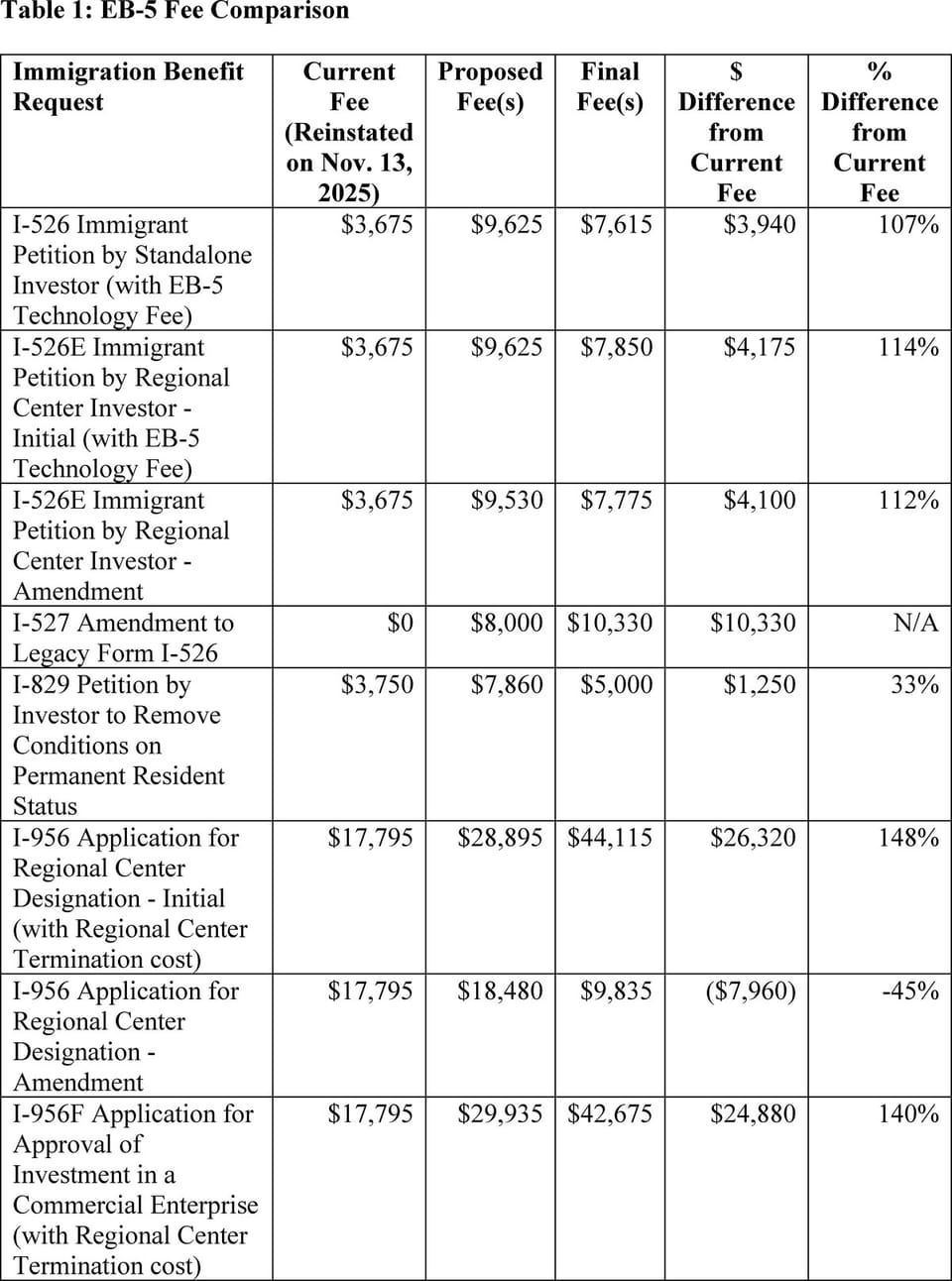
EB-5 Fees More Than Double From November 30, 2026: Every New Cost for Investor Green Card Seekers
Last updated: October 2026
The fee for Form I-526E, the petition behind most new EB-5 investor green card applications, rises 114 percent on November 30, 2026 — from $3,675 to $7,850. Nearly every EB-5 filing fee climbs, a new $10,330 form arrives for pre-2022 investors, Integrity Fund dues rise, and two regional-center fees actually fall. Petitions postmarked before November 30 lock in the old fees.
The figures come from the final rule at 91 FR 61940, published in the Federal Register on September 30, 2026 and effective November 30, 2026. USCIS confirmed the change in a September 29, 2026 alert titled "USCIS Adjusts EB-5 Fees to Cover Program Costs and Strengthen Integrity Measures."
For investors, the practical questions are narrower than the rule's dozens of pages: what do I pay if I file before November 30, what do I pay after, and which of these line items applies to me at all? The complete schedule below answers that directly from the rule itself, followed by the filing-window arithmetic, the new form nobody saw coming, and the unusual legal history that explains why the "old" fee was $3,675 in the first place.
The complete fee table: every EB-5 form, old fee, new fee, and percentage change
The I-526E is the headline, but the rule touches ten separate line items, and two of them moved down. Here is the full schedule as published in Table 1 of the final rule.
Source: Federal Register
| Form | What it covers | Fee before Nov 30, 2026 | Fee from Nov 30, 2026 | Change |
|---|---|---|---|---|
| I-526 | Standalone investor petition (pre-2022 program) | $3,675 | $7,615 | +107% |
| I-526E | Initial petition, regional center investors | $3,675 | $7,850 | +114% |
| I-526E amendment | Amended petition, regional center investors | $3,835 | $7,775 | +103% |
| I-829 | Petition by entrepreneur to remove conditions | $3,750 | $5,000 | +33% |
| I-956 | Application for regional center designation | $17,795 | $44,115 | +148% |
| I-956F | Regional center-specific project application | $17,795 | $42,675 | +140% |
| I-956 amendment | Amendment to a designated regional center | $17,795 | $9,835 | -45% |
| I-956G | Regional center annual statement | $3,035 | $2,165 | -29% |
| I-527 | New petition for legacy investors after regional center termination | No prior form | $10,330 | New form |
| EB-5 program fee | Collected with the initial I-526 or I-526E | None | $75 | New fee |
Three details are easy to miss. First, the weighted average increase across the forms is about 70.7 percent, roughly $2,946 per filing: the I-526E's 114 percent is the steepest investor-facing jump, while the I-956's 148 percent is the steepest overall and lands on regional center operators rather than investors. Second, the I-829 — which every successful investor files to remove the conditions on permanent residence — rises the most gently at 33 percent, but because it is filed years after the initial petition, anyone filing an I-829 after November 30, 2026 pays $5,000 no matter when their original petition went in. Third, the $75 program fee exists only under this rule, so a filing postmarked before the effective date avoids it entirely.
The agency's justification is cost recovery. USCIS puts the EB-5 program's operating cost at about $105.0 million against expected fee revenue of $56.6 million, a $48.4 million gap that this schedule is designed to close, based on a reference volume of roughly 16,600 EB-5-related filings per year. Whether that arithmetic holds at the new prices — higher fees historically dampen filing volumes — is a question the rule itself acknowledges only indirectly.
The two fees that went down
Amid the increases, two regional center line items were cut, and both matter for program economics. The I-956 amendment, the filing a designated regional center uses to change its structure, ownership, or territory, drops from $17,795 to $9,835 — a 45 percent reduction that removes a real disincentive. Under the old schedule, a center making routine corporate changes weighed a filing costing almost as much as its original designation application.
The I-956G annual statement falls from $3,035 to $2,165, a 29 percent cut. Since every designated regional center must file the I-956G each year to stay in good standing, this is the one line in the rule that recurs annually for operators, and the reduction partially offsets the headline increases on the designation and project applications.
The pattern is deliberate: the rule raises the cost of entering the program sharply (I-956 at $44,115, I-956F at $42,675) while lowering the cost of staying compliant once in it. For investors evaluating regional centers, that structure favors established operators with clean compliance records over newly formed entities — a useful screening signal when choosing where to invest $800,000.
The Integrity Fund rises, and the penalty calendar is unforgiving
Separate from the filing fees, the EB-5 Integrity Fund — the annual levy created by the 2022 Reform and Integrity Act to fund program oversight — increases across all three payer categories, as set out in Table 2 of the rule.
Source: Federal Register
| Payer | Annual fee before | Annual fee from the new rule |
|---|---|---|
| Each EB-5 investor | $1,000 | $1,100 |
| Regional center with 20 or fewer investors | $10,000 | $11,000 |
| Regional center with more than 20 investors | $20,000 | $22,000 |
The Fund operates on a fixed calendar: payment is due by October 1 each year. The penalty schedule for late payment is escalating and mechanical — an additional 10 percent in November, an additional 20 percent in December, and termination of the regional center's designation if the obligation remains unpaid after December 30. For investors, a regional center that misses Integrity Fund payments is a regional center whose designation is at risk, which in turn puts affiliated petitions at risk. It is a due-diligence question worth asking directly: ask to see the current fiscal year's Fund confirmation before wiring capital.
There is a sequencing quirk in 2026: the Fund deadline of October 1 arrives nearly two months before the fee rule's November 30 effective date, so this cycle's payments were made under the prior amounts, and the higher figures apply from the following annual cycle.
The November 30 window: what filing early actually saves
Because the rule keys off the postmark date — a submission postmarked after November 30, 2026 pays the new fees — there is a hard, quantifiable window. For a principal applicant filing an I-526E, the arithmetic is straightforward.
| Cost item | File before Nov 30, 2026 | File on or after Nov 30, 2026 | Saving from early filing |
|---|---|---|---|
| I-526E petition fee | $3,675 | $7,850 | $4,175 |
| EB-5 program fee | $0 | $75 | $75 |
| Total per principal applicant | $3,675 | $7,925 | $4,250 |
Four thousand two hundred and fifty dollars is real money, but keep it in proportion: on a total commitment that starts at $800,000 of capital plus legal fees, the saving is about half of one percent. The window matters most for filers whose documents are genuinely ready — pushing an incomplete source-of-funds file out the door to beat a deadline creates rejection risk that dwarfs the fee delta. What the window does not do is change the investment floor, which the rule leaves untouched: $800,000 for projects in a targeted employment area or qualifying infrastructure, and $1,050,000 for all others.
For investors budgeting in other currencies, the delta is the same $4,175 regardless of where you bank. Indian applicants, the largest single cohort of EB-5 filers outside China, will see the new $7,850 petition fee alone convert to roughly ₹69.7 lakh at late-2026 exchange rates — a number that has already drawn attention in Indian business coverage of the rule. Family members each carry their own adjustment or consular processing costs on top, which is why total household budgets should be built with counsel rather than from any single table, ours included.
If your source-of-funds documentation is close to ready, a specialist review before you commit to a filing date usually costs a small fraction of the $4,250 at stake, and Truescho's consultant directory lists immigration advisors who handle EB-5 filings week in and week out.
Form I-527: the $10,330 question legacy investors are asking
Buried in the fee schedule is something no predecessor rule contained: a brand-new petition type. Form I-527, priced at $10,330, is the vehicle for investors with legacy I-526 petitions — those filed under the pre-2022 program — whose regional center has been terminated. Until now, such investors occupied a procedural gray zone: their petitions survived on paper, but moving their investment to a compliant project meant improvised requests with no dedicated form and no defined fee.
The proposed rule had floated this filing at $8,000; the final rule sets it at $10,330, roughly 29 percent above the proposal. For the population it affects — investors who filed years ago, in many cases while the old program's litigation and lapses played out — it is simultaneously good news and expensive news. Good, because a defined pathway beats procedural limbo; expensive, because it adds a five-figure government fee to journeys that have already stretched across years.
If you are a pre-RIA investor with a pending I-526 and your regional center has been terminated, this is the line item to raise with your attorney before the end of the year. The form's arrival also sends a signal to new filers: the agency is building out infrastructure for legacy cases, which reduces one category of tail risk when selecting a regional center with a long operating history.
How we got here: from the 2022 reform to Moody v. Noem to this final rule
The $3,675 baseline itself has a story, and understanding it matters for anyone wondering whether this increase can be reversed in court. The EB-5 fee landscape has shifted three times in four years.

Source: Federal Register
| Date | Event | Effect on what investors pay |
|---|---|---|
| March 2022 | The EB-5 Reform and Integrity Act reauthorizes the program | Creates the I-526E, the I-956 form family, and the Integrity Fund |
| April 2024 | USCIS publishes a broad fee schedule | The I-526E fee is set at $11,160 |
| November 12, 2025 | A court order in Moody v. Noem enjoins the 2024 fee rule | Fees revert to pre-2024 levels; the I-526E returns to $3,675 |
| September 29, 2026 | USCIS publishes its alert | The agency announces the adjusted EB-5 fee schedule |
| September 30, 2026 | The final rule is published at 91 FR 61940 | The new schedule is fixed and dated |
| November 30, 2026 | Effective date | Filings postmarked after this date pay the new fees |
| October 1, annually | Integrity Fund payment deadline | Escalating penalties follow in November and December |
That November 2025 order is why the "old" fee in every table above is $3,675 rather than $11,160. The April 2024 rule had more than tripled the main petition fee; the Moody v. Noem order enjoined those fees and restored the pre-2024 schedule, and for nearly a year investors filed at the restored rates. The 2026 final rule was built on that reverted baseline, which is precisely why the percentage increases look so dramatic: the comparison point is the discounted 2016-era fee, not the enjoined 2024 one.
Could this rule be challenged the same way? Major law firms were flagging the change within a day — one widely circulated alert from Fragomen was titled simply "USCIS Final Rule Increases EB-5 Fees Effective November 30" — but no one can promise litigation outcomes, and no challenge had been announced as of early October 2026. The rational planning assumption is that the November 30 date holds: if a filing is ready, waiting for a hypothetical injunction is a bet, not a strategy.
How the new totals compare with other investor routes
Set against the alternatives, the fee increase barely moves EB-5's relative position. The program's total stack for a TEA investor filing after November 30 — $800,000 of capital, $7,925 in petition fees, $1,100 and up in annual Integrity Fund dues, plus counsel — remains in the same bracket it occupied before the rule. The much-publicized Gold Card concept pitched by the Trump administration at $5 million, without any job-creation requirement, remains a proposal rather than a program with forms, regulations, and a processing history, which is a meaningful distinction for anyone actually writing checks this year.
The genuine alternatives are outside the United States, and they are worth pricing honestly. The UAE has broadened its long-residence categories, and the current UAE Golden Visa rules for 2026 offer residency at capital thresholds that compete for the same Gulf-based wealth that once defaulted to EB-5. New Zealand's active investor visa rules for 2026 take a weighted-investment approach with lower government fees but stricter residency expectations. For families comparing English-speaking destinations end to end, the full cost stack of immigrating to Canada in 2026 typically runs far below US investor routes, with slower certainty in exchange. And for investors whose priority is regional mobility rather than a single passport, the GCC unified visa changes the calculus for basing a family in the Gulf while investments sit elsewhere.
Two after-arrival notes that filers routinely forget. Once residence is secured, US tax obligations follow worldwide income, and non-resident investors often need to sort how the ITIN taxpayer number works for non-residents well before the first filing season. And for those comparing service providers rather than destinations, it helps to review the leading online visa-service platforms alongside, not instead of, licensed immigration counsel; some firms now run practices built specifically around investor-visa consulting, and their track records with source-of-funds documentation are what you are actually buying.
Frequently asked questions
How much does the EB-5 visa cost in total after the 2026 fee increase?
For a principal applicant investing $800,000 in a targeted employment area, government costs from November 30, 2026 run to roughly $809,000: the $800,000 capital, $7,850 for the I-526E, the new $75 program fee, and $1,100 in annual Integrity Fund dues. Legal, translation, and regional center administration fees are additional, and family members file separately.
What is the new I-526E filing fee?
The initial I-526E petition fee rises from $3,675 to $7,850, a 114 percent increase, for any filing postmarked on or after November 30, 2026. An amended I-526E rises from $3,835 to $7,775. Initial petitions also carry the new $75 EB-5 program fee created by the same rule, bringing the post-November total to $7,925.
What is the minimum EB-5 investment in 2026?
The capital floor is unchanged by the fee rule: $800,000 for projects in a targeted employment area or qualifying infrastructure, and $1,050,000 for all other projects. The final rule adjusts government filing fees and Integrity Fund dues only; the investment amounts themselves were set by the 2022 statute.
Has the EB-5 fee increase been challenged in court?
An earlier round was. The April 2024 fee rule, which had set the I-526E fee at $11,160, was enjoined by a court order in Moody v. Noem on November 12, 2025, restoring pre-2024 fees — which is why the baseline was $3,675. No challenge to the 2026 rule had been announced as of early October 2026, and outcomes cannot be promised.
How much does EB-5 cost in Indian rupees?
At late-2026 exchange rates, the new $7,850 I-526E filing fee alone converts to roughly ₹69.7 lakh, before the $800,000 capital, the $75 program fee, or advisory costs. Indian business coverage of the rule has centered on that figure because it more than doubles the previous petition-stage outlay for the country's applicant pool.
Is EB-5 still worth it after the fee increase?
The fee adds $4,250 to a commitment already measured in hundreds of thousands of dollars, so the decision still turns on project quality, job-creation evidence, capital at risk, and the value of conditional permanent residence for the whole family — not on this line item. Individual worth depends on each family's goals, timeline, and professional advice.
How long does the EB-5 green card take?
There is no fixed statutory timeline. Processing depends on USCIS volumes, visa availability for your birth country, and the project's documentation. Conditional residence generally follows I-526E approval plus consular processing or adjustment of status, and the I-829 to remove conditions is filed later at the new $5,000 fee. Current processing times are published by USCIS.
What happens if my petition is postmarked after November 30, 2026?
It pays the new fees in full: $7,850 plus the $75 program fee for an initial I-526E, $7,615 for an I-526, and correspondingly more for regional center filings. The postmark date, not the receipt date, controls under the rule, so courier cut-offs and mailroom timing in the final week of November deserve explicit confirmation with your attorney.
Your November 30 action checklist
Dated, in order, and realistic about what can still be done in the weeks remaining:
- Now through mid-October 2026: Confirm your regional center's Integrity Fund standing and I-956G history, verify the project's TEA designation, and lock your counsel's filing timeline in writing.
- By the end of October 2026: Complete source-of-funds documentation, obtain required translations, and have counsel pre-check the fee amount and filing address for your specific form version.
- First two weeks of November 2026: Assemble and internally review the full petition; resolve every outstanding document request rather than filing with gaps.
- November 16-27, 2026: File deliberately — early enough in the week, and early enough in the day, that the postmark is certain. Do not plan a November 30 filing unless your courier can confirm a same-day postmark.
- November 30, 2026: Last day a postmark locks the old fees. After this date, budget $7,925 per principal I-526E applicant.
- December 2026 onward: Pre-RIA investors with terminated regional centers should ask counsel whether the new I-527 at $10,330 applies to their case, and all filers should calendar next October 1 for Integrity Fund dues.
If reading this changed your timeline, the fastest next step is a conversation: Truescho's consultants page connects you with advisors who can tell you within one review whether your file can realistically beat November 30, and the opportunities desk lists programs worth considering if the honest answer is next year.
Sources
- Federal Register — EB-5 final rule, 91 FR 61940 — the complete rule text with Table 1 (form fees) and Table 2 (Integrity Fund fees).
- USCIS alert: USCIS Adjusts EB-5 Fees to Cover Program Costs and Strengthen Integrity Measures — the agency's September 29, 2026 announcement of the fee schedule.
- USCIS newsroom — official alerts, processing updates, and program announcements.