
East Germany Would Have Lost 191,000 Jobs Without Foreign Workers, New IW Study Finds
Last updated: September 13, 2026
On September 8, 2026, the German Economic Institute (IW) in Cologne published a short study with a striking bottom line: without foreign workers, employment in Germany's eastern states would be 191,000 jobs lower today than it actually is. The figure is not a political slogan or a newspaper estimate. It is a counterfactual calculation built on Germany's social-security employment data, and it is the latest official confirmation that the German labor market — and its eastern half in particular — depends on people who move there to work, not on those who leave.
For anyone outside the European Union weighing a move to Germany, whether through the Opportunity Card, the EU Blue Card, or a credential-recognition route, this study carries a practical message. This article breaks down the numbers one by one, explains why they work in favor of skilled applicants from third countries, and identifies the exact occupations where foreigners already hold the line against Germany's eastern labor shortage.
The Official Numbers at a Glance
Before the details, here is what the German Economic Institute documented in its study, published through its iwd information service on September 8, 2026:
- 191,000 jobs: the gap between actual qualified employment in the eastern states and a scenario in which foreign worker numbers had stayed frozen at 2014 levels.
- 160,000 foreigners currently work in shortage occupations in eastern Germany: professional drivers, physicians, care workers, and restaurant staff.
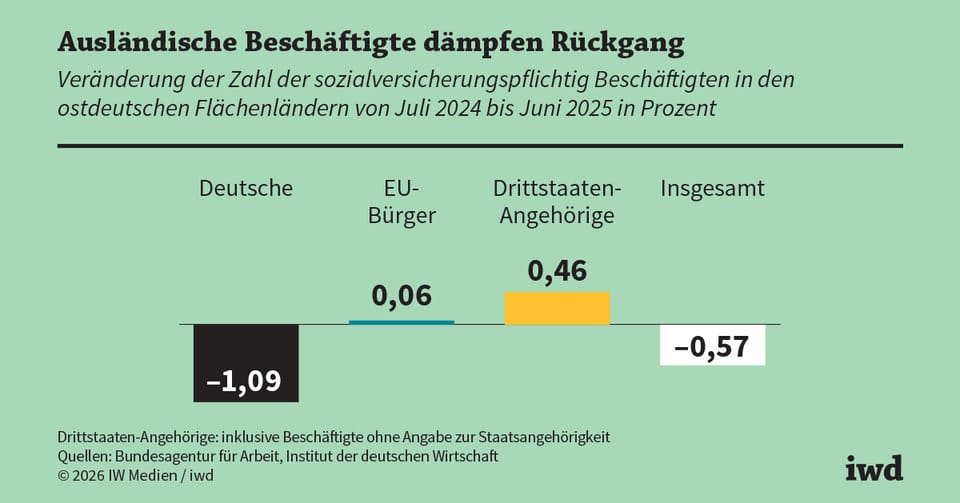
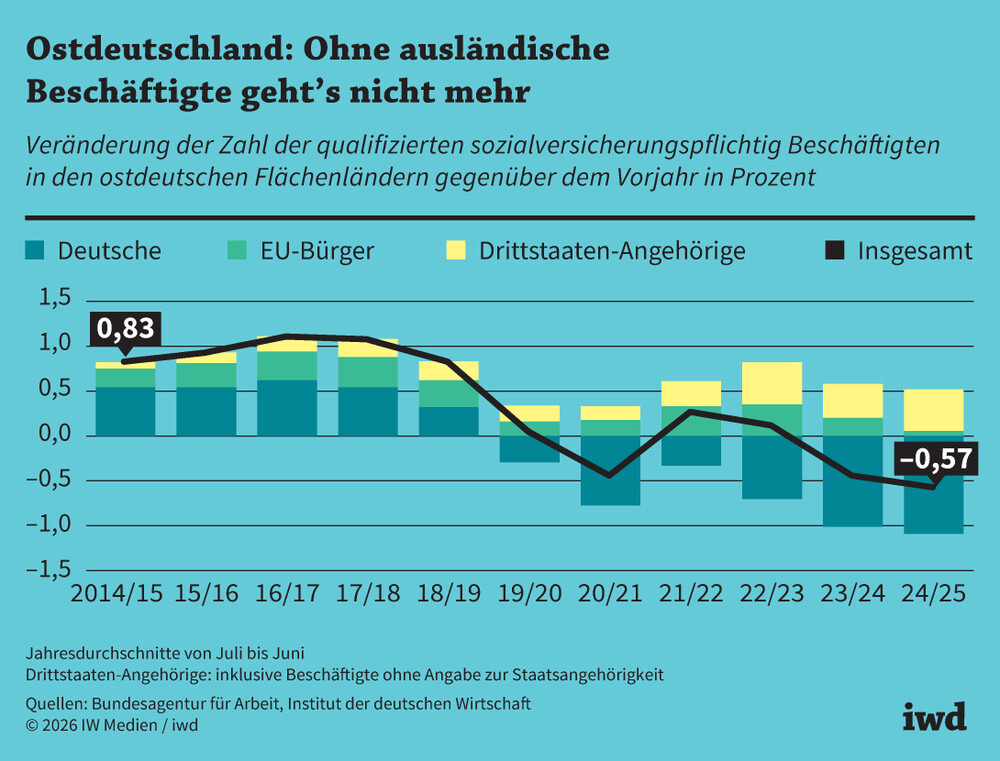
- A retirement wave among German workers in the East that has been shrinking the domestic workforce continuously since 2019 — offset only by EU and third-country nationals.
- Slowing growth: the eastern states (excluding Berlin) grew just 0.4% per year between 2020 and 2025, down from 2% per year between 2015 and 2019.
- A widening employment gap: qualified employment in the East rose only 3% above 2014/2015 levels, versus nearly 15% in western Germany.
Source: German Economic Institute (IW) — iwd article, September 8, 2026
What the Study Actually Says
The study was written by researchers Fabian Semsarha, Gero Kunath, and Lydia Malin at the German Economic Institute in Cologne and is available on the institute's official website. The team worked with socially insured employment data — regular, registered jobs, not gig work or casual arrangements — which is why its numbers carry weight in Germany's ongoing debate about skilled immigration.
The headline finding rests on a "what if" calculation: had the number of foreign workers in the eastern states remained at 2014 levels, qualified employment in those states would be 191,000 jobs smaller. In practical terms, every bit of net growth in qualified employment across the East over an entire decade exists because of immigrants — EU citizens and third-country nationals together.
The study adds a demographic detail that matters more than any single year: the number of German skilled workers in the East has been falling continuously since 2019 as a retirement wave advances, while the number of EU and third-country workers rises year after year. Older workers are leaving the labor market faster than young Germans are entering it, and only new arrivals fill the difference. This is a structural condition, not a temporary one.
At the same time, the researchers caution that the share of immigrant skilled workers in the East still sits below the national average. Translation: the door is wider than headlines suggest, especially in states such as Saxony, Thuringia, Saxony-Anhalt, Brandenburg, and Mecklenburg-Vorpommern, where shortages run deepest and competition is thinner than in Munich or Frankfurt.
Why This Matters If You Want to Work in Germany
This is not an academic exercise. If you are building a Germany employment plan from abroad, the September 2026 numbers send three clear signals.
First, the demand is structural, not seasonal. A shortage driven by retirement does not resolve with one hiring campaign. The outflow of German workers will continue for years, which means opportunities for newcomers expand over time rather than shrink.
Second, eastern Germany is the quieter opportunity zone. Most applicants picture Germany as Berlin and Munich. Yet the study counts 160,000 foreigners already working in shortage occupations across the eastern states. Living costs there are lower, and competition for both jobs and housing is measurably less fierce than in the big western metros.
Third, the shortage occupations are named, not implied. The institute lists specific categories: professional driving (trucks and transport), human medicine, nursing and care work, and restaurants. Anyone with a qualification or documented experience in one of these fields holds a genuine entry point.
For readers comparing the legal routes currently available, here is a summary table based on the latest official information:
| Occupation / sector | Status in eastern Germany | Typical applicant requirements |
|---|---|---|
| Nursing and care | Among the widest shortage gates; part of the 160,000 foreigners in shortage roles | Recognized qualification + German B1–B2 |
| Human medicine | Physician shortage explicitly documented by IW | License recognition + medical German C1 |
| Professional driving | Named outright among IW shortage occupations | Truck driving license + verified experience |
| Restaurants and hospitality | Named among occupations where foreigners already fill gaps | Practical experience + basic German |
| IT and engineering | Covered by the Blue Card route with lower salary thresholds for shortage fields | Job offer + university degree |
For the full picture on which professions qualify and how to apply, see our guides on Germany's shortage occupations in 2026 and the EU Blue Card in Germany.
The Wider Context: Germany's Public Sector Is Short 631,000 Staff
The picture extends beyond the eastern labor market. On September 9, 2026 — one day after the eastern-states study — the same institute published an analysis showing that Germany's public sector is short roughly 631,000 employees, according to the German Civil Service Federation, with acute gaps in municipal administrations, schools, and daycare centers. Per the analysis published on iwd, converting every public-sector part-time contract to full time would arithmetically equal 634,000 full-time equivalents — meaning the shortfall and the theoretical fix are almost the same size.
This context matters to job seekers for two reasons. First, staffing pressure inside government agencies — including foreigners' offices and visa-issuing authorities — can slow your paperwork, so plan for longer processing times on credential recognition and permits. Second, the repeated official calls to simplify immigration and qualification recognition, echoed explicitly in the eastern-states study, come from institutions that understand the alternative is a documented economic loss, not merely a goodwill gesture.
The Institute's Recommendations — and What They Mean for Applicants
The research team closed with three recommendations: simpler immigration and credential-recognition procedures, adequate housing for incoming workers, and an open social climate. However general they sound, they reflect a policy direction anchored in hard numbers, and they translate into realistic expectations:
- Credential recognition is the true starting line. Before applying anywhere, check how your degree is classified and get certified translations prepared early.
- German language skills remain the strongest currency. Even in the most shortage-hit trades, B1 or better multiplies your options — see our guide on working in Germany without German.
- Dual vocational training (Ausbildung) is a real alternative for those without a university degree, and it is paid from the first month — our Ausbildung salary guide for 2026 explains the numbers.
- Look beyond the famous cities. Compared with the big western metros, the eastern states offer better admission odds and cheaper housing, and the new study shows employers there already hire foreigners at scale.
Mistakes to Avoid After the September 2026 Numbers
Strong macro numbers raise expectations, but they do not rewrite the rules. The most common applicant mistakes:
- Paying unofficial intermediaries for a "guaranteed job." No official guarantee exists. Trusted channels are documented on the government portal Make it in Germany.
- Submitting incomplete recognition files and losing months to a rejection that a checklist would have prevented. Review the document list twice before sending.
- Ignoring the eastern states because they sit outside the usual international-student map, even though the official data shows the deepest shortage is exactly there.
- Relying only on English-language job boards, while a large share of eastern-Germany openings is posted in German on local platforms.
Frequently Asked Questions
Where does the 191,000 jobs figure come from?
A short study by the German Economic Institute (IW) in Cologne, published September 8, 2026 via its iwd service, written by researchers Fabian Semsarha, Gero Kunath, and Lydia Malin, based on socially insured employment data. The number represents the difference between actual qualified employment in the eastern states and a scenario in which foreign worker numbers had stayed at 2014 levels.
Does the study mean eastern Germany is opening a new immigration program?
No. It is an economic analysis, not legislation. What it does is prove with official data that demand for foreign labor in the East is structural and ongoing, and its explicit recommendation to simplify immigration and recognition strengthens the case for applicants using existing routes such as the Opportunity Card and the Blue Card.
Who benefits most from these numbers?
People with qualifications or verified experience in nursing and care, human medicine, professional driving, and restaurants — the four categories the study names as shortage occupations where 160,000 foreigners already work in eastern Germany.
Can I apply from outside Germany?
Yes. Routes like the Opportunity Card allow entry to search for work, while the Blue Card requires a job offer first. For a practical comparison, see our guide on the Germany Opportunity Card in 2026.
How does the public-sector shortage affect my application?
A 631,000-employee gap in Germany's public sector means processing pressure on the very offices that handle credential recognition and visas. Expect longer timelines and prepare complete files from the first submission to minimize delays.
The Practical Takeaway
The September 2026 study converted Germany's talking point about "needing foreign workers" into an accounting fact: 191,000 jobs in eastern Germany exist because foreign workers do. For internationally mobile professionals, the message is that demand is real, documented, and occupation-specific — and that language skills, completed credential recognition, and serious consideration of the eastern states are the three levers that actually raise admission odds. Start by browsing open programs on the Truescho platform, or let our team handle the paperwork through the Apply For Me service.