

Dubai Work Visa 2026: Complete Guide to Fees, Timeline, and New Digital Process
Last updated: July 2026
A Dubai work visa in 2026 looks very different from the paper-heavy, in-person process that defined the emirate even two years ago. The Federal Authority for Identity, Citizenship, Customs and Port Security (ICP) now requires digital-only filing for standard employment visas, the Ministry of Human Resources and Emiratisation (MOHRE) has restructured its work-permit fees into three clear skill tiers, and professionals earning AED 30,000 (roughly USD 8,170) or more per month can self-sponsor through the 10-year Golden Visa salary pathway — removing employer dependency entirely.
This guide breaks down every component an international professional, hiring manager, or HR lead needs to understand: the actual MOHRE fee structure by skill level, the end-to-end digital timeline, the mainland-versus-free-zone cost split, the medical fitness and Emirates ID stages, the Golden Visa alternative, and the common mistakes that derail applications. Every figure below is cross-referenced against official MOHRE, ICP, and Dubai Health Authority (DHA) sources current as of mid-2026.
If you are also evaluating opportunities elsewhere in the Gulf, the process differs substantially from the Saudi Work Visa 2026 and the Kuwait Work Visa 2026 tracks, and you can model net take-home pay across all three markets using the Gulf Tax-Free Salary Calculator 2026. If you are still in the job-search phase, the Gulf Relocation Package Guide 2026 breaks down what a standard employer-funded move should include
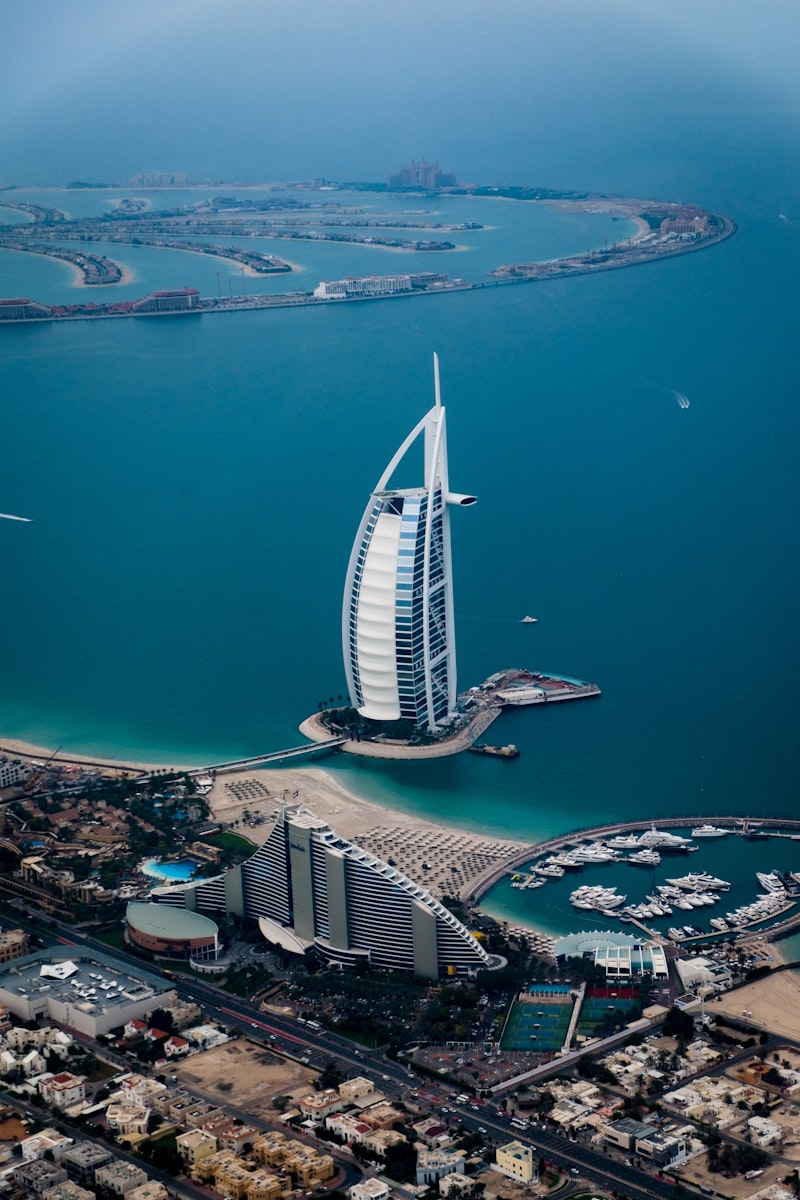
Source: Unsplash: unsplash.com

Source: Wikimedia Commons: commons.wikimedia.org
What Changed in 2026: Five Material Updates
Before diving into the step-by-step process, here are the five developments that materially reshaped the Dubai employment visa landscape this year.
1. ICP Digital-Only Filing Mandate
The ICP smart portal (icp.gov.ae) is now the single compulsory entry point for standard employment visa applications across all seven emirates. In-person visits to the General Directorate of Residency and Foreigners Affairs (GDRFA) typing centers — long a fixture of the old process — are no longer accepted for routine employment filings. Employers or their authorized PRO (public relations officer) agents upload every document through the portal, pay fees electronically, and receive entry permits and residency confirmations as digital PDFs linked to the applicant's passport number. The physical visa sticker that once occupied a passport page was retired for most nationalities in 2023 and is now entirely gone for employment residency.
2. MOHRE Work Permit Fee Restructured by Skill Tier
MOHRE no longer applies a flat work-permit charge. Instead, the 2026 schedule tiers fees according to the worker's classified skill level, creating a clear financial incentive for employers to hire higher-skilled talent:
| MOHRE Work Permit Tier | Skill Classification | Typical Roles | 2026 Fee (AED) | 2026 Fee (USD equiv.) |
|---|---|---|---|---|
| Type 1 | Low-skill | Construction labor, cleaners, drivers | AED 500 | ~USD 136 |
| Type 2 | Medium-skill | Technicians, skilled trades, junior admin | AED 1,200 | ~USD 327 |
| Type 3 | High-skill | Engineers, managers, doctors, specialists | AED 3,000 | ~USD 817 |
The tier is determined by MOHRE's classification of the job title in the signed offer letter and the attested degree on file — not by the actual salary. A company hiring a senior software engineer (Type 3) pays six times the work-permit fee it would pay for a general laborer (Type 1) on the same payroll.
3. Golden Visa Salary Pathway Expanded
Professionals who can demonstrate a monthly salary of at least AED 30,000 (approximately USD 8,170) are eligible to self-sponsor under the 10-year Golden Visa, bypassing the standard employer-sponsored two-year residency cycle entirely. The salary threshold is assessed from the most recent six months of WPS (Wage Protection System) payroll records or, for new arrivals, from the signed executive contract. This pathway matters financially: over a decade, a high earner on a standard two-year visa cycles through five renewal rounds at employer-borne costs of roughly AED 5,000–7,000 each, whereas the Golden Visa is a single upfront filing. We quantify this comparison in the cost analysis below.
4. Mandatory Health Insurance Reinforced
Dubai Health Authority (DHA) and the Department of Health – Abu Dhabi (HAAD) now enforce the mandatory employer-funded health insurance rule with automatic residency-flag triggers. If an employer lets a sponsored employee's policy lapse, the ICP system automatically blocks the renewal of that employee's residency visa at the next cycle. Employers bear the full cost, which ranges from approximately AED 1,000 (basic essentials plan, roughly USD 272) to AED 2,500 or more (mid-tier plan, roughly USD 681) per employee per year, depending on the visa category and the coverage tier the company selects.
5. 48-Hour Express Track for Pre-Registered Establishments
MOHRE's Tadbeer digital platform, fully rolled out in 2025, now auto-processes work permits within 48 hours for companies that hold a valid, pre-registered establishment file with no outstanding compliance violations. Companies that have failed WPS audits, have unresolved labor disputes, or carry expired establishment cards fall back into the standard 5-to-10-business-day queue. This means the cleanliness of the employer's compliance record now directly controls how fast a new hire can legally start work.

Source: Unsplash: unsplash.com
The Five-Phase Step-by-Step Process
The Dubai employment visa process in 2026 breaks down into five sequential phases. Each phase has discrete inputs, outputs, and timelines that you can track independently through the ICP portal.
Phase 1: Job Offer, Contract Signature, and MOHRE Quota Approval (3–7 business days)
The employer issues a formal job offer on the standard MOHRE template. This document specifies the basic salary, housing and transport allowances, job title, and working hours. The candidate signs it electronically through the MOHRE worker portal. Once both parties have signed, the employer applies for a quota approval — the government's permission to hire one expatriate worker against the company's establishment file. For clean, pre-registered companies on the 48-hour express track, quota approval can arrive in under two days.
Phase 2: Work Permit Issuance and Entry Permit (Pink Visa) (2–5 business days)
After quota approval, MOHRE issues the actual work permit (charged at the Type 1, 2, or 3 rate described above). The employer then files, through the ICP portal, for an employment entry permit — the document commonly called the "Pink Visa" because of its historical paper color. This permit is valid for 60 days from issue and allows the holder to enter the UAE once for the purpose of completing the residency process. If the candidate is already physically inside the UAE on a tourist or visit visa, the employer files for an in-country status change instead of a new entry permit. The status change costs slightly more (AED 600–750 versus AED 250–350) but avoids an exit-and-reentry trip.
Phase 3: Medical Fitness Test (1–3 business days for results)
Within 60 days of entering (or of the status change), the employee must report to a government-approved medical fitness center — run by DHA in Dubai or HAAD in Abu Dhabi — for a blood test and chest X-ray. These screen for HIV, active tuberculosis, syphilis, and Hepatitis B and C. Two service tiers are available:
- Standard service: AED 330 (approximately USD 90). Results in 2–3 business days.
- VIP/fast-track service: AED 720 (approximately USD 196). Results within 4–24 hours.
A "fit" certificate is uploaded electronically to the ICP system and is a strict prerequisite for residency issuance. A confirmed "unfit" result triggers automatic cancellation of the entry permit and a mandatory exit from the country.
Phase 4: Emirates ID Biometrics and Card Issuance (5–7 business days)
Concurrently with or immediately after the medical test, the employee visits an ICP biometrics center to submit digital fingerprints and a high-resolution photograph for the Emirates ID. The Emirates ID is the central identity document in the UAE — it serves as the primary proof of residency, the digital signature for government services, and the linked record for health insurance and bank accounts.
| Emirates ID Fee (2026) | Cost (AED) | Cost (USD equiv.) | Validity |
|---|---|---|---|
| Standard employment (2-year) | AED 270 | ~USD 74 | 2 years |
| Investor / partner visa (3-year) | AED 370 | ~USD 101 | 3 years |
The card must be applied for within 30 days of entry. The physical card typically arrives by courier within 5–7 business days of the biometrics appointment, but the digital Emirates ID is activated immediately on the ICP app once biometrics are captured.
Phase 5: Residency Stamping and Final Contract Upload (3–7 business days)
After the medical certificate clears and the Emirates ID is activated, the employer uploads the final, fully signed employment contract to the MOHRE system. ICP then processes and issues the formal residency visa, which is digitally linked to the Emirates ID rather than stamped as a physical sticker in the passport. The entire residency is now verified by scanning the Emirates ID or by checking the passport number on the ICP portal. Total elapsed time from job-offer signature to active residency, for a clean employer with complete documents, is typically 15–25 business days.
Mainland vs Free Zone: The Decision That Shapes Cost and Timeline
One of the most consequential variables in the Dubai work visa process is whether the sponsoring employer is registered in the mainland or in one of the emirate's 30-plus free zones. The distinction affects regulatory authority, permitted business activity, visa allocation flexibility, and total cost.
| Comparison Factor | Mainland (MOHRE) | Free Zone Authority |
|---|---|---|
| Regulating body | MOHRE + ICP | The specific free zone authority (e.g., DCCA, JAFZA, DMCC) |
| Work permit issuer | MOHRE | Free zone issues its own; MOHRE not involved |
| Fee structure | MOHRE tiered (Type 1/2/3) | Free zone package — often bundled into license fees |
| Business activity scope | Anywhere in the UAE | Within the free zone and internationally; mainland requires a local agent |
| Visa allocation | Based on office size and activity | Based on the license package (often 3–6 visas per package) |
| Typical processing time | 15–25 business days | 7–15 business days (free zones are generally faster) |
| Establishment card | Required via MOHRE Tadbeer | Integrated into the free zone registration |
| Corporate tax exposure | Subject to UAE 9% corporate tax (above AED 375,000 threshold) | Many free zones still offer 0% corporate tax under qualifying activity certificates |
For employees, the practical difference is speed and paperwork volume. Free zone visas tend to move faster because the authority handles both the work permit and the residency in one portal, with no MOHRE dependency. Mainland visas require coordination between MOHRE (for the work permit) and ICP (for the residency), adding 3–5 business days in typical cases. For a deeper comparative look at mainland employer obligations and cross-Gulf relocation economics, see the Gulf Tax-Free Salary Calculator 2026.
Total Cost Breakdown: What the Employer Actually Pays
Employees in the UAE never legally pay for their own employment visa. Understanding what the employer pays, however, is valuable for salary negotiation context and for evaluating whether a job offer is from a company robust enough to absorb these costs without hesitation.
Standard Mainland Employment Visa — Type 3 (High-Skill) Total
| Cost Component | AED | USD Equivalent |
|---|---|---|
| MOHRE quota approval | 200–500 | USD 54–136 |
| MOHRE Type 3 work permit | 3,000 | USD 817 |
| ICP entry permit (Pink Visa) | 250–350 | USD 68–95 |
| Medical fitness test (standard) | 330 | USD 90 |
| Emirates ID (2-year) | 270 | USD 74 |
| Health insurance (basic plan, annual) | 1,000–1,500 | USD 272–409 |
| ICP residency processing | 300–500 | USD 82–136 |
| Total employer cost (Year 1) | AED 5,350–6,450 | USD 1,458–1,758 |
For Type 1 (low-skill) roles, the MOHRE work permit drops from AED 3,000 to AED 500, bringing the Year 1 total to approximately AED 2,850–3,950 (USD 776–1,076). For Type 2 (medium-skill), the permit costs AED 1,200, producing a Year 1 total of roughly AED 3,550–4,650 (USD 968–1,267).
Free Zone Employment Visa — Typical Total
| Cost Component | AED | USD Equivalent |
|---|---|---|
| Free zone employment visa fee | 1,500–3,500 | USD 409–954 |
| Medical fitness test (standard) | 330 | USD 90 |
| Emirates ID (2-year) | 270 | USD 74 |
| Health insurance (basic plan, annual) | 1,000–1,500 | USD 272–409 |
| ICP residency processing | 300–500 | USD 82–136 |
| Total employer cost (Year 1) | AED 3,400–6,100 | USD 927–1,663 |
Free zone costs vary more widely because each authority bundles services differently. Some premium free zones (DIFC, DMCC) charge toward the upper end but include faster processing and concierge medical appointments.
Case Study: A Senior Engineer's Relocation from Lagos to Dubai
To ground these numbers in a real scenario, consider the case of Adaeze Okonkwo, a 34-year-old civil engineer from Lagos, Nigeria, who accepted a senior structural engineering role with a Dubai mainland consultancy in March 2026 at a monthly salary of AED 22,000 (approximately USD 5,990).
Before arrival. Adaeze's prospective employer issued the MOHRE-standard offer letter electronically. She signed it through the MOHRE worker app using her passport number. Because her job title — Senior Structural Engineer — is classified as Type 3 (high-skill), the company's MOHRE work permit cost was AED 3,000 (USD 817). The company also paid AED 350 (USD 95) for the ICP entry permit. The only cost Adaeze bore personally was degree attestation in Nigeria: approximately USD 180 across the Nigerian Ministry of Foreign Affairs and the UAE Embassy in Abuja, which the company reimbursed on arrival.
Entry and medical. Adaeze flew into Dubai on a company-paid ticket costing AED 2,800 (USD 763). On day 3 in the UAE, she visited a DHA-approved medical fitness center and opted for the standard AED 330 (USD 90) package. Her "fit" certificate appeared in the ICP portal 48 hours later.
Emirates ID and residency. On day 6, she completed biometrics at an ICP center. Her digital Emirates ID activated within 24 hours, and the physical card arrived by courier on day 11. The company paid AED 270 (USD 74) for the 2-year card and AED 1,400 (USD 381) for a mid-tier annual health insurance plan.
Total outcome. By day 14 from her arrival — day 24 from the initial offer signature — Adaeze held an active residency, a functional Emirates ID, bank-eligible health insurance, and a payroll-registered employment contract. Her employer's total out-of-pocket cost, excluding the flight, was approximately AED 7,650 (USD 2,084). Adaeze's personal cost was zero after reimbursement.
For professionals weighing similar moves, the Gulf Tax-Free Salary Calculator 2026 lets you model the net benefit of a UAE salary against Saudi and Kuwaiti alternatives.
Critical Mistakes That Delay or Destroy Applications
Even with a compliant employer, specific candidate-side errors can freeze the process for weeks or end it permanently.
1. Name Mismatches Between Passport and Degree
If the name on your attested university degree does not character-for-character match the name in your passport — including middle names, hyphens, and transliteration — MOFA in the UAE will reject the attestation. Resolve discrepancies with a legal affidavit and a passport-office update before beginning attestation, not after.
2. Low-Quality Document Scans
The ICP portal runs automated optical-character-recognition checks on uploaded passport pages and photographs. Blurry, cropped, or shadowed scans trigger automatic rejection without human review. Use a 300-dpi flatbed scan, not a phone photo, for every uploaded document.
3. Unrecognized Degree Institutions
The UAE Ministry of Education maintains a curated list of recognized universities worldwide. Degrees from institutions outside this list — including many fully online programs — cannot be attested for skilled-worker visa purposes. Verify your institution's recognition status on the MOE UAE website before accepting a skilled-role offer.
4. Withholding Medical History
The DHA medical fitness test includes chest X-ray scar-tissue analysis for historical tuberculosis. Attempting to suppress a known medical condition does not work and triggers a permanent residency ban. If you have a documented medical history, disclose it to the employer's PRO in advance so they can assess options before you enter the country.
5. Failing to Verify Visa Authenticity
A small but persistent scam involves fake recruitment agencies issuing forged Pink Visas. Before booking a flight, independently verify your entry permit number on the official ICP portal (icp.gov.ae) using your passport number. A legitimate permit will appear in the system. If it does not, it is not a valid document.
Golden Visa vs Standard Work Visa: The AED 15,000+ Question
For professionals earning AED 30,000 (USD 8,170) or more per month, the 10-year Golden Visa salary pathway can eliminate the employer-sponsorship cycle entirely. The comparison below models a high earner over a 10-year horizon.
| Cost / Step | Standard 2-Year Visa (renewed 5x over 10 years) | Golden Visa (10-year, self-sponsored) |
|---|---|---|
| Employer visa cost per cycle | AED 5,000–7,000 (USD 1,362–1,906) | Not applicable (self-sponsored) |
| Renewal cycles over 10 years | 5 | 0 |
| Cumulative employer visa spend | AED 25,000–35,000 (USD 6,808–9,531) | AED 0 employer cost |
| Golden Visa filing fee (one-time) | Not applicable | AED 2,800–4,000 (USD 763–1,089) |
| Medical fitness tests over 10 years | 5 (one per renewal) | 1 (at filing) |
| Residency continuity if changing jobs | Requires transfer process, possible gaps | Continuous — no employer dependency |
| Time cost of renewals | 5 cycles × 2–3 weeks each | Single filing, then no renewals for a decade |
The financial case is clear: for an employee earning above the threshold, the Golden Visa saves between AED 21,000 and AED 31,000 (USD 5,719–8,442) in cumulative employer visa costs over 10 years, plus 4–5 renewal cycles of downtime. The strategic benefit — not being tied to a single employer for residency — is often more valuable than the cash saving, particularly for senior professionals who change roles every 3–4 years.
The 48-Hour Express Track: How Compliant Free Zone Companies Bypass MOHRE Delays
The MOHRE Tadbeer platform's 48-hour express track is not available to every employer. It activates only when the sponsoring establishment file meets three conditions simultaneously:
- Active establishment card — not expired, not under review.
- Zero unresolved labor disputes — no open cases in the MOHRE dispute system.
- Clean WPS record — all payroll runs in the past 12 months completed on time and in full through the Wage Protection System.
When all three conditions are met, the work-permit portion of the visa (Phase 2 above) drops from 5–10 business days to under 48 hours. Free zone companies that maintain clean compliance records consistently hit this window, which is why free zone visas often complete end-to-end in 10–14 business days versus 18–25 for mainland employers with older compliance issues.
For founders structuring a new entity, this means that compliance hygiene at the establishment-card level is not a bureaucratic formality — it directly controls the speed at which every future hire can legally begin work.
Visa Cancellation: The 30-Day Grace Period Explained
When an employer cancels a residency visa — whether due to termination, resignation, or contract non-renewal — the employee receives a 30-day grace period from the date of cancellation to either (a) leave the UAE, (b) find a new employer and transfer sponsorship, or (c) switch to a tourist or job-seeker visa. Key rules in 2026:
- No exit required for transfer. The new employer files a status change through the ICP portal. The employee does not need to leave and re-enter the country.
- Ban rules. A six-month labor ban can apply if the employee leaves a job before completing the notice period specified in the MOHRE-registered contract, unless the employee is moving to a higher skill tier or has completed at least one full year.
- Grace period overstay fines. Overstaying beyond 30 days incurs fines of AED 100 (USD 27) per day, charged personally to the individual, not the former employer.
- End-of-service gratuity. Employees who complete one year or more of continuous service are entitled to a gratuity payment calculated as 21 days of basic salary per year for the first five years and 30 days per year thereafter, capped at two years' total salary. This is separate from the visa process but is triggered by it.
Emirates ID, ICP Portal, and MOHRE Tadbeer: The Three Digital Systems
Every 2026 employee interacts with three distinct digital platforms. Understanding what each one does prevents the confusion that delays filings.
| System | Operator | Primary Function | When You Interact |
|---|---|---|---|
| ICP Smart Portal (icp.gov.ae) | Federal Authority for ICP | Entry permits, residency visas, Emirates ID, status changes | Phases 2, 4, and 5 |
| MOHRE Tadbeer (mohre.gov.ae) | Ministry of Human Resources & Emiratisation | Work permits, quota approvals, contract registration, labor disputes | Phases 1 and 2 |
| DHA / HAAD Portal (dha.gov.ae) | Dubai Health Authority / Dept. of Health – Abu Dhabi | Medical fitness test bookings and results | Phase 3 |
The systems are interconnected — a medical "fit" result from DHA auto-populates in ICP, and a MOHRE work permit number is required to file an ICP residency application — but each has its own login, fee account, and tracking dashboard. Employees track their overall progress through the ICP app using their passport number; employers track through MOHRE's establishment dashboard using their trade license number.
Document Checklist: What to Prepare Before You Accept an Offer
Gathering documents before the process begins shortens the total timeline by 1–3 weeks for most applicants.
- Passport valid for at least six months from intended entry date, with at least two blank pages.
- Passport-size photographs on a pure white background, taken within the last six months, no glasses, neutral expression. Order at least eight prints.
- Attested university degree (for skilled roles only). The chain is: (1) issuing university, (2) Ministry of Education or equivalent in your home country, (3) Ministry of Foreign Affairs in your home country, (4) UAE Embassy in your home country, (5) MOFA inside the UAE. Each step charges a fee; total attestation cost ranges from USD 100 to USD 400 depending on country.
- Professional license (for doctors, nurses, engineers, teachers): DHA, HAAD, KHDA, or Society of Engineers registration as applicable.
- Police clearance certificate (good conduct certificate) from your home country, issued within the last six months. Required for certain regulated roles.
- Previous visa cancellation document if you have ever held a UAE residency before.
- Signed offer letter and signed final contract — both on MOHRE-standard templates.
Before assembling this packet, make sure your CV is optimized for the UAE market — the ATS CV Checker for Gulf Jobs 2026 flags formatting and keyword issues that get resumes auto-rejected by MOHRE-registered employers.
If the attestation chain feels overwhelming, professional visa consultants can handle the full legalization for a service fee of approximately USD 200–500 on top of government charges. For context on how UAE document requirements compare to Saudi Arabia's stricter attestation regime, see the Saudi Work Visa 2026 guide.
Dubai vs Riyadh vs Doha: Employer Cost Comparison
No major competitor guide currently compares employer visa costs across the three primary Gulf business hubs. The table below fills that gap using 2026 verified government fee schedules.
| Cost Component (Year 1, one high-skill employee) | Dubai (UAE) | Riyadh (Saudi Arabia) | Doha (Qatar) |
|---|---|---|---|
| Work permit / Iqama fee | AED 3,000 (USD 817) | SAR 2,000 (USD 533) | QAR 1,500 (USD 412) |
| Residency / visa stamping | AED 500 (USD 136) | SAR 1,000 (USD 267) | QAR 500 (USD 137) |
| Medical fitness test | AED 330 (USD 90) | SAR 300 (USD 80) | QAR 100 (USD 27) |
| National ID equivalent | AED 270 (USD 74) | SAR 100 (USD 27) | QAR 100 (USD 27) |
| Mandatory health insurance (annual) | AED 1,200 (USD 327) | SAR 600 (USD 160) | QAR 250 (USD 68) |
| Total Year 1 employer cost | AED 5,300 (USD 1,443) | SAR 4,000 (USD 1,066) | QAR 2,450 (USD 672) |
Dubai is the most expensive of the three for employers on a per-visa basis, but it compensates with the fastest processing times, the most flexible job-changing rules (no exit requirement for transfers), and the broadest Golden Visa pathway. Saudi Arabia has raised fees substantially under Vision 2030 reforms and now requires the employer to fund a more extensive medical and document attestation chain. Qatar remains the lowest-cost option but has narrower sector access for new entrants. For a full breakdown of the Saudi process and its attestation requirements, see the Saudi Work Visa 2026 guide, and for modeling net salary across all three markets, use the Gulf Tax-Free Salary Calculator 2026.
Visual References: Official Government Resources
Watch: The MOHRE official YouTube channel publishes step-by-step work permit tutorials.
Frequently Asked Questions
How much does a Dubai work visa cost in 2026?
The total employer cost for a standard high-skill (Type 3) mainland employment visa in 2026 is approximately AED 5,300–6,500 (USD 1,443–1,770) in Year 1, including the AED 3,000 MOHRE work permit, entry permit, medical test, Emirates ID, basic health insurance, and residency processing. For Type 1 (low-skill) roles, the total drops to roughly AED 2,850–3,950 (USD 776–1,076). Employees themselves pay nothing under UAE labor law.
Can I convert a tourist visa to a work visa in Dubai?
Yes. If you are already inside the UAE on a valid tourist or visit visa, your new employer files an in-country status change through the ICP portal. This costs the employer an additional AED 350–400 (USD 95–109) over the standard entry permit fee but eliminates the need for you to exit and re-enter the country. The status change is processed in 3–5 business days.
What is the MOHRE work permit fee structure in 2026?
MOHRE charges three tiered rates: Type 1 (low-skill) at AED 500, Type 2 (medium-skill) at AED 1,200, and Type 3 (high-skill) at AED 3,000. The tier is determined by the job title classification and the attested degree on file, not by the salary amount. These fees are paid by the employer at the work-permit issuance stage (Phase 2 of the process).
How long does the entire Dubai work visa process take?
For a compliant employer with complete, accurate documents, the full process from signed offer letter to active residency takes 15–25 business days. Free zone employers on the 48-hour express track can complete the process in 10–14 business days. Mainland employers with compliance issues (expired establishment cards, open labor disputes, or WPS gaps) face 25–35 business-day timelines.
What documents are needed for a UAE employment visa?
The core set is: a passport with at least six months validity, white-background passport photographs, an attested university degree (for skilled roles), a signed MOHRE-standard offer letter, a signed final employment contract, and a police clearance certificate for certain regulated professions. Doctors, engineers, and teachers need additional regulatory body registration (DHA, Society of Engineers, KHDA respectively).
What is the difference between mainland and free zone work visas?
Mainland visas are regulated jointly by MOHRE (work permit) and ICP (residency), follow MOHRE's tiered fee schedule, and allow the employer to conduct business anywhere in the UAE. Free zone visas are issued entirely by the free zone authority, often bundle the work permit into the license package, process faster (typically 10–14 business days), but restrict the employer's business activity to within the free zone unless a mainland agent arrangement is in place.
Who pays for the work visa — employer or employee?
Under UAE labor law, the employer pays 100% of the costs associated with recruitment, visa processing, medical testing, Emirates ID issuance, and residency stamping. The only expense an employee may incur is degree attestation in their home country, which most employers reimburse on arrival. Any request from an employer or recruiter for the employee to pay visa fees is illegal and is a strong indicator of fraud.
What is the Emirates ID processing time for new employees?
After biometrics are captured at an ICP center, the digital Emirates ID activates within 24 hours. The physical card arrives by courier within 5–7 business days. The biometrics appointment itself must be booked within 30 days of entering the UAE, and the fee is AED 270 for a 2-year employment card or AED 370 for a 3-year investor card, both paid by the employer.
Can I bring my family once I have a Dubai work visa?
Yes. Once your residency is active and your Emirates ID is issued, you can sponsor a spouse and children if your monthly salary meets the GDRFA minimum threshold (typically AED 4,000, or AED 3,000 with company-provided housing) and you hold suitable accommodation and health insurance for each dependent. Dependent visas follow a similar but separate process through the ICP portal.
What happens if I fail the medical fitness test?
If the test confirms HIV, active tuberculosis, or another listed communicable disease, you are deemed medically unfit. The entry permit is cancelled, and you must leave the UAE. There is no appeal process for these specific conditions. Non-communicable conditions (diabetes, hypertension, etc.) do not trigger a fail result.
Conclusion
The Dubai work visa process in 2026 is faster, more transparent, and more digital than at any point in the emirate's history. The ICP portal has eliminated in-person typing centers, MOHRE's tiered fee structure has made employer costs predictable, and the 48-hour express track rewards companies that maintain clean compliance records. For high-earning professionals, the Golden Visa salary pathway offers a decade of residency security without employer dependency.
The critical variables are preparation and employer quality. Candidates who arrive with pre-attested degrees, clean document scans, and accurate passport-matching names move through the system in two to three weeks. Candidates who cut corners on documentation or accept offers from non-compliant employers spend months in queues. Verify your employer's establishment status, confirm your degree is on the MOE recognition list, and never pay a fee to a recruiter for a visa that the employer is legally required to fund.
For professionals evaluating the wider Gulf, the Saudi Work Visa 2026 and Kuwait Work Visa 2026 guides cover the parallel processes, and the Gulf Tax-Free Salary Calculator 2026 lets you compare net take-home pay across all three markets before you sign.
Sources
- Ministry of Human Resources and Emiratisation (MOHRE) — mohre.gov.ae
- Federal Authority for Identity, Citizenship, Customs and Port Security (ICP) — icp.gov.ae
- UAE Government Official Portal — u.ae
- Dubai Health Authority (DHA) — dha.gov.ae
- General Directorate of Residency and Foreigners Affairs (GDRFA) Dubai — gdrfad.gov.ae
Get Started with Truescho
Whether you're forming a company, planning an investor residency, or expanding into the Gulf, Truescho brings the tools, data, and services together in one place.
Get Started →