
Saraab Explained: Dubai's Open-Source Deepfake Detector and Why It Matters Beyond the Gulf
Last updated: September 2026
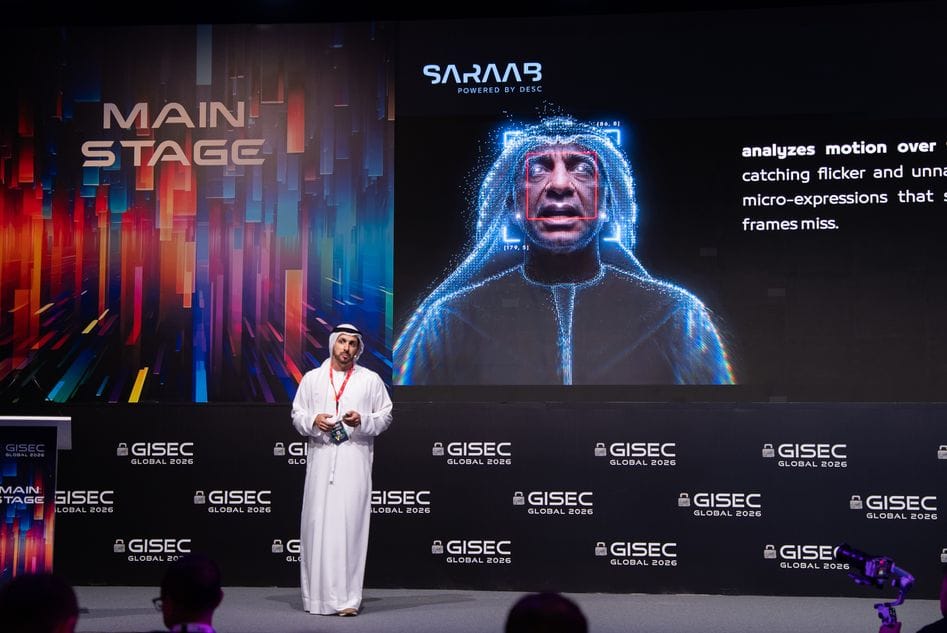
A student in Manila gets a video call from a "university admissions officer" offering a conditional seat — pay a reservation fee today to lock it in. The face moves naturally, the voice is warm, and the official letterhead in the attached PDF looks flawless. Last year, verifying that call required an expert. This month, Dubai built an alternative. On September 16, 2026, the Dubai Electronic Security Center (DESC) announced Saraab, the Arab region's first government-built deepfake detection tool — and, unusually for a government project, it's open source, with an announced 91% accuracy and a public release on Hugging Face by the end of 2026.
What Saraab actually is
Saraab is a deepfake detection system developed by the Dubai Electronic Security Center, the emirate's cybersecurity authority. It was announced at GISEC Global, the cybersecurity exhibition held at Expo City Dubai from September 16 to 18, 2026, as part of a broader package of security initiatives.
The headline distinction is the delivery model. Government detection tools usually stay inside government walls. Saraab's code will be published for developers and researchers worldwide through developer platforms including Hugging Face. That choice subjects the tool to global scrutiny, invites outside improvement, and — perhaps most importantly — gives every other government and university a reference implementation to build against rather than starting from zero.
Source: Dubai Electronic Security Center (DESC)
How the technology works
The announced numbers deserve unpacking. A 91% accuracy figure means the system correctly classifies roughly nine out of ten videos — a respectable result in a field where detectors and generators improve in lockstep, and where yesterday's state-of-the-art detector can become tomorrow's baseline.
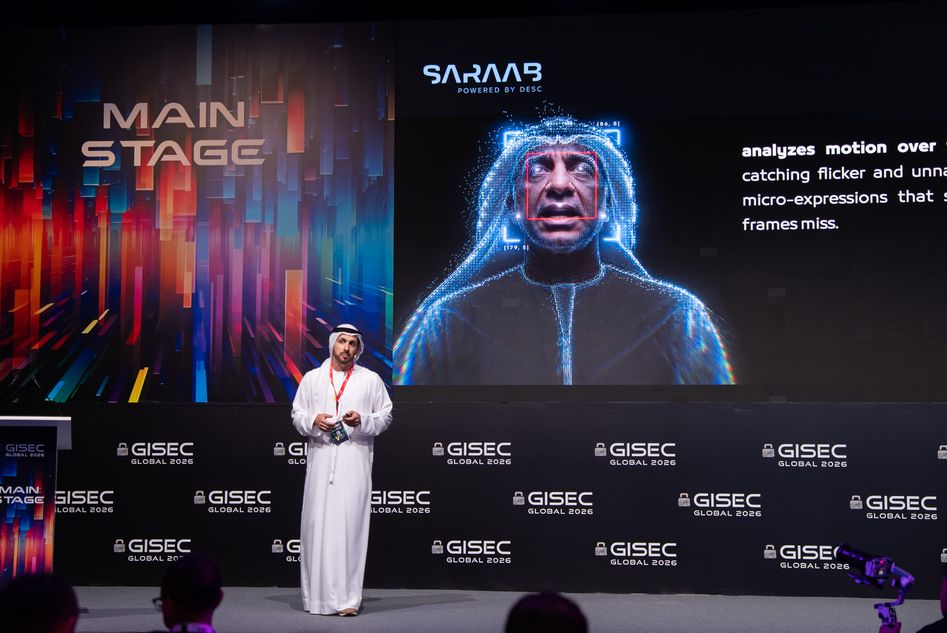
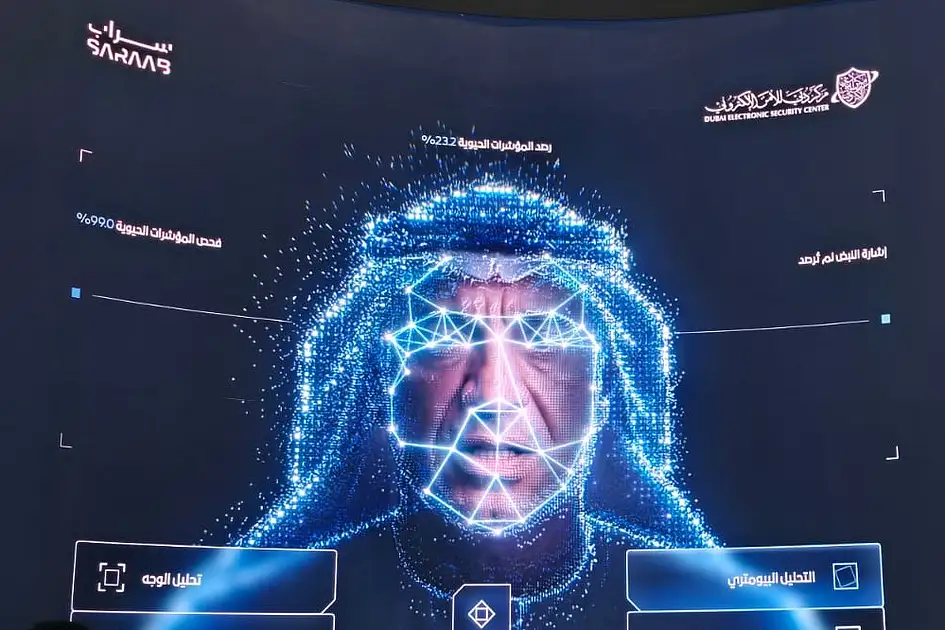
The more meaningful innovation is the output format. Instead of a binary verdict — real or fake — Saraab produces a heat map across the entire video, identifying which time segments are suspected of manipulation and the degree of suspicion in each. For investigators, that points directly to the seconds needing human review. For researchers, it reveals where manipulation lives, not merely whether it exists.
And the analysis covers the full video, frame by frame, rather than sampling selected frames. That closes a common evasion route: splicing a few fabricated seconds inside an otherwise authentic long video, one of the most prevalent manipulation techniques in circulation.
Source: Khaleej Times
How it compares with existing detection tools
| Criterion | Typical commercial detectors | Saraab |
|---|---|---|
| Developer | Private companies | Government center (DESC), Emirati team |
| Code | Mostly closed | Open source |
| Output | Usually a real/fake score | Heat map across the full video |
| Analysis scope | Sampled frames | Every frame |
| Public availability | Paid subscriptions | Hugging Face and developer platforms, end of 2026 |
| Stated accuracy | Varies, no common standard | 91%, officially stated |
For the global research community, an open, government-built model with a stated accuracy becomes a benchmark: any team anywhere can measure their own detector against it. That matters especially for regions — including much of Africa and South Asia — where deepfake fraud via video calls and fabricated "official" clips is rising faster than local verification capacity.
Why international students should care
The connection to student life is direct. Deepfake-assisted education fraud now spans fake video interviews, fabricated "admissions officers," spoofed scholarship announcements, and forged language-certification videos. The pattern repeats across countries: urgency, a fee, and a video too convincing to question. And when models themselves can fabricate official-looking figures — as OpenAI's six disclosed misalignment incidents documented the same week — independent verification tools stop being a luxury.
A student applying abroad can treat tools like Saraab as a second line of defense: when an "official" video arrives through an unofficial channel, detection software can flag manipulation before money moves. The first line of defense remains unchanged — no legitimate university collects fees through unscheduled video calls — but verification technology narrows the gap between suspicion and proof.
There's an academic angle too. With the code going public, Saraab becomes research material for anyone studying AI security — one of the fastest-growing scholarship categories of the decade, spanning trustworthy AI, cybersecurity, and digital forensics programs. Students comparing study destinations and programs will find AI-security tracks expanding at universities across the Gulf, Europe, and Asia, and a tool like this in the public domain is exactly the kind of artifact final-year projects and theses are built on.

Source: GISEC Global
The wider initiative package
Saraab arrived surrounded by supporting programs. The announcement came under the agenda of the UAE Cybersecurity Award's eighth cycle, accompanied by the Dubai Cyber Skills Framework — defining the competencies the market actually demands — and the ISR Auditor Certification Program for qualifying certified cybersecurity auditors.
Seen together, the three form a coherent strategy: an open technical tool (Saraab), a skills framework that produces people qualified to operate it, and a certification that standardizes the quality of the review. The official statements matched the ambition: Hassan Majid Alkhazraji, Senior AI Executive at the center, framed the tool within Dubai's commitment to leading trusted AI development, while CEO Yousuf Hamad Al Shaibani tied the launch to the UAE's standing in global cybersecurity indices.
The public release is scheduled for the end of 2026 via developer platforms and Hugging Face — a timeline that gives the team room to finalize documentation and licensing before the code fully opens.
Frequently asked questions
What is the Saraab deepfake detection system?
Saraab is a system from Dubai's Electronic Security Center announced on September 16, 2026, that detects AI-manipulated video with a stated 91% accuracy. It produces a heat map of suspicious segments instead of a simple real/fake verdict, and it's the Arab region's first government-built tool of its kind.
Is Saraab available to download now?
Not yet. The public release for developers and general users is expected by the end of 2026 through developer platforms and Hugging Face. What was announced in September is the system itself, unveiled at the GISEC Global summit in Dubai.
Why does a heat map matter for deepfake detection?
Instead of one verdict for an entire video, the heat map shows which seconds appear manipulated and how strongly. That directs investigators to specific moments for human review and exposes "splicing" — embedding a few fabricated seconds inside an otherwise genuine video.
Who built Saraab, and is it really open source?
An Emirati team at the Dubai Electronic Security Center (DESC). The code will be released as open source through Hugging Face by the end of 2026 per the official announcement — a decision that opens the tool to global research review and outside improvement.
How do I protect myself from deepfakes before Saraab launches?
Practical rules now: never transfer money based on a video call, however realistic; verify claims through the institution's official channel directly; watch for physical inconsistencies in lighting, eye edges, and lip-sync; and treat manufactured urgency as a fraud signal more than a genuine opportunity.
Why does an open-source government detector matter globally?
It sets a public, measurable reference point. Governments, banks, and universities in any country can benchmark against it, adapt it locally, and hold it to scrutiny — shifting deepfake defense from a handful of paid vendors toward a shared public utility.
Back to that video call
The student in the opening scenario has a simpler question after 2026: pay or not? Once Saraab is public, uploading the clip for a suspicion heat map takes minutes. But the rule that protects them today needs no software at all: no legitimate admissions office collects rush fees over an unscheduled video call. Tools evolve; sense remains the first line of defense — Saraab, when it arrives, just makes proving the fraud far easier than falling for it.
To follow what's changing in AI — and how it shapes your studies and career — Truescho brings together coverage and opportunities, and the university rankings help you choose institutions worth trusting in the first place.
Sources
- Dubai Electronic Security Center announcement via Zawya — official press statement and specifications
- Khaleej Times coverage of the Saraab launch — launch details from GISEC Global
- GISEC Global — official summit site — announcement venue and dates
- Dubai Electronic Security Center — DESC — the developing authority