
Dubai Free Zones Compared 2026: DMCC vs IFZA vs JAFZA vs Meydan
Last updated: August 2026
Nearly every Dubai free zone comparison ends with the same four names, and that is no accident: between them, DMCC, IFZA, JAFZA, and Meydan Free Zone cover the vast majority of what international founders actually come to Dubai to do. The short answer up front: DMCC for trading, commodities, and financial services; IFZA for low-cost, remote-friendly incorporation; JAFZA for logistics and manufacturing next to Jebel Ali Port; and Meydan Free Zone for flexible, central packages aimed at startups and consultants. All four sit under the same federal tax rules, offer 100% foreign ownership, and charge no personal income tax. What separates them is your business model.
That last sentence is the entire game. A free zone is not a badge to collect; it is infrastructure matched to an activity. A commodity trader and a freelance marketing consultant have completely different needs, and the zone that impresses one will irritate the other. This comparison lays out the differences zone by zone, then maps each to the business types they serve best, so your decision takes an afternoon instead of a month of contradictory forum threads.
The Comparison at a Glance
Any useful Dubai free zone comparison has to start with structure rather than price, because the price only makes sense once you know what you are buying. Read this table as a map, not a verdict: each row is developed in the sections below, and the right choice depends on which row matters most for your business.
| Factor | DMCC | IFZA | JAFZA | Meydan Free Zone |
|---|---|---|---|---|
| Best for | Trading, commodities, financial services | Cost-conscious setup, remote operation, consultants | Logistics, manufacturing, import and export | Startups, general trading, flexible packages |
| Scale signal | 25,000+ member companies per its official site | Growing remote-setup specialist | One of the largest free zones in the region | Newest of the four, launched 2021 |
| Flagship location | Uptown Tower and the DMCC business district | Flexi-desk-based Dubai presence | Adjacent to Jebel Ali Port | Meydan, central Dubai |
| Setup style | Full business-hub ecosystem | Open and operate remotely | Facility and warehouse-led | Flexible package-led |
| Visa approach | Tied to office type and package | Flexi-desk typically supports 1-3 visas | Tied to leased facilities | Flexi-desk typically supports 1-3 visas |
| Cost position | Premium | Budget-friendly | Premium industrial | Competitive |
| Official portal | dmcc.ae | ifza.com | jafza.com | meydanfreezone.ae |
The tax row is deliberately absent, because it is identical across all four: the same federal corporate tax, the same value-added tax, the same absence of personal income tax. We cover it separately below, because it changes how you should read every other row.
DMCC: The Trading Powerhouse
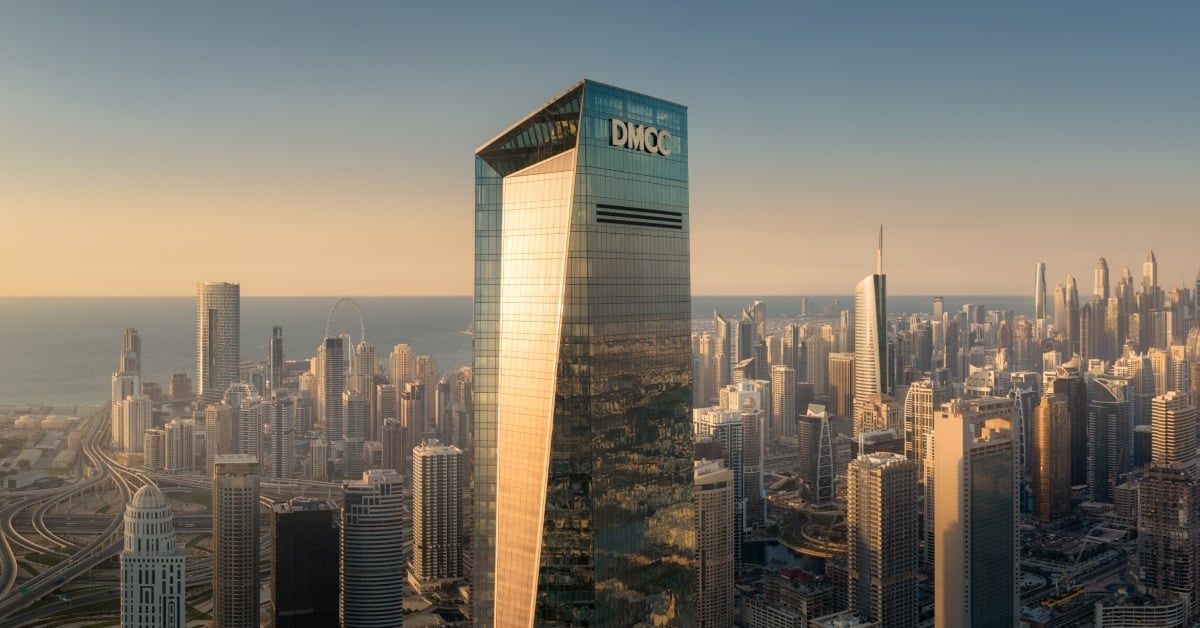
DMCC, the Dubai Multi Commodities Centre, is the heavyweight of this comparison, and it sells itself on scale. Its official materials cite more than 25,000 diverse member companies, an ecosystem spanning traders, commodity houses, and financial and professional services. For a founder whose business depends on counterparties, that density is the product: your bankers, insurers, shippers, and clients are all within the same district.
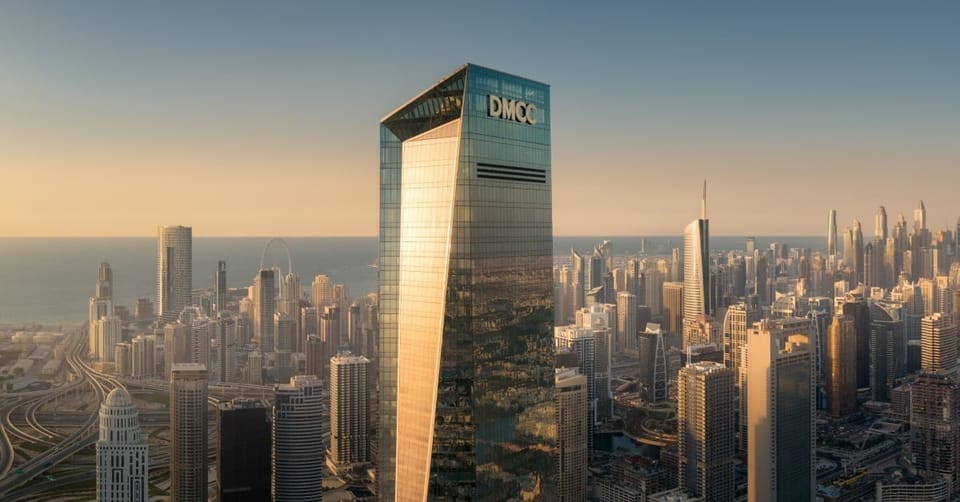
Physically, DMCC is anchored by its tower cluster, including Uptown Tower, and its recognitions include distinctions from fDi, the Financial Times division that benchmarks foreign direct investment. That pedigree translates into practical advantages: banks anywhere recognize a DMCC license instantly, and the authority's processes are mature simply because they have been exercised at scale for years.
Source: DMCC Official Website
The trade-off is cost. DMCC positions itself as a premium hub, and its pricing reflects that. If your company trades physical goods or financial instruments at meaningful volume, the premium buys credibility and infrastructure that pays for itself. If you are a solo consultant, it usually buys you more than you need. We cover the formation route in detail in our DMCC company formation guide.
IFZA: The Remote-Setup Specialist
IFZA has built its reputation on being the accessible entry point, and it does so openly: the authority's own website leads with the pitch that you can open and operate your UAE company remotely, booking a free consultation to start. That positioning tells you exactly who it serves: founders who want a legitimate UAE entity without relocating first, and small teams whose office is a laptop.
The model rests on the flexi-desk: a shared-facility arrangement that satisfies the physical-presence requirement for a license at minimal cost, typically supporting one to three residence visas depending on the package. For consultants, agencies, e-commerce operators, and holding structures, that is usually sufficient, and the savings against a tower-district setup are substantial.

Source: IFZA Official Website
What IFZA does not offer is gravity. If your business needs warehousing, port access, or the trading-ecosystem density of DMCC, a low-cost flexi-desk is the wrong instrument. But for the large class of digital businesses that simply need a stable, credible UAE vehicle with visa access, IFZA is routinely the value pick, a verdict echoed in our rundown of the cheapest UAE free zones.
JAFZA: Logistics and Manufacturing at the Port
JAFZA, the Jebel Ali Free Zone, is the industrial anchor of this comparison, and its advantage is geographic before it is anything else: it sits directly alongside Jebel Ali Port, the largest seaport in the Middle East, operated by DP World. For an importer, exporter, or manufacturer, proximity is money: the distance between your license and your containers is measured in minutes.
JAFZA is one of the largest free zones in the region, home to thousands of companies across logistics, manufacturing, and trade. Its offering is facility-led: warehouses, light-industrial units, and land for heavier operations, with visa allocations tied to the facilities a company leases. Where DMCC clusters professional services, JAFZA clusters supply chains.
Choose JAFZA when your business physically touches goods: consolidation, distribution, packaging, assembly, or manufacturing for re-export. Choose elsewhere when it does not, because industrial facilities carry industrial costs. A common pattern for trading groups is a two-entity structure: a JAFZA arm for the physical flow and a DMCC or IFZA entity for the commercial and consulting side, each matched to what it actually does.
Meydan Free Zone: The Flexible Newcomer
Meydan Free Zone is the youngest of the four, established in 2021, and it competes on flexibility and location. Set in Meydan in central Dubai, it offers package-based setup that has proven popular with startups, general trading activities, and consultants who want a Dubai address and visa access without committing to premium-district pricing.
Its competitive posture sits between IFZA and DMCC: more flexible and startup-oriented than the incumbents, with visa-supporting flexi-desk arrangements similar in structure to IFZA's, but with the pull of a central address and aggressive, founder-facing marketing. For a solo founder or small team that wants options later, its packages scale in steps rather than cliffs.
The honest caveat about any young zone is ecosystem depth. DMCC has two decades of accumulated trading gravity; JAFZA has the port; IFZA has refined remote setup into a headline feature. Meydan's case is that it delivers the essentials, flexibly and centrally, at competitive cost, which is precisely what a large share of new founders actually need.
Taxes: Identical Rules, Different Consequences
Every free zone in this comparison operates under the same federal tax framework, so the rules deserve one shared section rather than four footnotes. Since June 2023, the UAE levies a 9% federal corporate tax on business profits above AED 375,000, roughly USD 102,000 at the long-standing peg. Free zone companies are not automatically exempt from it, and assuming they are is the single most expensive planning mistake of the current era.
The exemption that does exist is conditional: income that qualifies under the Qualified Free Zone Person rules can remain taxed at 0%, provided the company meets the compliance conditions attached to that status, covering the nature of its income and how it conducts its activity. On top of this sit two constants: 5% value-added tax on most taxable supplies, and no personal income tax on salaries or drawings, the latter being the reason so many international professionals structure their lives around a UAE entity.
For choosing between our four zones, the tax system is neutral in wording but not in consequence. A JAFZA manufacturer's income profile differs from an IFZA consultant's, and each must test its own qualification status. We walk through the mechanics, thresholds, and safe-harbor conditions in our guide to free zone corporate tax and QFZP status.
Visas: How Many Do You Actually Get?
Visa allocation is where vague marketing claims meet contractual reality. The working principle across Dubai's free zones is that visas follow facilities: a flexi-desk package typically supports one to three residence visas, while leasing dedicated office space unlocks additional allocation, with the exact numbers set by each authority's current package rules.
That makes your hiring plan a zoning decision. A founder who expects to sponsor four employees within a year should not buy a single-visa flexi-desk on price alone; the upgrade path matters more than the entry price. Conversely, paying for office space you do not need to obtain visas you will not use is equally backwards.
Source: DMCC Authority official YouTube channel
The authorities' own portals publish the current visa-to-package mappings, and they change often enough that any specific figure printed in an article would age badly. Treat visa allocation as a question to ask the zone directly, in writing, at the moment you request a quote. Getting help with structuring the license and visa plan before you commit is precisely the kind of work Truescho consultants handle for founders planning a UAE move.
Which Zone Fits Your Business?
This is the section that answers the search that brought you here, because a free zone comparison only earns its keep when it ends in a decision. Match your primary activity to the zone whose strengths align with it, then sanity-check cost and visa needs.
| Your business | First choice | Why | Worth comparing |
|---|---|---|---|
| General or commodity trading | DMCC | Largest trading ecosystem, 25,000+ companies, banking familiarity | Meydan Free Zone for leaner setups |
| Import, export, warehousing, manufacturing | JAFZA | Direct adjacency to Jebel Ali Port and DP World logistics | DMCC for the trading and financing arm |
| Consulting, agency, digital services | IFZA | Lowest structure cost, strongest remote setup | Meydan Free Zone |
| Early-stage startup, solo founder | Meydan Free Zone | Flexible packages, central location, scaling in steps | IFZA |
| Holding or investment vehicle | Depends on income mix | Tax qualification planning drives the choice | IFZA or DMCC depending on activities |
Two refinements complete the picture. First, if your priority is financial-services regulation rather than Dubai itself, Abu Dhabi's financial center is a different animal entirely; see our ADGM business setup guide for that route. Second, if pure cost is the deciding factor, revisit the cheapest-zones analysis linked above before committing to any package.
Costs: Why Honest Comparisons Avoid Exact Figures
You will notice this Dubai free zone comparison deliberately refuses to print a single license price. That is not coyness; it is accuracy. Free zone pricing is modular: a license fee that varies with the number of business activities, a facility fee that varies from flexi-desk to office to warehouse, per-visa fees and deposits, and renewal costs that arrive annually and are easy to forget at incorporation time. Two founders incorporating in the same zone a week apart can pay meaningfully different totals.
What you can compare structurally is the shape of the cost curve. DMCC's curve starts higher and buys ecosystem; IFZA's starts low and stays low for digital businesses; JAFZA's is dominated by facility costs that scale with square meters; Meydan's steps up gradually with package tiers. When a formation agent quotes you a suspiciously flat number, ask what happens at renewal and what each additional visa costs; the honest answer is on the authority's own portal, and the four portals are linked in the table above.
Dubai Free Zone FAQs: Straight Answers
Which is the best free zone in Dubai for a trading company?
DMCC is generally the strongest choice. Its official materials list more than 25,000 member companies, and its ecosystem of traders, commodities firms, and financial services providers is the deepest among Dubai's zones. Trading companies that need credibility with banks and international counterparties usually start there, while budget-conscious traders often compare IFZA or Meydan Free Zone first.
DMCC vs IFZA: which is cheaper in 2026?
IFZA is typically the lower-cost option. Its model is built around flexi-desk packages and remote-friendly setup, which keeps license and facility costs down, while DMCC positions itself as a premium business hub with correspondingly higher package pricing. Exact fees change with activity count and visa needs, so confirm current numbers on both authorities' official portals before deciding.
Can I set up a Dubai free zone company remotely?
Yes, and IFZA makes this a headline feature: its own website promotes opening and operating a UAE company remotely. Other zones, including Meydan Free Zone, also support largely remote incorporation, with identity verification handled digitally. Physical presence mainly becomes necessary for banking appointments, visa stamping, or when you lease real office or warehouse space.
Do Dubai free zone companies pay the 9% corporate tax?
Generally yes, above a threshold. Since June 2023 the UAE levies a 9% federal corporate tax on profits exceeding AED 375,000, and free zone companies are not automatically exempt. However, income that qualifies under the Qualified Free Zone Person rules can remain taxed at 0%, provided the company meets the compliance conditions attached to that status.
How many visas do I get with a flexi-desk package?
Typically between one and three residence visas, depending on the zone and the package tier. A flexi-desk allocation is deliberately small because it is tied to shared facilities rather than dedicated office space. Leasing a real office usually unlocks additional visa allocation, and the exact numbers are set by each authority's current package rules.
Is JAFZA better for logistics than DMCC?
For heavy logistics, usually yes. JAFZA sits directly next to Jebel Ali Port, the largest seaport in the Middle East, operated by DP World, which shortens the distance between your license and your containers. DMCC suits companies that trade, finance, and broker; JAFZA suits businesses that import, store, manufacture, and export at scale.
What is the cheapest free zone in Dubai for consultants?
Among these four, IFZA is usually the budget pick for consulting businesses, with Meydan Free Zone close behind thanks to its flexible, startup-oriented packages. Both support flexi-desk arrangements that keep costs minimal. Consultant licenses with many activities or several visas will cost more everywhere, so the realistic cheapest option depends on your activity list.
Can a free zone company do business in mainland UAE?
Only within limits. A free zone company can sell to mainland customers, but regulated onshore commercial activity generally requires a mainland license or a structure involving a local distributor or branch. The corporate tax rules also treat qualifying and non-qualifying activity differently, so check how planned mainland revenue would affect your free zone tax position.
Our Verdict
If forced into one line: choose DMCC when you trade at scale and need the ecosystem around you, JAFZA when goods physically move through your business, IFZA when you want the leanest legitimate UAE vehicle with remote setup, and Meydan Free Zone when you want central-Dubai flexibility that scales with a young company. For the largest single group of readers, digital founders and consultants comparing all four, the practical shortlist is IFZA on cost and Meydan on location, with DMCC worth the premium the day counterparties start mattering more than fees.
Whichever way you lean, validate two things before paying anything: the current visa allocation for your package, in writing from the authority, and your corporate tax position under the QFZP conditions. If you would rather have that validated for you, Truescho consultants advise on UAE business setup and relocation, and the wider Gulf opportunity landscape is browsable on opportunities.
Official Sources
- DMCC Official Website - the authority's own materials on membership scale and setup
- IFZA Official Website - official positioning on remote company formation
- JAFZA Official Website - official information on facilities and port adjacency
- Meydan Free Zone Official Website - official packages and location details
- UAE Government Portal - federal rules on corporate tax, VAT, and business setup