

Dubai Family Office 2026: DIFC vs ADGM Costs, Asset Thresholds And Hybrid Setup
Last updated: July 2026
A UAE family office can be a powerful structure for a globally mobile family, but it is also easy to overbuy. DIFC and ADGM both offer common-law environments, strong professional ecosystems, foundation and holding structures, and access to advisers who understand cross-border wealth. They do not solve the same problem at the same price.
The most common mistake is to ask, "How much does a Dubai family office cost?" before asking whether the family needs a full family office at all. Many families need a foundation, SPVs, succession governance, and a disciplined investment policy. Fewer need a fully staffed office with employees, premises, internal operations, and a formal single-family-office licence from day one.
For 2026, the core decision is this: DIFC is often stronger for families that want a Dubai-based apex, privacy, succession planning, the DIFC Wills Service, and a mature wealth ecosystem. ADGM is often stronger for official fee transparency, lower-cost SPVs, foundation-led structuring, and Abu Dhabi common-law positioning. Many sophisticated families use both.
Source: DIFC
The Short Answer
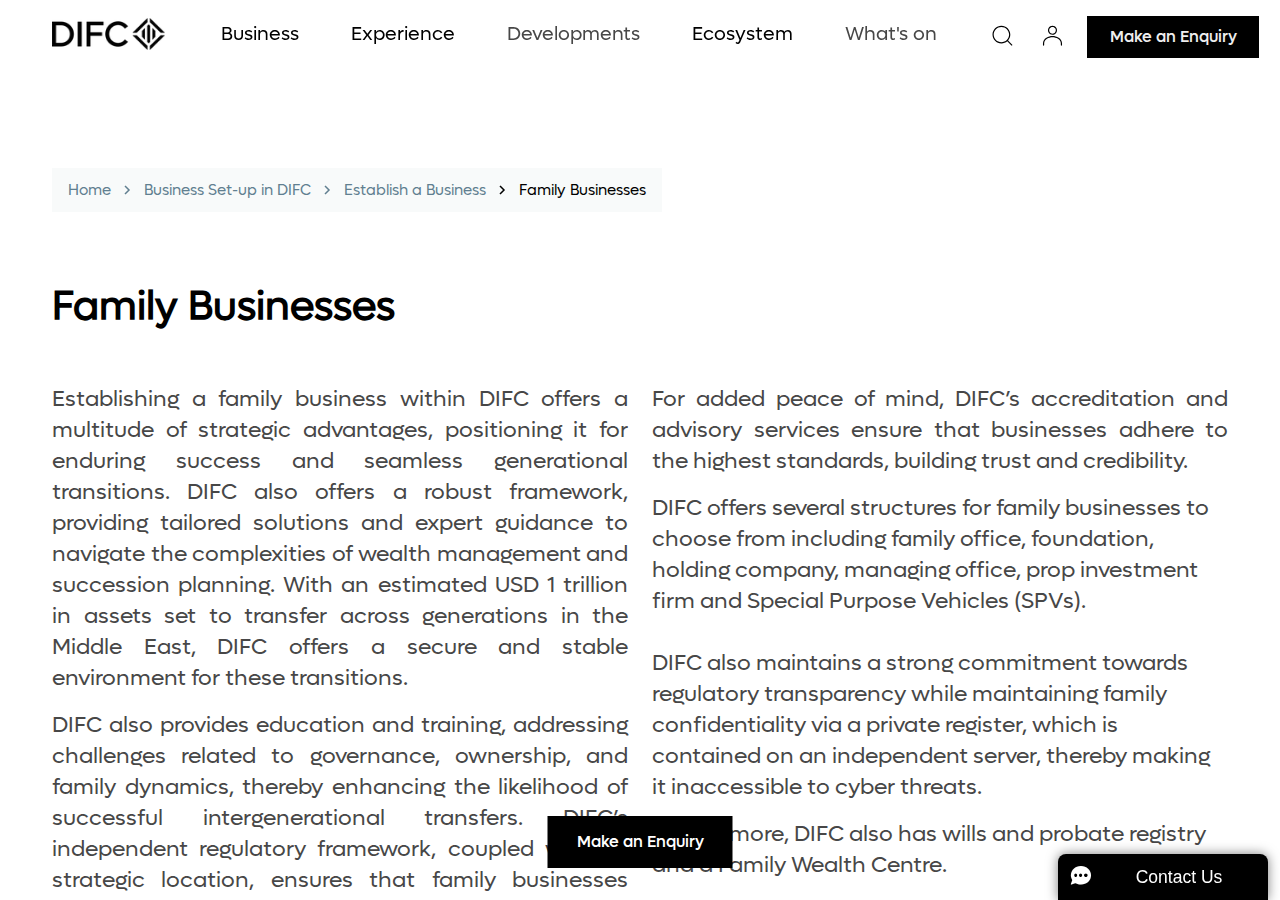
A DIFC family-office strategy is not one product. It may involve a family office, a foundation, a holding company, a managing office, SPVs, and succession documents. DIFC's official family-business page presents family office, foundation, and holding company options and describes family offices as structures that centralise wealth management, investments, tax, succession planning, risk, legal, fiduciary, and concierge services.
ADGM is similarly flexible, but its official fee page is more transparent. It lists a Single Family Office at USD 10,900 total, made up of a USD 5,600 incorporation fee and a USD 5,300 annual renewal fee. It lists an ADGM Foundation at USD 800 incorporation and USD 500 annual renewal, and an ADGM SPV at USD 1,900 setup and USD 1,400 annual renewal.
The cleanest structure for many families is not a full office on day one. It is a foundation-led holding architecture: a foundation at the top, SPVs below it, and a governance framework around investment, succession, distributions, family employment, and adviser oversight. For cross-border families with UAE relocation plans, this should be considered alongside residency and tax planning, including our guide to wealthy Britons moving to Dubai under the FIG regime and our comparison of the Italy flat tax for new residents.
DIFC Family Arrangements: The Date Matters
Many online guides describe the DIFC family-office regime as a 2024 change. That is imprecise. DIFC announced the enactment of the new Family Arrangements Regulations on 31 January 2023. The announcement said the regulations repealed the older Single Family Office Regulations and replaced them with a new Family Office regime. It also described private registers and reduced DFSA DNFBP registration burden for single-family services, unless the office provides services to more than one family by way of business.
That matters because families and advisers should not rely on stale summaries of the old single-family-office framework. DIFC moved toward a broader family-arrangements regime, supported by the DIFC Family Wealth Centre, foundations, private registers, and family-business tools.
The practical implication is not "everyone should create a DIFC family office." A family with USD 15 million to USD 25 million may need a foundation, SPVs, registered wills where relevant, and a governance charter. A family with USD 75 million, operating companies, employees, private investments, real estate, and cross-border heirs may justify a more institutional office.
DIFC vs ADGM At A Glance
| Factor | DIFC | ADGM |
|---|---|---|
| Best use case | Dubai apex, family governance, succession, private registers, wills ecosystem | Lower-cost structuring, SPVs, Abu Dhabi common-law base, transparent official fees |
| Official family-office positioning | Family Office, Foundation, Holding Company and related structures | Single Family Office, Multi-Family Office, Foundation, SPV and trust framework |
| Foundation official fee signal | DIFC page says foundations can be established for USD 350 | ADGM Foundation: USD 800 incorporation, USD 500 renewal |
| SPV official fee signal | Available, but less central to public fee messaging | SPV setup total USD 1,900, annual renewal USD 1,400 |
| SFO threshold issue | DIFC family-office regime is commonly associated with higher asset expectations | ADGM page says no minimum capital or bank balance, while the SFO rule condition includes USD 10M net asset value |
| Succession tools | DIFC Wills Service and family wealth ecosystem | Foundation, SPV, trust framework, ADGM legal framework |
| Substance expectation | Strong for serious offices and bank-facing structures | Strong for offices; leaner for structuring-only vehicles |
| Hybrid role | Often the apex layer | Often efficient SPV and holding layer |
The decision is not merely Dubai versus Abu Dhabi. It is apex protection versus holding efficiency, family governance versus asset ring-fencing, and formal office versus lean structure.
ADGM's Two Numbers: No Minimum Capital, But A USD 10M Net-Asset Rule
ADGM creates confusion because two statements can both be true.
The ADGM family-office page says its Single Family Office has no minimum capital requirement and no minimum bank balance requirement. That means the family office entity does not need a prescribed paid-in capital amount or a required account balance merely to exist.
Separately, the ADGM rulebook condition for a Single Family Office refers to a minimum value of USD 10,000,000, calculated by reference to the family's net asset value. That is not the same as minimum capital. It is an eligibility and value test for the family-office activity.
This distinction matters in board papers. A founder should not read "no minimum capital" as "any asset level works." A family with USD 4 million in assets may be able to create a basic holding structure or foundation-led plan, but a formal ADGM Single Family Office activity should be assessed against the rulebook condition and adviser guidance. A family with USD 12 million may meet the numeric value condition but still need to ask whether the running costs and substance make sense.
Source: ADGM
Foundation vs Family Office vs SPV
The right structure starts with terminology.
A family office is an operating platform. It centralises services for the family: investments, reporting, succession coordination, tax, governance, property oversight, philanthropy, family employment, adviser management, and sometimes concierge services. A real family office has people, systems, meetings, policies, and cost. It is not just a registration certificate.
A foundation is usually the apex vehicle. In DIFC or ADGM, a foundation can hold assets, set governance rules, name beneficiaries, appoint council members, and embed succession instructions. It is often used because it separates control and benefit more cleanly than a simple company shareholding chain.
An SPV is a holding vehicle. It can hold one asset or one asset class: a property, an operating-company stake, a securities portfolio, private-company shares, or a family project. SPVs help ring-fence assets so a dispute around one asset does not disturb the entire structure.
For many families, the best first move is not "create a family office." It is "create a foundation and a clean SPV map." The office can come later when assets, complexity, and family needs justify the cost.
Step By Step: Setting Up A UAE Family-Office Structure
- Map the assets and family decision makers. List operating businesses, real estate, securities, private holdings, bankable assets, family members, jurisdictions, marital-property issues, and expected succession events. Do this before choosing DIFC or ADGM.
- Decide whether you need an office or a structure. If the family only needs succession and asset holding, a foundation plus SPVs may be enough. If the family needs staff, investment governance, reporting, adviser oversight, and family services, a formal family office may be justified.
- Choose the apex jurisdiction. DIFC is often preferred for a Dubai apex, private registers, family wealth ecosystem, and wills planning. ADGM is often preferred for cost transparency, Abu Dhabi common-law positioning, and efficient holding structures.
- Select the vehicles. Common options include a DIFC Foundation, ADGM Foundation, DIFC holding company, ADGM SPVs, and in some cases a formal Single Family Office. The structure should be based on purpose, not fashion.
- Prepare the charter and governance pack. The charter should cover beneficiaries, council powers, guardian or protector role, distribution policy, family employment principles, conflict rules, adviser appointment, and succession triggers.
- Incorporate the entities. Submit applications, owner documents, source-of-wealth information, board or family approvals, registered-office arrangements, and any required service-provider appointments.
- Open accounts and operational rails. Banks and custodians will review the structure, purpose, assets, controlling persons, source of wealth, and tax position. Prepare a clear structure memo and adviser letters.
- Maintain substance and records. Hold meetings, keep minutes, renew licences, update registers, review tax classification, file returns where required, and revisit the structure after major asset sales, births, deaths, divorces, or relocation events.
Official Fee Reality: ADGM Is Transparent, But Adviser Costs Still Matter
ADGM's official public fee table is useful because it gives anchor numbers. A Single Family Office is listed at USD 10,900 total, with USD 5,600 incorporation and USD 5,300 annual renewal. A Multi-Family Office is listed at USD 33,300 total, with USD 16,800 incorporation and USD 16,500 annual renewal. A Foundation is listed at USD 800 incorporation and USD 500 renewal. An SPV is listed at USD 1,900 setup and USD 1,400 renewal.
The ADGM SPV page separately confirms the USD 1,900 setup total: USD 200 name reservation, USD 700 registration including data protection registration, and USD 1,000 commercial licence.
Those are official fees, not total project cost. A real family structure also needs legal drafting, tax advice, accounting setup, corporate service support, registered office, bank onboarding, governance documents, and sometimes family-constitution work. The difference between a USD 5,000 registration exercise and a USD 75,000 planning project is usually not government fees. It is adviser time and complexity.
| Component | Typical role | Fee note |
|---|---|---|
| ADGM Foundation | Apex or asset-protection vehicle | Official fee: USD 800 incorporation, USD 500 renewal |
| ADGM SPV | Asset-holding company | Official setup total: USD 1,900; renewal: USD 1,400 |
| ADGM Single Family Office | Operating family-office vehicle | Official fee table: USD 10,900 total |
| DIFC Foundation | Apex succession and holding vehicle | DIFC page gives a USD 350 foundation fee signal |
| Legal drafting | Charter, bylaws, governance, adviser terms | Varies by family complexity |
| Substance | Office, meetings, employees, records | Often the largest ongoing cost |
Source: ADGM
The Hybrid Blueprint: DIFC Foundation Over ADGM SPVs
The hybrid structure is popular because it separates two jobs.
The apex job is governance. It asks: who controls the family wealth, who benefits, how are decisions made, what happens on death or incapacity, who can remove an adviser, and how do heirs receive benefits without fragmenting the structure? DIFC is often attractive for this layer because of its family-business ecosystem, private-register features, Family Wealth Centre, foundation framework, and wills infrastructure.
The holding job is asset separation. It asks: which entity holds the London property, which entity holds the operating-company shares, which entity holds the securities portfolio, and which entity signs the shareholder agreement for a private investment? ADGM SPVs are attractive for this layer because the official fee table is clear and the SPV is designed for holding assets.
A simplified hybrid can look like this:
| Layer | Vehicle | Purpose |
|---|---|---|
| Apex | DIFC Foundation | Family governance, succession rules, beneficiary framework |
| Holding 1 | ADGM SPV | Operating-business shareholding |
| Holding 2 | ADGM SPV | Real estate portfolio |
| Holding 3 | ADGM SPV | Securities and private investments |
| Oversight | Family council or adviser committee | Investment policy, distributions, reporting, conflict management |
This is not automatically the right answer. Some families should use ADGM for both apex and SPVs. Some should use DIFC only. Some should keep the holding structure outside the UAE and use a UAE office for management and residency planning. The hybrid becomes attractive when the family values DIFC's governance layer but wants ADGM's SPV economics underneath.
Succession Planning: Where The UAE Structure Adds Value
Succession is the main reason a family structure is worth paying for. Without a structure, the death or incapacity of a founder can leave heirs, executives, trustees, personal representatives, banks, and courts trying to coordinate across jurisdictions. That is slow, costly, and deeply disruptive to operating businesses.
A foundation-led structure reduces that risk by moving ownership and governance into a durable legal vehicle. The family can define beneficiaries, council powers, distribution rules, family employment principles, dispute handling, and protections for vulnerable beneficiaries.
SPVs then keep assets organized. The family does not need one entity holding everything. It can isolate asset classes and keep management cleaner. If one property is sold, the relevant SPV can be sold or transferred. If an operating company receives a strategic investor, the shareholding SPV can sign the documents without touching the real-estate layer. If a family member moves country, advisers can analyze the affected layer rather than untangle the whole estate.
DIFC's wills infrastructure can also matter for non-Muslim individuals with UAE assets outside the foundation. The will and the foundation should not contradict each other. They should be designed as one succession system.
UAE Corporate Tax And Substance
A family office is not outside tax analysis simply because it is in a free zone. UAE corporate tax is generally 9%. Qualifying free-zone income can be taxed at 0% only if the entity meets the relevant conditions. Those conditions include adequate substance, qualifying income, transfer-pricing compliance where relevant, and avoiding disqualifying activity or income.
For a family structure, tax classification depends on the vehicle, activity, income type, and whether the entity is merely holding assets or providing services. A passive holding SPV, a foundation, and an operating family-office company may not be analyzed in the same way. A family office that charges service fees, employs staff, and manages assets can have a different tax profile from an SPV that holds one investment.
Substance also matters for banking. Banks and custodians want to understand why the UAE entity exists, what assets it holds, who controls it, where decisions are made, and how the structure complies with tax and reporting rules. Cheap setup without a credible governance and substance story can fail at the account-opening stage.
For more on the UAE tax side, read Truescho's guide to UAE free-zone corporate tax and QFZP status. For account opening, see our guide to UAE corporate bank accounts for non-residents.
Scenario: A Singapore-London Family Builds A UAE Hybrid
Consider the Chen-Rossi family. The first generation built a logistics technology company in Singapore, sold a minority stake, and now holds roughly USD 68 million across founder shares, a London property portfolio, listed securities, and a small venture portfolio. Two adult children live in London, one parent is relocating to Dubai, and the family wants a Gulf base for governance, succession, and future investment into the region.
The family first asks for a "Dubai family office." Their advisers push back. They do not yet need a full staff, premises, investment team, and concierge platform. They need an apex structure, asset separation, succession rules, bankable documentation, and a path to expand later.
The chosen blueprint uses a DIFC Foundation as the apex. The charter creates a family council, names beneficiaries, appoints a professional council member, sets distribution principles, and creates rules for adding future spouses or descendants. Under the foundation, the family establishes three ADGM SPVs: one for the operating-company shares, one for real estate, and one for securities and private investments. The official ADGM SPV setup fee is USD 1,900 per SPV, with annual renewal at USD 1,400, before adviser and service-provider costs.
The family also prepares a tax and substance memo. The foundation and SPVs are not marketed as magic 0% entities. Each vehicle is assessed under UAE corporate tax rules, and the family decides where meetings, records, approvals, and reporting will happen. Because one parent is moving to Dubai, they also review UAE residence planning and compare it with Dubai retirement visa planning for older family members.
The result is deliberately modest: a structure that fits the asset base today and can become a formal office later if the family hires staff, creates an internal investment team, or begins serving multiple branches of the family more actively.
Common Mistakes Families Make
- Buying a full family office too early. A USD 12 million or USD 20 million family may need succession and holding vehicles, not a staffed office.
- Ignoring the ADGM distinction between capital and net asset value. No minimum capital or bank balance does not erase the SFO value condition.
- Using outdated DIFC timing. The Family Arrangements Regulations were announced and enacted on 31 January 2023, not simply a 2024 event.
- Underestimating adviser drafting. The registration fee is only a small part of the work. The charter, bylaws, governance policy, tax memo, and bank pack matter more.
- Promising blanket 0% UAE tax. The UAE corporate tax rate is generally 9%, and free-zone 0% treatment applies only where conditions are met.
- Putting every asset in one entity. A single holding entity can make reporting, sale, dispute management, and succession more difficult. SPV separation is often cleaner.
- Treating succession as a document exercise. A will, foundation charter, family constitution, and shareholder agreement must work together. Contradictions create future disputes.
- Forgetting operating companies. Founders often structure family wealth but leave the main company outside the plan. If an operating company may be moved, compare our guide to redomiciling a company to the UAE and, where relevant, a US LLC for non-residents.
When DIFC Is The Better Choice
DIFC is usually stronger when the family wants a Dubai-facing apex, mature wealth ecosystem, private-register features, succession planning support, and proximity to DIFC advisers, banks, courts, and professional services. It can also help where the structure has a reputational function for global counterparties.
The tradeoff is cost and complexity. DIFC can be the better apex, but not every asset needs to sit directly in DIFC. That is why the DIFC Foundation plus ADGM SPV hybrid is common in planning conversations.
When ADGM Is The Better Choice
ADGM is usually stronger when the family wants transparent official fees, efficient SPVs, foundation-led holding, Abu Dhabi common-law positioning, and a leaner structure. It is especially attractive for families that need several asset-holding companies.
The caution is that low official fees do not remove governance work. An SPV still needs a purpose, records, tax analysis, bank documentation, and renewal discipline.
Multi-Family Office: A Different Conversation
A single family office serves one family. A multi-family office serves more than one family and moves closer to a regulated services business. ADGM's page says a Multi-Family Office requires a financial services permission to service more than one family, and its official fee table lists Multi-Family Office total fees at USD 33,300.
If a founder, adviser, or wealthy family wants to serve other families or turn private infrastructure into a commercial service platform, permissions, staffing, compliance, client agreements, and professional liability need specialist review.
Frequently Asked Questions
DIFC vs ADGM family office: which is better in 2026?
DIFC is often better for a Dubai apex, family governance, private registers, wills planning, and a mature wealth ecosystem. ADGM is often better for transparent official fees, lower-cost SPVs, foundation-led holding structures, and Abu Dhabi common-law positioning. Many families combine both.
How much does an ADGM Single Family Office cost?
ADGM's official family-office page lists a Single Family Office at USD 10,900 total, made up of a USD 5,600 incorporation fee and a USD 5,300 annual renewal fee. Adviser, office, governance, tax, and bank onboarding costs are separate.
What are the official ADGM SPV setup and renewal fees?
The ADGM SPV page states a setup total of USD 1,900, made up of USD 200 for name reservation, USD 700 for registration including data protection registration, and USD 1,000 for the commercial licence. ADGM's family-office page lists annual SPV renewal at USD 1,400.
Does ADGM require USD 10 million for a Single Family Office?
ADGM's public fee page says no minimum capital and no minimum bank balance for the SFO entity. Separately, the ADGM SFO rule condition refers to a USD 10,000,000 minimum value by family net asset value. That is an eligibility value condition, not paid-in capital.
Did DIFC enact the Family Arrangements Regulations in 2024?
No. DIFC announced the enactment of the new Family Arrangements Regulations on 31 January 2023. The announcement said the regulations repealed the older Single Family Office Regulations and replaced them with a new Family Office regime.
When is a foundation enough instead of a full family office?
A foundation may be enough where the family mainly needs succession planning, asset holding, beneficiary rules, and governance. A full family office becomes more useful when the family needs staff, investment operations, reporting systems, adviser management, and day-to-day family services.
What is the difference between a foundation and an SPV?
A foundation is typically the apex governance and succession vehicle. It can hold assets and define beneficiary and council rules. An SPV is a holding company for a specific asset or asset class. Families often place several SPVs beneath one foundation.
Is a DIFC Foundation plus ADGM SPVs a good hybrid structure?
It can be. The DIFC Foundation can provide the governance and succession layer, while ADGM SPVs can provide efficient asset-holding entities. The hybrid is useful when the family values DIFC's apex ecosystem but wants ADGM's SPV fee profile underneath.
Does UAE corporate tax apply to family-office structures?
Potentially, yes. UAE corporate tax is generally 9%, and qualifying free-zone income can be taxed at 0% only if conditions are met. Each foundation, SPV, and family-office company should be reviewed based on activity, income type, substance, and classification.
Can a non-resident family set up a DIFC or ADGM structure?
Yes. Non-resident families commonly use UAE structures for succession, asset holding, and regional governance. Bank onboarding, source-of-wealth documentation, tax residence, and management substance still need careful planning, especially when family members live in several countries.
Official Sources
- DIFC - Family Businesses
- DIFC - Enactment of New DIFC Family Arrangements Regulations
- DIFC - Family Wealth Centre
- DIFC - Legal Database
- ADGM - Family Offices
- ADGM - Special Purpose Vehicles
- ADGM Rulebook - Specific Conditions of Licence, Single Family Office
- UAE Federal Tax Authority - Corporate Tax
- UAE Federal Tax Authority - Free Zone Corporate Tax Bulletin
A strong UAE family-office structure is not the one with the most entities. It is the one that makes ownership, succession, tax, banking, and governance easier to manage. Truescho helps families and founders compare DIFC and ADGM so the structure matches the asset base.