
DeepSeek Harness: The Open-Source AI Agent Framework Where Everything is a Plugin 2026
In August 2026, DeepSeek released DeepSeek Harness — a fully open-source agent harness framework licensed under MIT. This is not a new AI model. It is the infrastructure that transforms a language model into a functional agent capable of understanding its environment, using tools, and persisting through real-world tasks. The foundational philosophy is captured in a simple equation: Agent = Model + Harness. The model is the soul of an agent. The harness is what lets that agent operate in the world.
What sets DeepSeek Harness apart from every other agent platform on the market is a radical design principle: "Everything is a plugin." Models, tools, skills, sessions, sandboxes, storage, loops, scheduling, and even the UI — every single component is swappable through configuration, without touching the framework's source code.
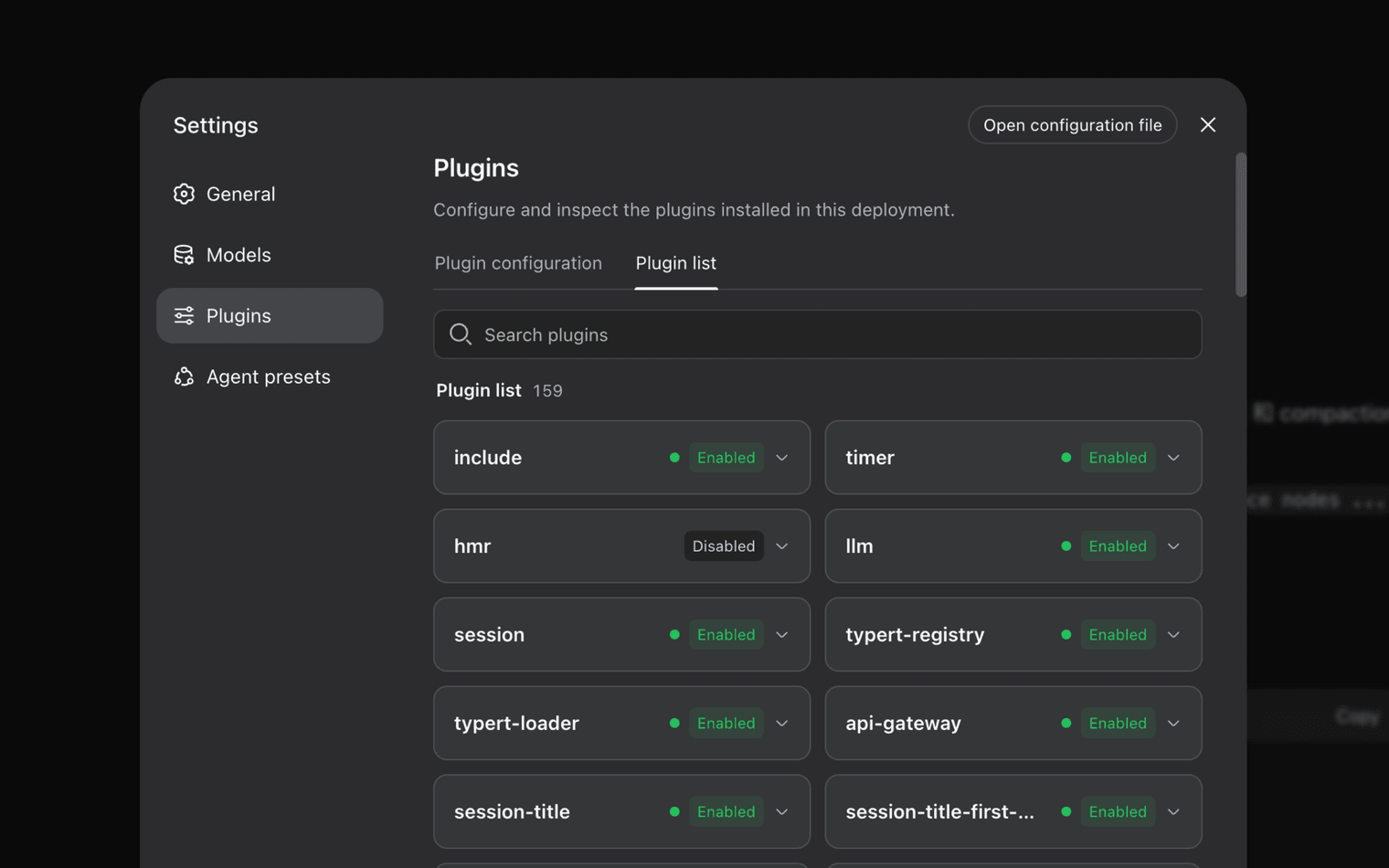
Source: DeepSeek — plugin architecture diagram.
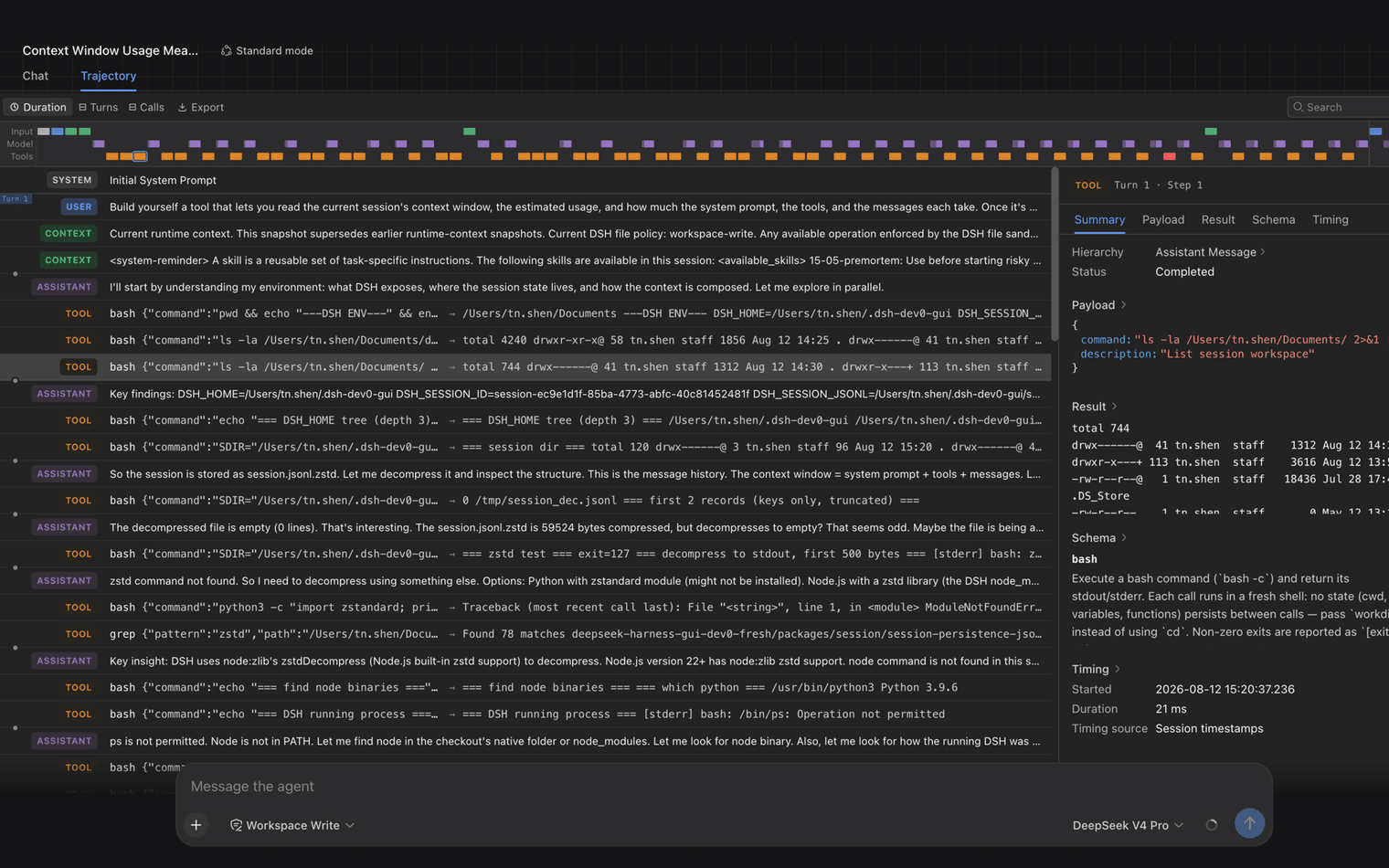
Source: DeepSeek — agent operations tracing.
Why This Release Matters
The AI agent space in 2026 is dominated by closed-source products. Claude Code, Cursor, and Windsurf all deliver capable coding agents, but they operate as black boxes. You cannot inspect their internals, swap their models freely, or replace their tool ecosystems. You pay a subscription and accept the product as-is.
DeepSeek Harness takes the opposite approach. It is free, MIT-licensed, and built from the ground up for developers who want total control over their agent's architecture. Every layer is transparent, replaceable, and extensible. Whether you want to build a coding agent, a research assistant, or a custom automation pipeline, the framework gives you the scaffolding to do it on your own terms.
That said, this is currently a developer preview — APIs will evolve, documentation is still maturing, and production deployments carry real risk. This article gives you an honest, thorough look at what the framework offers today.
Architecture: How DeepSeek Harness Works
The Core Equation
DeepSeek Harness defines the relationship between a model and its surrounding environment with deliberate clarity:
Agent = Model + Harness
The model is the soul — it reasons, decides, and generates. The harness is the body — it lets the agent understand its environment, use tools, and keep working in real-world settings. This clean separation between brain (model) and body (harness) is precisely what makes each component independently swappable. You can change the model without changing the harness. You can replace the harness internals without touching the model.
The Cordis Kernel
At its foundation, DeepSeek Harness is built on the Cordis kernel. Cordis handles three operations that are critical to a plugin-based system:
- Plugin Mounting — dynamically loading and initializing plugins when needed
- Plugin Unmounting — safely removing plugins when they are no longer required
- Dependency Management — ensuring plugins load in the correct order and resolving dependency conflicts automatically
Plugins communicate with each other through Cordis services and Cordis events. This creates a loosely coupled architecture where plugins interact through well-defined interfaces rather than direct imports, making the system modular, maintainable, and extensible.
Key Features in Depth
1. Plugin-Based Architecture — Total Swappability
This is the headline feature and the most consequential design decision. In most agent frameworks, core components like the model, tools, or session management are hardcoded into the framework's core. DeepSeek Harness inverts this completely.
Every component of the agent is configurable and replaceable:
| Component | What It Controls |
|---|---|
| Models | Choose DeepSeek V4 or any compatible model |
| Tools | File editing, shell execution, web search, and more |
| Skills | Custom capabilities added per use case |
| Sessions | Conversation context and memory management |
| Sandboxes | Isolated execution environments for safety |
| Storage | Where and how data is persisted |
| Loops | Task iteration and repetition mechanisms |
| Scheduling | Timing and orchestration of operations |
| UI | Fully customizable interface layer |
The practical implication: developers can select, swap, or extend any capability in configuration without changing the DeepSeek Harness source code. Want to swap DeepSeek V4 for a different model? Change the config. Want to replace the default file editor tool with a custom one? Write a plugin. Want to run the agent in a headless mode with no UI at all? Remove the UI plugin.
2. Full Traceability — Everything Is Recorded
One of the hardest problems in agent development is understanding what happened and why. When an agent makes a mistake, you need to trace back through its reasoning, tool calls, and context to find where things went wrong.
DeepSeek Harness solves this with a comprehensive logging system. Everything the model sees is recorded in an append-only session log:
- System prompts
- Reasoning traces (chain-of-thought)
- Tool calls and their results
- Subagent scheduling decisions
- Context injections from external sources
The framework provides a Trajectory View for inspecting each step in detail. Four critical operations all work on the same event stream:
- Resume — continue a session from where it stopped
- Fork — create a branch from a specific point in the session
- Search — find specific events in the log
- Replay — re-simulate the session step by step
This level of transparency is invaluable for debugging, auditing, and improving agent behavior over time. In a production setting, it also provides accountability — you can trace exactly why an agent took a specific action.
3. Multiple Runtime Modes
DeepSeek Harness offers four runtime modes, each tailored to a specific use case:
Standard Mode
A full-featured coding agent with:
- File editing
- Shell execution
- File and web search
- Skills system
- Planning and goal-setting
- Subagents for delegated tasks
- Workflow orchestration
This is the default mode for general-purpose agent work — the equivalent of what you would get from a full-featured coding assistant.
Code Mode
Builds on Standard mode by adding the Code Mode SDK. This enables the model to combine multi-step operations into a single TypeScript program. Instead of executing each step individually (which introduces latency and error risk at each step), the agent writes a complete program that accomplishes the task end-to-end, then executes it.
This is particularly powerful for complex, multi-file operations where intermediate state matters. The agent reasons about the entire task, writes the code to accomplish it, and runs it in one shot.
Minimal Mode
A stripped-down agent with just two tools: a persistent bash shell and a str_replace_editor. This mode exists specifically for benchmarking models in a controlled, minimal environment.
For researchers and developers evaluating how well a particular model performs without the noise of additional plugins, Minimal Mode removes all variables except the model's raw capability. It is the closest thing to a pure model evaluation within an agent harness.
Creator Mode
Combines Standard mode capabilities with:
- Runtime inspection — examine the agent's internal state while it runs
- In-memory plugin testing — develop and test new plugins without full deployment
- Tools for authoring custom agent presets — design and save reusable agent configurations
Creator Mode is aimed at developers building their own plugins or designing custom agent experiences for their team or product. It is the meta-mode: a mode for building modes.
What This Means for You
For Developers Evaluating Agent Frameworks
If you are a developer building AI agents — whether for coding, research, automation, or customer support — DeepSeek Harness removes the biggest constraint of existing tools: vendor lock-in.
With Claude Code, you use Anthropic's model, Anthropic's tools, Anthropic's UI, and Anthropic's pricing. With Cursor or Windsurf, similar constraints apply. You are renting a sealed product.
With DeepSeek Harness, you own the entire stack. The cost structure is fundamentally different:
- Framework cost: $0 (MIT license)
- Model inference cost: Pay-per-use through DeepSeek API, which is among the most cost-effective in the market thanks to DeepSeek V4's efficiency
- Infrastructure cost: Run locally, on your own servers, or in the cloud — your choice
For a developer or small team, this can mean orders of magnitude lower operating costs compared to per-seat subscription models.
Getting Started
The fastest way to try DeepSeek Harness is a single command:
npx @deepseek-ai/dsh web
This requires Node.js installed on your machine. It downloads the framework and launches a local web interface immediately.
For a deeper dive, clone from source:
git clone https://github.com/deepseek-ai/deepseek-harness
Community-built plugins are tracked under the dsh-plugin topic on GitHub. Browse there to find extensions built by other developers — from custom tools to specialized skill packs.
Quick Comparison: DeepSeek Harness vs. The Alternatives
| Criterion | DeepSeek Harness | Claude Code | Cursor | Windsurf |
|---|---|---|---|---|
| Open Source | Yes (MIT) | No | No | No |
| Price | Free | Subscription | Subscription + Free Tier | Subscription |
| Model Swappable | Yes — any compatible model | Claude only | Limited models | Limited models |
| Plugin Architecture | Everything is a plugin | Closed | Closed | Closed |
| Full Traceability | Append-only log + Trajectory view | Limited | Limited | Limited |
| Runtime Modes | 4 (Standard, Code, Minimal, Creator) | Single mode | Editor + Agent | Editor + Agent |
| UI Customization | Fully swappable | Not customizable | Limited settings | Limited settings |
| Maturity | Developer Preview | Production | Production | Production |
The fundamental difference: DeepSeek Harness is not a finished product like Cursor or Windsurf. It is a framework that gives you, the developer, complete freedom to build exactly the agent you need. This means a steeper learning curve, but it also means flexibility that closed tools simply cannot offer. If Cursor is a furnished apartment, DeepSeek Harness is the land, the foundation, and the building materials.
Honest Limitations: What to Know Before You Commit
Transparency matters. DeepSeek Harness has real constraints that you should weigh carefully:
Developer Preview Status: The framework is in Developer Preview. This means APIs will change. Code you write today against the current API surface may need modifications in future releases. Do not build mission-critical production systems on it without a contingency plan and a willingness to track breaking changes.
Requires Node.js Proficiency: The quick-start command uses npx, and the framework is written in TypeScript. Plugins are authored in TypeScript. If you are not comfortable with the JavaScript ecosystem — TypeScript types, async/await patterns, Node.js module resolution — you will face a learning curve. This is not a framework for non-developers.
Documentation Is Still Maturing: As a new project, the official documentation does not yet cover every advanced scenario. You will occasionally need to read the source code to understand how a specific plugin or service works. This is expected for a developer preview, but it means more time investment upfront.
Small Community: Compared to established tools like Claude Code (backed by Anthropic's marketing and documentation), the DeepSeek Harness community is in its early stages. The number of available community plugins is limited. Solutions to uncommon problems may not be readily findable on Stack Overflow or community forums.
No Warranty: The MIT license explicitly provides no warranty. If something breaks in a way that costs you time or money, there is no vendor to hold accountable. You rely on the GitHub community and DeepSeek's responsiveness through official channels.
Frequently Asked Questions
Is DeepSeek Harness free?
Yes. The framework is completely free and open-source under the MIT license. You can use it in commercial projects without restrictions. The only cost is model inference fees if you use the DeepSeek API, which is a separate operational expense from the framework itself.
How do I get started with DeepSeek Harness?
The simplest way is to run npx @deepseek-ai/dsh web from your terminal (requires Node.js installed). This downloads the framework and launches a local web interface. To install from source, clone the repository from https://github.com/deepseek-ai/deepseek-harness.
Can I use models other than DeepSeek with Harness?
Yes. Because everything in this framework is a plugin, the model itself is swappable. You can configure the agent to work with any compatible model through the configuration file, without modifying the framework's source code.
How does DeepSeek Harness compare to Claude Code or Cursor?
DeepSeek Harness is a fully open-source framework with a universal plugin architecture, while Claude Code and Cursor are closed-source subscription products. Harness offers greater flexibility and zero licensing cost, but requires more technical effort to set up and customize. It is best suited for developers who want full control over their agent's architecture. For more context on the model behind the framework, see our coverage of DeepSeek V4.
Is DeepSeek Harness ready for production use?
Not yet. The framework is in Developer Preview, and its APIs will evolve. It is well-suited for experimentation and prototyping, but relying on it for production workloads carries risk due to potential breaking API changes in future releases.
The Bottom Line
DeepSeek Harness represents a bold bet on open, transparent, and fully extensible agent infrastructure. The "everything is a plugin" philosophy, combined with append-only traceability and four distinct runtime modes, makes it one of the most interesting open-source projects in the AI agent space in 2026.
It is not ready to replace your daily-driver coding tool today. The developer preview status, evolving APIs, and maturing documentation mean it carries real risk for production deployments. But for developers who want to understand how agent frameworks work under the hood — or who need a level of customization that closed tools will never offer — it is a project worth investing time in now.
The trajectory is clear: open-source agent frameworks are catching up to closed tools, and DeepSeek Harness is pushing the boundary of what "open" means in this space.
For more AI tools and reviews, explore our AI Tools directory.
Sources
- DeepSeek Harness — Official Website: https://deepseek.com/harness/en/
- Official GitHub Repository: https://github.com/deepseek-ai/deepseek-harness
- DeepSeek — Company Website: https://deepseek.com/
- Community Plugins on GitHub (dsh-plugin topic): https://github.com/topics/dsh-plugin