
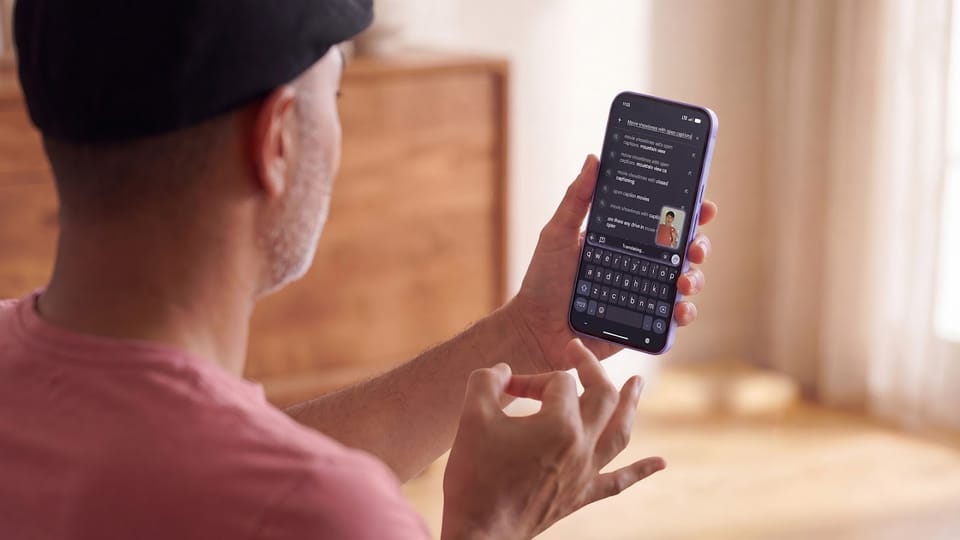
For most of us, typing a quick message or running a web search takes seconds of thoughtless effort. For someone whose first language is American Sign Language, that same task means composing in a second language — written English — every single time. On August 12, 2026, Google DeepMind removed that friction with the announcement of SL2T, a sign-language-to-text translation model that turns signing directly into written words, now shipping to consumers inside Gboard and Live Transcribe on the Pixel 11 at no extra cost.
This is not a research demo buried in a lab notebook, and it is not a third-party app that may vanish next quarter. It is the first time a sign-language translation model has reached a mass-market phone with a published, benchmarked accuracy score and a privacy architecture designed for real users. Here is what DeepMind actually built, how it works under the hood, and why the implications reach well beyond the first supported language.
What exactly is SL2T?
SL2T stands for Sign Language to Text. It is a translation model developed by Google DeepMind that converts sign language input into written text directly. The critical word in that sentence is "directly," because it marks the technology's main break from earlier approaches.
Previous academic and commercial attempts typically relied on an intermediate representation called gloss — a written notation that transcribes each individual sign as a word or symbol before a second system translates that notation into English. The pipeline sounds reasonable in theory and fails in practice: gloss strips out facial expressions that carry grammatical meaning, loses spatial information encoded by where the hands are positioned, and chops a fluid visual language into a choppy sequence of disconnected tokens. The result was translation that felt mechanical and frequently missed meaning.
SL2T skips the intermediate layer entirely. The model learns to map the visual signing sequence straight to an English sentence, the same way modern neural machine translation systems learn from text to text without hand-written grammatical rules. Output streams as the person signs, the way voice dictation text appears while you speak, rather than waiting for a sentence to finish. The model also handles the messy realities of human users: it recognizes left-handed signers as well as right-handed ones, works for people signing with one hand, and — crucially — does not hallucinate text when the camera sees movement that is not signing at all.
How the technology actually works
The most consequential design decision is on-device pose tracking. The raw video from your camera never leaves the phone. Instead, MediaPipe Holistic runs on the device's processor and extracts only body-landmark coordinates — the positions of hands, arms, face and posture as numeric points. Those coordinates, not pixels, are what the translation model consumes. The system reads a digital skeleton, not your living room.
The training foundation is equally significant. DeepMind trained SL2T on more than 100,000 hours of data spanning more than 50 sign languages, with American Sign Language representing roughly 25% of that corpus. That is why the first release serves ASL signers producing English. On the FLEURS-ASL (sd-test) benchmark, the model achieved a zero-shot score of 70 BLEURT — measured without task-specific tuning — which DeepMind describes as higher than any previously reported score on that benchmark.
The fairness work is worth pausing on, because it signals product maturity rather than a proof of concept. Around 10% of signers are left-handed, and a model trained exclusively on right-handed signers would simply fail for millions of people. DeepMind documented coverage of both signing orientations, alongside support for one-handed signing styles.
Where you will find it on your phone
The feature ships starting with the Pixel 11, at no additional charge, in two practical surfaces:
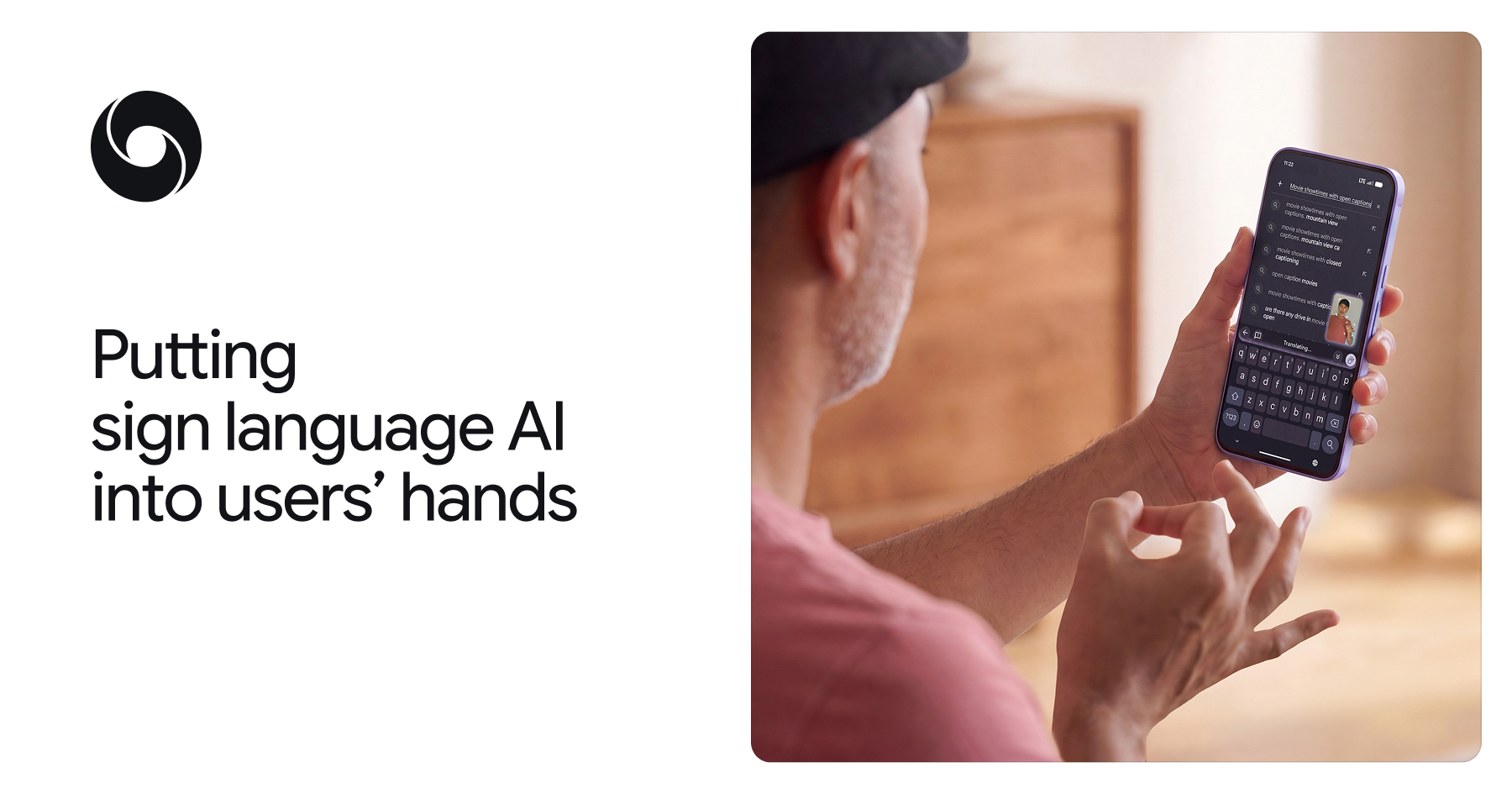
- Gboard: Google's Android keyboard gains sign-to-text dictation. Sign toward the front camera and the text lands in any input field — a WhatsApp message, an email, a Google search query, or a question to Gemini.
- Live Transcribe: Google's real-time captioning app for deaf and hard-of-hearing users now supports replying by signing. The conversation partner's speech is transcribed to text; the deaf user's reply is signed and converted to text on the same screen.
Source: Google DeepMind
DeepMind has confirmed this is only the beginning, with additional devices and additional sign languages promised. That single sentence is what turns a US product launch into a global story.
The official DeepMind video
Watch Google DeepMind's official demonstration: SL2T: Sign Language AI on Pixel
Why sign language translation is genuinely hard
Anyone following AI progress might assume that translating sign language became routine once text translation got good. The reality is a fundamentally harder problem, and understanding why explains the years it took to get here.
Sign language is not spoken language performed with hands. It is a full natural language operating in three dimensions. The location of a hand in the signing space changes meaning. Facial expressions carry grammar that the hand shapes alone do not encode. Speed and repetition modify meaning the way verb aspects modify sentences in written languages. A model must therefore comprehend an entire visual sequence unfolding in space and time — not a static image, not a word in isolation.
Then there is the hallucination problem. A phone camera runs continuously. The user lifts a cup of coffee, waves at a colleague, scratches their head. A system that tries to translate any motion will produce embarrassing nonsense text. SL2T's ability to recognize non-signing input and simply decline to translate it is the kind of unglamorous engineering detail that separates a daily-use product from a conference-stage demo.
Finally, there is the on-device performance gate. Pose tracking must run smoothly on a phone processor without draining the battery, while the translation model must stay accurate enough to be useful. Balancing those constraints is where many similar projects have stalled at the prototype stage and never reached a store listing.
Who benefits immediately?
Three groups will feel the difference first:
- Deaf ASL signers: Writing in English meant composing in a second language every time. Sign-to-text dictation means writing in their first language — for quick messages, web searches, long documents, and questions to AI assistants alike.
- Families and colleagues: Hearing people around a deaf user get a faster reply channel. Instead of waiting for a typed response, the deaf user signs and the text appears instantly in Live Transcribe.
- Service organizations: A bank branch, clinic, or government reception desk gets a baseline of dignified communication on demand, without needing a human interpreter scheduled for every single appointment. Professional interpreters remain essential for high-stakes contexts — this is a complement, not a replacement.
What this means for international users
The current release covers ASL to English only, so the immediate practical value outside the United States is limited. But the strategic reading of the announcement matters more than the first-language choice:
- The model was trained on more than 50 sign languages. Adding a language is now an extension problem — more data, more fine-tuning — rather than building a new system from scratch. When DeepMind says more languages are coming, it is building on a foundation that already exists.
- The platform plumbing is done: on-device pose tracking, the Gboard dictation pipeline, and the Live Transcribe reply channel are language-agnostic components that work with any sign language the model is trained on next.
- The competitive field is moving. Microsoft, Apple, and Meta have invested in accessibility AI for years, and multimodal models that understand video — like the embodied-reasoning systems we covered in Gemini Robotics ER 2 and Google's medical consultation research with AMIE Video — make sign-language understanding a natural next application. An estimated 70 million deaf and hard-of-hearing people use more than 200 sign languages worldwide; the addressable audience guarantees this race accelerates.
- For businesses and public-sector teams, digital accessibility standards keep tightening across jurisdictions. Knowing that phone-native sign translation exists — and watching which languages arrive — should shape multi-year accessibility roadmaps now, before regulation forces rushed decisions later.
Quick comparison: SL2T versus previous options
| Criterion | Human interpreter | Earlier sign-translation apps | DeepMind SL2T |
|---|---|---|---|
| Speed | Requires booking and scheduling | Seconds, but unstable accuracy | Streams live while signing |
| Benchmarked accuracy | High but costly | Rarely published | 70 BLEURT zero-shot on FLEURS-ASL |
| Privacy | Content exposed to a person | Often sends video to servers | Only body-landmark coordinates leave the device |
| Language coverage | Any language, if an interpreter exists | One or two | Trained across 50+ sign languages |
| Cost to user | High | Subscriptions and ads | Free on Pixel 11 |
The structural difference matters as much as any row in the table: this capability lives inside the operating system's own keyboard and accessibility app, not inside a third-party product whose business model can change overnight.
Honest limitations
An announcement this promising still deserves a clear-eyed list of what it does not do:
- One language, one output pair: ASL to English only, with no official date for any specific additional language.
- One device family: Pixel 11 only for now, a phone with limited distribution in many markets.
- One direction: sign-to-text. The hearing party still replies via text (or speech transcribed to text), so full two-way sign immersion remains unsolved.
- A great score is not a perfect score: 70 BLEURT is a milestone, not 100. Sign languages and written languages differ deeply in grammar, and translation quality will vary with signing style, speed, and regional variation.
- The training data skews American: roughly 25% ASL out of 100,000 hours reflects a deliberate first-market focus — and a bias worth naming.
Frequently asked questions
Is Arabic Sign Language supported?
Not yet. The first release supports American Sign Language to English on the Pixel 11. However, DeepMind trained the model on more than 50 sign languages and has stated that additional languages and devices are coming, which opens a practical path for Arabic sign languages without a committed timeline.
Does the feature send my face video to Google's servers?
No. Pose tracking runs on the device using MediaPipe Holistic, and only body-landmark coordinates — not raw video — are used for translation, according to DeepMind's official announcement.
How much does the sign-language dictation feature cost?
Nothing beyond the price of the phone. It ships at no extra charge on the Pixel 11 within Gboard and Live Transcribe, as stated in the August 12, 2026 announcement.
How is this different from voice dictation?
Voice dictation converts spoken words to text for people who can speak. SL2T converts a visual language — sign language — to text, serving users whose first language is signed and for whom written text is often a second language learned with effort.
Can it replace a certified interpreter in medical or legal settings?
No. In its current form it is best suited to everyday communication. High-stakes contexts like medicine and law still require certified human interpreters — a boundary even Google's own health research projects acknowledge.
What to watch next
Three signals will reveal how fast this trend matures. First, a second or third sign language appearing on the platform, proving the multilingual training pipeline actually extends. Second, partnerships outside Google — healthcare systems, education ministries, enterprise accessibility programs — which mark institutional seriousness. Third, competitor responses: when Apple, Microsoft, and Meta answer with their own sign-language features, coverage will expand across devices within months, not years.
The bottom line: SL2T is a transition moment for assistive technology — the first sign-language translation model to reach a consumer phone with a documented accuracy benchmark and a privacy-first architecture. The door is now open for every sign language that follows. We will keep tracking what comes through it in our ongoing AI coverage on Truescho's AI tools.
Sources:
- Google DeepMind official announcement: Putting sign language AI into users' hands