

Deel vs Remote vs Multiplier 2026: EOR Platform Comparison — Pricing, Features, and Best Use Cases
Last updated: July 2026
The deel vs remote vs multiplier EOR comparison 2026 matters because hiring talent across borders has shifted from a luxury to a necessity for growth-focused companies. With remote work now mainstream and talent shortages persisting in key markets, Employer of Record (EOR) platforms have become the fastest way to legally employ people in countries where you have no legal entity.
Whether you are a startup in Karachi hiring developers in Vietnam, a UK company onboarding a designer in the Philippines, or a US firm expanding into Brazil — choosing the right EOR platform can save you $50,000-150,000 annually in legal fees, compliance penalties, and administrative overhead. This guide compares Deel, Remote, and Multiplier across 30+ features with verified 2026 pricing.
What Is an Employer of Record (EOR)?
An Employer of Record is a third-party organization that legally employs workers on your behalf in countries where you do not have a registered business entity. The EOR handles payroll, tax withholding, benefits administration, employment contracts, and compliance with local labor laws — while you maintain day-to-day management of the worker.
The EOR model differs from hiring contractors in one critical way: the worker becomes a full legal employee with all the protections, benefits, and entitlements required by local law. This includes health insurance, pension contributions, paid leave, severance protection, and statutory bonuses where applicable.
Source: Deel
EOR platforms have exploded in popularity because the alternative — setting up a legal entity in a foreign country — is expensive and slow. Establishing a subsidiary in Brazil costs $15,000-30,000 and takes 3-6 months. In Saudi Arabia, the process can take 6-12 months and requires a local sponsor. An EOR lets you hire someone in any of these countries within 5-14 days at a fraction of the cost.
Why This Comparison Matters in 2026
The global remote work market has fundamentally reshaped how companies hire. According to a Gartner survey, 48% of knowledge workers now work remotely at least part of the time. Companies that restrict hiring to their home country are competing for a shrinking talent pool while competitors access global talent at 30-60% lower costs.
Source: YouTube — Deel vs Remote vs Multiplier EOR Comparison
The EOR market itself has matured significantly. In 2026, the three leading platforms — Deel, Remote, and Multiplier — collectively serve over 50,000 companies across 150+ countries. Competition has driven down prices, improved features, and expanded country coverage.
But choosing between them is not straightforward. Each platform has distinct strengths: Deel offers the widest country coverage and the richest feature set. Remote provides the most transparent pricing and owns its own entities. Multiplier competes aggressively on cost. Your decision should be based on your specific hiring patterns, budget, and growth trajectory.
Comprehensive Feature Comparison: Deel vs Remote vs Multiplier
| Feature | Deel | Remote | Multiplier |
|---|---|---|---|
| Countries (EOR) | 150+ | 90+ | 150+ |
| Owns local entities | Yes (most) | Yes (all) | Mixed (partners in some) |
| EOR pricing | ~$599/employee/mo | $699/employee/mo | ~$400/employee/mo |
| Contractor plan | ~$49/contractor/mo | $29/contractor/mo | ~$40/contractor/mo |
| Payroll-only | Available (custom) | From $50/employee/mo | Available (custom) |
| Setup fee | None | None | None |
| Minimum commitment | Month-to-month | Month-to-month | Month-to-month |
| Currency support | 150+ currencies | 12 major currencies | 120+ currencies |
| Equipment management | Yes (included) | Yes (included) | Yes (add-on) |
| Health benefits | Yes (localized) | Yes (owned plans) | Yes (partner-provided) |
| Equity/stock options | Yes (Carta integration) | Yes (own equity module) | Limited |
| Mobile app | Yes (iOS + Android) | Yes (iOS + Android) | Limited |
| 24/7 support | Yes | Yes | Business hours |
| G2 rating | 4.7/5 | 4.7/5 | 4.5/5 |
| Capterra rating | 4.8/5 | 4.7/5 | 4.6/5 |
| API access | Yes (full) | Yes (full) | Yes (limited) |
| Slack integration | Yes | Yes | Yes |
| HRIS included | Yes (Deel HR) | Yes (Remote HR) | No |
| Background checks | Yes (add-on) | Yes (included) | Yes (add-on) |
| Compliance guarantee | Yes | Yes | Yes |
Source: Deel
Pricing Deep Dive: What Will You Actually Pay?
Deel Pricing
Deel does not display exact EOR pricing on its website — it requires a demo call. However, based on verified customer data and third-party sources, the current pricing structure is:
- EOR (full-time employees): approximately $599 per employee per month (based on third-party estimates; Deel does not publish pricing publicly) in most countries. Premium countries (Germany, France, Brazil) may cost $699-899.
- Contractor management: approximately $49 per contractor per month, including compliance checks, global payments, and invoicing.
- Deel HR (free): included at no cost for companies under 200 employees using the EOR or contractor plan.
- Deel Payroll: custom pricing based on country and complexity.
Deel offers month-to-month contracts with no long-term commitment. There are no setup fees, and you can cancel any employee at 30 days notice.
Remote Pricing
Remote is the most transparent of the three, publishing all prices openly on its website:
- Employer of Record: $699 per employee per month across all 90+ supported countries. No hidden fees.
- Contractor Management: $29 per contractor per month — the lowest contractor rate among the three.
- Global Payroll: starting at $50 per employee per month (for entities you already own).
- No platform fees, no setup fees, no minimum headcount.
Source: Remote
Remote owns its own entities in every country it operates in, which means it does not rely on local partners. This gives it direct control over compliance, data handling, and service quality.
Multiplier Pricing
Multiplier positions itself as the affordable alternative. Based on verified customer data:
- EOR: approximately $400 per employee per month — the lowest among the three.
- Contractor management: approximately $40 per contractor per month.
- No setup fees, month-to-month contracts.
Multiplier operates in 150+ countries but uses a mix of owned entities and local partners. In some countries, the partner model can create slightly longer onboarding times or less direct control over compliance.
Cost Calculator: Total Annual Cost at Different Scales
| Team Size | Deel (EOR) | Remote (EOR) | Multiplier (EOR) | Difference (Deel vs Multiplier) |
|---|---|---|---|---|
| 5 employees | $35,940/yr | $41,940/yr | $24,000/yr | $11,940 |
| 10 employees | $71,880/yr | $83,880/yr | $48,000/yr | $23,880 |
| 20 employees | $143,760/yr | $167,760/yr | $96,000/yr | $47,760 |
| 50 employees | $359,400/yr | $419,400/yr | $240,000/yr | $119,400 |
At 50 employees, the cost difference between Deel and Multiplier is nearly $120,000 per year. However, price alone does not determine value — you must weigh coverage, compliance depth, and feature set against your specific needs.
For businesses that also need to protect their remote workforce and data infrastructure, having proper cyber insurance is essential when managing international teams and sensitive payroll data.
Deel vs Remote: Head-to-Head
Source: YouTube — Deel vs Remote Which to Choose
Choose Deel if: You need the widest country coverage (150+), want a unified platform for contractors and full-time employees, need equity management tools, or operate in niche countries where Remote does not have coverage. Deel is also the better choice for companies that need extensive integrations (200+ app integrations including all major HRIS, ATS, and accounting platforms).
Choose Remote if: You value pricing transparency, want the lowest contractor rate ($29/month), prioritize data ownership (Remote owns its entities and does not use partners), or need advanced benefits administration. Remote's IP protection framework is also more robust, with automatic IP assignment baked into every employment contract.
The table below summarizes the key differentiators:
| Criterion | Winner | Why |
|---|---|---|
| Lowest EOR price | Multiplier ($400/mo) | Cheapest base rate |
| Lowest contractor price | Remote ($29/mo) | Most affordable for contractor-only teams |
| Widest country coverage | Deel (150+) | Covers more niche markets |
| Pricing transparency | Remote | All prices published openly |
| Entity ownership | Remote | Owns all entities, no partners |
| Feature richness | Deel | HR, equity, equipment, background checks |
| Best mobile app | Deel/Remote (tie) | Both offer full-featured apps |
| Best for startups | Multiplier | Lowest cost entry point |
| Best for enterprises | Deel | Scale, integrations, dedicated CSM |
| IP protection | Remote | Strongest automatic IP assignment |
Global Payroll and Benefits Administration

Source: Deel
All three platforms handle payroll processing, but the depth varies significantly.
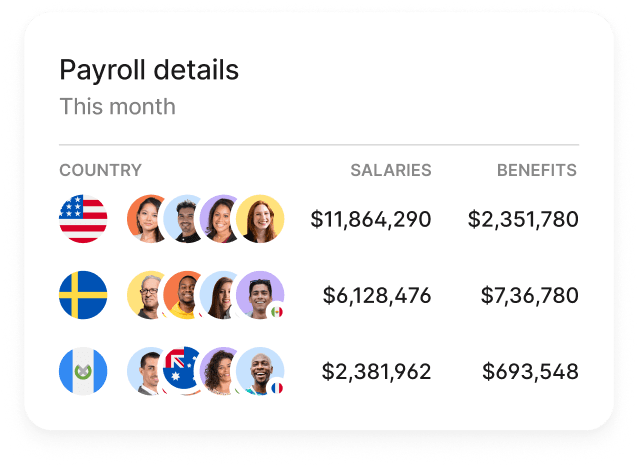
Deel offers the most comprehensive payroll capabilities. It processes payroll in 150+ currencies, handles tax calculations and filings, manages benefits administration (health insurance, pension contributions, statutory bonuses), and offers a unified dashboard for viewing all global payroll data. Deel also integrates with major accounting software including QuickBooks, Xero, and NetSuite.
Remote provides similar capabilities across its 90+ countries but distinguishes itself with its benefits design. Remote designs and administers its own health insurance plans in many countries rather than partnering with local providers. This means faster claims processing and more consistent coverage for employees.
Multiplier handles core payroll and statutory benefits but has a more limited benefits administration offering. For companies that need rich, localized benefits packages — particularly in countries with complex mandatory benefits like Brazil, India, or France — Deel and Remote offer deeper coverage.
Source: Deel
Middle East and Emerging Market Support
A critical differentiator for global companies is how well each platform supports emerging markets — particularly in the Middle East, South Asia, and Africa.
Saudi Arabia: All three platforms support hiring in Saudi Arabia. Deel and Remote offer full EOR services compliant with Saudi labor law, including GOSI (social insurance) contributions, end-of-service benefits, and Saudization requirements. Multiplier also covers Saudi Arabia but through a local partner.
UAE: All three platforms fully support the UAE. The process is straightforward — the EOR handles the employment visa process, WPS (Wage Protection System) compliance, and end-of-service gratuity calculations.
Egypt, Jordan, Morocco, Pakistan, Nigeria, Vietnam, Philippines, Brazil: Deel covers all of these through its own entities or trusted partners. Remote covers most but not all — for example, Remote added Nigeria and Vietnam in 2025 but does not yet cover some smaller African markets. Multiplier covers all these countries through partners.
If you are also managing payment processing in the Gulf region, our guide on payment gateways for UAE and Saudi Arabia complements your EOR strategy when hiring in the region.
Real Case Study: How a Pakistani Startup Scaled Globally Using EOR
Bilal Ahmed, founder and CEO of TechFlow, a software development agency based in Karachi, Pakistan, needed to hire talent across five countries without setting up legal entities in each. In early 2025, TechFlow had 35 employees in Pakistan and needed to onboard:
- 2 senior developers in Vietnam
- 1 design lead in the Philippines
- 1 sales manager in the UK
- 1 product manager in Germany
Bilal compared Deel, Remote, and Multiplier over a two-week evaluation period. He ultimately chose a split approach: Remote for the UK and German employees (because Remote owned its entities there and provided stronger IP protection), and Multiplier for the Vietnam and Philippines contractors (because of the lower cost at $40/month vs $49/month).
For the five new international team members, the annual cost breakdown was:
- Remote EOR (UK + Germany): 2 x $699 x 12 = $16,776/year
- Multiplier contractors (Vietnam x2 + Philippines): 3 x $40 x 12 = $1,440/year
Total annual EOR cost: $18,216 — compared to an estimated $80,000-150,000 in legal fees, entity setup, and ongoing compliance costs if TechFlow had set up its own entities.
The onboarding time was 7 days for the Remote employees and 3 days for the Multiplier contractors. Without EOR platforms, entity setup alone would have taken 3-6 months per country.
TechFlow has since grown to 52 employees across 7 countries and has never needed to establish a single foreign legal entity.
Decision Checklist: How to Choose the Right EOR Platform
Answer these ten questions to determine which platform fits your needs:
- How many countries do you need to hire in? If over 100, Deel has the widest coverage.
- Do you need contractors only, or full-time employees? For contractors only, Remote at $29/month is cheapest.
- Is pricing transparency important to you? If yes, choose Remote — all prices are public.
- Do you need equity/stock option management? Deel integrates with Carta; Remote has its own equity module.
- Are you hiring in the Middle East? All three support it, but Deel and Remote offer deeper compliance.
- What is your monthly budget per employee? Under $450/month points to Multiplier.
- Do you need an all-in-one HRIS? Deel HR and Remote HR are included; Multiplier does not offer HRIS.
- Is IP protection critical? Remote has the strongest automatic IP assignment framework.
- Do you need 24/7 support? Deel and Remote offer it; Multiplier offers business-hours support.
- Are you planning to scale to 100+ employees? Deel offers dedicated customer success managers and enterprise features.
EOR vs PEO: Understanding the Difference
Many people confuse EOR with Professional Employer Organization (PEO) services. The distinction matters:
EOR (Employer of Record): The EOR is the legal employer. It handles all employment responsibilities — contracts, payroll, taxes, benefits, compliance. You do not need a local entity. The worker appears on the EOR's payroll, not yours.
PEO (Professional Employer Organization): A PEO is a co-employment model. You maintain your own legal entity in the country, and the PEO handles HR functions alongside you. You need an existing entity to use a PEO.
For most companies hiring internationally for the first time, EOR is the right choice because it eliminates the need to set up a legal entity. PEO is better suited for companies that already have entities but want to outsource HR administration.
Common Mistakes When Using EOR Platforms
1. Misclassifying Employees as Contractors
Hiring someone as a contractor when they work full-time hours under your direct supervision creates misclassification risk. Countries like Brazil, Spain, and the UK have strict tests for contractor vs employee status. Misclassification can result in fines, back taxes, and mandatory conversion to employee status with retroactive benefits.
2. Not Understanding Local Benefits Requirements
Each country mandates specific benefits. In Brazil, employees receive 13th-month pay, vacation premium (one-third extra on vacation pay), and severance protections. In Saudi Arabia, employers must contribute 2% GOSI and provide end-of-service gratuity. Failing to budget for these costs leads to surprises.
3. Choosing Based Only on Price
Multiplier is cheapest, but in some countries it relies on local partners rather than owned entities. This can mean slower onboarding, less direct compliance control, and potentially more friction if issues arise. Weigh price against coverage depth and service quality.
4. Not Reading the Employment Contract
EOR platforms generate employment contracts based on local law. Always review these contracts carefully, especially termination clauses, notice periods, and probation terms. In many countries, terminating an employee after probation requires 30-90 days notice and severance pay.
5. Forgetting About Data Protection Compliance
When you use an EOR, sensitive employee data crosses borders. Ensure your chosen platform complies with GDPR (for EU employees), PDPL (Saudi Arabia), CCPA (California), and other applicable data protection laws. Remote and Deel both maintain strong data protection frameworks.
FAQ
What is an Employer of Record and how does it work?
An Employer of Record (EOR) is a service that legally employs workers on your behalf in countries where you have no entity. The EOR handles payroll, taxes, benefits, contracts, and compliance while you manage the worker's daily tasks. Onboarding typically takes 5-14 days, compared to 3-6 months for setting up a foreign entity.
What is the difference between Deel, Remote, and Multiplier?
Deel offers the widest coverage (150+ countries) and richest features. Remote provides the most transparent pricing ($699/employee/month) and owns all its entities. Multiplier is the most affordable (~$400/employee/month) but uses local partners in some countries. Each excels in different use cases.
How much does it cost to hire through an EOR platform?
EOR costs range from $400 to $699 per employee per month, depending on the platform. Contractor management is cheaper at $29-49 per contractor per month. There are typically no setup fees or minimum commitments. At 10 employees, annual costs range from $48,000 to $84,000.
Which is better: Deel or Remote for international hiring?
Deel is better for companies needing maximum country coverage, advanced HR features, and equity management. Remote is better for companies that prioritize pricing transparency, direct entity ownership, strong IP protection, and the lowest contractor rate. For most startups, either platform works well — test both with a free trial.
Do EOR platforms support hiring in Saudi Arabia and the UAE?
Yes, all three platforms — Deel, Remote, and Multiplier — support full EOR services in Saudi Arabia and the UAE. They handle GOSI contributions, WPS compliance, end-of-service gratuity, visa processing, and Saudization requirements. Onboarding typically takes 7-14 days for these markets.
Can I hire international contractors without a legal entity?
Yes, you can hire contractors globally without a local entity using any EOR platform's contractor management plan. Deel charges ~$49/month, Remote charges $29/month, and Multiplier charges ~$40/month per contractor. This covers compliant contracts, global payments, and tax form collection.
How long does the EOR onboarding process take?
Most EOR platforms onboard new employees within 5-14 days, depending on the country. Contractor onboarding is faster — typically 1-3 days. Complex cases involving visa sponsorship or background checks may take longer. Remote and Deel both offer expedited onboarding for urgent hires.
Which EOR platform is the cheapest?
Multiplier is the cheapest EOR platform at approximately $400 per employee per month. For contractor management only, Remote is cheapest at $29 per contractor per month. However, always compare total value — coverage depth, compliance guarantees, and included features matter as much as the headline price.
Conclusion
Choosing between Deel, Remote, and Multiplier ultimately comes down to your specific needs. If you want maximum coverage and the richest feature set, Deel is the leader. If you value transparency, direct entity ownership, and the best contractor rates, Remote stands out. If cost optimization is your top priority and you are comfortable with a partner-based model, Multiplier delivers the lowest prices.
For most growing companies, the best strategy is to start with one platform, evaluate the experience over 3-6 months, and adjust as your international team grows. All three offer month-to-month contracts with no lock-in, so switching costs remain manageable.
Ready to build your global team? Explore international opportunities, business resources, and more at Truescho.
Sources
- Deel Official Pricing
- Remote Official Pricing
- Multiplier Official Website
- G2 EOR Platform Reviews
- Gartner Future of Work Trends
Start Your Journey with Truescho
Whether you're building a business or expanding globally, truescho.com gives you everything.
Get Started →