

DAAD Opens Germany Summer Course Scholarships Until 30 October — B1 German Is Enough
Last updated: September 2026
The German Academic Exchange Service (DAAD) is accepting applications for its University Summer Courses for Foreign Students and Graduates (HSK) for the 2026–2027 cycle. The online portal opened on 1 September 2026 and closes at midnight German time on 30 October 2026. The award funds a German-taught intensive course at a state university or an affiliated language school: course fees, housing, health/accident/liability insurance, a travel allowance, and a one-off cash grant paid in Germany.
This is not a master’s scholarship. It is a three- to four-week, on-site course between June and September, at least 25 class hours a week, taught only in German. For a bachelor’s student in Lagos, Pune, or Manila who already holds B1, it is the rare DAAD award that does not wait until graduation.
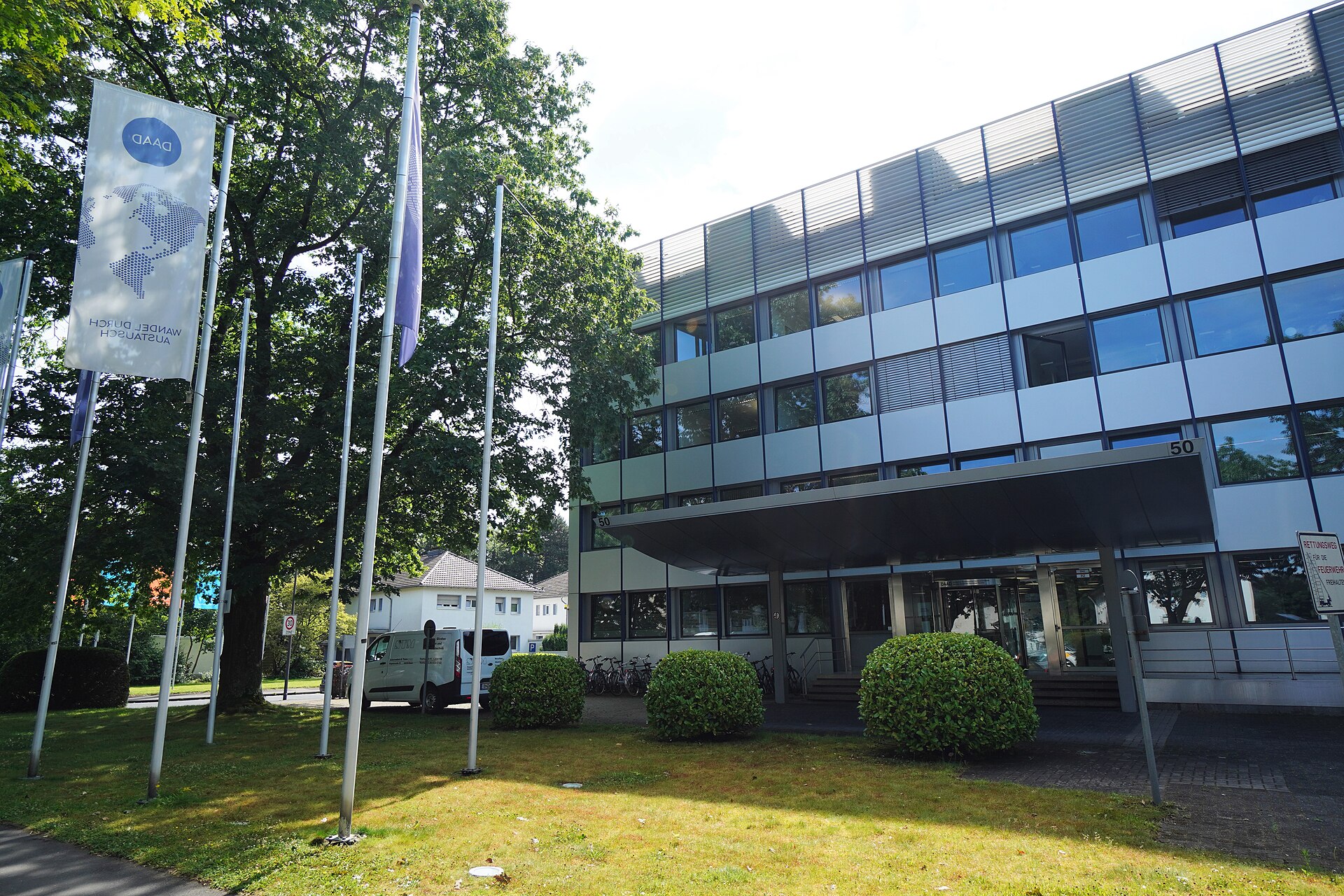
Source: Wikimedia Commons — DAAD headquarters in Bonn

What the HSK award actually pays
DAAD’s programme page states the aim in one sentence: help students and graduates improve their German — general and subject-specific — and their knowledge of the country. Courses run at public or state-recognised universities and at language schools tied to those universities. They must be in person and in German.
Typical coverage, with amounts set per country of residence on the DAAD portal:
| Component | What is covered |
|---|---|
| Course fee | Paid directly to the course provider |
| Housing | A single room for the full course (hall, shared flat, or homestay) |
| One-off cash grant | Living money paid in cash in Germany; it is not wired abroad |
| Travel allowance | A lump sum based on the country you travel from |
| Insurance | Health, accident, and personal liability |
Regional DAAD offices publish different cash-grant figures. India’s office, Japan’s 2026 HSK leaflet, and third-party summaries do not always match. Treat the figure on your country’s announcement in the DAAD scholarship database (programme 50035295) as the only binding number.
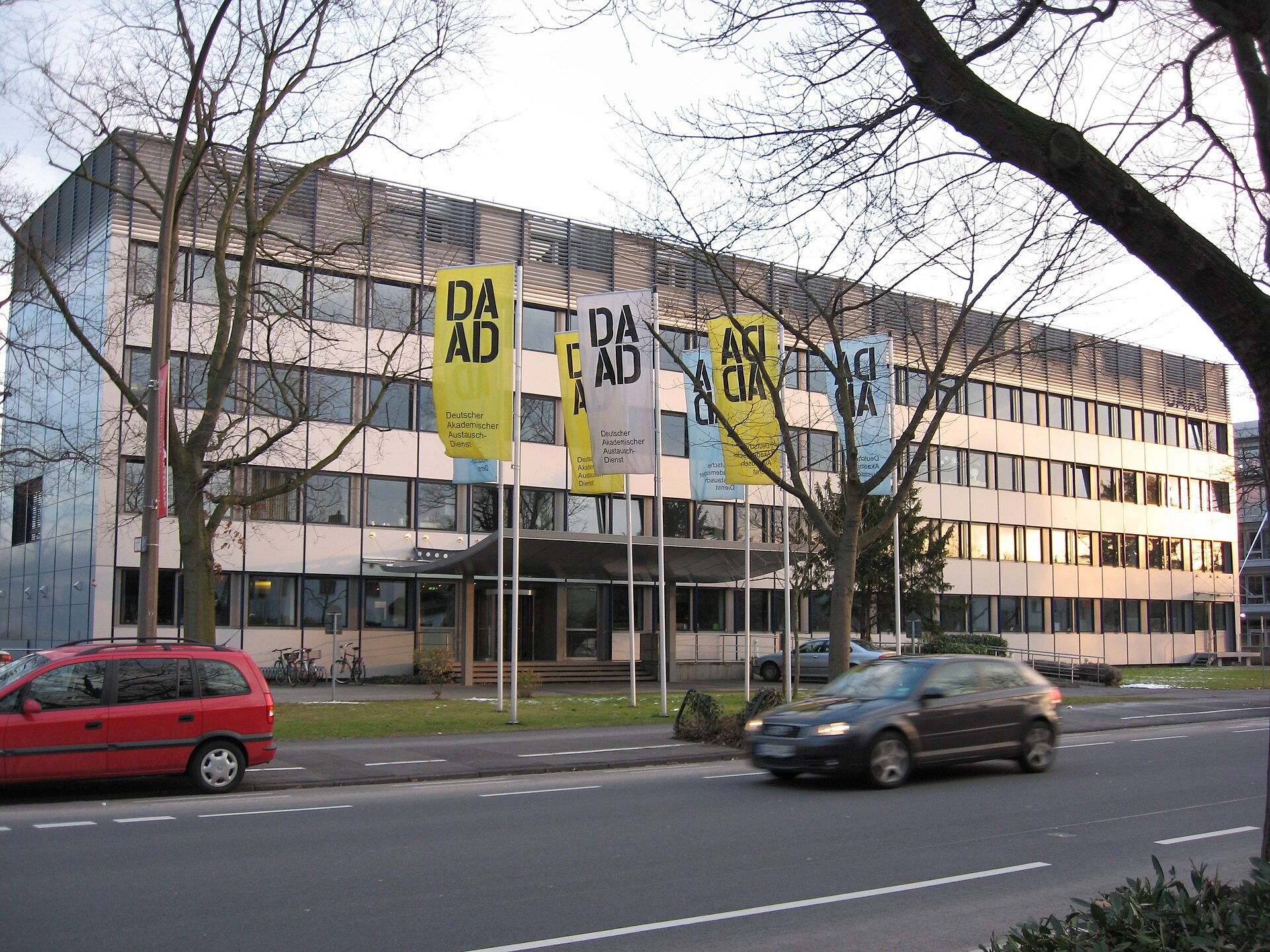
Source: Wikimedia Commons — DAAD Bonn

Source: DAAD TUNISIE on YouTube
Who can apply — and who is cut on day one
The 2026–2027 call, as restated by DAAD India for the global programme, sets three hard filters:
- You must be a full-time bachelor’s or master’s student in any field.
- Bachelor’s applicants must have finished at least two academic years by the time the course starts. Final-year bachelor’s students and final-year master’s students are not eligible.
- You must hold a B1 German certificate from the approved list, no more than 12 months old on the application date.
Accepted certificates named in the call: onSET-Deutsch, TestDaF, Goethe-Institut, DSD, DSH, telc Deutsch, ÖSD, and a German Abitur for specialised-language courses only.
The final-year ban is deliberate. DAAD wants you back at your home university to finish the degree. If you graduate in summer 2027, skip HSK and read the DAAD 2027 master’s scholarship guide instead.
Dates you should put in your calendar
| Stage | Date |
|---|---|
| Portal opens | 1 September 2026 |
| Portal closes | 30 October 2026, 24:00 Central European Time |
| Course window | June–September 2027 (at least 18 teaching days, typically 3–4 weeks) |
| Teaching load | At least 25 hours a week, usually five days a week |
Do not file on the last evening. A portal outage on 30 October is your problem, not DAAD’s.
How to apply in six concrete steps
1. Open the database and switch the country filter to where you live now. The programme is global; the form and the travel lump sum are not. Start from the HSK record in the DAAD database.
2. Get the B1 certificate before you start the form. Some offices run onSET sittings with limited seats. A C1 certificate older than twelve months still fails the freshness rule.
3. Pick three courses from DAAD’s list. After selection, DAAD assigns the place. Most national calls forbid changing preferences after submit.
4. Upload transcripts and a current enrolment letter. The letter must show you are a registered student and that you will not be in your final year during the course.
5. Write a short language plan, not a leadership essay. Two honest paragraphs: why B1 now, and which home-university module you will take in German afterwards.
6. Submit a week early. Screenshot the application ID. Email submissions are not accepted.
If you need a certified translation or a second pair of eyes on the letter, Truescho’s Apply for Me service handles the file. It does not replace the DAAD portal.
What this means if you are studying in India, Nigeria, or Southeast Asia
For many DAAD regional offices, HSK is one of the few funded routes still open to students who have not yet graduated. Master’s awards such as EPOS ask for a completed degree and, often, two years of work. HSK asks for B1 and two years of undergraduate study already done.
Practical consequences:
- Country of residence, not passport, drives the form. A Nigerian student enrolled in Malaysia applies through the Malaysia announcement, not Abuja, unless the portal says otherwise. Read the residence line twice.
- B1 is the floor, not a decoration. Courses start at B1 or higher. If your certificate is A2, you will not be placed.
- The cash grant is not a salary. Budget food and local transport from that one-off payment. Course fees and the room are the large items DAAD already covers.
- It stacks with a later master’s file. A funded summer at a German university is a fact you can cite in a 2027 DAAD master’s application. It is not a substitute for the master’s award itself.
If your longer-term plan is work in Germany rather than a degree, the Germany Opportunity Card 2026 is a different legal track. HSK does not issue a job visa. It issues a short study stay.
Five mistakes that fail the first administrative check
- A German certificate older than 12 months, even at C1.
- A final-year student who thinks “still enrolled” is enough. The call excludes that group by name.
- Three English-taught summer schools. HSK funds German-taught courses only.
- A Chevening-style leadership essay. The panel is reading for a language plan.
- A university email that dies at graduation. Use an address you will still open in 2027.
Other deadlines in the same season — Chevening closes 6 October and the Erasmus Mundus 2027 wave — compete for your calendar, not for the same seat. HSK lasts weeks, not a full degree year.
| Route | Length | Language | Closes | Who it fits |
|---|---|---|---|---|
| HSK summer (this page) | 3–4 weeks | German B1 | 30 October 2026 | Non-final-year bachelor’s/master’s |
| DAAD master’s scholarship | 10–24 months | Programme-dependent | Varies by country | Graduates with a completed degree |
| Chevening | One master’s year | University English | 6 October 2026 | Applicants with two years’ work |
| Erasmus Mundus | Two-year joint master’s | Programme language | October–January wave | Graduates picking a consortium |
HSK is the only row that a third-year undergraduate can file this month.
A realistic case: third-year engineering, B1 in May, course in August
A third-year engineering student in Pune sits Goethe-B1 in May, opens the HSK portal in September, and lists Heidelberg (technical German), Leipzig (contemporary culture), and Aachen (engineering German). DAAD assigns Aachen. Four weeks, 25 hours, a student room, cash collected at the course office on day two. The grant does not fund restaurants; it funds groceries and a monthly transit pass.
Back home, the attendance certificate sits next to B1 in a later internship file. HSK did not admit anyone to a German degree. It created one sentence that later applications can stand on: “I completed a DAAD-funded summer course at a German university.” Write that sentence only if it is true.
Your next step before 30 October
Open the database today. If your B1 paper will be older than twelve months on 30 October, book a re-sit this week. Choose three courses in three cities so a full Heidelberg list does not kill the file. Submit, then screenshot.
Browse other open awards on Truescho opportunities, and use consultants if the enrolment letter or translations are the bottleneck.
Is the DAAD summer course scholarship open now?
Yes. The portal opened on 1 September 2026 and closes on 30 October 2026 at 24:00 German time. After that, this cycle is closed.
Do I need B1 or is A2 enough?
The 2026–2027 call asks for B1, with a certificate no older than one year. Older North American webinars mentioned A2 for a previous cycle. Do not use that bar for this one.
Can final-year students apply?
No. Final-year bachelor’s and final-year master’s students are excluded. You must return to your home university after the course.
Does the scholarship buy my plane ticket?
DAAD includes a travel lump sum. The amount depends on your country of departure and is printed on your national announcement. It may be less than the ticket you actually buy.
Can I apply without a Goethe certificate?
Yes, if you hold another listed exam: TestDaF, telc, onSET-Deutsch, DSH, DSD, or ÖSD. Goethe is not the only accepted path. The certificate still has to be B1 and recent.
Sources
- DAAD scholarship database — University Summer Courses (HSK), record 50035295 — official programme record.
- DAAD India HSK 2026–2027 call — eligibility and 1 September–30 October portal.
- DAAD Tunisia — official HSK explainer — regional DAAD office.
- Study in Germany (DAAD campaign) — official study-in-Germany portal.
Whether you want a funded summer course or a later master’s award, Truescho lists the live opportunities and the tools to file them.
Browse open opportunities →