

The question engineering managers have been quietly asking for months just got an official answer: where should our code live in the AI era? On August 17, 2026, Cursor announced Origin, its new code-hosting service — a move that takes the world's most popular AI-native editor beyond editing and turns it into a full platform for repositories, pull requests, and CI/CD pipelines. The launch lands just days after SpaceX officially closed its $60 billion acquisition of the company, and it signals where Cursor believes developer infrastructure is heading. Here is exactly what Origin offers, who gets it, and whether your team should care this quarter.
What Origin Code Hosting actually is
Cursor's changelog sums it up in one line: "Cursor can now host your code." Until now, the standard workflow kept your repositories on GitHub or GitLab while Cursor connected to them as an intelligent editing surface. With Origin, the logic inverts: your code can live inside Cursor itself, with GitHub acting as a connected, synchronized counterpart rather than the sole home.
The first release ships with three documented pillars:
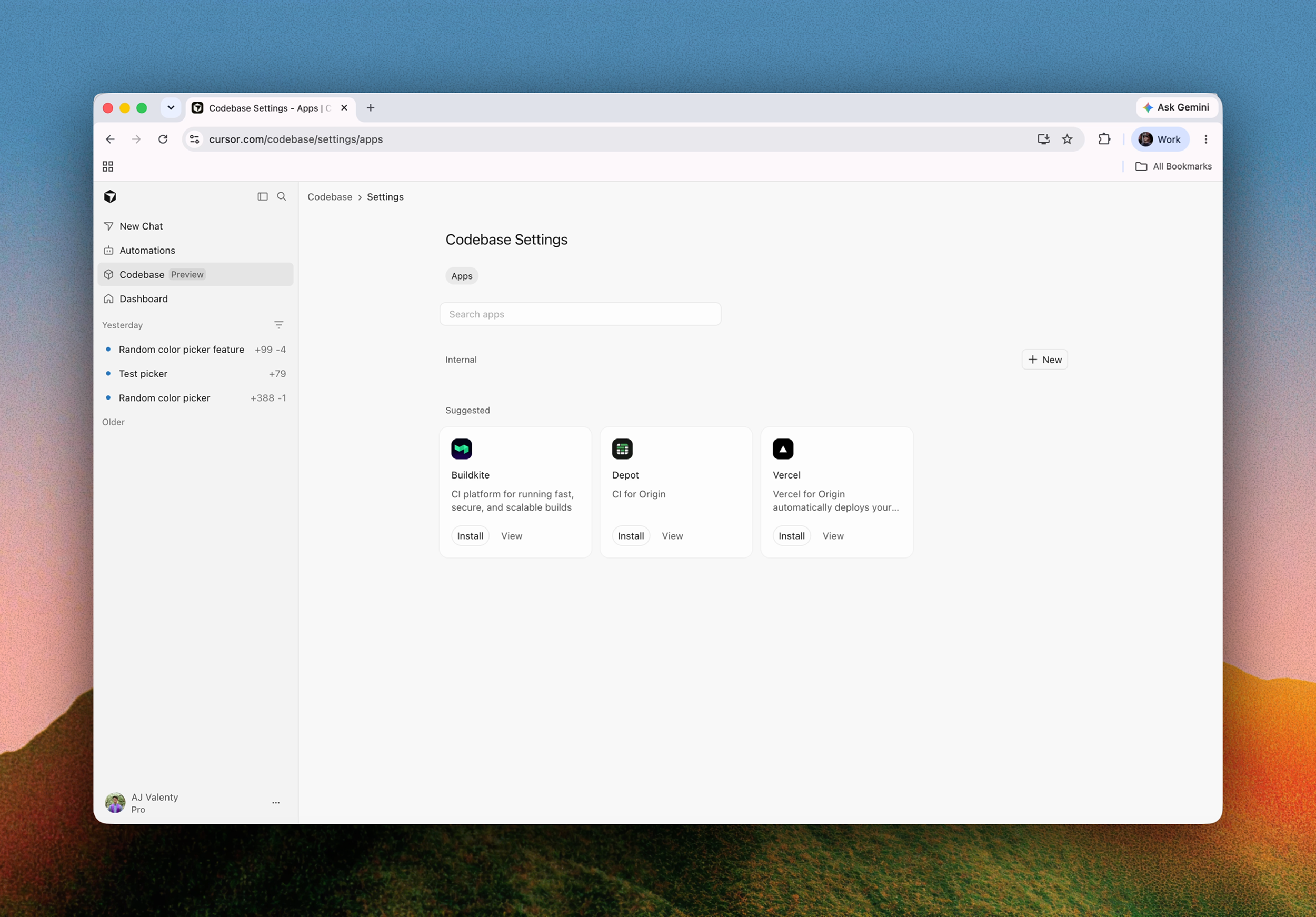
- Origin Repos: A new Codebase tab inside the app. Create a repo with one click, install the CLI, then clone or push your existing local projects. The codebase name you choose once becomes part of your repo URLs, in the form cursor.com/codebase/your-company.
- Two-way GitHub sync: Connect your GitHub account, pick an organization, and select which repos sync into Cursor. Synced repos update in real time, and for repositories that started on GitHub, GitHub "stays the source of truth" — pushes still land there. Comments on pull requests sync both directions "within seconds," GitHub-assigned reviews can be handled from inside Cursor, and you control what syncs and can disconnect anytime.
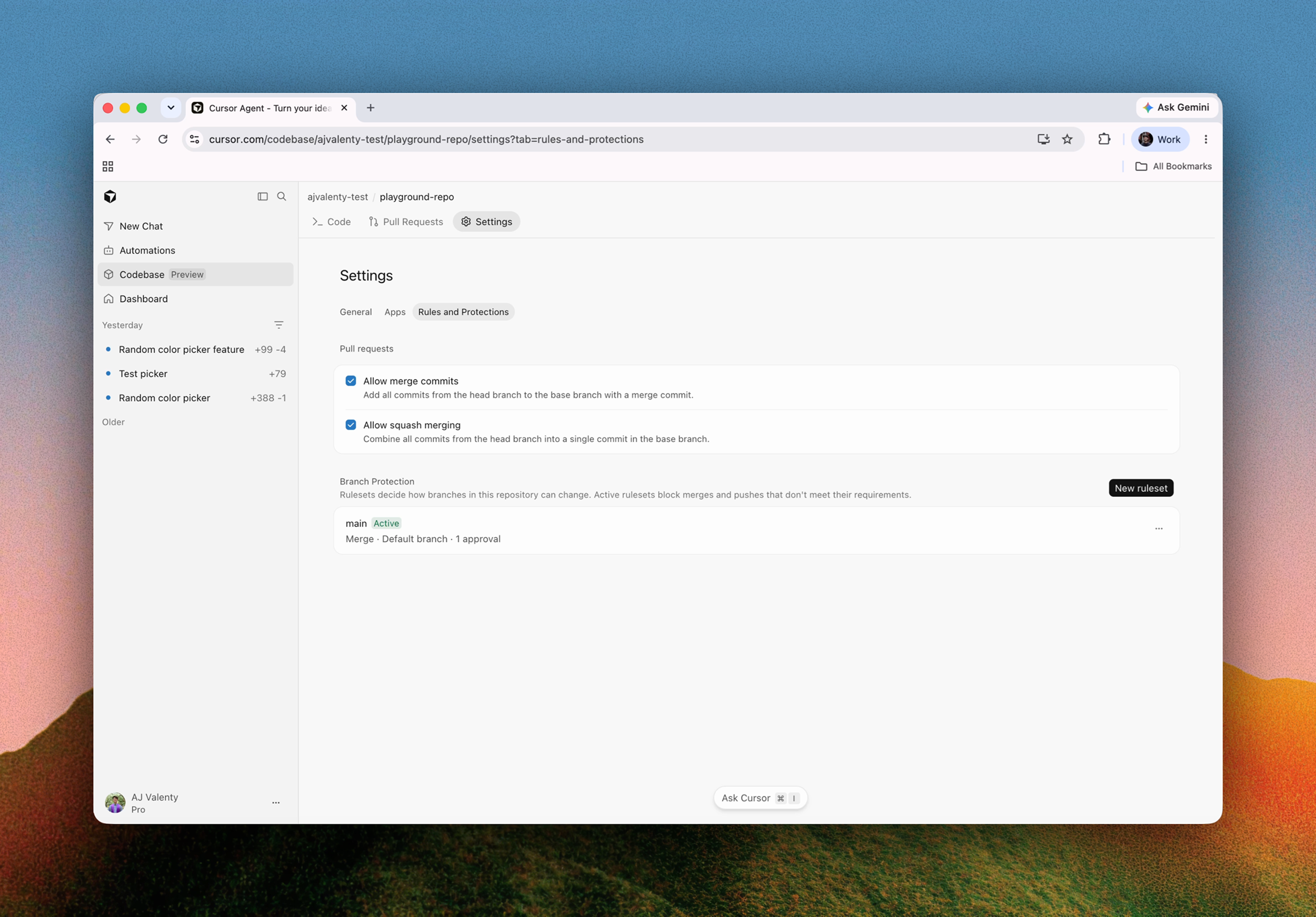
- Full pull requests: Every repo gets a PR experience with timeline, commits, checks, and changed files. Review diffs, comment, and merge — all without leaving the environment your agents already work in.
Source: Cursor — Origin Code Hosting changelog
Agents and AI are the architectural point
Here is what separates Origin from every conventional hosting platform: repositories and pull requests have existed elsewhere for fifteen years. What has not existed is an infrastructure layer where AI agents are first-class citizens.
From any repository view, you can ask Cursor's agent questions about the code you are browsing. It answers, edits files, updates pull requests, and pushes new branches — in place, with full repository context, no copy-pasting URLs into a separate chat window. That is the strategic bet: the longer an agent lives inside a single environment containing the code, its history, and its review process, the better its decisions become and the fewer fragile manual handoffs interrupt its work.
The bet extends into the integration layer. The first version of Origin ships with three announced integrations:
- Vercel: Automatic preview deployments for every pull request, with merges shipping straight to production.
- Depot: Run your existing GitHub Actions workflows unchanged.
- Buildkite: Also runs existing GitHub Actions workflows, with additional support for native Buildkite pipelines.
Source: Cursor — Origin Code Hosting changelog
Why hosting is the logical endgame for an AI editor
Some historical context explains why this move was close to inevitable. When AI coding tools first appeared, they were add-ons: extensions inside your existing environment, fetching suggestions from a cloud service, while your code stayed where it had always lived. Commercially successful — but structurally capped. Every suggestion crossed a bridge between two different worlds, the editing surface and the hosting platform, and every bridge slowed agents down, fragmented their context, and produced strange failure modes.
Then the work itself changed shape. Developers stopped asking for completed lines and started delegating entire tasks: fix this bug, add tests, open a pull request. An agent with that mandate needs permissions across a whole repository — reading history, creating branches, running checks, updating PRs. The deeper those permissions go, the less tolerance there is for shuttling between disconnected platforms. Hosting is not a commercial vanity project; it is the arithmetic consequence of agents evolving from writing assistants into task executors.
This is also why the coming platform wars will look nothing like the editor wars of the last decade. Editors competed on typing experience, and switching between them was cheap because the code lived outside all of them. Platforms compete on how deeply an agent can integrate with the entire lifecycle of code — and every month your team spends inside one environment raises the cost of leaving it. These are platform economics, not tool economics.
Availability, plans, and what it costs
The operational facts from the official announcement:
- Status: early beta.
- Availability: all paid plans, with a rolling rollout that started August 17, 2026.
- Enterprises: excluded by default unless their administrators opt in — a deliberate design choice respecting large organizations' governance requirements.
- Pricing: no separate pricing, storage quotas, or usage limits were announced. The beta is included in existing paid subscriptions.
That structure serves two audiences at once. Small and mid-sized teams already paying for Cursor gain hosting capability at no visible additional cost, while product teams running multiple SaaS subscriptions get a credible path to consolidating their tooling bills.
A safe two-week evaluation plan
For a team of three to ten engineers, the announcement converts into a low-risk experiment:
- Day one: Enable the feature from the new Codebase tab, confirm your plan qualifies, and create your codebase under your organization's canonical name.
- First days: Pick one non-critical repository — a small internal tool — and create it natively in Origin without sync, to learn the platform's native workflow.
- Midweek: Turn on GitHub sync for a second, actively developed repository. Watch how fast comments propagate and how PR state stays consistent in both directions. This is the real test of the promises in the announcement.
- Week two: Connect Vercel to a demo project to test per-PR preview deployments, then assign an agent one genuine task from the repository view and measure completion time against your current workflow.
- End of week two: Hold a three-question decision meeting. Did the team notice less tool-switching? Did you document any data loss or sync conflicts? Are you missing any GitHub feature you use daily? A yes on the first and no on the others argues for gradual expansion; the reverse argues for waiting.
One golden rule governs the whole experiment: never onboard a single production-critical repository during a beta, no matter how tempting the fresh start looks.
What this means for development teams worldwide
- Tool consolidation is a real productivity gain: Most teams today stitch together GitHub for hosting, Cursor for agentic editing, and a separate CI platform. Collapsing those layers into one surface means longer focused sessions and fewer context switches — which is precisely the value teams pay AI tooling for.
- Do not rush a migration: An early beta is not the moment to move hundreds of repositories. Repositories with long histories carry ecosystems — pre-built integrations, webhooks configured years ago, branch protection rules — that partially break on any hasty move.
- A pricing signal worth watching: Including hosting in the existing subscription puts direct pricing pressure on incumbents. If the model sticks, the first winners are startups and mid-market teams currently paying three separate vendors, and the second-order effect is downward pressure across the market. The standard cloud caveat applies: read storage and usage limits before committing, because a generous beta can become a paid tier later, and no official quotas have been published yet.
- The bigger picture: This is the first major product move after SpaceX closed its Cursor acquisition, and the message is clear — the company is building infrastructure, not just tooling. In a world where the developer increasingly supervises intelligent agents, as with xAI's cloud-based Grok Bot teammates, the platform that manages the agents matters more than the editor that writes the code.
Quick comparison: Origin versus GitHub hosting
| Criterion | GitHub | Cursor Origin |
|---|---|---|
| Repositories and pull requests | Fully mature for a decade | First beta with the basics |
| AI agents | Add-ons on top (Copilot) | Built into the browsing experience itself |
| Sync | Standalone reference platform | Two-way with GitHub in seconds |
| CI/CD ecosystem | Enormous marketplace | Vercel, Depot, Buildkite at launch |
| Enterprise governance | Documented at global scale | Large orgs excluded by default |
| Pricing | Known and stable | Included in paid plans, no published quotas |
A fair reading: the two platforms are not peers in maturity, and the gap between a decade-old feature set and a day-one beta should discipline any serious comparison.
Honest limitations
- Early in every sense: The announced scope is "the basics" — repos, pull requests, code browsing, sync. Deeper agent-native features are explicitly promised "later."
- GitHub-only sync for now: No GitLab, no Bitbucket in the first announcement, and teams standardized on Azure DevOps are outside the picture entirely.
- No storage quotas or usage limits published: Normal for a beta, but a gap anyone building on it should know exists.
- One source of truth: Repositories born on GitHub remain GitHub's to govern — meaning Origin functions as a parallel working layer, not a full replacement, in that scenario.
- The cost of early adoption: Wiring your entire workflow into one platform hands that platform lasting negotiating power over your team. A trade-off to weigh consciously, not with launch-day enthusiasm.
Frequently asked questions
Is Origin Code Hosting free?
It is included in Cursor's paid plans during the current beta. The company has announced no separate pricing or official storage quotas as of this article.
Does using Origin mean leaving GitHub?
Not necessarily. Two-way sync keeps GitHub as the source of truth for repositories that started there, with comments and activity reflected in both directions within seconds. Repositories created directly in Origin live on Cursor by default.
How do I create a repository in Origin?
Open the new Codebase tab in the app, click to create a repository, install the CLI, then clone or push your local projects. Your codebase name becomes part of the repo URL in the form cursor.com/codebase/name. Full documentation is at cursor.com/docs/origin.
Is it suitable for large enterprises?
Not yet. The announcement excludes enterprise organizations by default unless their administrators explicitly opt in, reflecting the governance sensitivities large companies have around source-code hosting.
How is this different from Cursor's existing GitHub repository sync?
Regular sync makes Cursor a reader and editor of repositories that live elsewhere. Origin provides repositories resident inside Cursor, with pull requests, review, and deployment and CI integrations on the same platform.
Where the market goes from here
The deeper message of this launch is directional. Developer tooling is shifting from "editors that connect to AI" to "complete work platforms where the agent moves between code, review, and deployment without leaving the environment." Days earlier, the same company shipped an update making its cloud agents start three times faster — and the map completes itself: faster agents, code infrastructure, and native deployment integrations.
For the rest of the market, the questions are now open. Does GitHub answer with equivalent agent depth? Do other platforms follow the hosting-plus-editor consolidation? What is close to certain is that separating "where your code lives" from "what understands and edits it" will not last — and the ultimate winner is the team that experiments early and commits with a cool head.
For anyone planning next year's tooling budget, one accounting exercise: total the cost of your three separate subscriptions — hosting, editing, deployment — and put that number next to the prospect of consolidating them. If consolidation arrives, the annual saving for a ten-engineer team can fund a full plan upgrade. If it does not, you will have documented a precise baseline to measure every future offer against. Either way, two weeks of disciplined experimentation cost less than years of unmeasured dependency.
We will keep following AI developer tooling on Truescho's AI tools.
Sources:
- Cursor — official Origin Code Hosting changelog
- Origin documentation on cursor.com
- Cursor — cloud agents start 3x faster