
Are Coursera Certificates Recognized in Canada? 2026 Guide for Jobs, PR and Universities
Last updated: August 2026
💬 Disclosure: Some links in this article are affiliate links. We may earn a small commission when you complete a purchase at no extra cost to you. This helps us keep our content free, and it does not affect the integrity of our recommendations.
Immigration, Refugees and Citizenship Canada is unambiguous about what counts as education for Express Entry. An educational credential assessment confirms that a degree, diploma or certificate earned outside Canada is valid and equal to a completed Canadian credential. A Coursera course, Specialization or Professional Certificate is not that object. World Education Services, one of the IRCC-designated bodies, evaluates degrees and diplomas earned outside Canada and states that it does not evaluate occupational or trade qualifications.
So the legal frame is simple. Canadian employers may read a Coursera certificate as a skills signal. It is not a Canadian academic accreditation. It is not an ECA-eligible credential. It does not earn Express Entry education points. It does not replace a provincial licence. The only clean exception is a real university degree delivered through Coursera Degrees: the credential being assessed is the university’s degree, not “a Coursera certificate”.
This page stays inside that frame. For the global employer overview, use are Coursera certificates recognized in 2026. For the British regulator version of the same problem, see is a Coursera certificate valid in the UK.
Are Coursera certificates recognized in Canada?
Recognized by whom?
A hiring manager in Toronto or Calgary may recognize the Google, IBM or university brand on the certificate and treat it as evidence that you finished a structured skills programme. That is a labour-market judgement. It is not a government decision.
IRCC does not recognize a Coursera Professional Certificate as a completed foreign degree or diploma for Express Entry education points. Provincial professional regulators do not recognize it as an accredited programme for engineering, nursing, law, accounting or teaching. Canadian universities do not automatically recognize it as transfer credit.
Three facts should sit at the top of any Canada plan:
- A Coursera course / Specialization / Professional Certificate is a completion record from a platform and a content partner.
- An ECA is an assessment of a completed secondary or post-secondary credential earned outside Canada.
- Those are different documents. One cannot be stretched into the other.
If someone on a forum told you to “do Google Data Analytics so WES will give you extra points”, they described a process that does not exist on the IRCC page.
The rest of this article answers the questions people actually search, in the order they usually discover the problem.
Is a Coursera certificate valid in Canada for jobs?
Valid for a job search is not the same as valid for permanent residence.
In software, data analytics, digital marketing and some project-coordination roles, Canadian employers are used to non-traditional learning. A certificate plus a portfolio can help a career switcher get past an automated screen, especially when the posting lists SQL, Python, Tableau or Google Ads by name. The certificate is a label. The work sample is the evidence.
It does not make you equally competitive with a candidate who already has Canadian experience, a Canadian diploma the posting asked for, or a provincial licence the law requires. Job descriptions that say “bachelor’s degree required” mean a bachelor’s degree. Job descriptions that say “P.Eng. required” mean a provincial engineering licence.
A practical way to use the certificate in Canada:
- Put it under Professional development, not under Education beside your degree.
- Name the issuer (Google, IBM, Meta, University of Alberta, and so on) and the platform.
- Link a project hosted on GitHub, Tableau Public or a personal site.
- On LinkedIn, file it under Licenses & certifications. The walkthrough is in how to add a Coursera certificate to LinkedIn.
A software engineer already working in Toronto who completes an IBM Data Science Professional Certificate is buying a structured syllabus and a shareable record. That can be rational. An applicant in Lagos, Karachi or Manila who completes the same certificate and expects it to move a Comprehensive Ranking System score is buying the wrong product.
If you are choosing programmes because they photograph well on a résumé, use best Coursera career and résumé courses and be ruthless: one relevant certificate beats five decorative ones.
Is Coursera accredited in Canada?
No Canadian ministry of education “accredits Coursera”.
Accreditation in Canada attaches to institutions and to specific programs, usually through provincial quality-assurance bodies and, for professional programs, through the relevant regulator. Coursera is a Californian platform that hosts content from universities and companies. Hosting is not accreditation.
A university partner being a recognized university does not turn every short course from that partner into a Canadian-accredited program. The University of Toronto can be a respected Canadian institution and still offer an open online course that confers no University of Toronto credit. Read the credential sentence on the course page. If it promises a shareable certificate and does not promise the university’s degree, you are buying the certificate.
Coursera Degrees are different. They are the university’s own bachelor’s or master’s, delivered on the platform. Accreditation, if any, is the university’s, in the university’s jurisdiction. That degree can later be the input to an ECA if you earned it outside Canada. The input is the degree. It is not the platform brand.
Do not write “Coursera, accredited in Canada” on a form. There is no such box that means what applicants hope it means.
Can a Coursera certificate get Express Entry education points?
No.
IRCC’s education points in Express Entry come from a completed credential that an ECA (for foreign education) or a Canadian credential (if you studied in Canada) can support. The official explanation is on IRCC’s education assessment page.
You need an ECA if you completed your education outside Canada and you want to be eligible as a principal applicant in the Federal Skilled Worker stream, or you want to claim points for foreign education. You do not need an ECA for a credential you completed in Canada.
A Coursera course, Specialization or Professional Certificate is not a completed foreign degree or diploma of the kind that page describes. It therefore produces zero Express Entry education points. There is no hidden CRS line for MOOCs.
To see why people get confused, look at the official education-point examples IRCC publishes for the Comprehensive Ranking System. These are illustrative of how completed credentials are scored, not an invitation to map a Google certificate onto them:
| Completed credential (once properly assessed) | Points with a spouse | Points without a spouse |
|---|---|---|
| Master’s | 126 | 135 |
| Bachelor’s, three or more years | 112 | 120 |
| Two-year diploma | 91 | 98 |
| One-year certificate | 84 | 90 |
| Coursera completion certificate (Google / IBM / university Specialization) | 0 | 0 |
The last row is not on IRCC’s table. That is the point. It does not enter the table.
Two more IRCC rules that applicants skip:
- An ECA report must be less than five years old when you create your profile and when you apply.
- An ECA does not guarantee a job and does not grant a licence to practise. Licensing is provincial.
- In most cases the assessment looks at your highest credential. To claim points for two or more credentials, each one needs an assessment, and one of them must be from a program of three years or longer.
None of those rules create a side door for a Professional Certificate.
The only honest exception is unchanged: if you completed a real university degree through Coursera Degrees, the ECA — if you need one — evaluates that degree. Ask the designated organization how they want the documents sent. Do not send them a Coursera course PDF and hope.
This is not immigration advice. It is a reading of the public IRCC page. Rules change. Recheck the official site before you pay any fee.
How the Express Entry education box actually works
When you create an Express Entry profile you are asked what education you have completed. The drop-down is built around completed secondary and post-secondary credentials — high school, one-year certificates, two-year diplomas, three-year or longer bachelor’s degrees, master’s, professional degrees, doctorates. A Coursera Professional Certificate does not have a truthful home in that list.
If you select “one-year certificate” because a Google programme felt about a year long, you have misrepresented the credential. IRCC can ask for the ECA that supports the line. The ECA will not appear, because WES and the other designated bodies are not in the business of assessing that PDF. A profile built on a guessed drop-down is a profile you may have to tear down later.
The safe sequence is boring, and that is why forums skip it:
- List only credentials you can support with transcripts and, if they were earned outside Canada, with an ECA from a designated organization.
- Create the Express Entry profile against those credentials.
- Keep skills certificates on the résumé you send to employers, not in the education field of the profile.
Federal Skilled Worker eligibility also has a separate education floor. You cannot meet that floor with a platform completion certificate. If your only post-secondary document is a Coursera Specialization, you are not looking at an Express Entry education strategy. You are looking at a different pathway entirely — and you should read IRCC, not a course landing page, before you spend.
Language points, arranged employment, provincial nomination and Canadian work experience are the levers that actually move a CRS score. A new Professional Certificate is not on that list. Spend the study hours on IELTS or CELPIP if the language score is the constraint. That is usually the higher-return study decision for a PR file.
Canadian Experience Class applicants who already completed a Canadian degree or diploma do not use an ECA for that Canadian credential. Adding a Coursera certificate after arrival still does not create a second education-points event. It is, again, a résumé line.
If a consultant offers to “bundle” Professional Certificates into an Express Entry file for a fee, ask them to show the IRCC page that lists the product. They will not find one. Keep the money for language testing or for the designated ECA of the degree you already hold.
Will WES or another ECA body evaluate a Coursera certificate?
Source: World Education Services
Not as an occupational or trade qualification, and not as a substitute for a degree.
IRCC designates specific organizations to issue ECAs for Express Entry. The list on the official page, with the designation dates IRCC publishes, includes:
- Comparative Education Service – University of Toronto School of Continuing Studies (17 April 2013)
- International Credential Assessment Service of Canada (17 April 2013)
- World Education Services (17 April 2013)
- International Qualifications Assessment Service, Alberta (6 August 2015)
- International Credential Evaluation Service – British Columbia Institute of Technology (6 August 2015)
Separate professional bodies are designated for specific occupations, including the Canadian Architectural Certification Board, the Medical Council of Canada, and the Pharmacy Examining Board of Canada. Those assessments serve their professions. They are not a workaround for a MOOC.
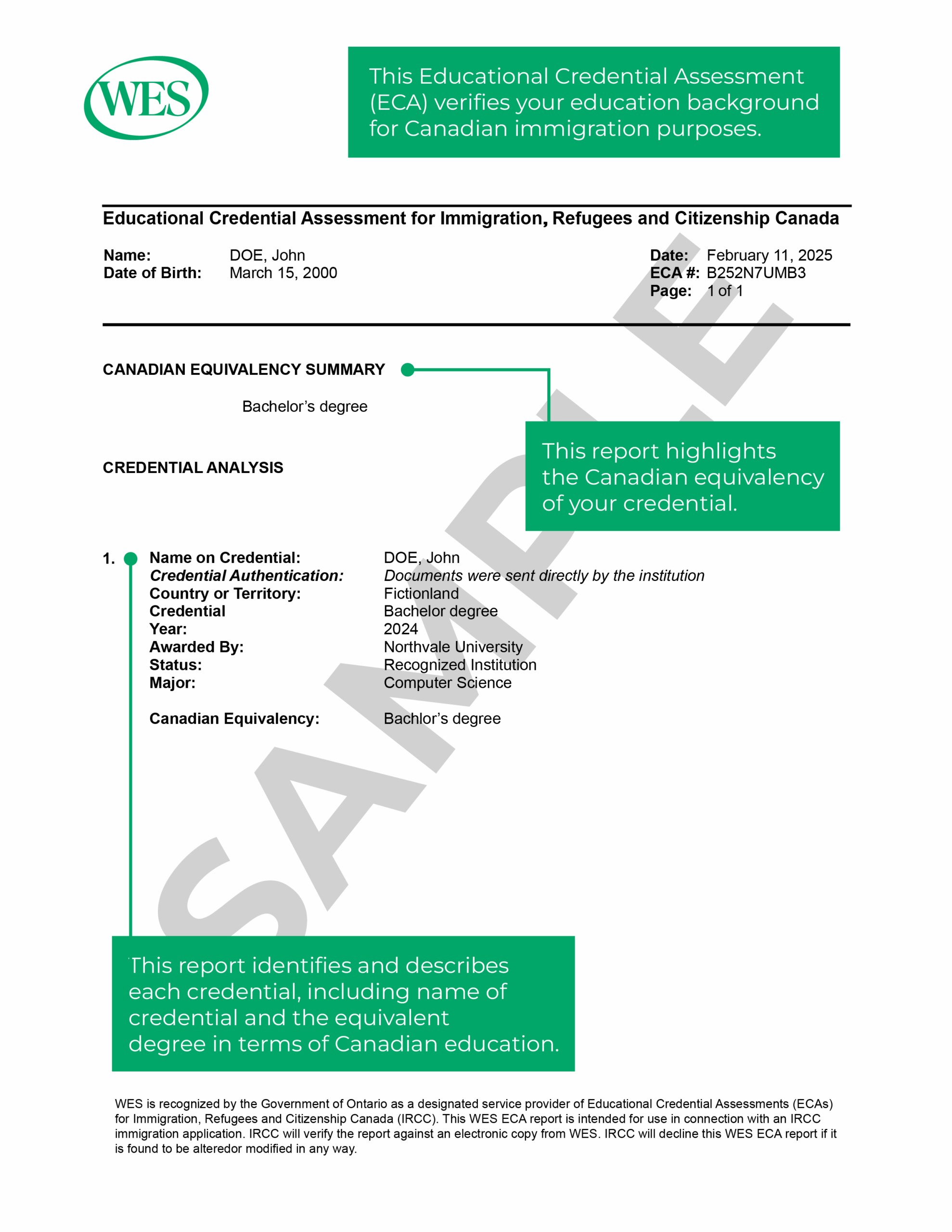
WES is the name most applicants know. Its ECA page states that it is designated to evaluate degrees and diplomas earned outside Canada. A WES ECA report is valid for five years from the date of issue. WES also states, in plain language, that WES does not evaluate occupational or trade qualifications.
A Google Data Analytics Professional Certificate is an occupational skills programme. An IBM Data Science Professional Certificate is an occupational skills programme. A four-course university Specialization that “does not carry university credit” is not a diploma. Those products sit on the wrong side of the WES sentence.
Do not pay for an ECA in the hope that a Coursera PDF will come back as “equivalent to a Canadian one-year certificate”. You would be paying for an application that does not match what the organization evaluates.
Check IRCC before you pay any evaluation fee

Source: World Education Services
Use this sequence. It is slower than a forum rumour and cheaper than a refused report.
1. Open the IRCC education assessment page. Confirm you actually need an ECA. Canadian credentials do not.
2. Confirm which designated organization you will use. WES is one option, not the only option.
3. Confirm the credential you want assessed is a completed secondary or post-secondary degree, diploma or certificate from an institution, with official documents the organization will accept.
4. If the only document you hold from the last twelve months is a Coursera completion certificate, stop. That is not the input.
5. If you hold a foreign bachelor’s and a Coursera certificate, send the bachelor’s. The certificate can live on your résumé. It does not belong in the ECA packet as a second degree.
What WES typically wants, for the credentials it does evaluate, is official documentation from the teaching institution — transcripts sent the way WES specifies, sometimes in a sealed envelope or via a digital official channel. A Coursera confirmation email, a downloadable PDF, and a LinkedIn badge are not that packet. They are useful for a hiring manager. They are the wrong object for an ECA application. If the only new document you can produce is the PDF, you do not have an ECA case; you have a skills-certificate case.
Do Canadian universities accept Coursera for transfer credit?
Not as a default, and not as a right.
Canadian universities and colleges decide their own transfer-credit and prior-learning rules. There is no national switch that converts Coursera hours into credits at UBC, McGill, University of Toronto or a public college in the Prairies.
Some institutions will look at prior learning case by case. That process usually wants detailed syllabi, hours, assessment evidence and a close map onto a specific course they already teach. A beginner Professional Certificate is a weak file. A credit-bearing course from the same university, taken as a visiting student, is a different file.
If a Canadian university is also a Coursera partner, that still does not mean its open courses carry that university’s credit. Many partner courses are explicit: shareable certificate, no university credit.
Do this instead of assuming:
- Read the official transfer-credit page of the faculty you want.
- Email the admissions or registrar office with the exact course URL and ask whether credit is possible.
- Keep the written answer.
- If the answer is no, use the course as preparation, not as a shortcut around tuition.
Applicants who need a Canadian credential for points should enrol in a Canadian designated learning institution and complete that credential. That is a study-permit and funding decision, not a MOOC decision. Truescho lists study and scholarship routes on opportunities; that page is not an immigration service and it will not turn a Coursera PDF into an ECA.
Will a provincial licensing body accept Coursera instead of an accredited program?
No. Not in place of the accredited program the statute or the by-law names.
Licensing in Canada is provincial. The same occupation can have different application packets in Ontario, Alberta and British Columbia. What does not change is the basic pattern: the regulator wants an accredited degree or diploma, an exam, supervised practice, and sometimes a language test. An open online certificate is not that degree.
Examples of gates you cannot bypass with a MOOC:
- Engineering — provincial associations such as Professional Engineers Ontario and APEGA, coordinated at the national level by Engineers Canada. They assess accredited engineering programs, not four-week Specializations.
- Nursing — bodies such as the College of Nurses of Ontario. Registration follows an approved nursing program and the national exam path, not a Coursera anatomy course.
- Law — the National Committee on Accreditation plus the provincial law society. A Coursera business-law course is general interest.
- Accounting — CPA Canada and the provincial CPA bodies. The CPA Professional Education Program is not a Professional Certificate on a platform.
- Teaching — provincial teacher-regulation offices. Certification follows an approved teacher-education program.
If you already hold the foreign professional credential and you are seeking Canadian licensure, follow that regulator’s document list. An ECA for Express Entry and a professional assessment for a licence are different processes. IRCC says so. Completing a Coursera course in the meantime can help you learn local software or refresh theory. It does not move the licence.
Check the regulator in the province where you will live. Do not rely on a blog’s generic list — including this one — as a substitute for that page.
What can a Coursera certificate actually do for a Canada job search?
It can do four useful things and it cannot do the four things applicants usually want.
It can show a structured attempt to learn a named tool. It can give you a project to discuss in a Canadian behavioural interview. It can fill a gap between a foreign degree and a posting that lists Canadian-flavoured tools. It can be cheap CPD once you already have status and a job.
It cannot add CRS education points. It cannot replace an ECA. It cannot replace a provincial licence. It cannot replace a degree the posting required.
| Goal | What a Coursera course / Specialization / Professional Certificate does | What it does not do |
|---|---|---|
| Get a tech or marketing interview | Sometimes helps, with a project | Guarantee a callback |
| Claim Express Entry education points | Nothing | Produce a CRS line |
| Obtain an ECA | Nothing | Become a WES-evaluable diploma |
| Gain a provincial licence | Nothing as a substitute program | Satisfy PEO, CNO, NCA, CPA or a teacher regulator |
| Transfer into a Canadian university | Only if that university agrees in writing | Create automatic credit |
| Strengthen a résumé you already have | Useful under Professional development | Belong under Education as a degree |
Two applicants, same certificate, different outcomes
Amina, software engineer in Toronto, already on a work permit. She takes a data-analytics Professional Certificate because her team is moving reporting into BigQuery. She lists it under Professional development, ships a dashboard, and uses the vocabulary in her next internal interview. The certificate did a training job.
Daniel, Express Entry hopeful in Manila. He holds a three-year foreign diploma and a new Google certificate. He wants the Google certificate to “top up” his CRS education points to bachelor’s level. IRCC has no such top-up. His ECA, if he obtains one, will speak to the diploma. The Google certificate stays on the résumé. If his score is short, he needs language points, work-experience documentation, a provincial nominee path, or a Canadian credential — not another MOOC.
Kemi, career switcher in Lagos targeting Toronto data roles, not yet in the pool. She already has a Nigerian bachelor’s that WES can assess. She does not need another education document. What she needs, if she wants Canadian interviews later, is a portfolio. One focused Professional Certificate plus three public notebooks is a job-search plan. Treating the same certificate as a second credential for CRS is an immigration plan that IRCC’s page does not support.
Those stories are why a single global blog post about “recognition” fails Canadian readers. The job-market answer and the immigration answer diverge.
A Canadian résumé block that stays honest
Professional development
IBM Data Science Professional Certificate — IBM via Coursera, 2026
Capstone: classification model on a public housing dataset (GitHub)

Education
B.Sc. Computer Science, University of Lagos, 2019
(WES ECA: equivalent to a Canadian bachelor’s degree — report date 2025)
Notice what is missing. There is no “equivalent to a Canadian one-year college certificate” line under the IBM programme. There is no Express Entry points claim. The ECA sentence attaches only to the degree WES actually evaluated.
When is a Coursera certificate the wrong Canada purchase?
Do not pay for a Coursera certificate as part of a Canada plan if:
You are buying it for CRS education points. Those points will not appear.
You think WES will convert it into a one-year Canadian certificate. WES has said it does not evaluate occupational or trade qualifications.
You need a licence in the province where you will settle. Take the regulator’s required program.
A job posting requires a degree and you do not have one. The certificate will not become one.
You cannot produce a project. Canadian hiring managers will ask what you built.
You have not yet read the IRCC page yourself. Read it before you spend.
If you still want the skills, buy the smallest product that teaches the skill. Compare Coursera Plus against a single-programme subscription. Official Plus prices displayed in August 2026 included about USD 59 a month or USD 399 a year, with regional variation; your account may show CAD at checkout. Cancel when the project is done.
What should you use instead of Coursera for Express Entry or licensing?
For Express Entry education points: a completed foreign degree or diploma that a designated ECA organization will assess, or a completed Canadian credential. Nothing else.
For a licence: the provincial regulator’s approved program and exam. No platform shortcut.
For a Canadian classroom credential: a public college or university program. That is time and money. It is also the document IRCC understands.
For skills only: a targeted Coursera Professional Certificate, an edX course, a vendor exam, or a free syllabus plus a public portfolio. Pick the cheapest path that produces work you can show.
For choosing the product type: course vs Specialization vs Professional Certificate.
Browse current listings on Truescho courses only after you have decided you are shopping for skills, not for points.
The question nobody answers
Applicants keep asking whether Coursera is “recognized in Canada” because they want one word that works for IRCC, WES, a dean and a hiring manager. That word does not exist.
The precise answer is a split screen. On the employment side, a named Professional Certificate can be a useful, unregulated skills record — if you can demonstrate the work. On the immigration side, a Coursera course, Specialization or Professional Certificate is not an ECA-eligible credential and does not earn Express Entry education points. WES evaluates degrees and diplomas earned outside Canada; it does not evaluate occupational or trade qualifications. Provincial regulators will not accept the certificate in place of an accredited program. The only time “Coursera” appears in a successful education-points story is when the applicant actually earned the university’s degree and had that degree assessed.
Read it on IRCC and on WES before you pay anyone — including us — for a course you hoped would do an immigration job it cannot do.
Sources
- IRCC — Get your education assessed (ECA) — when you need an ECA, designated organizations, validity, what an ECA does not do
- World Education Services — ECA — designated to evaluate degrees and diplomas earned outside Canada; does not evaluate occupational or trade qualifications
- Coursera Plus — current subscription display prices and terms