

Cost of Living in Kuwait 2026: Complete Expat Guide With Real Budgets
Relocating to Kuwait on a KWD 800 offer? Before you sign it, you need an honest picture of the cost of living in Kuwait in 2026 — rent by district, groceries at real supermarket prices, school fees after this year's changes, and the new insurance charges most guides still ignore. The starting point is better than you may expect: Kuwait is now the cheapest Gulf state to live in, ranks first in the region for purchasing power, and still charges no personal income tax.
Quick answer: a single person needs about KD 239 a month excluding rent — roughly $780 — or KD 450–530 all-in with a one-bedroom flat. A family of four needs around KD 902 before rent, which lands at KD 1,300–1,600 with a three-bedroom apartment, schooling and insurance. Inflation is running at just 2.19%.
One dinar trades near $3.26, so every figure below carries its dollar equivalent. If you are not yet through immigration, read our Kuwait work visa 2026 guide first, because your visa class determines which costs you actually face.
How to build your monthly budget in five steps
Start with rent, because housing is one-third of Kuwait's consumer price basket. Then layer groceries, transport and utilities at real 2026 prices, price schooling and insurance before you negotiate salary, and hold a ten percent buffer. Done in that order, the exercise takes one evening and prevents the classic first-year cash squeeze.
Step 1 — Lock your rent before anything else
Housing carries a 33 percent weight in Kuwait's official inflation basket, more than food and transport combined, so no other decision moves your budget as much. A one-bedroom apartment in central Kuwait City runs around KD 284 ($925), while the nationwide central average is KD 255 ($830). Outside the centers, one-bedroom rents drop to about KD 190 ($620).
Decide your district before you fly. Salmiya, the expat hub, prices higher than the capital — about KD 327 ($1,065) for a central one-bedroom. Furnished units carry a premium over unfurnished ones, and most leases run twelve months, so a rushed week-one signing is expensive to undo.
Step 2 — Price food from a real supermarket basket
Groceries in Kuwait are cheaper than newcomers expect, but they are the fastest-rising category: food inflation hit 5.55 percent in June 2026 against a headline rate of 2.19 percent. Budget from actual prices, not from home-country memories. The current snapshot per kilogram or liter: milk KD 0.49, bread KD 0.35, rice KD 0.61, a dozen eggs KD 0.71, chicken KD 2.09, beef KD 3.27, and a 1.5-liter bottle of water KD 0.17.
Eating out spans every budget. An inexpensive restaurant meal costs KD 2.50, a mid-range dinner for two runs KD 16, and a cappuccino is KD 1.58. A single professional who cooks mostly at home and eats out weekly spends around KD 90–110 a month on food; families buying imported brands should budget roughly KD 250–280.
Step 3 — Add transport and utilities
Transport is where Kuwait quietly subsidizes your life. Gasoline costs KD 0.11 per liter — about $0.36 — among the cheapest fuel on earth, a bus fare is KD 0.25, a monthly pass is KD 15, and taxis start at KD 1 plus KD 1 per kilometer. A driver who owns a car and commutes daily can hold transport under KD 45 a month including fuel.
Utilities are equally gentle. Electricity and water for an 85-square-meter flat average KD 17.32 a month, a mobile plan runs KD 6.60, and home internet KD 10.66. Expats from Europe will find the combined utilities line — under KD 35 for a small household — almost implausibly low compared with home.
Step 4 — Price schooling and insurance before you sign
For families, this step decides whether an offer works — not rent. International primary school tuition averages KD 2,182 a year (a range of KD 1,200–3,000), and private kindergarten runs about KD 96 monthly. Two children in a mid-range international primary therefore add roughly KD 200–500 a month depending on the school bracket, a number that can swing a family budget by more than the difference between districts.
Health insurance changed in 2026: the state raised expatriate health-insurance fees while exempting nine categories of residents, and we detail the new fee structure and exemptions in our guide to health insurance for expats in Kuwait. Single professionals absorb the cost easily; families should confirm their category in writing before accepting a package that excludes insurance.
Step 5 — Keep a buffer and re-check after 90 days
The final step is discipline: add ten percent to your computed total and re-check the numbers after your first ninety days. Headline inflation was 2.19 percent in June 2026 — the lowest reading in months and among the lowest since 2020 — but food at 5.55 percent shows where drift happens. Average net salaries sit near KD 975 nationwide, so a buffer also protects you against the salary-timing gaps that come with any new posting.
What you will actually spend: two computed budgets
A single professional living outside the city center spends about KD 450–530 a month all-in, including rent. A family of four with a three-bedroom flat and two school-age children needs KD 1,300–1,600 before any buffer. These are our computed figures built from the May and June 2026 price snapshots above — not round-number guesses.
Single professional, one-bedroom outside the center:
| Expense | KD per month | USD equivalent |
|---|---|---|
| Rent, 1-bedroom outside center | 190–257 | 620–840 |
| Electricity and water | 17 | 56 |
| Mobile and internet | 17 | 56 |
| Groceries | 100 | 326 |
| Transport (fuel or bus pass plus occasional taxis) | 20–25 | 65–82 |
| Eating out and leisure | 70 | 228 |
| Subtotal | 414–486 | 1,350–1,585 |
| Total with 10% buffer | 455–535 | 1,485–1,745 |
Notice what this means for that KWD 800 offer: a single person on KD 800 saves comfortably — potentially KD 300 or more a month — while living alone in a decent district. The same offer does not support a family, and no amount of frugality changes that arithmetic.
Family of four, three-bedroom, two children in primary school:
| Expense | KD per month | USD equivalent |
|---|---|---|
| Rent, 3-bedroom (Salmiya outside center to central range) | 410–750 | 1,335–2,445 |
| Utilities and communications | 35 | 114 |
| Groceries | 260 | 848 |
| Car fuel and running costs | 45 | 147 |
| School fees, 2 children, mid-range international primary | 200–500 | 650–1,630 |
| Eating out, leisure, children's activities | 120 | 390 |
| Subtotal | 1,070–1,710 | 3,490–5,575 |
Read the range carefully: the school bracket, not the apartment, is the swing factor. Consider Rajesh — an illustrative composite of real relocation profiles, not a documented case — a 41-year-old engineering manager from Bengaluru who relocated to Salmiya in 2026 on a KD 1,450 package. He chose a three-bedroom outside the center at KD 410, kept groceries disciplined at KD 260, and then watched his daughters' Indian-curriculum school raise fees by 15 percent in June — a jump he had not budgeted for, which pushed his total uncomfortably close to the KD 1,300 line. On KD 1,450 he still saves, but barely, and only because he picked the outside-center flat. A central Salmiya address plus the same school would have sunk the budget by KD 250 a month.
If you are still weighing offers, scan live Gulf vacancies on Truescho's opportunities board — knowing what employers actually pay in 2026 is the fastest way to test whether an offer clears these tables.
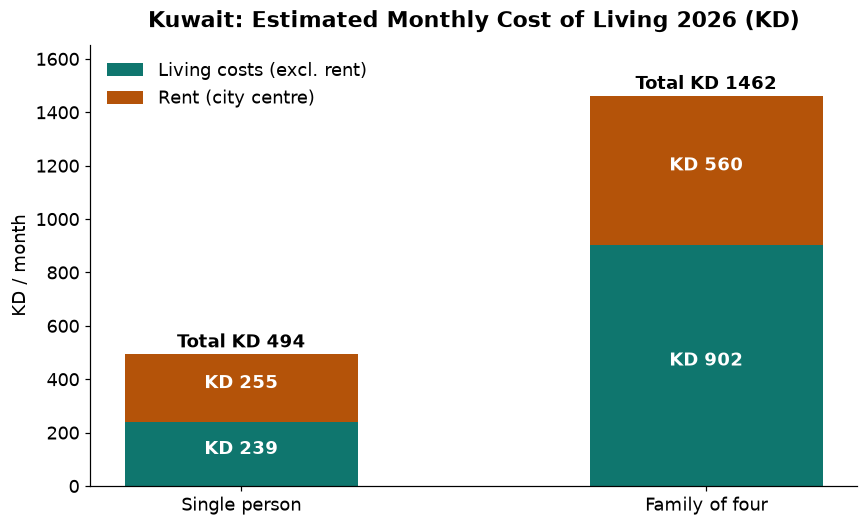
Chart: Truescho Research — August 2026
Kuwait City or Salmiya: what rent really costs by district
Central Salmiya is the priciest documented district: about KD 327 for a central one-bedroom versus KD 284 in Kuwait City. Outside the centers the gap narrows to KD 257 against a nationwide KD 190. Three-bedroom central flats run KD 750 in Salmiya versus KD 598 in the capital, so the district choice alone is worth hundreds of dinars a month.
| District and snapshot date | 1-bed central | 1-bed outside center | 3-bed central | 3-bed outside center |
|---|---|---|---|---|
| Kuwait City (June 2026) | KD 284 | near KD 190–257 | KD 598 | near KD 404–410 |
| Salmiya (late 2025 snapshot, still cited in 2026) | KD 327 | KD 257 | KD 750 | KD 410 |
| Kuwait nationwide (May 2026) | KD 255 | KD 190 | KD 560 | KD 404 |
Two caveats keep this table honest. Hawalli and Jabriya, popular with families, sit between the capital and Salmiya on price — use the KD 190–257 one-bedroom band as a planning range until you view units. And buying is a different market: central apartments cost about KD 1,632–1,635 per square meter, among the priciest in the region — which is why almost all expats rent.
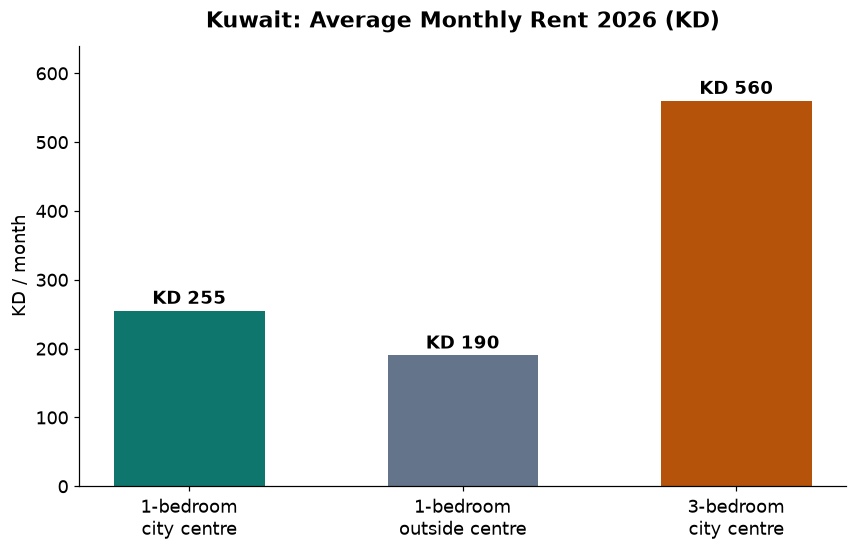
Chart: Truescho Research — August 2026
Schools and health insurance: what changed in 2026
Two 2026 changes hit family budgets hardest. Kuwait maintained its official freeze on private-school fee increases, yet Indian-curriculum schools raised fees by about 15 percent in June 2026 — a gap parents immediately felt. Separately, the state raised health-insurance fees for expatriate residents while exempting nine categories from the new charges.
The fee freeze is real and it covers private-school fee schedules broadly — but it did not stop every increase, and the Indian schools' 15 percent rise is the proof. Kuwait Times reported the jump in June 2026 under the headline parents quoted to each other all summer: they feel the pinch. If your children attend an Indian-curriculum school, add the increase to your 2026 math rather than relying on a 2024 fee sheet.

Source: Kuwait Times
Insurance is the second line to re-check. The December 2025 decision raising expatriate health-insurance fees took effect for 2026 with nine exempted groups, and the savings from an exemption are large enough to verify your own status in writing. The full breakdown of the new fees, the exemptions and what employers must cover is in our expat health insurance guide for Kuwait.
Is Kuwait safe for expats in 2026?
Day-to-day life continues normally, but 2026 has not been a normal year for the region: drone strikes hit Kuwaiti territory and the Strait of Hormuz in July, and outlets including Reuters and Al Majalla have covered the strain on foreign workers in the Gulf. Daily life is stable, the risk picture is elevated, and your preparation should reflect both.
Practical steps matter more than anxiety. Register with your embassy's citizen program, keep your employer's emergency and evacuation plan in writing, maintain valid health coverage — which the 2026 fee changes make doubly important — and hold an exit fund of two to three months of expenses in dinars. Expats who followed those basics through the July escalation reported disrupted travel and nervous families, not disrupted payrolls.
The baseline quality of life remains genuinely strong. Kuwait ranked 35th globally in Numbeo's 2026 quality-of-life index, and a July 2026 report in Al-Rai confirmed it as the cheapest Gulf state for cost of living while holding first place in the region for purchasing power. Cost trackers place it 43rd of 197 countries worldwide at roughly 1.24 times the global average — expensive by world standards, outstanding by regional ones.
Kuwait or Dubai: which one costs less?
Kuwait is generally the cheaper posting. Dubai's rents and school fees typically run above Kuwait's at comparable standards, while Kuwait adds subsidized fuel at KD 0.11 a liter and the region's strongest purchasing power. Dubai answers with a wider international job market and easier global connectivity, so the real decision is usually career and lifestyle, not price alone.
Both cities share the feature that matters most to long-term savers: no personal income tax on salaries. That makes the comparison a spending question rather than a tax question. A family that banks the housing and schooling difference Kuwait offers over Dubai compounds it tax-free year after year.
The same logic applies when you weigh Saudi Arabian offers: check whether housing and schooling are included in the package, because that single line decides the comparison more than any salary difference. Wherever the Gulf posting lands, run the numbers through the budget tables above before you commit.
Five cost-saving mistakes new expats make in Kuwait
The expensive mistakes are boring and predictable, and every one of them is avoidable with the numbers already in this guide. New arrivals lose money on housing lock-ins, stale school-fee assumptions, ignored insurance rules, home-country shopping habits, and over-remittances in the first months. Here is each trap and its fix.
- Signing a twelve-month lease in week one. Arrivals routinely take the first central-Salmiya flat they see and inherit the capital-district premium — the same size of flat runs roughly KD 70–140 a month cheaper outside the center in the bands above. Book short-stay accommodation for two weeks, view ten units across two districts, then sign.
- Budgeting school fees from a 2024 guide. The fee freeze and the Indian schools' 15 percent increase landed in 2026. A family with two children that plans on stale numbers starts the year underwater — get the current fee letter, not a blog table.
- Ignoring the new expat insurance fees. The 2026 increase applies to most residents, but nine categories are exempt. Confirm yours in writing before your employer defaults you into the wrong plan tier.
- Shopping like you never left home. Imported brands carry import costs, and food inflation at 5.55 percent punishes brand loyalty. Local and regional alternatives on rice, chicken and produce trim a family grocery bill meaningfully without touching quantity.
- Remitting everything in month one. The average net salary is KD 975 nationwide, and new posts always carry setup costs — deposits, furniture, school registration. Keep three months of runway in dinars before converting savings to your home currency.
Frequently asked questions
The questions expats actually search, answered with the 2026 numbers.
What is the cost of living in Kuwait per month?
A single person spends about KD 239 a month excluding rent, or KD 450–530 including a one-bedroom apartment. A family of four needs around KD 902 before rent, or KD 1,300–1,600 all-in with a three-bedroom flat, schooling and insurance. The dollar equivalents are roughly $780, $450–530 all-in for one, and $4,200–5,200 for the family.
How much is rent in Kuwait on average?
A one-bedroom in central Kuwait City averages KD 284, with the nationwide central average at KD 255 and outside-center rents near KD 190. In Salmiya, central one-bedrooms run KD 327. Three-bedroom central flats average KD 598 in the capital and KD 750 in Salmiya, dropping to KD 404–410 outside the centers.
What is the cost of living for an Indian family of four in Kuwait?
Plan for KD 1,300–1,600 a month including rent, schooling and insurance. Indian-curriculum schools raised fees about 15 percent in June 2026, so budget the school line from the current fee letter. At roughly ₹280 to the dinar, the monthly total is about ₹3.6–4.5 lakh — confirm your bank's live rate before fixing remittances.
Is Kuwait more expensive than Dubai?
Generally no — Kuwait is the cheaper posting. Comparable rents and school fees in Dubai typically sit above Kuwait's, and Kuwait adds fuel at KD 0.11 per liter and the Gulf's strongest purchasing power. Dubai offers a broader international job market, so professionals often weigh career upside against Kuwait's lower cost base.
What are international school fees in Kuwait in 2026?
International primary tuition averages KD 2,182 a year, ranging from KD 1,200 to KD 3,000 by school, and private kindergarten costs about KD 96 monthly. The official freeze on private-school increases still applies, but Indian-curriculum schools raised fees by around 15 percent in June 2026, so verify each school's current letter.
Is Kuwait an expensive country compared with the rest of the world?
Cost trackers rank Kuwait 43rd of 197 countries, at about 1.24 times the world average — expensive globally, but the cheapest state in the Gulf with the region's highest purchasing power. Subsidized fuel and utilities offset imported-food prices, and the absence of income tax raises real net income accordingly.
What is a good expat salary in Kuwait in 2026?
The average net salary is about KD 975 a month nationwide — near $3,180 — though the Kuwait City snapshot reads lower at KD 641, and trackers citing $2,078 net say that covers about 1.4 months of typical expenses. Singles live well from KD 600–800; families need KD 1,300 plus to save meaningfully.
Is Kuwait safe for expats right now?
Daily life is stable, wages are paid, and Kuwait ranks 35th globally for quality of life in 2026. The honest caveat is July's regional escalation, including drone strikes on Kuwaiti territory and the Strait of Hormuz. Register with your embassy, keep valid insurance, and hold two to three months of expenses as a runway.
What to do next
Turn these numbers into a plan this week. Convert your offer into an all-in monthly figure using the budget tables, choose one district and one school bracket, confirm your insurance category in writing, and keep three months of runway in dinars before you negotiate or remit anything.
Your closing checklist:
- Rebuild your offer letter into a monthly budget using the single or family table above.
- Shortlist units in two districts — one central, one outside center — before flying.
- Request the current 2026 fee letter from every school on your list, not 2024 figures.
- Confirm your health-insurance category and whether you qualify for one of the nine exemptions.
- Re-read the work-visa steps so paperwork delays do not eat your setup budget.
- Track live Gulf openings while you negotiate, so you know your market value in dinars.
When you are ready to compare offers or explore study options in the Gulf, Truescho's opportunities board lists current job vacancies alongside destination guides and a visa checker — everything you need on one page after the numbers check out.
Sources
- Kuwait Central Statistical Bureau — The official statistics authority behind Kuwait's inflation releases, including the 2.19 percent June 2026 headline rate and the 5.55 percent food figure.
- Kuwait Times — Reported the 15 percent fee increase at Indian-curriculum schools in June 2026 and its impact on expatriate families.
- Gulf News — Regional coverage of Gulf cost-of-living trends and expatriate policy changes affecting household budgets.
- Kuwait News Agency (KUNA) — Kuwait's official state news agency for government announcements relevant to expatriate residents.
DONE