

Last updated: July 2026
On June 12, 2026, the US government applied export controls to two of Anthropic's most advanced models, forcing the company to suspend worldwide access almost overnight. For nearly three weeks, developers and researchers across Nigeria, India, the Philippines, Brazil, and dozens of other countries could not reach Claude Fable 5 at all. On June 30, 2026, those controls were officially lifted, and on July 1, 2026, Anthropic redeployed the model globally across Claude.ai, Claude Code, Claude Cowork, and the Claude Platform.
If you searched "Claude Fable 5" weeks after launch and want the full picture, this guide explains what the model is, why it was restricted, how international users can access it today, how it compares to Sonnet 5, and what the cybersecurity safeguards actually do. Every fact below is drawn from Anthropic's official announcements.
Claude Fable 5 is Anthropic's frontier AI model, the most capable in the Claude family, classified by the company as carrying advanced cyber capabilities that require built-in safety classifiers. It sits above Sonnet 5 and Opus in raw performance and is now available globally after US export controls were lifted on June 30, 2026.
What is Claude Fable 5? How It Differs From Sonnet 5
Claude Fable 5 is the newest frontier model in Anthropic's lineup, positioned above Opus and above Sonnet 5 in raw capability. Anthropic introduced it as a specialized frontier model rather than a default daily-use model, and the distinction matters. While Sonnet 5 ships as the default model for Free, Pro, Max, Team, and Enterprise plans, Fable 5 is reserved for users who need the absolute highest reasoning, coding, and agentic performance that Claude can offer.
The core difference is cyber capability. In its July 2, 2026 announcement, Anthropic confirmed that Fable 5 carries advanced cyber capabilities, which is precisely why the US government applied export controls in the first place. To ship the model responsibly, Anthropic attached safety classifiers that detect and block dangerous cyber-related requests before the model responds. Sonnet 5, by contrast, has a much lower cyber capability profile than current Opus models, which is why it never faced export restrictions and why Anthropic markets it as "safe by default" for agentic workflows.
In practical terms, this means Fable 5 is the model you choose when Sonnet 5 is not strong enough for highly complex coding, deep research, or autonomous agent pipelines. It is not the model most users need for everyday writing, simple scripts, or casual chat. For a broader introduction to the Claude family, see our free Claude AI guide.
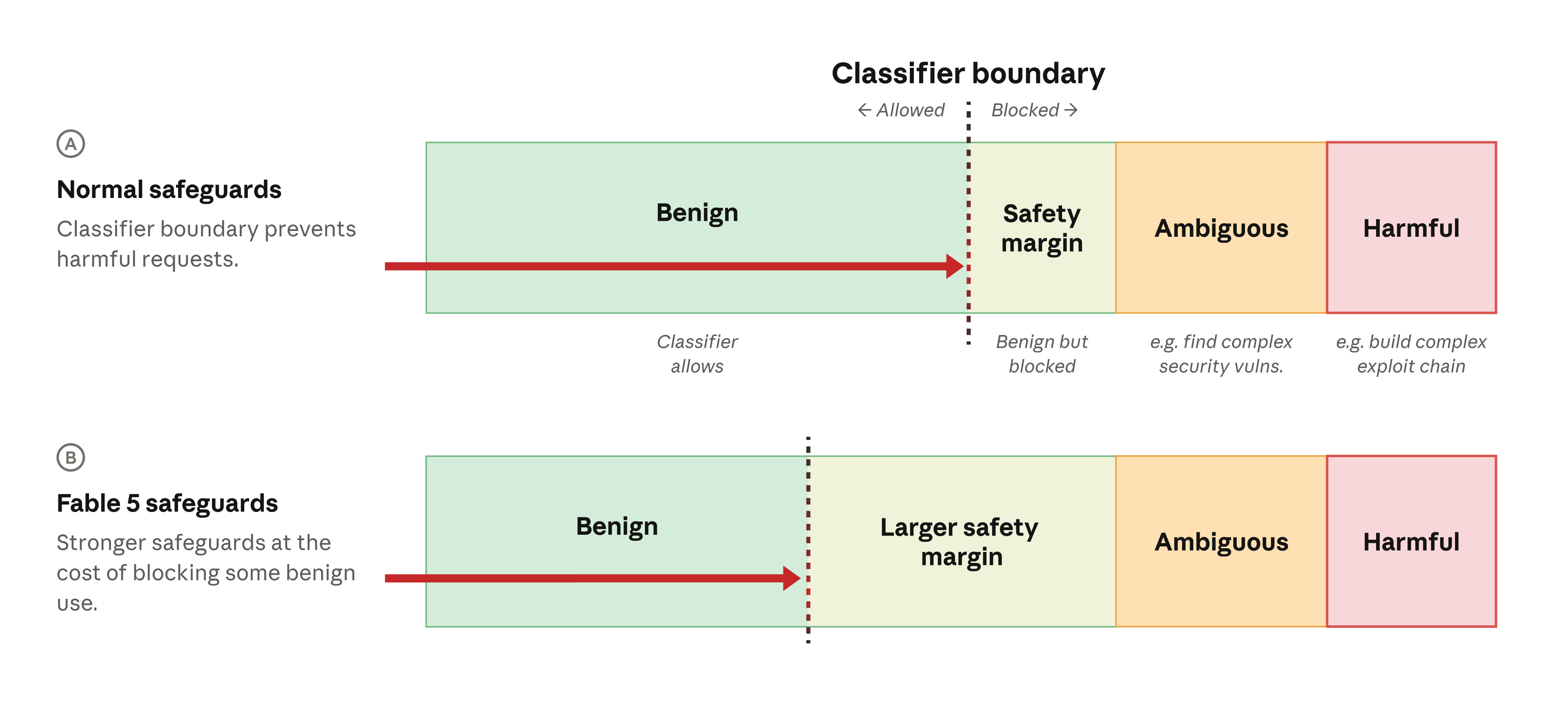
Source: Anthropic — Redeploying Fable 5
The Full Timeline of the Export Control Crisis
The export control saga lasted roughly three weeks, and the dates below are the ones every international user should know.
| Date | Event |
|---|---|
| June 12, 2026 | US government applies export controls to Fable 5 and Mythos 5 |
| June 12, 2026 | Anthropic suspends access for all users, domestic and international |
| June 26, 2026 | Mythos 5 restored for a set of approved US organizations |
| June 30, 2026 | Export controls officially lifted, "Redeploying Fable 5" announced |
| July 1, 2026 | Fable 5 available globally on Claude.ai, Claude Code, Claude Cowork, Claude Platform |
| July 7, 2026 | End of the "up to 50% of weekly usage limits" introductory window |
The critical detail is why Anthropic had to suspend access for everyone, including users inside the United States. When export controls took effect on June 12, 2026, the rules were immediate, and Anthropic had no reliable way to verify the nationality of every user in real time. Rather than risk a violation, the company blocked Fable 5 across the entire platform until it could build the legal and technical controls required.
This matters for international users because it shows how fragile access to frontier models can be. A developer in Lagos, Manila, or Islamabad had the same experience as a developer in San Francisco for those three weeks, no Fable 5 at all. The June 30 lifting of controls, followed by the July 1 global redeployment, restored access on equal terms across supported countries. For a deeper look at how Anthropic positions this against competitors, see our Claude vs ChatGPT comparison.
What This Means for International Users
Users in Nigeria, India, the Philippines, Indonesia, Pakistan, Brazil, Vietnam, and Eastern Europe were directly affected by the suspension. The impact was the same everywhere: between June 12 and July 1, 2026, no one outside approved US organizations could access Fable 5 through any official channel.
After July 1, availability returned globally via Claude.ai and the Claude API, subject to plan limits. For Pro at $20/month and Max at $100 to $200/month, Fable 5 is included for up to 50% of weekly usage limits until July 7, 2026. After that date, Fable 5 consumption draws from usage credits rather than the standard weekly allowance.
If you are looking for the most affordable way to access Claude Max with Fable 5, the Truescho digital shop offers shared Claude Max 5x subscriptions at €50/month instead of the official $200 rate. For full plan details and currency options, see our Claude AI pricing guide.
How to Access Claude Fable 5 From Anywhere
Once the export controls lifted, Anthropic opened four official access paths. Here is how each one works.
1. Claude.ai web and desktop app. The simplest route. A Pro subscription at $20/month or a Max subscription at $100 to $200/month unlocks Fable 5 inside the Claude.ai chat interface. Most supported countries can subscribe directly with a credit or debit card. Until July 7, 2026, Fable 5 can fill up to 50% of your weekly usage limit.
2. Claude API. Developers can call Fable 5 by its model identifier through the Claude Platform. After the introductory window ends on July 7, API usage is billed through usage credits, meaning you pay for what you consume rather than drawing from a flat weekly allowance. This is the path for anyone building applications, agents, or pipelines on top of Fable 5.
3. Claude Code. Programmers who live in the terminal can use Fable 5 inside Claude Code, Anthropic's command-line coding tool. This is the most natural fit for Fable 5 because its frontier coding and agentic capabilities are exactly what complex repositories require.
4. Claude Cowork. Teams that need collaborative access can use Claude Cowork, which gives groups shared access to Fable 5 under the Team and Enterprise plans.
After July 7, 2026, the model does not disappear from any plan. It simply shifts from the weekly allowance to the usage-credits system, so heavy users should budget credits accordingly.
Claude Fable 5 vs Sonnet 5: Which One Should You Use?
The comparison table below summarizes the practical tradeoffs.
| Criterion | Fable 5 | Sonnet 5 |
|---|---|---|
| Availability | Pro, Max, Team, Enterprise | All plans including Free |
| Capability tier | Frontier, highest in Claude family | Close to Opus 4.8 |
| Cyber capabilities | Advanced, requires classifiers | Much lower than Opus |
| API pricing | Usage credits after July 7, 2026 | $2/M input, $10/M output (introductory, until Aug 31, 2026), then $3/M input, $15/M output |
| Safety profile | Prior export controls, classifiers attached | Safe by default, no restrictions |
| Best for | Advanced research, complex coding, autonomous agents | Daily use, general programming, chat |
The honest advice is simple. Use Sonnet 5 for the vast majority of daily work, drafting, debugging, research summaries, and content generation. It is cheaper, available on every plan including Free, and strong enough that Anthropic internally routes a large share of its own engineering through Claude-assisted tooling. For a deeper walkthrough of the full Claude family, see our complete Claude AI guide.
Reach for Fable 5 when you genuinely need frontier performance, long-horizon agentic tasks, deeply complex codebases where Sonnet 5 stalls, or research problems that demand the strongest reasoning in the Claude family. If you are unsure, start with Sonnet 5 and upgrade only when you hit its ceiling.
Aisha from Lagos: Three Weeks Without Fable 5
Aisha Bello runs a four-person AI startup in Lagos, Nigeria, that builds automated code-review bots for West African fintech companies. Her team had built their entire CI/CD pipeline around Fable 5 because of its strong agentic coding performance on large Python repositories. When access was cut on June 12, 2026, the team had to downgrade to Sonnet 5 overnight.
The impact was measurable. Review turnaround on pull requests rose by roughly 30%, and the team had to manually re-check cases that Fable 5 had been handling autonomously. Aisha estimates the three-week disruption cost her startup around $4,000 in delayed contracts and extra engineering hours. When Fable 5 came back online on July 1, her team migrated back within hours. Her takeaway: Sonnet 5 is a strong fallback, but for production-grade autonomous code review at scale, Fable 5 is the model that keeps the pipeline moving.
Fable 5's Cyber Security Framework: What the Model Refuses to Do
Because Fable 5's cyber capabilities triggered the export controls in the first place, Anthropic shipped it with a layered safety framework. The model classifies incoming requests into four tiers before deciding how to respond.
- Prohibited use, blocked entirely. Requests such as writing advanced hacking software or generating full offensive exploit chains are refused outright.
- High-risk dual use, heavily restricted. Tasks like vulnerability scanning tools are allowed only under tight conditions.
- Low-risk dual use, allowed with warnings. Diagnostic and debugging tools can proceed when the context is clearly defensive.
- Benign use, fully allowed. Learning defensive security, reading about threat models, and writing standard protection code work normally.
Alongside the classifiers, Anthropic co-developed a community jailbreak severity framework with Amazon, Microsoft, Google, and other partners under the Glasswing program, so that the wider industry shares a common vocabulary for rating how dangerous a given jailbreak attempt actually is. The company also launched a HackerOne bug bounty program inviting security researchers to probe Fable 5's cyber guardrails and report weaknesses for reward.
Fable 5 vs Mythos 5: The Full Difference
Mythos 5 was the second model caught in the June 12 export controls, and its path back was different. On June 26, 2026, Mythos 5 was restored for a set of approved US organizations after Anthropic negotiated government approval. For international users, however, Mythos 5 remains accessible only through the Glasswing program for vetted international partners, not through open global channels the way Fable 5 is today.
In short, Fable 5 is now a globally available frontier model on standard Claude plans, while Mythos 5 is still a restricted-access model aimed at specific institutional use cases. Most developers and researchers will interact with Fable 5 and may never touch Mythos 5 directly.
Frequently Asked Questions
What is Claude Fable 5 and how does it differ from Sonnet 5?
Claude Fable 5 is Anthropic's frontier model, more capable than Sonnet 5 and Opus in raw performance. Sonnet 5 is the default daily-use model across all plans, while Fable 5 targets advanced coding, research, and agentic work that needs maximum capability.
Why did the US government impose export controls on Fable 5?
The controls, applied on June 12, 2026, targeted Fable 5's advanced cyber capabilities. Because Anthropic could not verify user nationality in real time, it suspended access globally until the controls were lifted on June 30, 2026.
How can international users access Claude Fable 5 now?
Since July 1, 2026, Fable 5 is available globally through Claude.ai, the Claude API, Claude Code, and Claude Cowork. Pro and Max subscribers get Fable 5 within their plan limits, moving to usage credits after July 7, 2026.
Is Claude Fable 5 included in the Pro plan or only Max?
Fable 5 is included in Pro, Max, Team, and Enterprise plans. Until July 7, 2026, it fills up to 50% of weekly usage limits, after which consumption is billed through usage credits.
What is the difference between Fable 5 and Mythos 5?
Fable 5 is now globally available on standard Claude plans. Mythos 5, also caught in the June 12 controls, was restored only for approved US organizations on June 26, 2026, and remains restricted internationally via the Glasswing program.
What are the cybersecurity safeguards on Fable 5?
Fable 5 ships with safety classifiers that sort requests into prohibited, high-risk, low-risk, and benign categories. Anthropic also co-developed a jailbreak severity framework with Amazon, Microsoft, and Google, plus a HackerOne bug bounty program.
What is the Glasswing program and how does it affect international access?
Glasswing is Anthropic's coordinated program with government and industry partners that manages access to restricted models like Mythos 5 and defines shared safety standards. It is the channel through which vetted international partners can reach models that are not openly available.
When will Fable 5 be fully available without restrictions?
Fable 5 has been globally available since July 1, 2026, with no country-level blocks. The only remaining limit is the plan-based usage allowance, which transitions to usage credits after July 7, 2026.
Conclusion
Claude Fable 5 is back, and the three-week export control saga is now part of the model's history rather than its present. For international developers, researchers, and AI users, the key takeaways are simple: Fable 5 is Anthropic's most capable frontier model, it carries real cyber safeguards, and it is available globally as of July 1, 2026 across Claude.ai, the API, Claude Code, and Claude Cowork. Most users will be well served by Sonnet 5, but anyone pushing into complex coding, deep research, or autonomous agents now has the strongest model in the Claude family back within reach.
For the most affordable way to access Claude Max 5x with Fable 5, the Truescho digital shop offers shared Claude Max 5x subscriptions at €50/month instead of the official $200, saving 75%+ with a 30-day guarantee and 20-minute delivery.
Sources
- Anthropic — Redeploying Fable 5 (June 30, 2026) — official announcement
- Anthropic — More details on Fable 5's cyber safeguards (July 2, 2026) — cybersecurity framework details
- Anthropic — Introducing Claude Sonnet 5 (June 30, 2026) — comparison data
Start Your Journey with Truescho
Whether you're searching for scholarships or the cheapest Claude Max subscription, truescho.com gives you everything.