

On 7 August 2026, Anthropic announced a meaningful update to Claude Fable 5 biology safeguards. The goal is not to remove guardrails; it is to cut false positives that routed ordinary health and education questions to a weaker model. In Anthropic’s testing, biology-related fallbacks fell by about 85% across product surfaces.
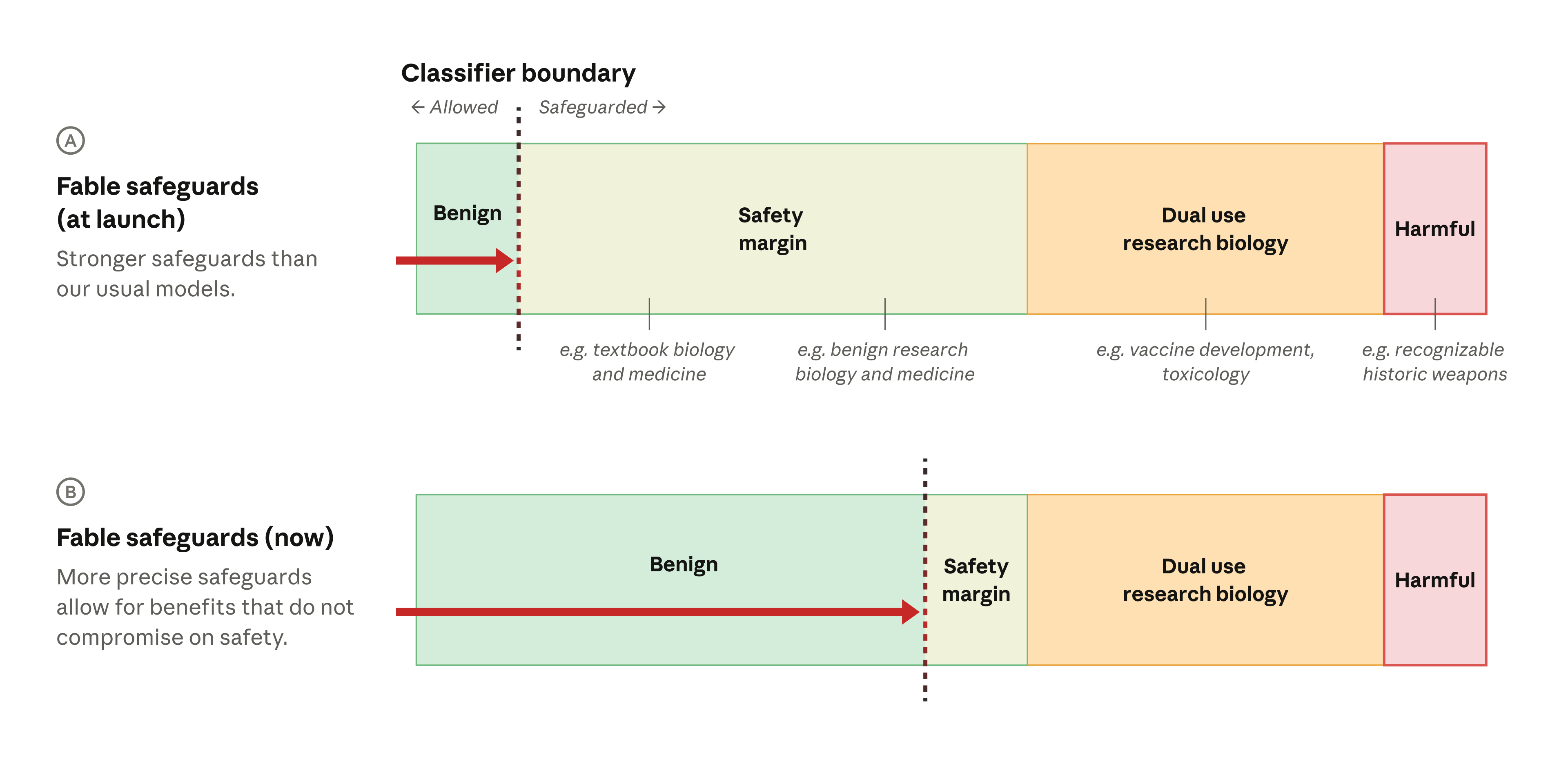
Source: Anthropic — Improving Fable 5's biology safeguards (7 August 2026)
Source: Official Claude post on X
What actually changed?
When Fable 5 launched, Anthropic took a deliberately conservative stance on biology. Many biology-adjacent prompts were re-routed to Claude Opus 5, which lacks Fable 5’s frontier biological capability. Anthropic’s stated reason: Fable 5 can outperform experts on some complex biological tasks and could give significant uplift to a malicious actor in dual-use scenarios such as virology, toxicology, or high-risk molecular design.
The user-visible cost was high false positives: lab-result interpretation, symptom education, and school-level biology questions often triggered fallbacks. The new update rewrites the classifier’s constitution, incorporates internal and external expert feedback, retrains the classifier, and re-checks that harmful and dual-use research content still triggers while more benign uses pass.
Numbers Anthropic published
| Metric | Stated figure |
|---|---|
| Reduction in biology-related fallbacks | about 85% |
| Expected total fallback reduction on Claude.ai | about 67% |
| On Claude Cowork | about 55% |
| On Claude Code | about 17% |
| On Claude Platform | about 7% |
These are product-surface estimates from Anthropic’s testing, not a promise of zero false positives. A safety margin remains.
How biology safeguards work
Core mechanism: smaller safety classifiers inspect the request. When they fire, the system falls back to Opus 5. Anthropic has used similar classifier patterns in cybersecurity. Biology is uniquely ambiguous: live vaccines require growing the pathogen; the hypertension drug captopril was inspired by snake-venom components that crash blood pressure. Professional dual-use work therefore remains blocked for Fable 5 on the public product path.

Source: Official announcement Open Graph artwork
What this means for you (Gulf and international professionals)
Students in medicine and life sciences
If you use Claude to learn physiology, interpret general lab panels for study, or revise biology lectures, you should see fewer unjustified downgrades. That matters if you pay for Max specifically for Fable 5-class capability.
Clinicians (support, not diagnosis)
Anthropic says healthcare professionals should get more support on clinical tasks. Claude is not a regulated medical device and must not replace local protocols or specialist judgment. Use it for structuring questions, summarizing literature, or organizing notes.
Biotech and drug-development teams
The explicit message: Fable 5 is still not a public pathway for professional dual-use biology research and drug development. Anthropic commits to trusted-access routes later. Do not assume this patch opens advanced lab workflows.
Availability and pricing
No pricing change is announced. The update is classifier-level inside Fable 5. Geographic availability follows Anthropic’s existing product rules.
Quick comparison
| Dimension | At Fable 5 launch | After 7 Aug 2026 | Claude Opus 5 | ChatGPT (GPT-5.6 Sol) |
|---|---|---|---|---|
| Everyday health/education | Frequent fallbacks | Far fewer biology fallbacks (~85%↓) | Less sensitive on this axis | Different safety stack |
| Dual-use professional biology | Blocked | Still blocked → Opus 5 | Lower bio capability than Fable | Model-specific limits |
| Policy transparency | Conservative by design | Clearer diagram + metrics | Strong daily driver | Separate OpenAI updates |
| Best fit | Non-bio frontier work | Broader education/health + frontier elsewhere | Everyday agents | General chat + Work |
Honest limitations
- False positives remain. Anthropic keeps a safety margin.
- Dual-use professional use stays closed. Virology, toxicology, sensitive molecular design → Opus 5.
- Not medical approval. Never sole source for treatment decisions.
- Internal metrics. 85%/67% come from Anthropic tests; your prompts and language may differ.
- Language coverage. No separate Arabic classifier metrics were published.
Why industry watchers care
After cyber-eval incidents and Anthropic’s open-weights policy paper, this update reinforces a pattern: ship with hard brakes, then carefully loosen false positives instead of either delaying the model for months or shipping without controls. Competitors will be measured against this transparency bar.
Practical next steps
- Re-run biology/health prompts that previously fell back; log outcomes.
- For sensitive research, do not jailbreak — wait for trusted access.
- Update internal Claude usage guides in medical schools and labs.
- Read our related coverage on Claude Opus 5 and cyber eval incidents.
FAQ
Is Fable 5 open for all biology questions now?
No. Benign false positives drop sharply, but dual-use professional tasks still fall back to Opus 5.
What is a “fallback”?
Automatic re-routing from Fable 5 to a less capable model (usually Opus 5) when a safety classifier fires.
Does this include the API?
Yes on the listed surfaces; expected total fallback reduction on Claude Platform is smaller (~7%) because usage patterns differ.
Does pricing change?
No pricing change is attached to this announcement.
Useful for Gulf university students?
Yes for concept learning and general biology study — not as a clinical decision engine.
Bottom line
The 7 August 2026 update makes Claude Fable 5 more usable for health and education without abandoning Anthropic’s red line on high-risk dual-use biology. If you pay for frontier capability, friction should fall. If you need advanced wet-lab assistance, you are still outside the public path — by design.
Wider context: why biology is a hard red line
Anthropic’s post points to capability assessments and the U.S. Intelligence Community’s 2026 Annual Threat Assessment, which notes that advances in synthetic biology and genomic editing “could lead to novel biological threats.” State-level offensive bio programs make raw frontier access a governance risk, not only a product UX issue.
For international and Gulf professionals adopting LLMs in medical education and knowledge work, fewer false positives mean higher daily trust — while keeping dual-use blocks reduces casual misuse via consumer surfaces.
Expected user experience after the update
- Likely pass: “Explain the insulin pathway briefly for a med student” → should stay on Fable 5 more often.
- Still blocked: operational requests about pathogen design or toxin production details → Opus 5 fallback.
- Grey zone: highly advanced prompts may still sit inside the safety margin; rephrase in educational terms if wrongly routed.
Related Truescho resources
Build a practical AI toolkit via AI tools, and read our explainer on Anthropic’s open-weights position for the industry-level safety debate around this update.
How this fits Anthropic’s 2026 safety posture
Through mid-2026 Anthropic repeatedly chose asymmetric risk management: ship frontier capability for coding and general knowledge while clamping domains where uplift could be catastrophic (cyber, biology). The biology update is the second half of that story — not a retreat from caution, but a calibration of precision. Users should interpret 85% fewer biology fallbacks as better discrimination, not as proof that dual-use risk vanished.
For procurement teams in universities and hospitals, document the change control: which prompts previously failed, which now succeed, and which still route to Opus 5. That log becomes evidence for internal AI governance committees.
Sources: Anthropic — Improving Fable 5's biology safeguards (7 August 2026); official @claudeai post; capability assessments cited in the announcement.