
Claude Discovered a CRISPR-Like Enzyme System: Why It Matters
Last updated: September 2026
Nine hundred and fifty AI agents ran for 21 straight hours, sifted through more than 200,000 enzymes, and one of them noticed a repeating pattern in DNA that no human had ever flagged — a novel enzyme system called ART with echoes of CRISPR, announced by Anthropic on September 23, 2026 as the first discovery from its new biology lab. The discovery was machine-sighted but human-verified: Claude proposed, scientists tested in a physical lab, and the system's actual function remains an open question.
Even if you never touch a pipette, this story matters. It is the first time a major AI lab has announced that its model "discovered" something new in basic biology with this degree of autonomy — not generating text, but spotting an unknown pattern in the code of life and pointing researchers to it.
The Short Version: What Anthropic Actually Announced
Anthropic revealed a new life sciences research group with its own laboratory in the San Francisco Bay Area, and shared early results from one of its first research programs. Claude autonomously discovered a novel enzyme system the team named array-associated reverse transcriptases (ART). It has three parts: a reverse transcriptase enzyme (RT), a partner gene beside it, and a long array of evenly spaced DNA repeats — the same structural signature that made CRISPR programmable and turned it into a gene-editing revolution.
The system lives mainly in bacteriophages, the viruses that infect bacteria. The most tantalizing detail: early experiments show the ART array is expressed as a set of distinct short RNAs, echoing how CRISPR arrays store a "memory bank." The function is still unknown, and Anthropic has released a pre-print so the wider community can dig in.

Source: Anthropic's official announcement of the enzyme discovery
How Claude Found It: 950 Agents, 21 Hours, 210 Million Tokens
The workflow is a masterclass in how AI-accelerated research actually operates:
- The brief. Scientists prompted Claude to search a massive DNA sequence database for interesting new examples of reverse transcriptases — with no specific target named.
- Parallel sweeping. Roughly 950 agents worked simultaneously for 21 hours, burning about 210 million tokens, and gathered over 200,000 reverse transcriptases.
- Distillation. The agents narrowed the field to 3,500 new candidate systems, then to the 20 most compelling — each with a human-readable report laying out the evidence.
- The eureka moment. One agent examining raw DNA next to an odd-looking RT enzyme wrote, verbatim: "[The DNA next to the RT] is spectacular: I can see by eye a tandem repeat array … that's a CRISPR-like … repeat array?!" It then behaved like a scientist: counted the repeats, measured spacing, compared against known systems, searched the literature for prior reports, and filed a report for human review.
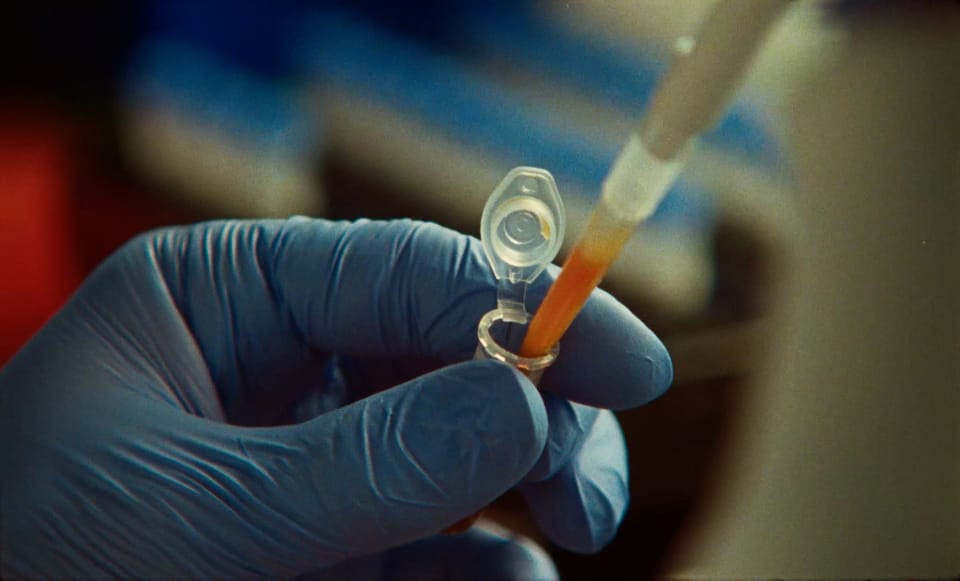
- Lab verification. Human scientists expressed the protein in standard lab strains and characterized it biochemically and structurally — at biosafety levels BSL-1 and BSL-2 only, with no human pathogens, and all lab work performed by people.
Every step ran on Claude Science and Claude Code — the same commercial tools any researcher in Lagos, Mumbai, or São Paulo can subscribe to today. That detail, more than the discovery itself, is why this story travels beyond biology.
Source: Anthropic's official YouTube channel
Why Everyone Is Saying "CRISPR": A Plain-English Explainer
CRISPR started as a bacterial immune system: bacteria store "snapshots" of attacking viruses in a repeating DNA array, then use cutting enzymes (Cas) to shred any matching invader. Scientists repurposed that machinery into a programmable molecular scissor that edits DNA at chosen spots — work that won the 2020 Nobel Prize in Chemistry and now underpins approved gene-editing medicines.
What Claude found carries the same architectural fingerprint: an enzyme (here, a reverse transcriptase, which copies RNA into DNA) paired with a repeat array that may function as programmable memory. Anthropic notes that this exact combination of traits has only ever been seen in a handful of other systems — all of which turned out to be programmable and perform cut, copy, and paste operations on DNA. Nobody knows what ART does yet, but the family history is why researchers are paying attention.
Feng Zhang — the MIT and Broad Institute researcher who helped pioneer CRISPR genome editing — reviewed the pre-print and called the work "an exciting example of how AI agents can contribute to biological discovery," adding that "the identification of RNA-repeat arrays associated with reverse transcriptases is genuinely intriguing and merits further investigation."
Quick Comparison: ART vs. CRISPR as We Know It
| Aspect | CRISPR | New ART system |
|---|---|---|
| Found in | Bacteria (immune system) | Bacteriophages (viruses of bacteria) |
| Core enzyme | Cas "scissors" that cut DNA | Reverse transcriptase that copies RNA into DNA |
| Memory | Repeat array storing virus snapshots | Repeat array expressed as short RNAs |
| Proven function | Bacterial defense + gene editing | Unknown so far |
| Medical use | Approved medicines already | None — pre-print stage only |
| Discovered by | Humans (Nobel 2020) | AI model proposed; humans verified |
The table explains both the excitement and Anthropic's own caution: function unproven, applications zero, publication a pre-print. It also explains why serious scientists care.
What This Means for You
For researchers and graduate students worldwide: the exact tooling behind the discovery is commercially available, and Anthropic's Life Sciences Verification Program gives biology professionals broader access with research-appropriate safeguards. This is one of the first genuinely open doors to replicating an "agent-driven genomic sweep" methodology in your own field.
For anyone tracking the model race: the competitive frontier quietly shifted. We covered Claude Opus 5.5's 40% cost cut and the biology safeguards update in Claude Fable 5; the lab announcement shows those were pieces of a bigger bet — a discovery engine, not just a chatbot. When capabilities get measured in "what did your model find," benchmarks start looking quaint.
For AI-safety watchers: note the deliberate division of labor — agents propose, humans execute every wet-lab step, at minimal biosafety levels. It is a working model of collaboration that partially answers the UN panel's loss-of-control warnings, even as the same week's OpenAI breach of Australian systems shows the other face of agent autonomy. The two stories are best read together.
The Honest Limits of the Story
- There is no medical or commercial application today, and no guarantee ART ever becomes a tool.
- The biological function is undetermined; what is proven is the three-part structure and the RNA expression of the array.
- The paper is a pre-print that has not completed peer review.
- "First of its kind" applies to Anthropic's lab specifically; AI has contributed to earlier scientific discoveries in other domains, such as protein-folding predictions.
Frequently Asked Questions
What is the ART system Claude discovered?
ART (array-associated reverse transcriptases) is a novel enzyme system announced by Anthropic on September 23, 2026. It combines a reverse transcriptase enzyme, a partner gene, and a long array of repeating DNA sequences, and it lives in bacteriophages — viruses that infect bacteria. Its layout resembles CRISPR's programmable memory, but its true function is still unknown.
Did AI discover a new medicine or cure?
No. This is basic biology: a new molecular system whose function scientists do not yet understand. There is no drug, no therapy, and no timeline. The value today is scientific — proof that AI models can spot patterns no human had noticed in vast genomic data.
How can an AI model "discover" something in biology?
By sweeping DNA databases at a scale impossible for humans: about 950 agents worked 21 hours, gathered over 200,000 reverse transcriptases, flagged 3,500 candidate systems, and shortlisted 20. One agent noticed the repeat pattern and filed a report. Human scientists then performed every laboratory experiment to verify the finding.
How is this related to CRISPR?
Structurally. Both systems pair an active enzyme with a repeat array that can act as memory, and that fingerprint has only previously been seen in programmable DNA-manipulating systems. That makes ART a strong candidate for further study, though the comparison remains a hypothesis until its function is proven.
Can researchers outside the US access these tools?
Yes. The work used Claude Science and Claude Code, both commercially available, alongside a dedicated program giving life-science professionals wider access with research-appropriate safeguards. Anthropic explicitly invites researchers worldwide to propose questions for collaboration.
Sources
- Anthropic — Claude discovers a novel enzyme system with CRISPR-like repeats — the primary announcement with all figures
- Al Jazeera — AI model Claude discovers CRISPR-like enzyme system — independent confirmation
- Anthropic official channel — inside the molecular biology lab — official video documentation
Science, Study, and AI in One Place
If discovery stories like this fuel your curiosity, explore the AI tools for students and researchers and international scholarship opportunities on Truescho. Start here →